Contents
14 or 16 inches with plenty of screen space
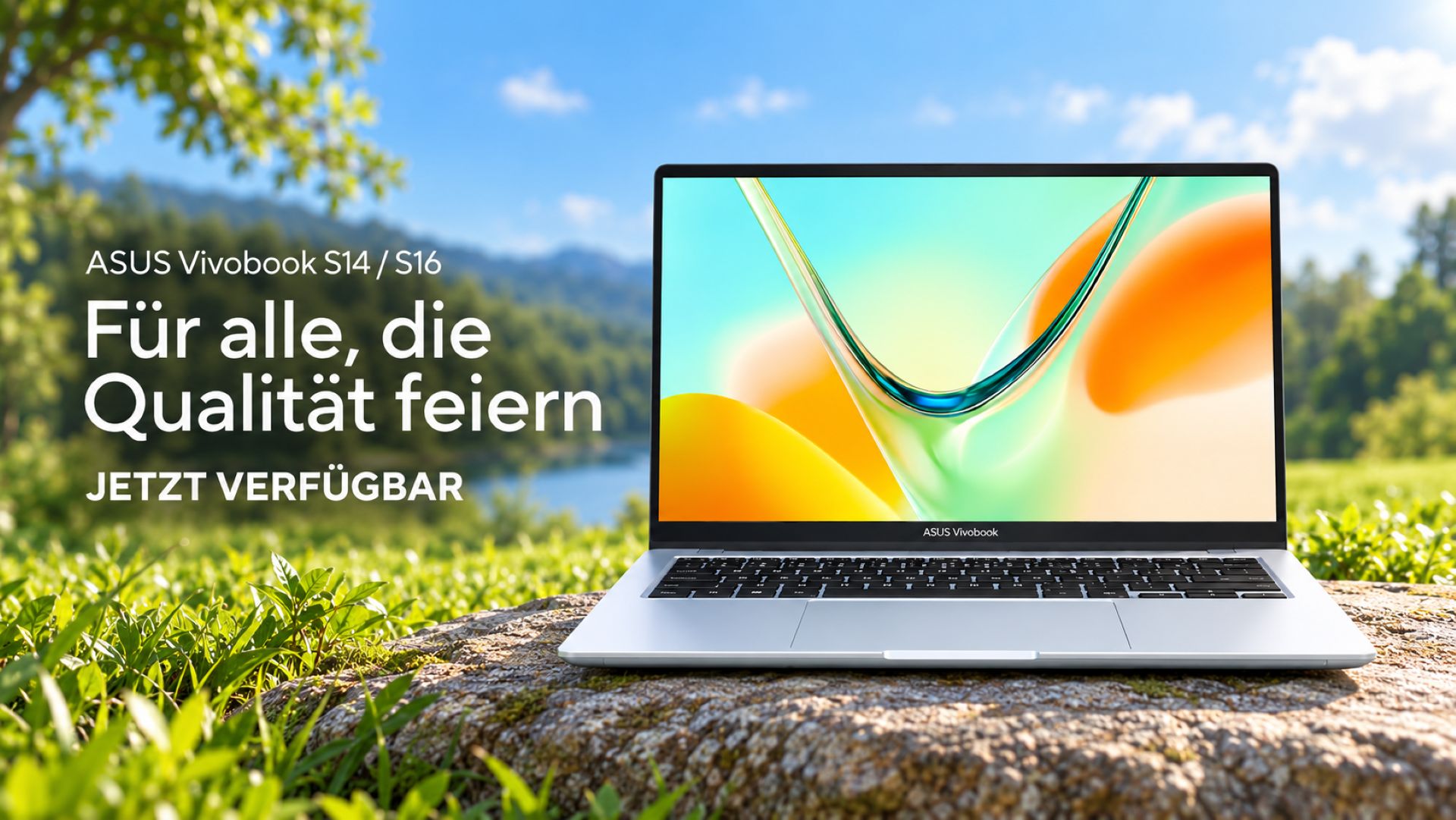
The new Vivobook models are aimed at users looking for a portable laptop for study, the office and multimedia. The Vivobook S14 has a 14-inch display with an 87 per cent screen-to-body ratio. On the larger Vivobook S16 with Snapdragon X, the screen diagonal increases to 16 inches, with a screen-to-body ratio of 89 per cent. Both models are available with either an IPS or OLED display, depending on configuration, and support technologies for reducing blue light.
The Intel-based Vivobook S16 (S5652MA) has a 16-inch IPS display with a resolution of 1,920 × 1,200 pixels and full sRGB colour-space coverage. The variable refresh rate of 30 to 144 Hz ensures smoother visuals depending on the content and can also reduce power consumption. Its screen-to-body ratio of 90 per cent means the bezels are relatively narrow here too. The display can be opened fully thanks to the 180-degree hinge.
Snapdragon X with 45 TOPS or Intel Core Series 3
The Vivobook S14 (S5408QA) and Vivobook S16 (S5608QA) are powered by the Snapdragon X, with eight CPU cores and an integrated Adreno GPU. The Qualcomm Hexagon NPU delivers AI performance of up to 45 TOPS, meeting the requirements for Microsoft’s Copilot+ PC platform and local AI features. These include, for example, processing and summarizing content, as well as AI-powered features in compatible applications.
An FHD infrared camera enables sign-in via Windows Hello. Microsoft’s Pluton security processor is also integrated to protect sensitive data. For audio playback, the Snapdragon models support Snapdragon Sound and Dolby Audio Premium.
The Vivobook S16 (S5652MA), on the other hand, uses an Intel Core 7 Series 3 processor. An integrated NPU is also available here for AI applications. According to ASUS, the device reaches a total TDP of up to 30 watts in performance mode. The Intel version is likely to appeal especially to users who want to stick with the traditional x86 platform and avoid having to consider ARM architecture when it comes to software compatibility.
Up to 30 hours of battery life and slim metal chassis
The Snapdragon models are expected to stand out particularly for battery life. Under optimal test conditions, ASUS claims up to 30 hours. The Intel model is said to last more than 15 hours. How long the devices actually last depends, among other things, on display brightness, workload and the applications in use. According to the manufacturer, the batteries can be charged to up to 60 per cent in 49 minutes via USB-C. On the Snapdragon variants, the charging limit can be set to 80 per cent via MyASUS to preserve the battery over the long term.
The devices are also designed with mobility in mind when it comes to their dimensions. The Vivobook S14 weighs 1.28 kilograms, while the Snapdragon-based Vivobook S16 tips the scales at 1.60 kilograms. Both are 14.9 millimetres thin. The Intel model weighs 1.50 kilograms and is 15.8 millimetres thick. According to ASUS, the metal casings were tested for durability in line with the criteria of military standard MIL-STD 810H.
Connectivity includes two USB-C and two USB-A ports, HDMI 2.1, and a combined 3.5 mm audio jack. The Snapdragon models also support connecting up to three displays. Large touchpads and backlit keyboards round out the features.
ASUS is also including three months of Google AI Pro at no extra cost for eligible buyers of the two Snapdragon models. The offer, redeemable through MyASUS, includes advanced Gemini features, higher usage limits and 5 TB of cloud storage, among other things. The promotion is limited to supported markets and eligible devices.
Pricing and availability
The new ASUS Vivobook models are now available in Germany and Austria.
The ASUS Vivobook S14 (S5408QA) costs 699 euros (RRP). The ASUS Vivobook S16 (S5652MA) is available starting at 999 euros (RRP). The ASUS Vivobook S16 (S5608QA) with Snapdragon X is expected to be available soon, starting at 719 euros (RRP).
Comments