Contents
Bluetti EB3A: Unboxing, design and connections
What’s included
The Bluetti EB3A comes in a well-organised packaging that includes the following:
- The EB3A power station
- A kettle lead
- A solar charging cable (DC7909 to MC4)
- A user manual
Important note: Certain special accessories, specifically the car charging cable (MC4 to 8mm DC), are not included in the scope of delivery and must be purchased separately.
Design and build quality
Weighing just 4.6 kilograms with dimensions of 255 x 180 x 183 millimetres, the EB3A is one of the most compact and lightweight power stations on the market. Its rugged plastic casing is sturdy, but not quite as resilient as some competitors.
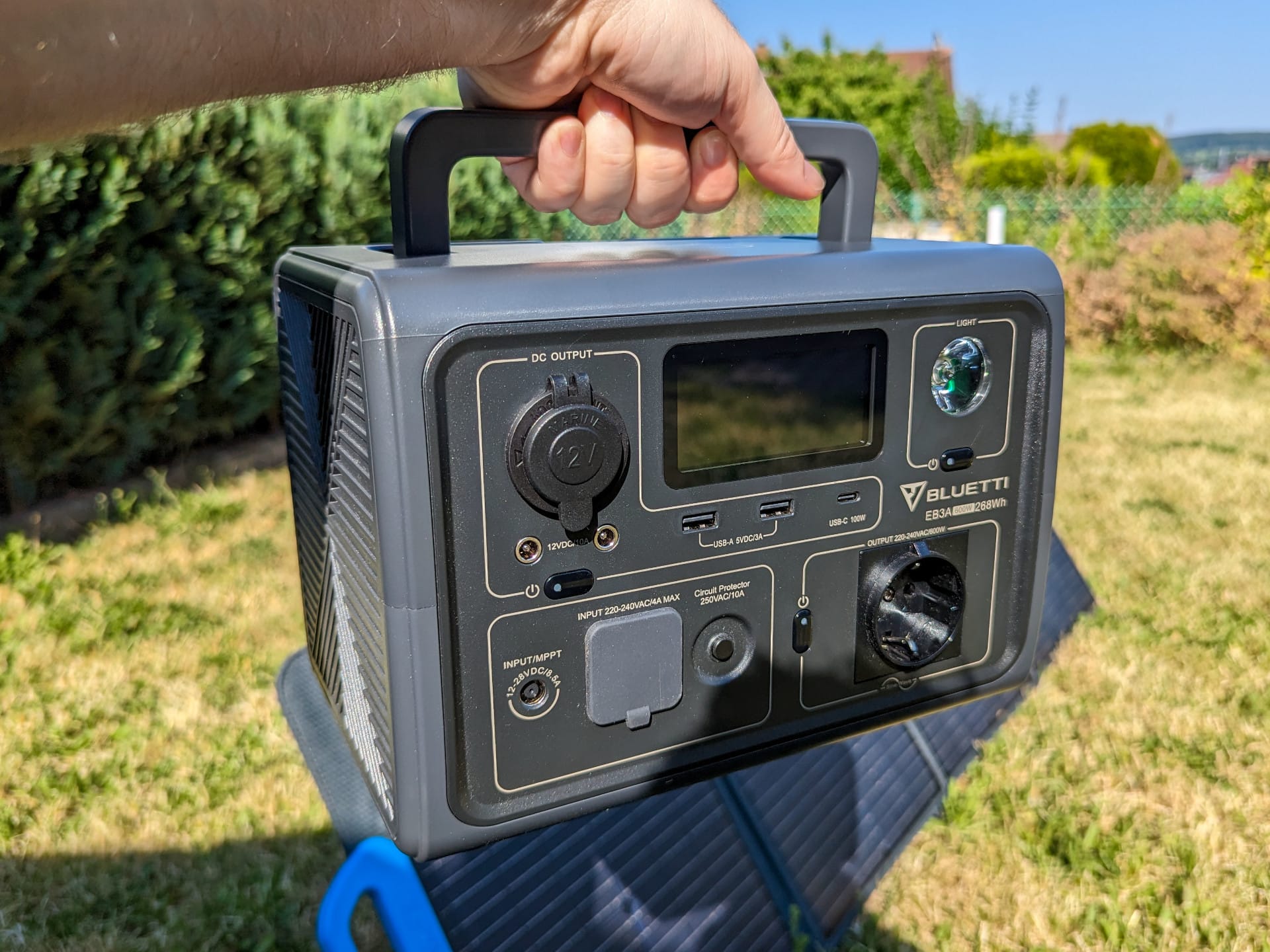
Another important point: The housing is not weatherproof, which should be considered for outdoor use.
Connections and functions
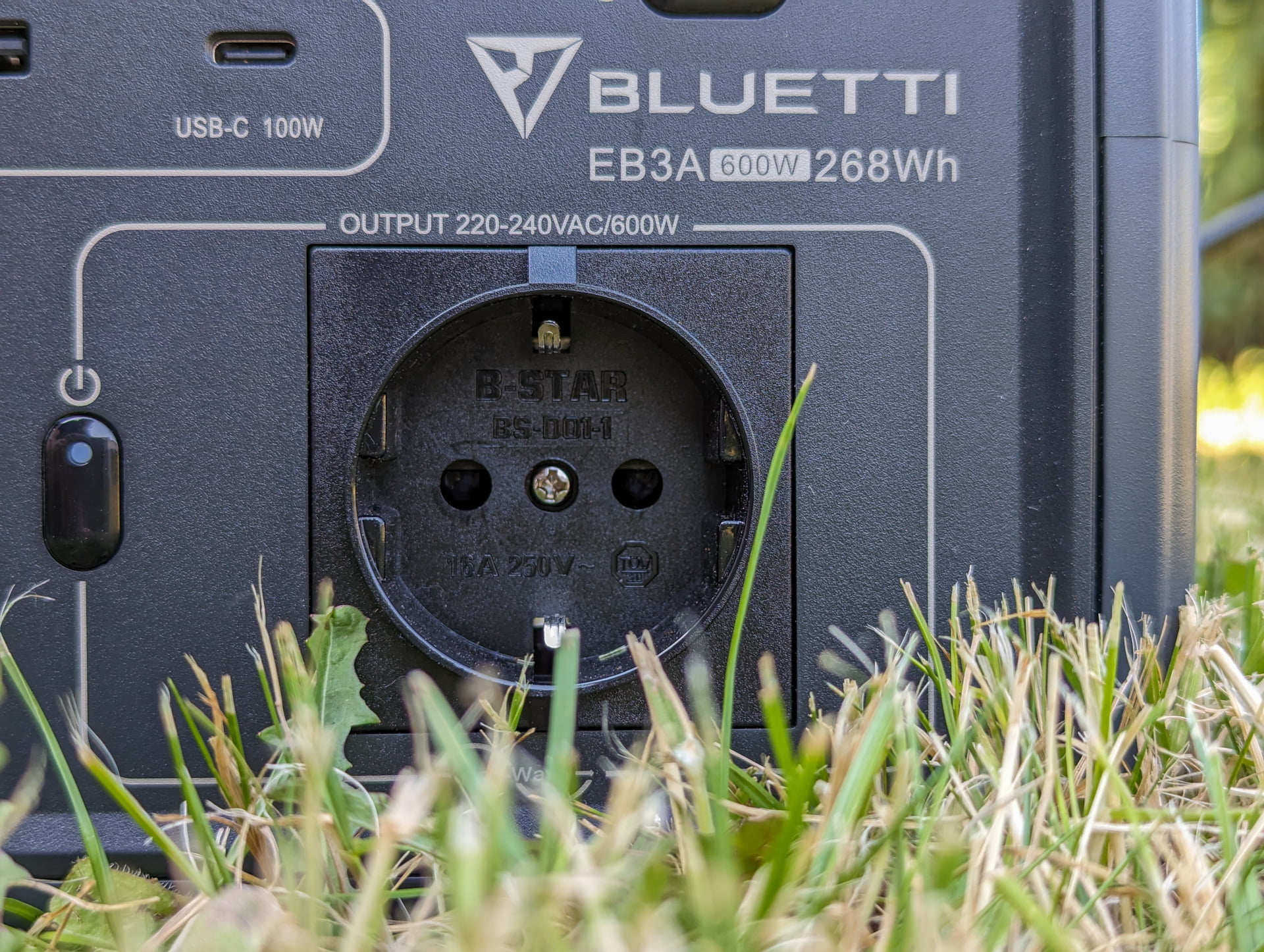
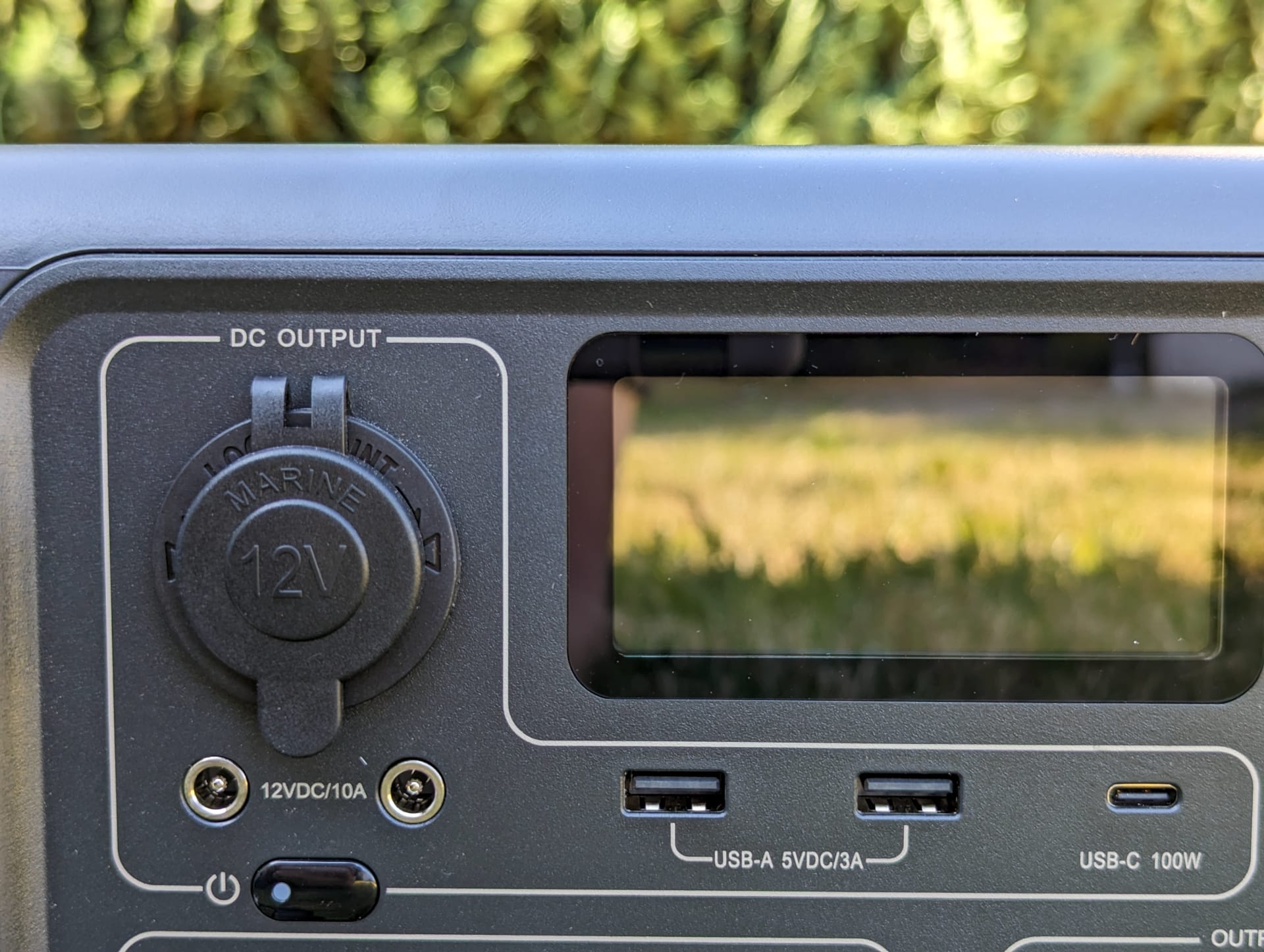
On the front are the various ports of the Bluetti EB3A:
- DC output
- 1x vehicle power outlet (12V 10A)
- 2x DC5521 (12V 10A)
- 2x USB-A (5V 3A)
- 1x USB-C Power Delivery (100W)
- AC output
- 1x Schuko socket (600W)
- Inputs
- 1x IEC inlet connector
- 1x DC7909
Each DC output and the Schuko socket have separate power buttons that light up green once activated. There is also a circuit breaker reset on the inputs.
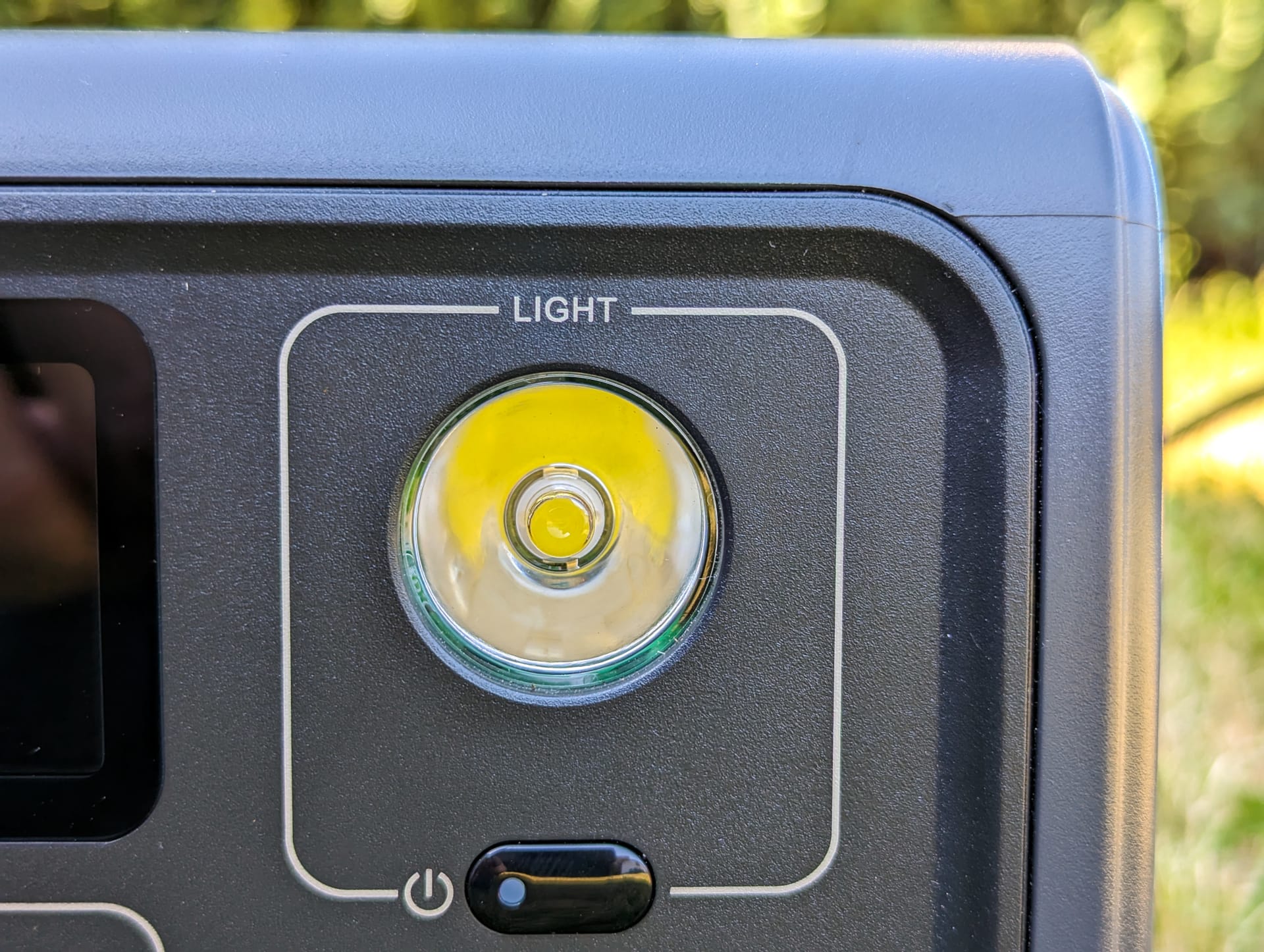
For better clarity, the EB3A features a two-colour display that is easily readable even outdoors. It shows the remaining charging time when recharging, the remaining operating time when a consumer is connected, and the battery capacity both graphically and in percentages. This estimate is adjusted in real time depending on the input or output power.
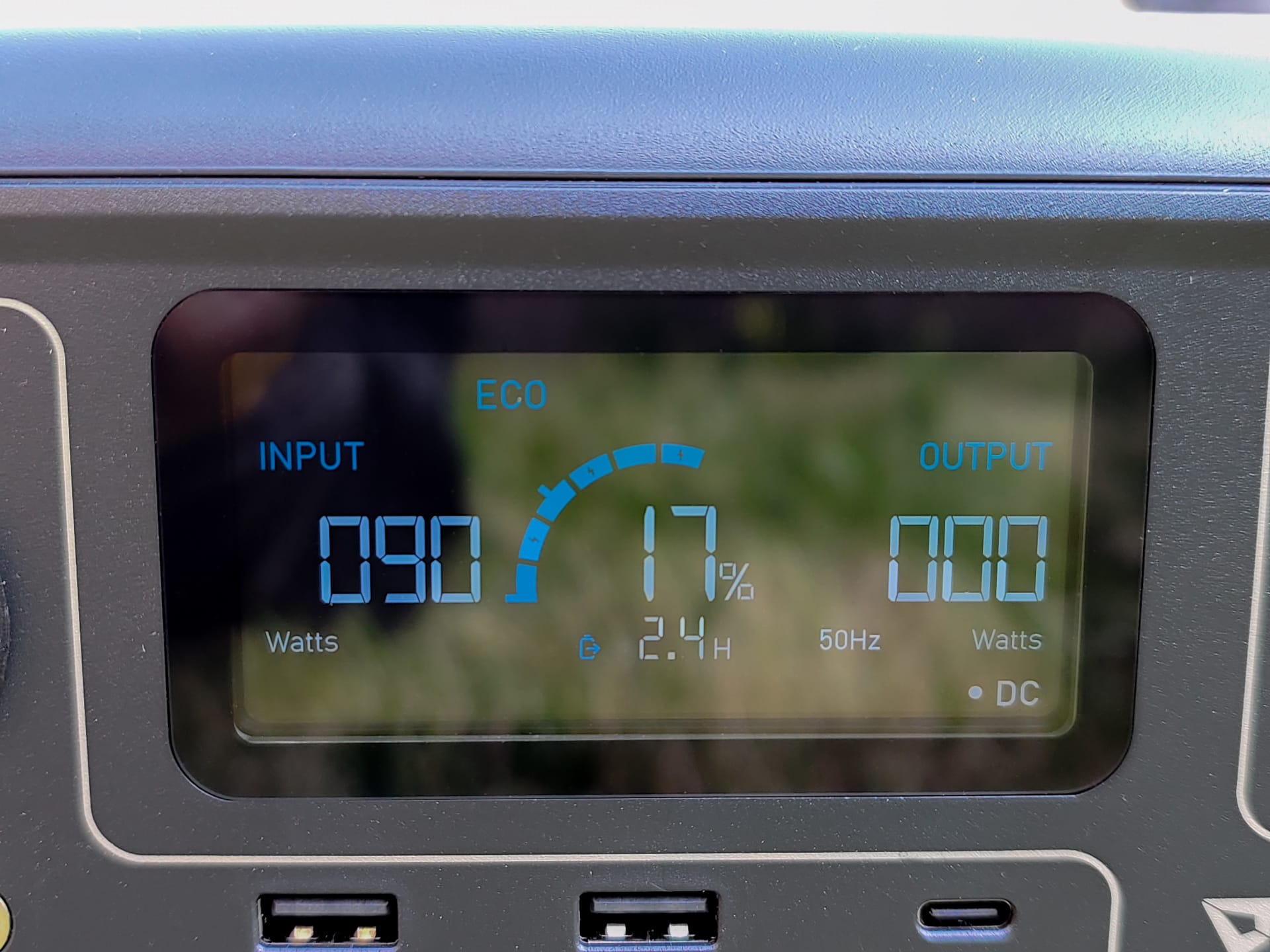
To the right of the display is a 5-watt LED floodlight with three modes operated by the power button: medium, high and flashing. Do not expect high brightness here. It is just enough to use the power station as an emergency flashlight.
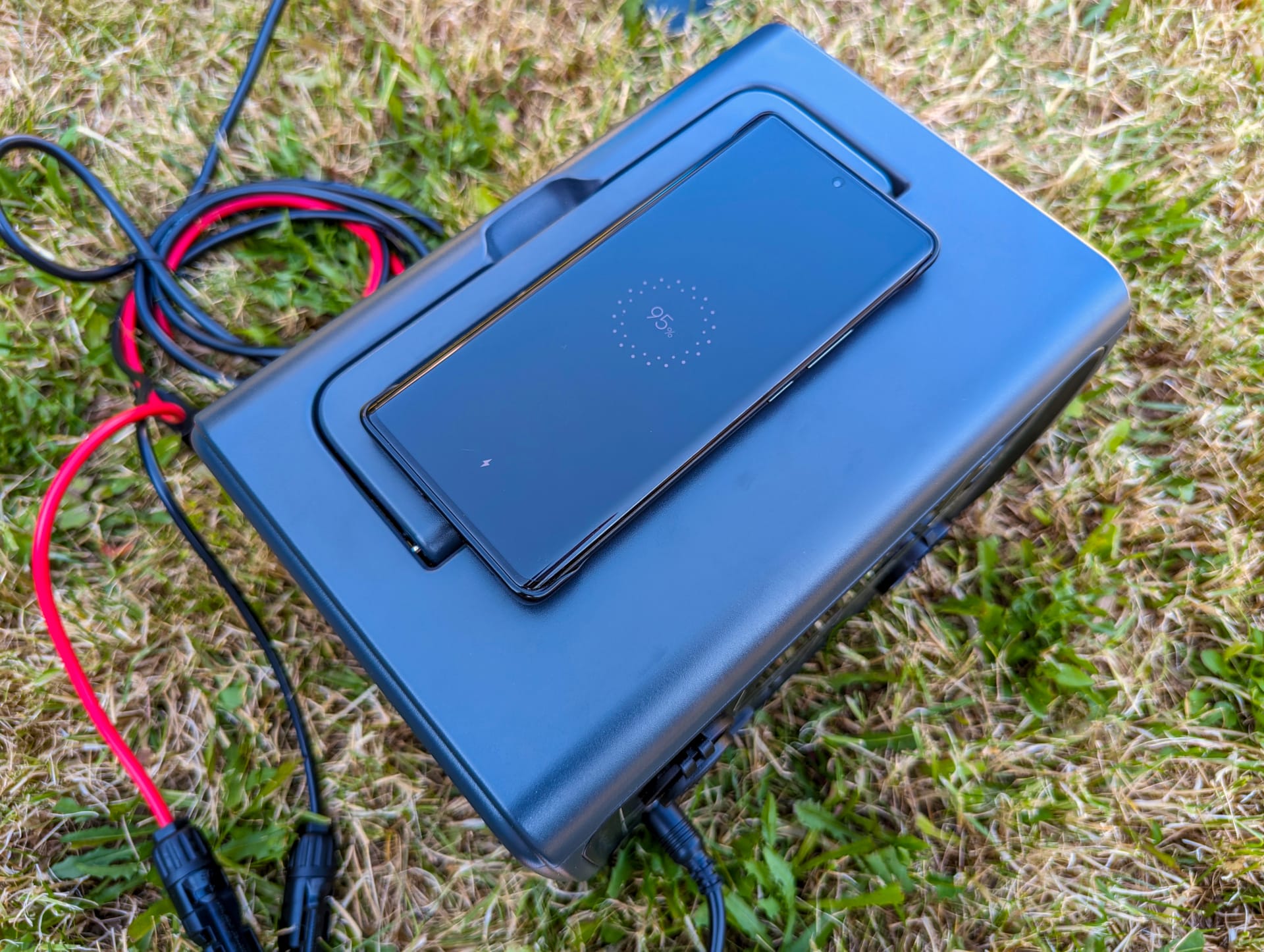
On the top, the foldable carry handle stands out, ensuring comfortable handling. Additionally, the top features a wireless 15-watt charging pad, optimal for Qi-compatible devices and a clear plus for convenience.
Bluetti EB3A: Technology and capacity
In terms of technology, the Bluetti EB3A is at the cutting edge. Surprisingly, high-quality LiFePO4 (lithium iron phosphate) cells are found inside, which are predominantly found in larger power stations. With this, Bluetti underlines the innovative character of the compact EB3A.
Bluetti also forecasts more than 2,500 charge/discharge cycles before the battery falls to 80% of its initial capacity. This represents up to five times the lifespan of conventional Li-ion batteries based on NMC (nickel-manganese-cobalt). Regarding the warranty period, Bluetti is somewhat more reserved with two years than competitors such as Anker or EcoFlow.
Despite a capacity of 268.8 watt-hours, the battery enables multiple charging cycles for mobile phones (~25) or laptops (~3.5) and can also power devices such as camping coolers, televisions or less power-hungry electric tools for several hours.
I checked whether the 268.8 watt-hours are really inside by draining the fully charged EB3A with a 300-watt light bulb. After about an hour, the light went off and my energy meter showed a consumption of 230 watt-hours. An efficiency of 85 per cent (230 watt-hours / 268.8 watt-hours) is impressive. The remaining 15 per cent is lost in the conversion.
I measured a very similar result via the DC output. With an 8-ampere load, consumption was 224 watt-hours, corresponding to an efficiency of 84 percent.
Bluetti EB3A: Performance
While the US model can offer two AC connections, the European version of the EB3A is limited to a single AC output with 600 watts. According to Bluetti, however, this is capable of handling short-term peak loads of up to 1200 watts and thus operate even the most power-hungry devices.
A catch here: The output voltage is reduced, which means this power mode is not optimal for all device classes. By default, the power mode is deactivated but can be activated via the Bluetti app with the press of a button. Whether this mode is useful or superfluous certainly depends on the respective use case and the connected devices.
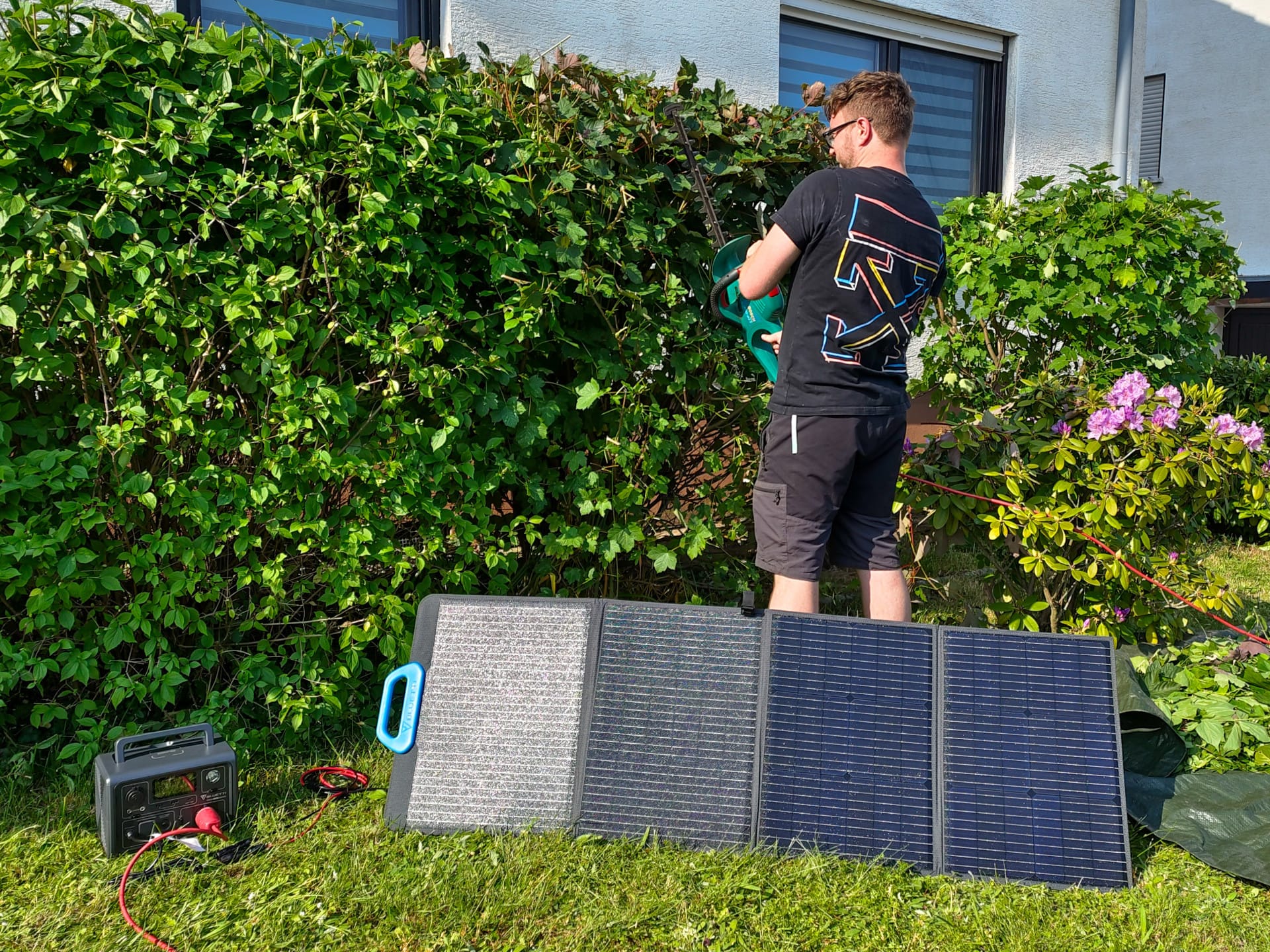
In practice, I was impressed by the EB3A's ability to easily power even demanding loads. Tools such as my 650-watt electric hedge trimmer or my 700-watt Bosch hammer drill operated without any problems. Only with my 750-watt Flex did the power station reach its limits and shut down with an error message.
I verified the output values specified by Bluetti using a load tester. Both DC outputs reliably triggered the overvoltage protection and switched off the power station when the load exceeded 10.1 amperes. The USB-A ports reliably adhered to the 5-volt, 3-ampere promise, and the USB-C port consistently delivered 100 watts – enough to power a laptop without problems.
Pass-through charging
A useful feature of the Bluetti EB3A is definitely the pass-through charging. With this function, the power station can charge devices while it is being charged itself.
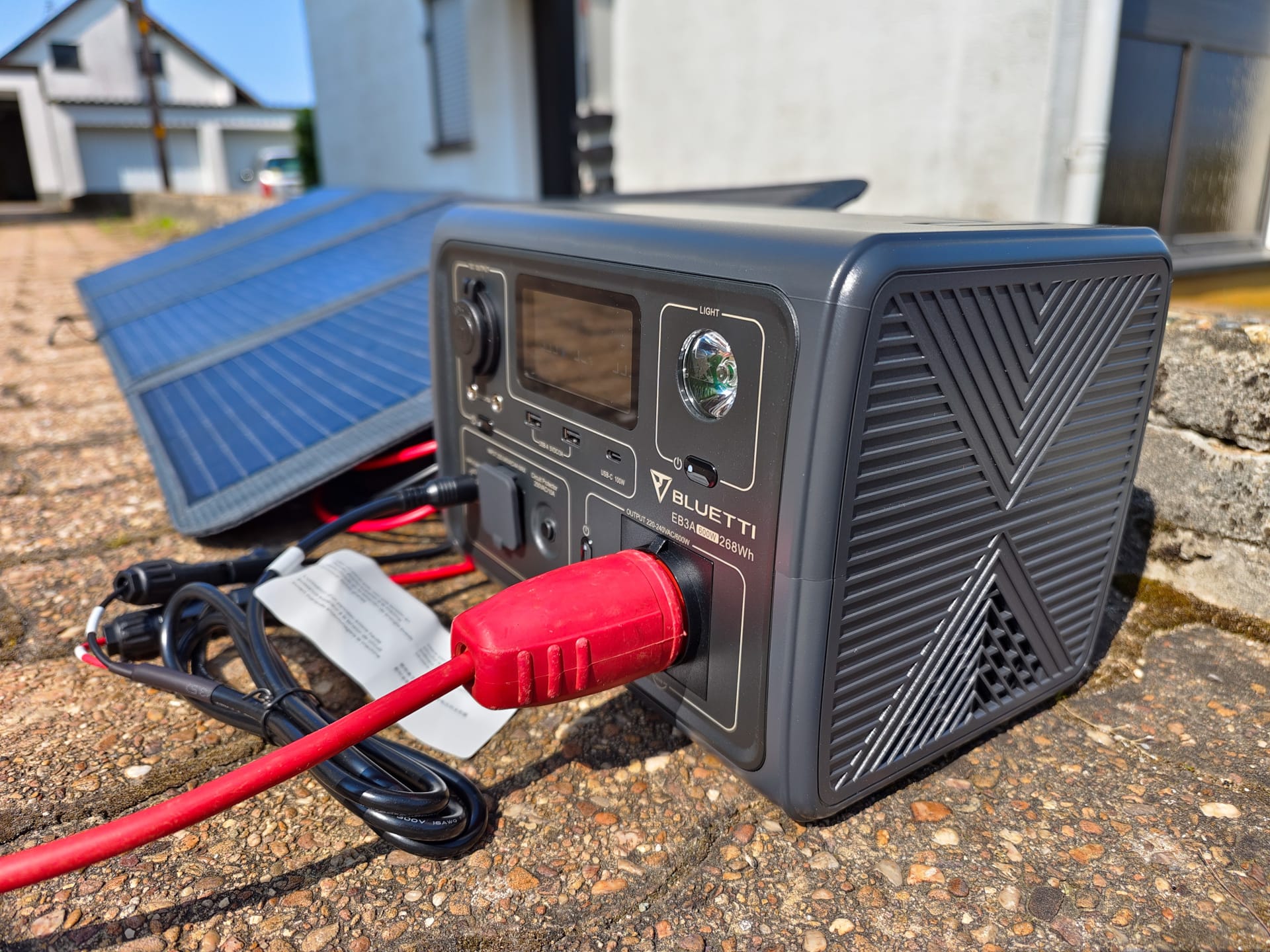
A practical example from my test: While I was powering my hedge trimmer with the EB3A, the power station was being charged simultaneously via a solar module. The result? After an hour of hedge trimming, the battery level only decreased by a modest 15 percentage points.
Uninterruptible power supply
Another bonus is the UPS function (uninterruptible power supply). When the power station is charging via the mains while devices are connected, it automatically switches to its own power supply in the event of a power outage. Unfortunately, Bluetti does not provide an exact switchover time.
I tested the UPS with a small home server, which continued to run reliably during power outages. However, those who want to secure a gaming PC should opt for a more powerful UPS.
ECO Mode
The ECO mode of the EB3A is programmed to automatically switch off the device if, after four hours, the AC power output drops below 10 watts and the DC power output falls below 1 watt. This function is particularly relevant for the EB3A.
In my tests, I found that the standby consumption is significant. For example, the active inverter draws an impressive five percentage points of capacity per hour without any connected load. The DC outputs behave similarly, consuming more than one percentage point of energy per hour.
Bluetti EB3A: Charging
Power socket
The EB3A offers various charging options. For conventional charging via the wall outlet, only a power cable is required, as the power station already features an integrated power supply. With a charging capacity of up to 268 watts, the EB3A is fully charged in approximately 90 minutes.
For those of us who are impatient, there is the option to activate the Turbo mode in the Bluetti app. This increases the charging power to up to 350 watts, but caution is advised here: The Turbo mode can lead to faster wear of the cells.
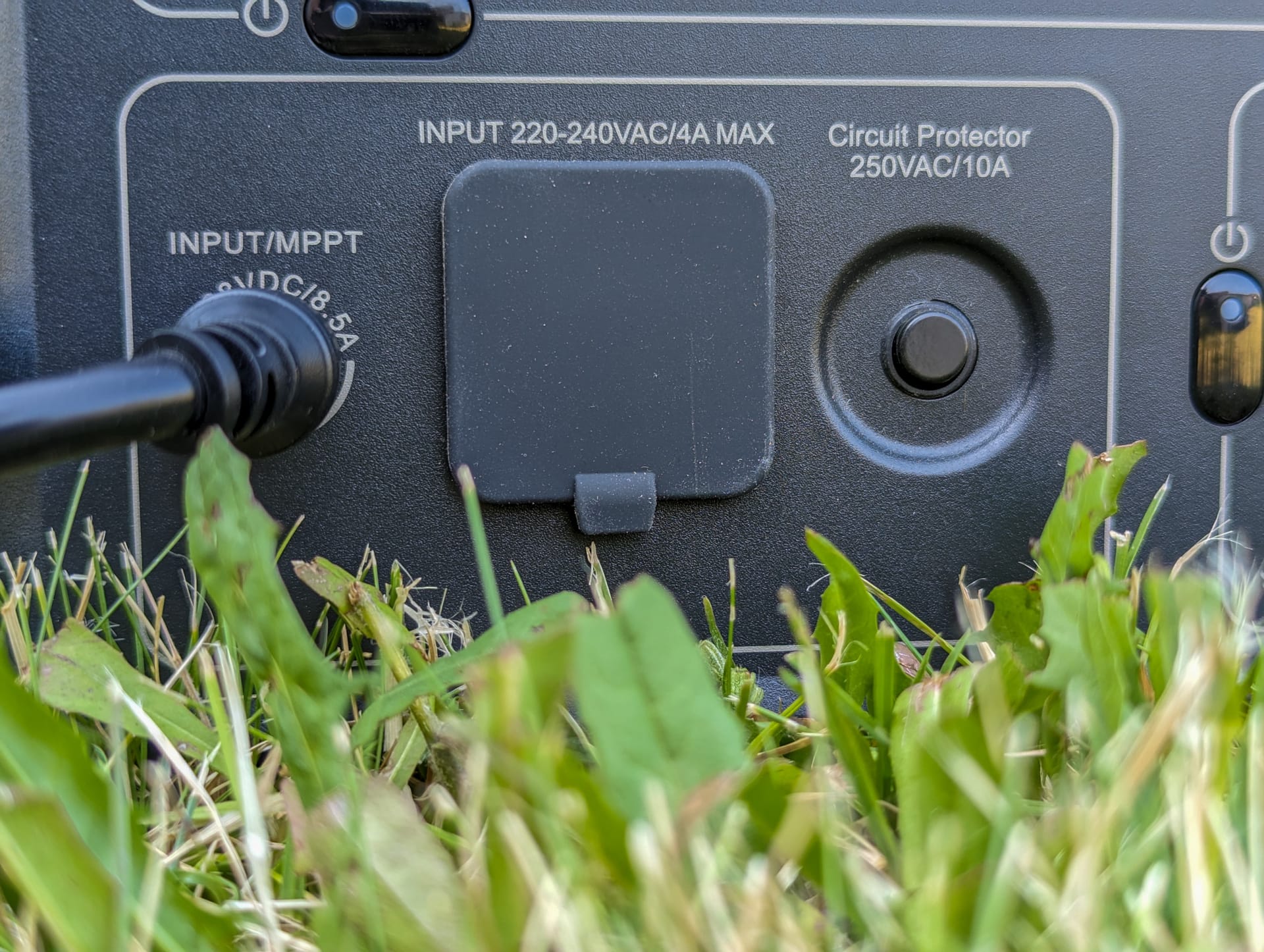
During my testing phase, I did not reach the maximum 350 watts, but only 310 watts. This resulted in a full charge in approximately 80 minutes. The time difference compared to the standard charging mode is minimal, so the turbo mode only appears advisable in genuine time constraints.
During charging, an active fan keeps the EB3A cool, generating a noise level of around 45 decibels. As a counterpart to the turbo mode, the app features a silent mode. This offers reduced noise levels, but requires accepting a slower charging speed.
Cigarette lighter
An additional option for charging the EB3A is the car cigarette lighter. However, the test did not run without obstacles. To begin with, the vehicle charging cable is, as mentioned before, not included in the scope of delivery.
Not a major problem in itself, as I had a car charging cable with an XT-60 connector to hand, but Bluetti uses an 8-millimetre DC connector unlike most other brands, which meant I had to order the matching cable separately.
In practice, I was unable to achieve the 8.5 amps at 12 volts promised by Bluetti. The ceiling was quickly reached at a maximum of about 80 watts. At this rate, a complete charging cycle of the EB3A would take about four hours.
Solar module
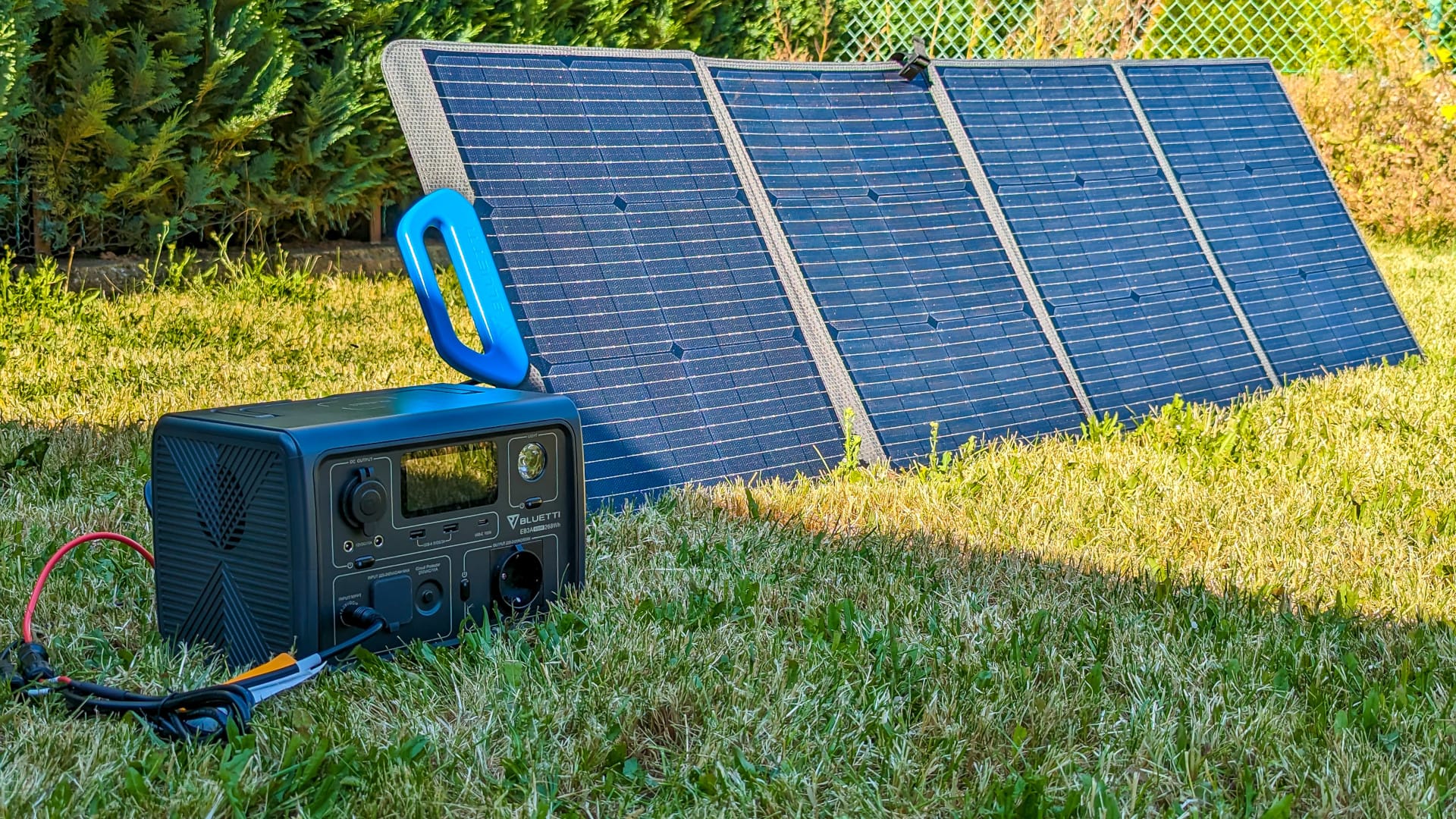
The most environmentally friendly charging method is the use of a solar panel. For my test, I used the Bluetti PV120 solar panel, which offers a performance of up to 120 watts. Pleasingly, both the cable and the connector between the solar panel and the power station are included in the package.
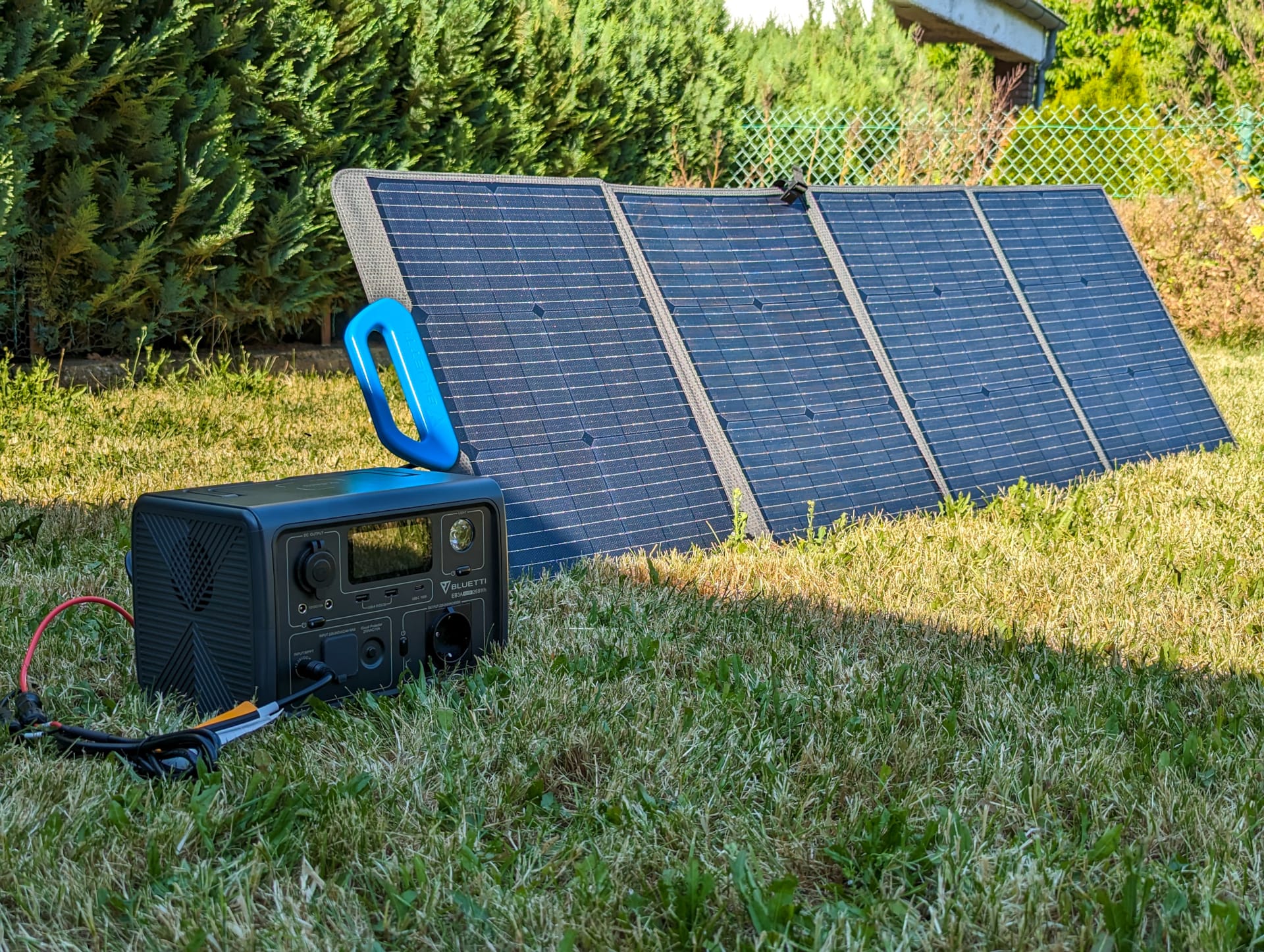
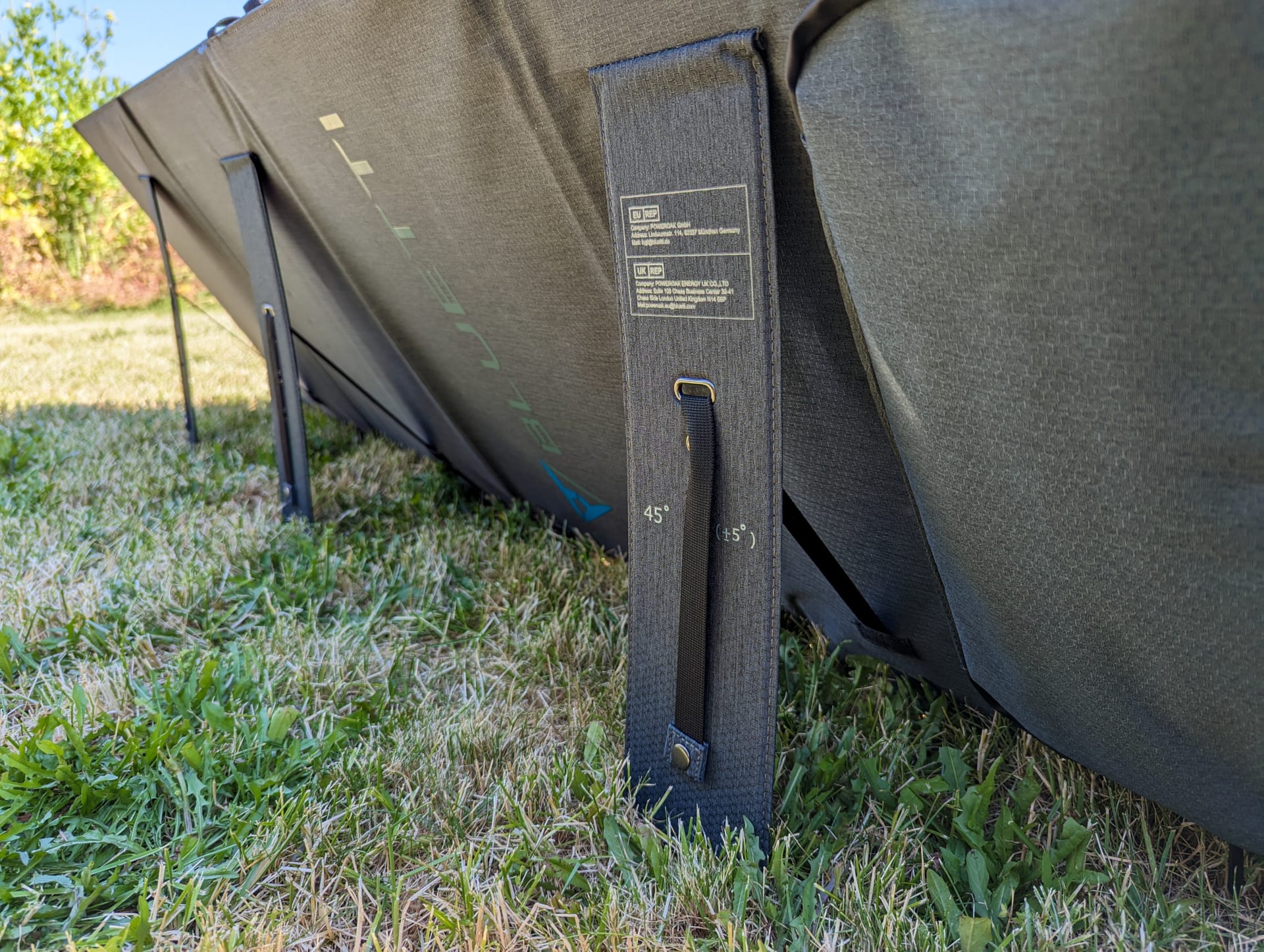
The solar module impresses with its mobility: in the folded state, it measures a compact 53.3 x 47 centimetres and is easy to transport thanks to a carry handle. When unfolded, it extends to a substantial 53.3 x 165.2 centimetres. However, the rather delicate stands can be a challenge and the module actually tipped over several times during my tests.
With optimal alignment on a sunny summer day, I was able to observe that up to 110 watts were transferred from the PV120 to the EB3A. This results in a charging time of under three hours. Those who want to maximize the sunny advantage can resort to the larger PV200 model or connect multiple modules in series. However, it should be noted that additional adapters may be necessary.
Simultaneous charging via AC and DC
Another feature of the Bluetti EB3A is its ability to charge simultaneously via its AC and DC charging inputs. For example, if you combine charging via the IEC connector (AC) with the connection of a solar panel, the power station theoretically achieves a charging rate of up to 430 watts.
However, this assumes that the turbo mode is activated in the app – a setting that Bluetti itself views with caution.
Bluetti EB3A: Bluetti app
Finally, a look at the Bluetti App (Android & iOS), a useful tool for monitoring and controlling the EB3A. The connection runs via Bluetooth, although WiFi is unfortunately missing as an option. This means that communication with the EB3A is limited to direct physical proximity.
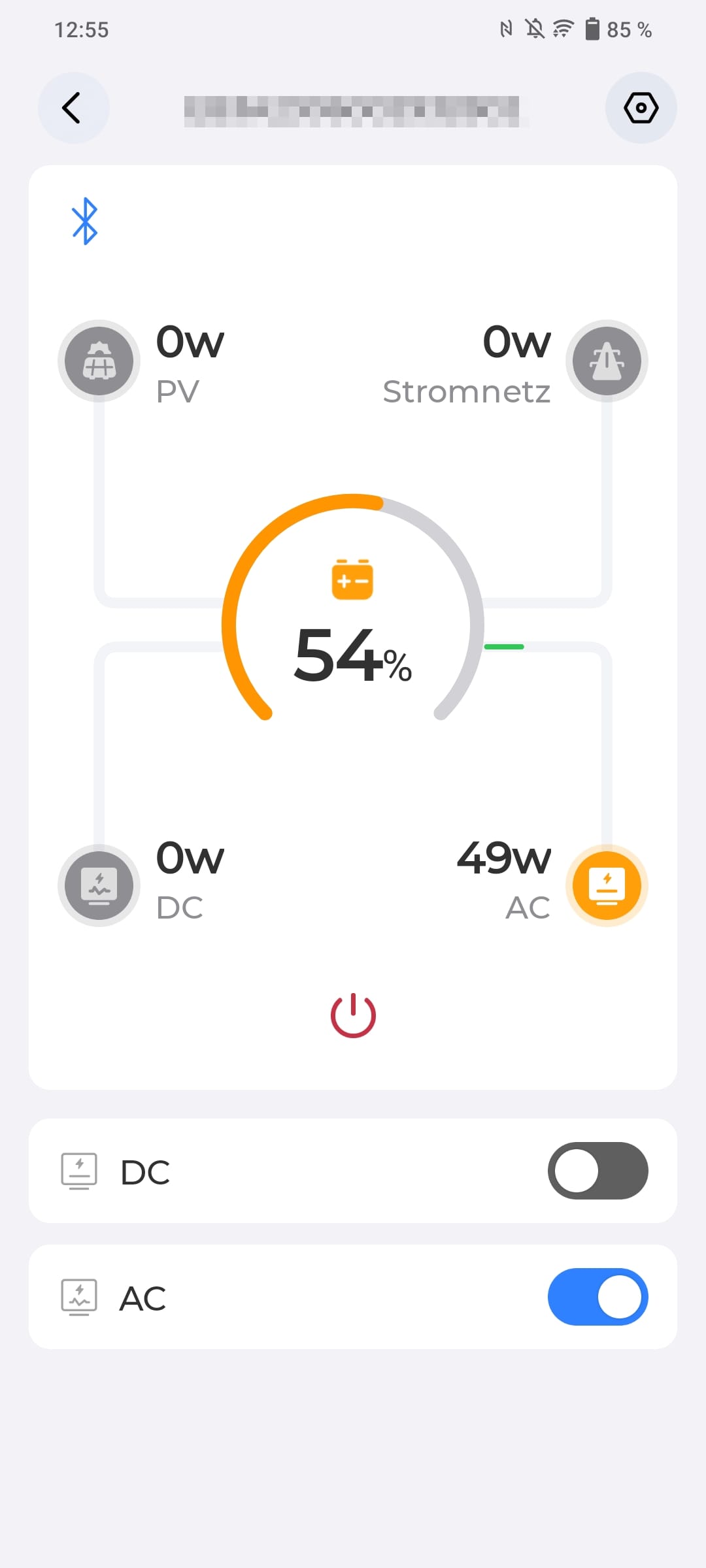
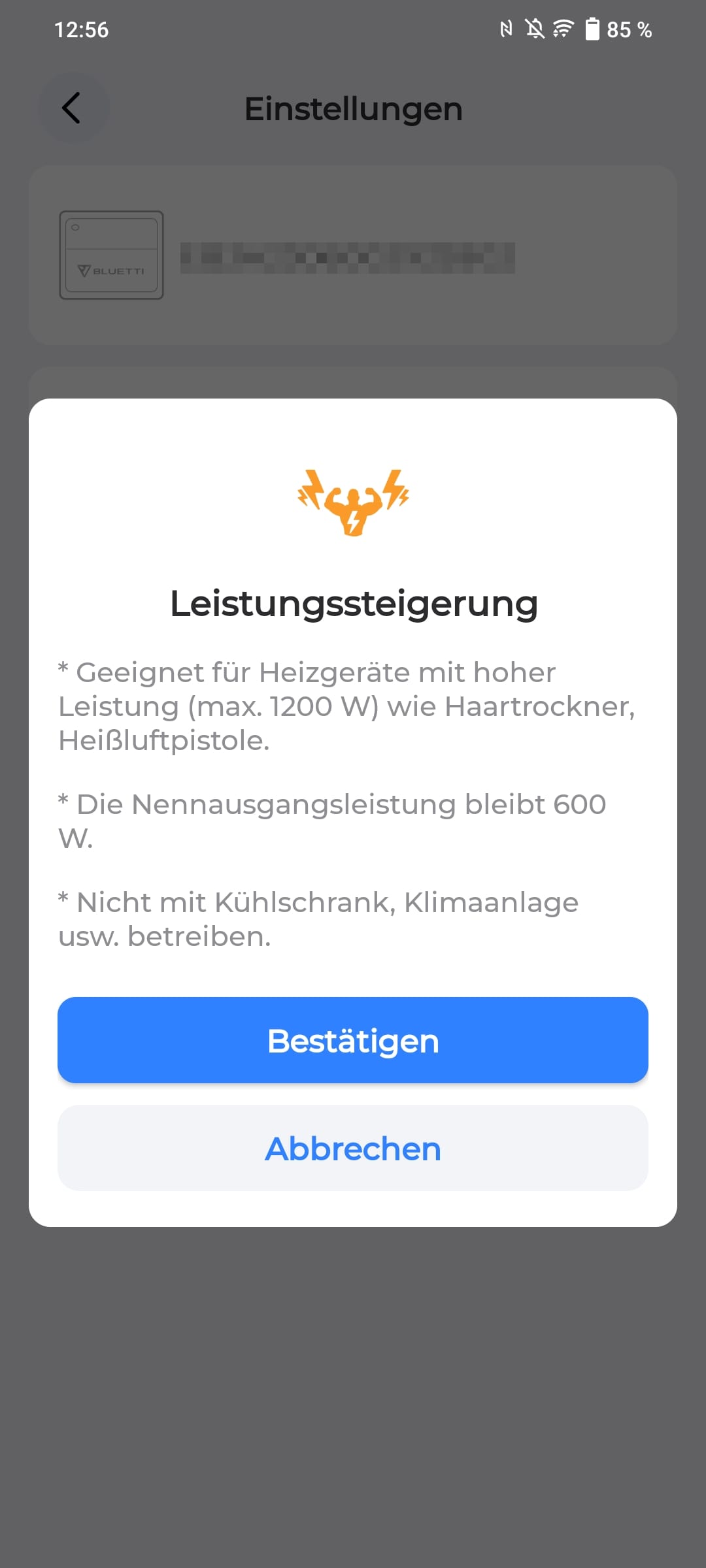
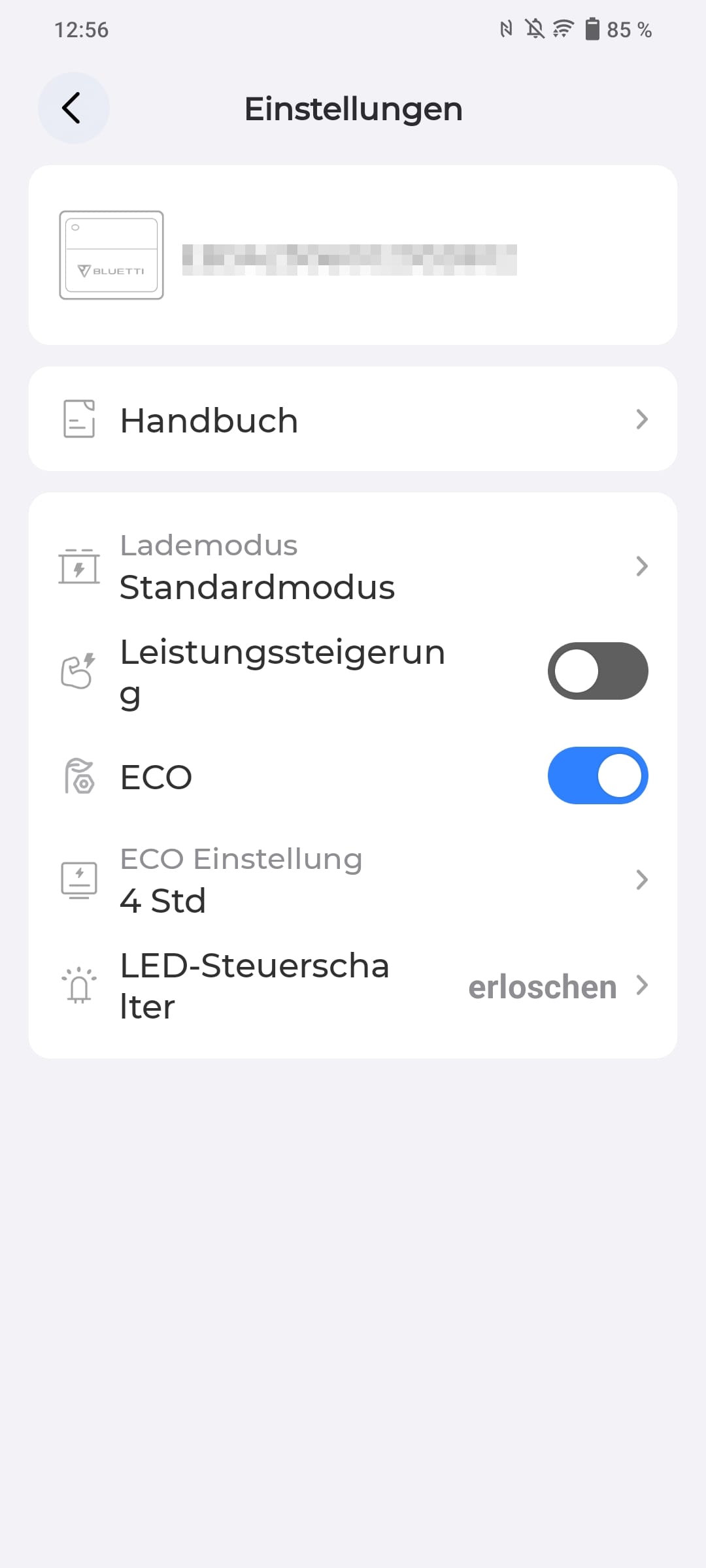
The app mirrors the information also displayed on the power station's screen. Functionally, it allows turning the AC and DC ports on and off, switching between operating modes – Standard, Turbo and Quiet – and adjusting the ECO mode. Additional features include control of the LED light, activation of power lifting, and the option to update the firmware.
Our verdict
In testing, the Bluetti EB3A presents itself as an impressive power station with excellent value for money. The compact design and resulting good portability make the power station the perfect companion for camping and festivals. Unfortunately, Bluetti has somewhat neglected weather protection, so caution is advised depending on the area of use.
Thanks to state-of-the-art LiFePO4 cells and a powerful 600-watt inverter, it provides a reliable power source even for demanding devices such as hedge trimmers or impact drills.
The Bluetti PV100 solar module is the finishing touch, providing the station with sustainable power. For anyone looking for a reliable power station, the Bluetti EB3A is undoubtedly a recommendable option.
Specifications
Battery
- Capacity
- 268.8 Wh (12 Ah)
- Type
- LiFePO4 (Lithium iron phosphate)
- Life cycles
- 2,500+ cycles to 80% of original capacity
- Durability
- Recharge to 80% every 3–6 months
- Management system
- MPPT controller, BMS etc.
Output
- AC output
- 1 x 220-240 V / 2.6 A sockets total 600 W
- Inverter type
- Pure sine wave
- Peak power
- 1.200 W
- USB-C port
- 1 x 100 W max.
- USB-A port
- 2 x 5 V/3 A USB-A
- DC output
- 1 x 12 V/10 A (car socket), 2 x 12 V/10 A DC 5521 (5.5 mm sockets)
- Wireless charging pad
- 1 x 15 W max.
Input
- AC input (standard mode)
- 268 W max.
- AC Input (Turbo Mode)
- 330 W max.
- Solar input
- 200 W max, VOC 12–28 VDC/ 8.5 A
- Auto input
- 12/24 V from the cigarette lighter socket
- Maximum input
- 430 W with simultaneous AC and solar input
Charging times
- AC charging (330W turbo mode)
- ≈1.3-1.8 hours
- AC Charging (Standard mode 268W)
- ≈1.5-2.0 hours
- Solar panel (200W)
- ≈1.8–2.0 hours
- (in the best sunshine, ideal alignment and low temperature)
- 12V/24V car socket (100W/200W)
- ≈3.2–3.7 or 1.9–2.4 hours
- AC + Solar (430 W)
- ≈1.2 ~ 1.7 hours
- (in the best sunshine, ideal alignment and low temperature)
- Dual AC (430 W)
- ≈1.2 ~ 1.7 hours
- (with optional BLUETTTI T200S adapter)
General
- Pass-through charging
- Yes
- Weight
- 10.14 lb/4.6 kg
- Dimensions (L x W x D)
- 10.04 x 7.09 x 7.20 inches / 255 x 180 x 183 mm
- Operating temperature
- -20-40℃
- Storage temperature
- 0-40°C
- Certifications
- UL standard, CEC, DOE, FCC, CA Prop 65
- Warranty
- 24 months
- Optional accessories
- BLUETTI PV120/PV200 solar panel
- Car charger
- Solar charging cable
Price comparison
| Store | Price | Link |
|---|
Comments