Contents
Build quality and modular design
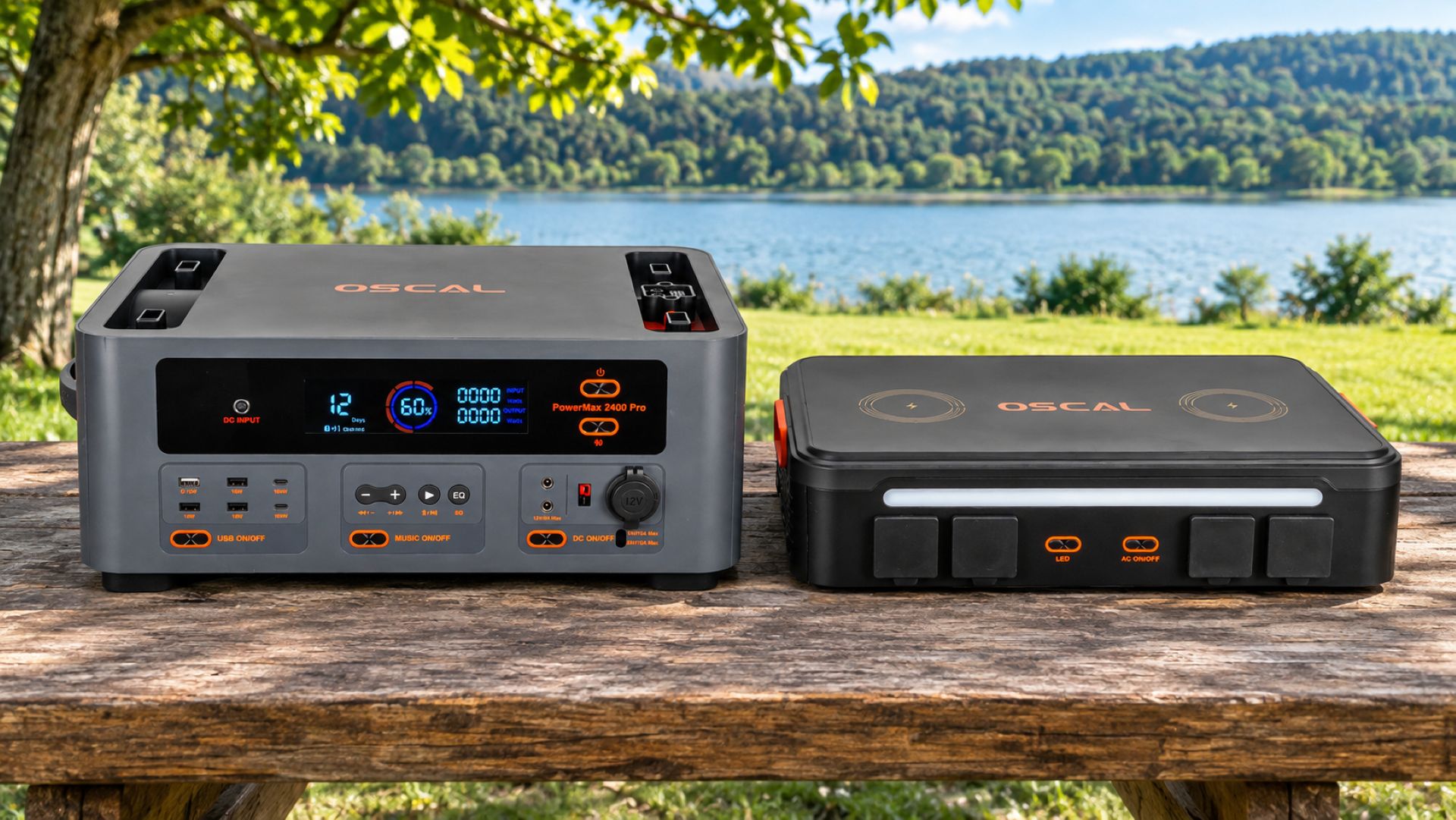
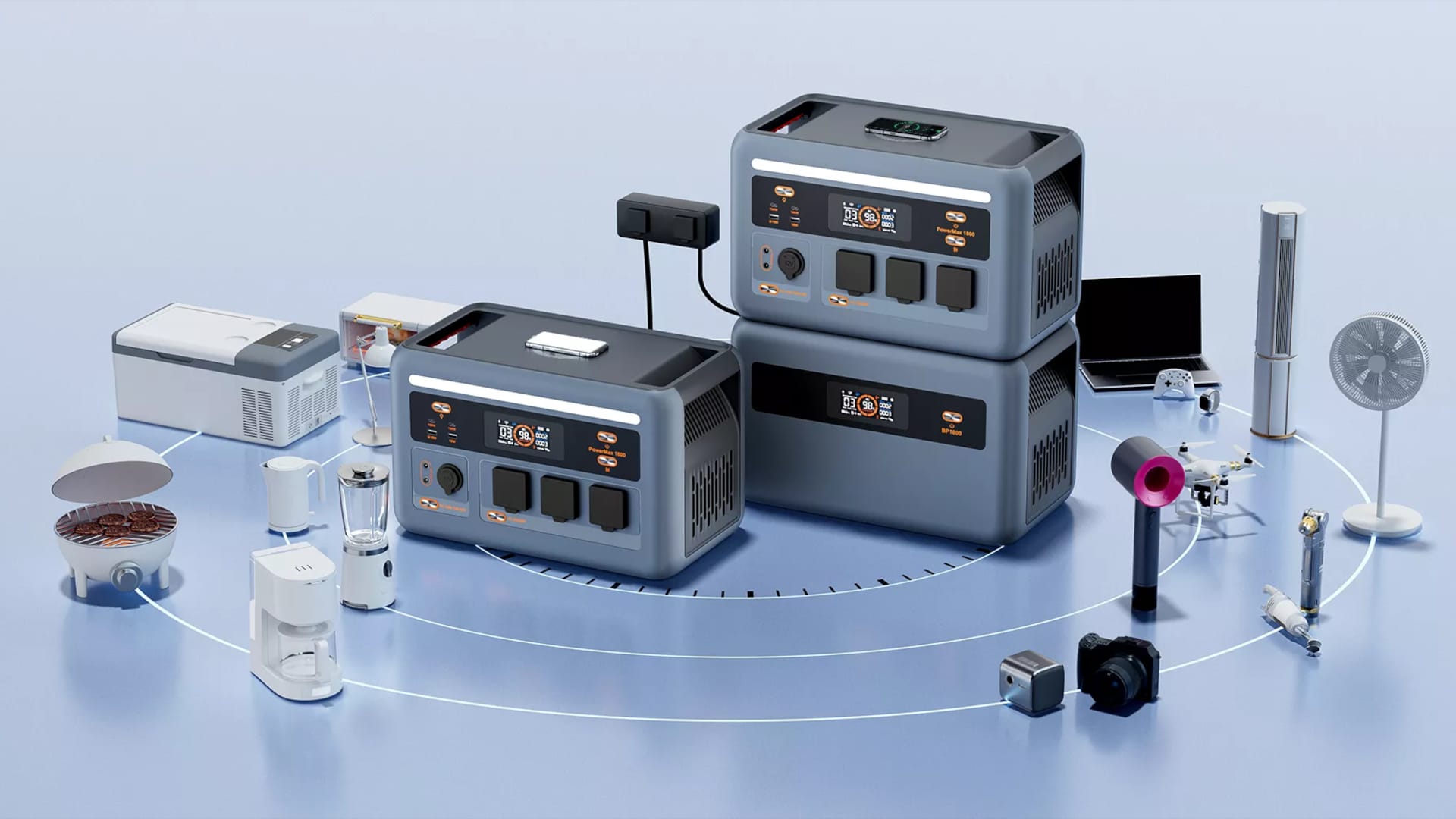
With 2,016 Wh of battery capacity and 2,400 watts of continuous output, the OSCAL PowerMax 2400 Pro is one of the more powerful portable power stations. Its modular design is particularly interesting and sets it apart from many competing models. Rather than permanently combining the battery and inverter in a single housing, the power station consists of two detachable units. The upper module houses the electronics and ports, while the lower section contains the battery pack itself. Integrated contacts connect the two components, so no extra cables are needed.
The main advantage of this design is easier transport. Fully assembled, the PowerMax 2400 Pro weighs around 26.8 kilograms, according to the manufacturer. The upper module weighs about 6.3 kilograms, making it possible to split the total weight when carrying it. This can make a significant difference when loading it into a car or carrying it up stairs. However, the battery pack still weighs around 20.5 kilograms. Its dimensions of 47 × 29 × 32.6 centimeters also make clear that the power station is intended more for occasional relocation than for carrying over long distances.
Another benefit of the modular concept is its expandability. The basic configuration already provides 2,016 Wh. According to OSCAL, the total capacity can be increased to up to 22.176 Wh with additional BP2400-Pro battery modules. The manufacturer uses a stackable connection system that links the modules without external cables. This allows the power station to be expanded as energy needs grow, without having to buy an entirely new system. However, the additional battery modules are sold separately and increase both the cost and the space required.
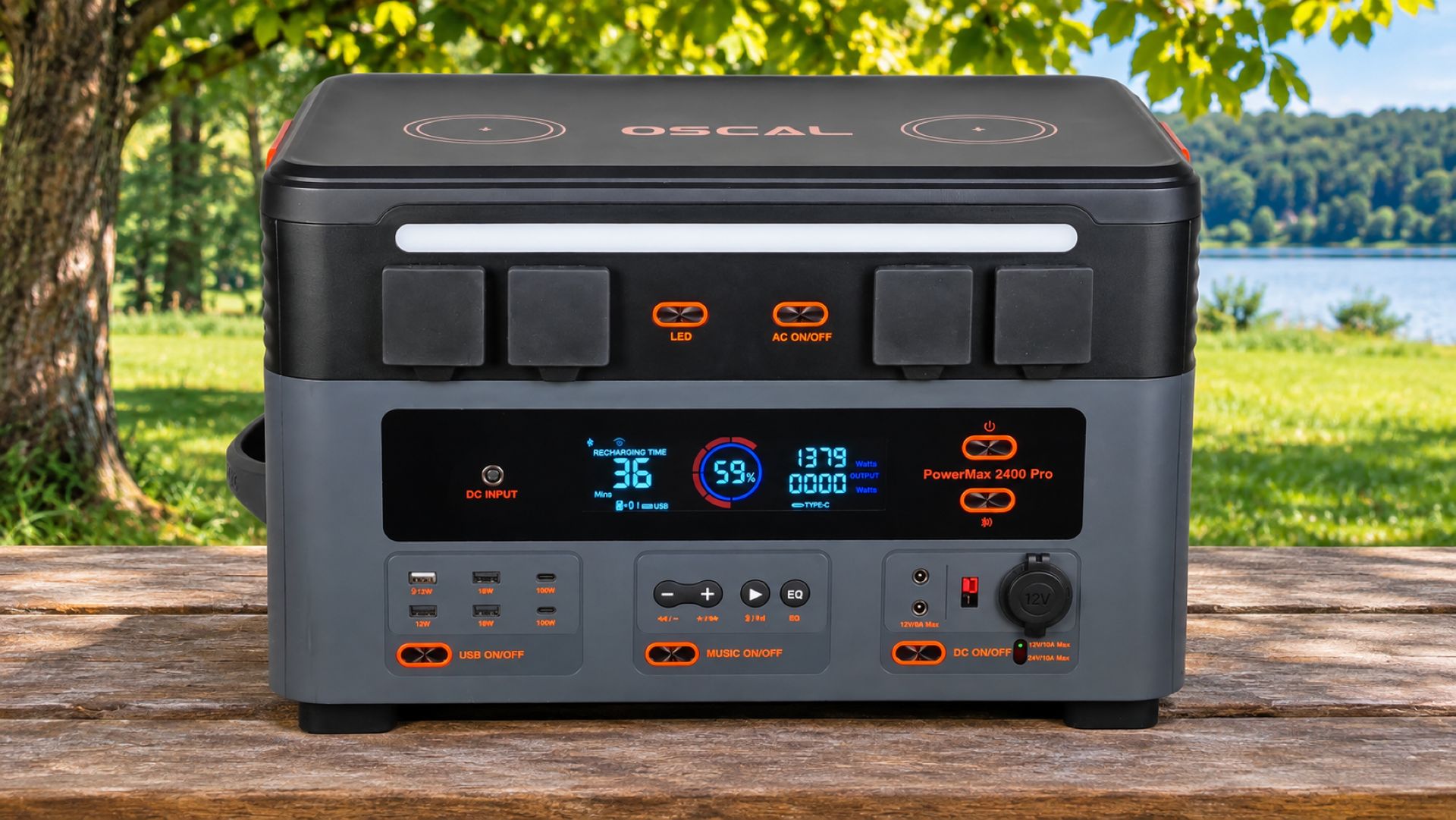
The power station feels robustly built. Its housing is mostly plastic, the various port sections are clearly laid out, and many sockets are protected by rubber covers. Notable features include the orange carry handles and the ventilation openings on the sides. The latter are important when output demands are high, as the built-in electronics require active cooling.
Ports, display, and features

OSCAL has not skimped on ports. There are 16 outputs in total, including four 230-volt Schuko sockets, four USB-A ports, and two USB-C ports rated for up to 100 watts each. There are also two DC5521 outputs, a car socket, and an Anderson connector. The top also features two wireless charging pads rated at 15 watts each. This makes it possible to connect a wide range of devices, from smartphones, laptops, and coolers to larger household appliances. However, the four sockets share the maximum AC output of 2,400 watts. The permitted total output must not be exceeded, even when using multiple outputs at the same time.
In our hands-on test, we used several charging options simultaneously. Along with an older tablet and a smartphone connected via USB-A and USB-C, another smartphone was charged on one of the two wireless charging pads on top. The power station showed a combined output of around 27 watts. This test mainly demonstrates the flexibility of the ports. It is particularly convenient when charging several mobile devices at once, as there is no need for additional power adapters or wall sockets.
The unit is operated using several buttons and a centrally positioned LCD display. Information shown includes the current battery level, input and output power, and estimated remaining runtime or charging time. OSCAL advertises the display as having a brightness of up to 1,000 nits. The key information is clearly presented, although actual readability outdoors also depends on the viewing angle and sunlight. Wi-Fi and Bluetooth connectivity are also available through an app.
Built-in Bluetooth speakers are an unusual feature for a power station. OSCAL combines a 25-watt woofer with a 10-watt tweeter, turning the power station into a portable sound system as well. The conspicuous circular speaker section is located on the side, while the corresponding controls are on the front. They can be used to adjust the volume and control music playback, among other things. This is an interesting extra feature for camping, the garden, or the workshop, even if it does not affect the power station's primary function.
Other features include a built-in LED light with several modes and a UPS function with a specified switchover time of 10 milliseconds. In the event of a power outage, the battery is supposed to automatically keep connected devices running. For sensitive equipment such as computers or network storage, however, it is important that its power supply can bridge this brief switchover time. We did not separately test the UPS switchover time.
Output, battery capacity, and efficiency

Inside is a LiFePO4 battery with a rated capacity of 2,016 Wh. This battery technology is particularly notable for its long cycle life. OSCAL specifies more than 3,500 charge cycles before the remaining capacity drops to 80 percent of its original value. An integrated battery management system monitors voltage, current, and temperature. The inverter produces a pure sine wave and is rated for continuous output of 2,400 watts. Up to 4,800 watts is said to be available briefly, for example to handle the higher starting currents of power tools or other motor-driven devices.
Among other things, we tested how the power station performs with a high-powered household appliance by using a kettle. We plugged it into one of the four Schuko outlets and monitored it during operation via the device display and the accompanying app. The power station showed an AC output of around 2,035 watts. The app showed 2,028 watts at the time the screenshot was taken. The seven-watt difference is explained by the time gap between the readings: we first photographed the display and then took the screenshot. Meanwhile, the kettle’s power consumption fluctuated slightly.

It was also interesting to note that the power station was being charged from the mains during this test. The app screenshot showed an input power of around 2,202 watts, while the connected kettle drew about 2,028 watts from the AC output. This test therefore shows that a high-powered device can also be operated while the power station is connected to the mains. However, the input power should not be equated with the battery’s charging power alone, since energy was also being supplied to the connected appliance at the same time. Nor can an efficiency rating be reliably calculated from these two instantaneous readings.
With its continuous output of 2,400 watts, the PowerMax 2400 Pro has sufficient power reserves for many typical household and workshop appliances. Coffee makers, electric grills, fan heaters, and more powerful power tools are all potential loads, provided their power consumption stays within the permitted limits. Our kettle test confirms that the power station can supply a load of around 2,000 watts, at least. However, we did not conduct a full-load test at 2,400 watts or a targeted overload test.
When considering battery capacity, it is important to distinguish between the nominal energy capacity and the amount of energy actually available for use. The stated 2,016 Wh is not fully available at the 230-volt outlets, because converting direct current to alternating current results in losses. The electronics’ own power consumption and, where applicable, active cooling also need to be taken into account. External measurements have recorded around 1,490 to 1,620 Wh drawn from the AC outputs, depending on the connected load. That corresponds to usable energy of around 74 to 80 percent of the nominal capacity. These figures are not from our own test and should therefore be treated as a guide only.
OSCAL uses four temperature-controlled fans for cooling. At low output, the power station can operate relatively quietly. However, as the load increases or while charging, the electronics generate more heat. According to the manufacturer, active cooling switches on at loads above approximately 480 watts.
During our hands-on test, we observed that the fans also switched on while the unit was connected to the mains and various charging outputs were in use. A measurement under these conditions recorded a noise level of around 58 to 59 dB. The cooling is therefore clearly audible and cannot be described as silent. The noise can be disruptive, especially in a quiet environment. Outdoors or in a workshop, on the other hand, it is less noticeable. Since the measurement was not taken under standardized acoustic conditions, this should be understood as a real-world observation rather than a standardized sound power level.
Charging speed and power supply

The PowerMax 2400 Pro offers several charging options. The simplest is to use the integrated AC input on the back. In its technical specifications, OSCAL lists a maximum charging power of 1,400 watts and a full charging time of approximately 1.7 hours. Elsewhere, the manufacturer advertises up to 1,500 watts and around 1.6 hours. The figures therefore differ slightly. External real-world measurements report charging power of between approximately 1,380 and 1,500 watts. The first 80 percent of battery capacity is reached in around 65 to 70 minutes.
We were also able to monitor charging directly via the display and app during our test. The display shows the current input power, battery level, and estimated remaining charging time. At a documented charge level of 59 percent, the app showed an input power of around 1,300 watts and an estimated 39 minutes remaining. These displayed values are snapshots and can change during charging. The charging electronics generally reduce power toward the end of the process to protect the battery cells.
Alternatively, the power station can be charged using solar panels. OSCAL specifies a combined maximum input of 1,500 watts for the two solar inputs, split between 1,200 and 300 watts. Under optimal conditions, this is supposed to allow a full battery charge in around 1.6 hours. In practice, however, actual charging power depends heavily on sunlight, panel orientation, and the output of the connected solar panels. The permitted voltage and current ranges of the inputs must also be taken into account. The power station can also be charged via a vehicle’s 12- or 24-volt connection. However, its lower charging power means this takes considerably longer than charging from a wall outlet.
Pass-through charging is another useful feature. It allows connected devices to continue receiving power while the unit is charging. Our kettle test shows that this works not only with smaller USB-powered devices, but also at an AC output of around 2,000 watts. Note that the input power shown at the same time does not necessarily all go toward charging the battery.
App, operation, and firmware

The PowerMax 2400 Pro can be controlled not only directly on the device, but also via the accompanying smartphone app. The connection is made via Wi-Fi or Bluetooth. The home screen displays the most important operating data graphically. It centers on the current battery level, alongside input and output power and the estimated remaining charging or discharging time. Individual sections, such as AC, DC, USB, and the speaker, can be switched on or off in the app. The status of the LED lighting can also be checked there.


The battery module display is an interesting feature. In the app, the connected battery is listed as “Battery 1.” This suggests that the software is designed to support modular expansion and may be able to display additional battery modules individually. However, as we did not have any additional expansion batteries available, we were unable to check what this overview looks like with multiple modules connected.
In addition to the main operating functions, the software offers various settings. These include the option to make the power station easier to locate by playing a sound. Firmware updates can also be initiated via the app.
During testing, however, we found that firmware updates can require some patience. One update took an unusually long time. The progress was displayed as a percentage, but the final few percentage points took particularly long. Even at 99 percent, it was not immediately clear whether the process had finished. Only after hearing more switching noises from inside did the device return to its normal display. The power station then showed its regular operating status again and was also accessible via the app.
While we continued testing the device, an additional firmware update became available. We initially chose not to install it because the previous update had taken so long. Without installing it, we could not determine whether it included bug fixes, functional improvements, or other changes.

Overall, the app is a useful addition, as it lets you monitor and control the most important functions in one place. The separate display of input and output power is particularly helpful when several devices are connected or the power station is charging at the same time. However, clearer feedback on when a firmware update has actually finished would be desirable.
Pricing and availability
In our research, we could not find the OSCAL PowerMax 2400 Pro at a regular German online retailer. The power station is currently available via AliExpress as the OSCAL PowerMax 2400 Pro. At the time of our research on November 19, 2026, the offer price was 877.56 euros, down from the regular price of 894.56 euros. According to the manufacturer, it ships from an EU warehouse in Poland. Prices and availability may change at short notice.
Our verdict
In our test, the OSCAL PowerMax 2400 Pro impresses above all with its high output power, modular design, and extensive range of connections. With a battery capacity of 2,016 Wh and a continuous output of 2,400 watts, it is suitable for camping and the garden, as well as for providing mobile power to more demanding household appliances.
In our hands-on test, the power station ran a kettle drawing around 2,035 watts and simultaneously powered several mobile devices via USB and wireless charging. Mains power pass-through and AC output also worked at the same time. The app provides a clear overview of the key operating values and lets you control various functions.
The noticeably loud fans are less impressive, reaching around 58 to 59 dB under heavy load in our test. The unusually lengthy firmware update also detracted from an otherwise positive impression. At just under 27 kilograms, the power station is also a heavyweight despite its modular design.
Overall, the OSCAL PowerMax 2400 Pro offers a versatile package with high output, numerous connections, and interesting extra features. Its expandable battery system in particular sets it apart from conventional power stations.
Specifications
Battery and power
- Battery capacity
- 2,016 Wh
- Battery technology
- LiFePO4
- Lifespan
- Over 3,500 charge cycles to 80% remaining capacity
- Continuous output
- 2.400 W
- Peak power
- 4.800 W
- Inverter
- Pure sine wave
- Expandability
- Up to 22,176 Wh with additional BP2400-Pro modules
Ports
- AC outputs
- 4x 230 V Schuko outlets, 2,400 W total
- USB-C
- 2x 100 W
- USB-A
- 3x 18 W, 1x 12 W
- DC5521
- 2x 60 W
- Car outlet
- 1x 240 W
- Anderson output
- 1x 240 W
- Wireless charging
- 2x 15 W
- Total outputs
- 16
Charging options
- AC charging power
- Up to 1,400 W according to the specification table
- AC charging time
- Approx. 1.7 hours
- Solar input
- Up to 1,500 W (1,200 W + 300 W)
- Car charging
- 12 V / 24 V
- Pass-through charging
- Yes
Features
- Display
- LCD
- Connection
- Wi-Fi and Bluetooth
- Bluetooth speaker
- 25 W + 10 W
- LED light
- 5 W, multiple operating modes
- UPS switchover time
- 10 ms
- Cooling
- 4 temperature-controlled fans
- Battery management system
- Yes
Dimensions and weight
- Dimensions
- 470 x 290 x 326 mm
- Weight
- approx. 26.8 kg
- Top module
- approx. 6.3 kg
- Battery module
- approx. 20.5 kg
- Warranty
- 5 years
What’s included
1x OSCAL PowerMax 2400 Pro electronics/inverter unit 1x OSCAL PowerMax 2400 Pro battery unit (2,016 Wh) 1x AC charging cable 1x 12V car charging cable 1x solar charging cable (MC4 to DC) 1x DC adapter cable (XT60U-M to DC7909) 1x user manual 1x warranty card

Comments