Contents
Design and build quality
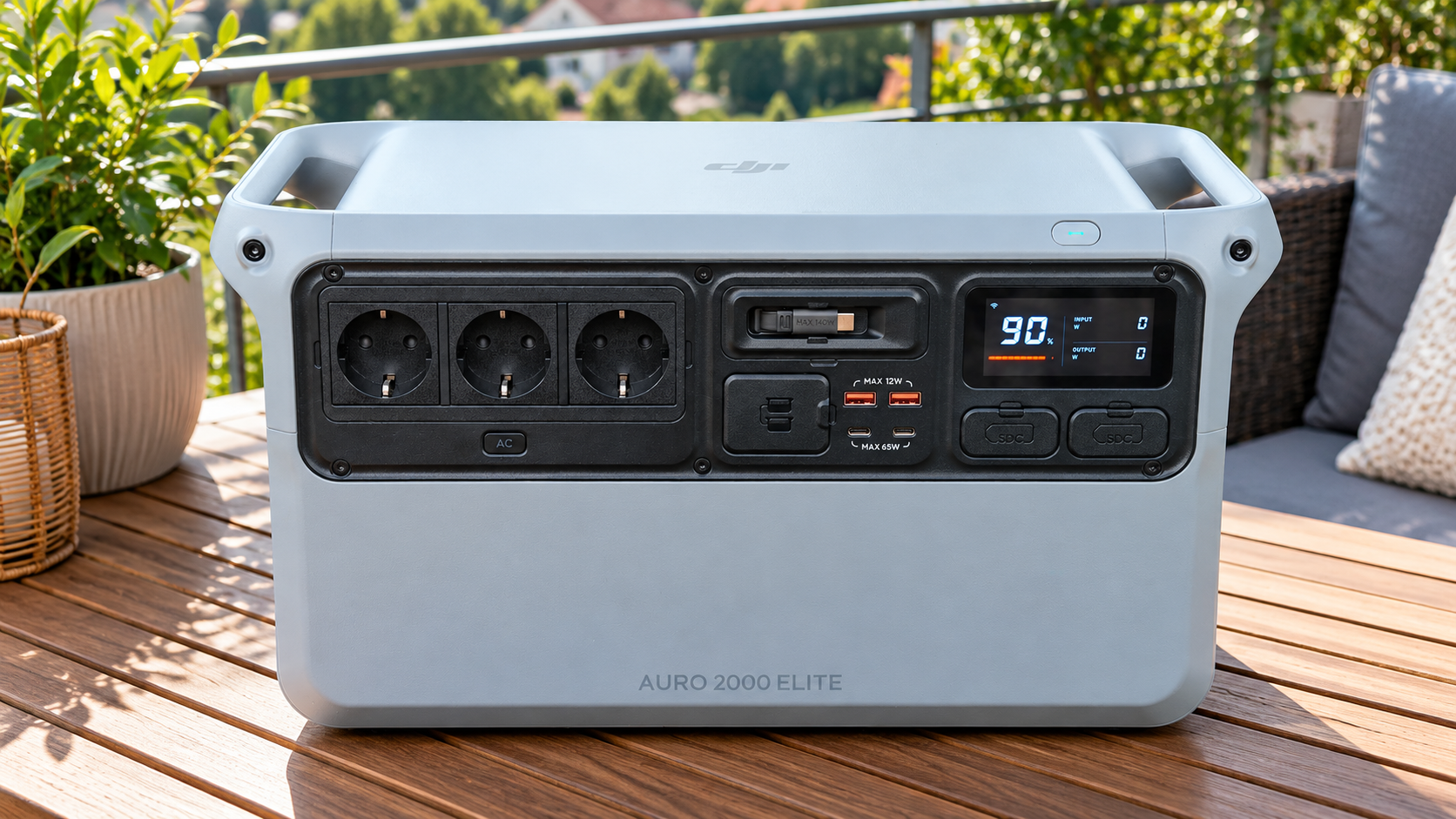
With a battery capacity of 2,016 Wh, the DJI Power Auro 2000 Elite is one of the more powerful portable power stations. Nevertheless, its housing is relatively compact at approximately 45.6 × 22.5 × 24.5 centimeters, but it weighs 19 kilograms. It is still portable, but is better suited to stationary use when camping, in a motorhome, or as a mobile power reserve at home.
Visually, DJI opts for the familiar grey already seen on the manufacturer's drones and other products. Overall, the build quality seems solid, the ports are neatly arranged and the display is easy to read even from a little further away. Only the plastic covers on some of the ports stand out on closer inspection, as they seem a little too thin for my taste and feel less premium than the rest of the housing.
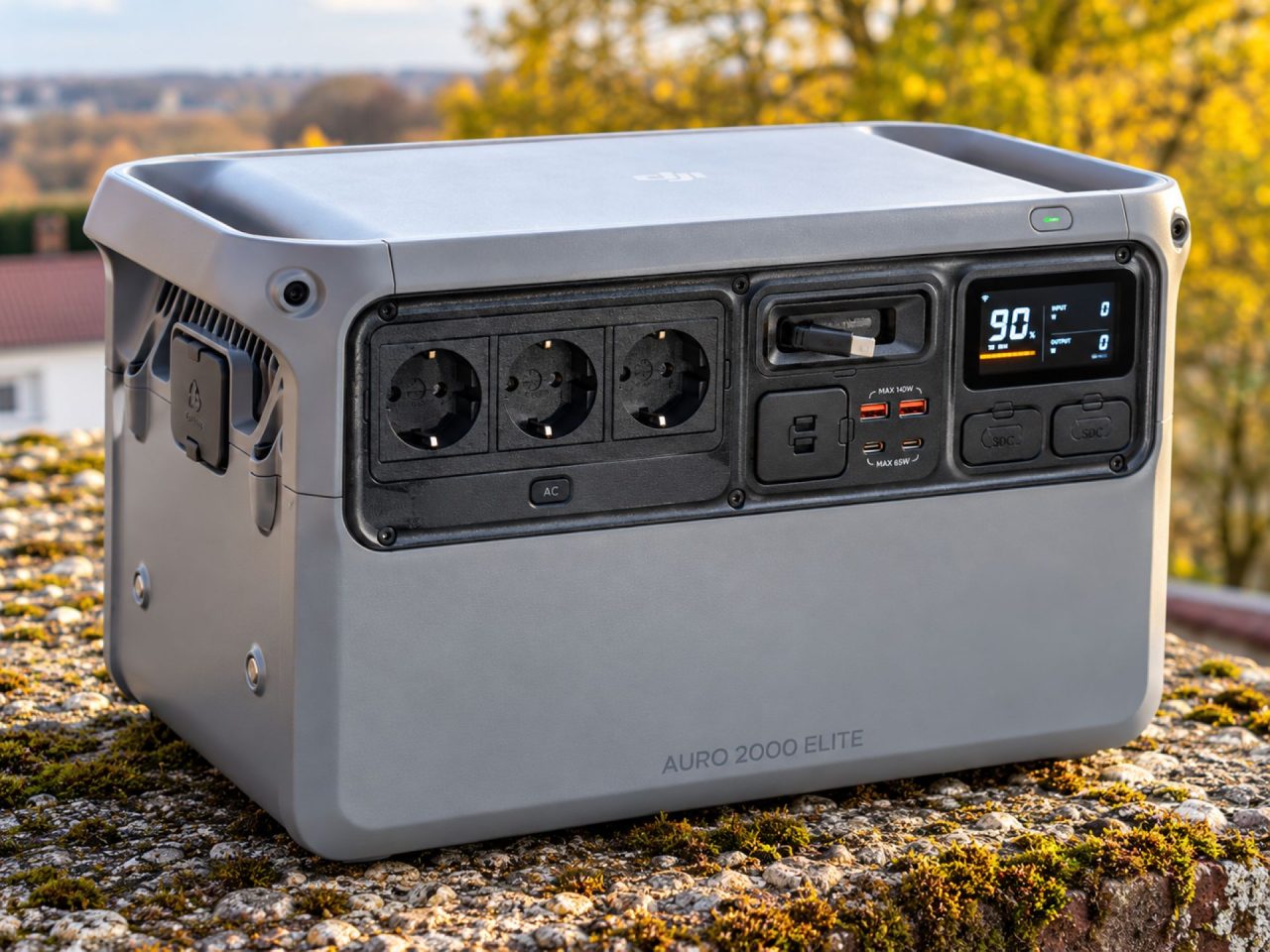
I would also have liked protective covers for the three 230 V sockets to protect the connections from dirt and dust. In addition, the IP30 rating offers no protection against water ingress, which means the Auro 2000 Elite is only suitable to a limited extent for unprotected outdoor use.
Ports and features
DJI equips the Power Auro 2000 Elite with three 230 V sockets, two USB-C ports rated at up to 65 W each and two USB-A ports rated at up to 12 W each. The setup is rounded off by two SDC ports for compatible DJI accessories and an integrated USB-C cable, which offers considerably more power than the other USB ports, at up to 140 W.

The three sockets share a total output of 2,000 W. The two SDC ports can be used, among other things, to charge compatible DJI drone batteries with the appropriate accessories. The supplied adapter for a 12 V car socket is also powered via one of these ports. This means that suitable cool boxes or other 12 V devices can be connected, for example.
Integrated USB-C cable
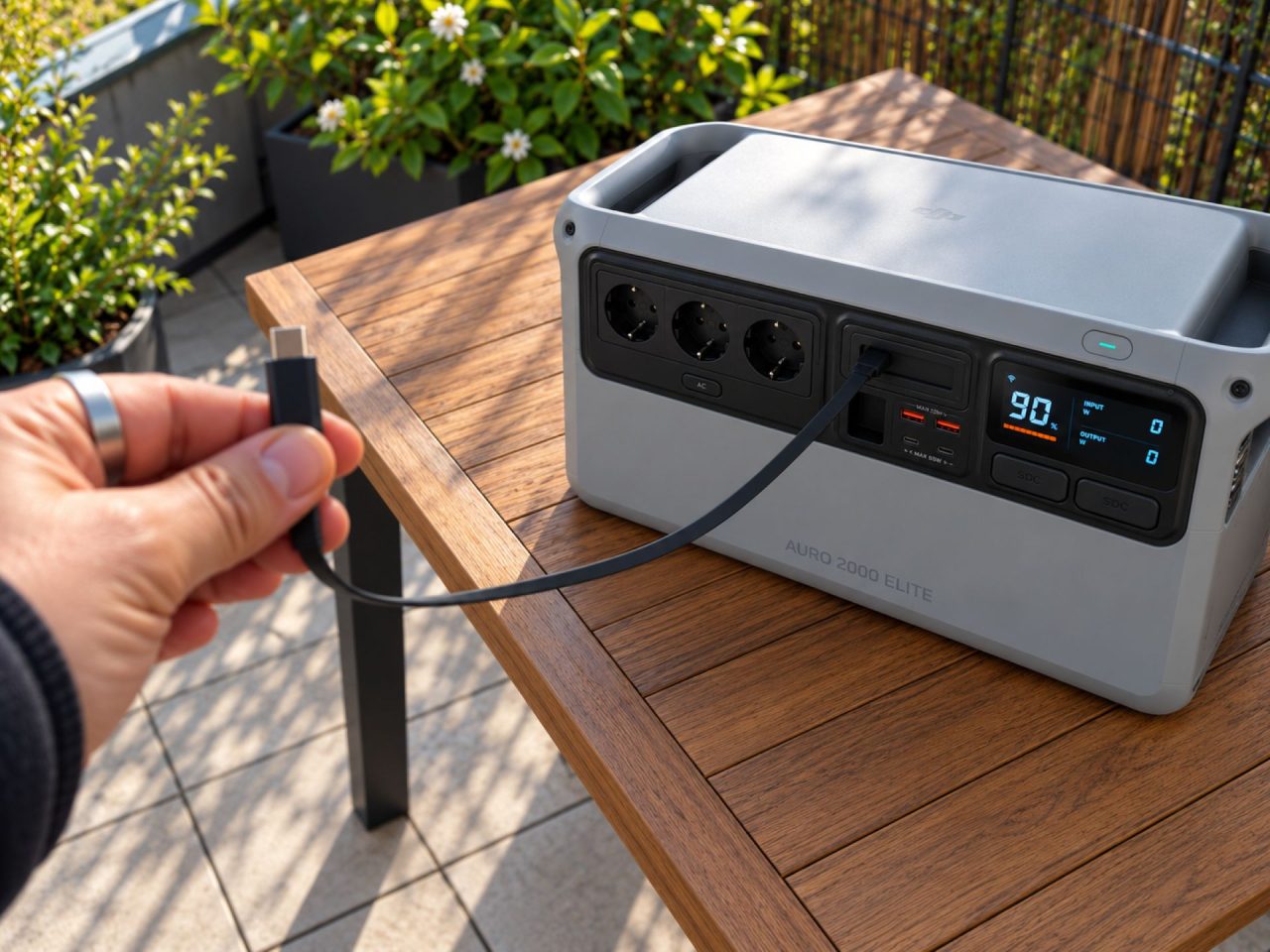
The permanently integrated USB-C cable can be pulled directly out of the housing and, at approximately 80 centimeters long, offers enough flexibility to place a smartphone or notebook next to the power station. After use, it is returned to its designated slot via the retraction mechanism. I recommend guiding the connector by hand as it retracts so it does not hit the housing uncontrollably. If the cable is ever damaged, DJI provides for replacement of the cable module, so the entire power station does not need to be replaced.
For me, the cable is one of the power station’s most practical details, as it is always within reach and I don’t need a separate cable to charge my smartphone or laptop. With up to 140 W via USB Power Delivery 3.1, it can also easily power more demanding laptops.
Laptop, smartphone and speaker put to the test
For my first everyday test, I connected a Lenovo notebook, a Huawei P60 Pro, and a soundcore Bluetooth speaker to the power station at the same time. The notebook was powered via one of the 230 V outlets, while I charged the smartphone and speaker via USB-C, also using the integrated charging cable.
All three devices ran simultaneously without any problems, and the DJI Home app showed a total output of 91 W during one measurement. Of this, 63 W went to the notebook, with another 17 W and 11 W going to the two USB-C connections. The values are displayed separately in the app, making it easy to track the power draw of each port.
Purely mathematically, the battery would last approximately 22 hours at this load if all the stored energy could be used without losses. However, conversion to AC power involves losses, and the power station itself also uses energy, so the actual runtime is shorter. Assuming, for example, that 80 to 90 percent of the energy is usable, around 18 to 20 hours would be realistic under these conditions. During my test, the DJI Home app showed a remaining runtime of 15 hours and 29 minutes.
I also appreciated the low operating noise. At this low load, the power station was barely audible, so it was not disruptive even in a quiet environment.

Household appliances push the power station to its limits
I then tested how the 2,000 W output handled powerful household appliances using a kettle, a COSORI air fryer, and a Senseo coffee machine.
The kettle alone drew 1,992 W, almost the entire available output, but worked without any problems and brought the water to the boil quickly. It was to be expected that this load would leave no capacity for other devices. When I also switched on the air fryer, there was a distinct click and, as expected, the power station cut off the power supply. The overload protection therefore responded exactly as it should, preventing further overloading of the outputs. After restarting, I was able to use the connected devices again.
In a subsequent standalone test, the COSORI air fryer drew approximately 1,260 W at a set temperature of 230 °C, leaving some headroom for smaller devices. After 30 minutes of operation, the power station still showed 68 per cent battery capacity, starting from a fully charged battery. Given the previous overload, I refrained from also running the coffee machine.
In addition to the overload protection successfully triggered during testing, the Auro 2000 Elite has further safety mechanisms. It has 13 temperature sensors to monitor heat generation, while 40 fuses or protective components and the integrated battery management system help protect against overheating, overvoltage and short circuits, among other things.

AC charging and battery management
When charging from a standard outlet, the Auro 2000 Elite supports a maximum input power of 2,000 W. Under optimal conditions, the battery can be charged to 80 percent in approximately 60 minutes and fully charged within 75 minutes. Charging speed can also be adjusted in the app between 200 and 2,000 W, which is especially useful when operating the power station from a less heavily fused outlet or when you deliberately want to charge more slowly.
Inside, DJI uses lithium iron phosphate cells, or LiFePO4, for which the manufacturer states that more than 80 per cent of the original capacity remains after 4,000 charge cycles. With one full charge and discharge per day, that would theoretically amount to just under eleven years of use, although actual degradation is naturally also affected by temperature, storage and charging habits.
If you need more than the integrated 2,016 Wh, you can expand the Auro 2000 Elite to a total capacity of approximately 12 kWh with up to five compatible expansion batteries. However, the Auro series uses its own expansion system and is not compatible with the DJI Power Expansion Battery 2000. So if you already own expansion batteries for an older DJI power station, you cannot simply continue using them.
The DJI Home app in everyday use

The DJI Home app lets you configure the Power Auro 2000 Elite to a great extent, and I particularly liked the extensive energy management options. In addition to AC charging power, you can set custom charging and discharging limits, configure automatic shutdown times, and create schedules for charging and discharging. The latter can be especially useful with dynamic electricity tariffs, when you want the power station to charge mainly at cheaper times.
The app also offers a cable resistance test, automatic restoration of AC outputs that were switched on previously after a restart, and the option to switch the output frequency between 50 and 60 Hz.


The app also provides energy consumption statistics. In addition to daily and weekly figures, monthly overviews are also available, making it possible to review energy consumption over time. The interface is mostly clear, although the German version is not entirely error-free. On our smartphone, several longer menu labels were cut off, including those for the energy optimisation settings.
Solar charging and power supply in the vehicle
Compatible solar panels with a total output of up to 1,200 W can be connected via the two SDC ports, with each input supporting a maximum of 600 W. Under optimal conditions, this can fully charge the battery in approximately 2.7 hours.
More interesting is vehicle charging, for which DJI has already integrated a suitable charging module. With the separately available connection cable, the power station can be charged directly from the vehicle battery, supporting up to 400 W on 12 V systems and up to 600 W on suitable 24 V or 48 V systems. This considerably reduces charging time compared with using a standard 12 V vehicle socket.
Unlike the older DJI Power 2000, neither charging method requires additional external charging modules, as the MPPT solar charge controller and vehicle charging technology are already built into the housing. However, suitable connection cables are still required and must be purchased separately.
Price and availability
The DJI Power Auro 2000 Elite is available now for 1,099 euros from the official DJI online store and authorized retailers. Accessories such as solar panels and suitable connection cables are sold separately.
If you need less battery capacity, the DJI Power 1000 Mini is a more compact alternative, which I have also tested.
Our verdict
In my test, the DJI Power Auro 2000 Elite impressed me above all with its compact design, versatile ports, and straightforward operation. I particularly like the integrated 140 W USB-C cable, which genuinely adds value in everyday use. The DJI Home app also makes a good impression with its extensive settings.
With an output power of 2,000 W, the power station has enough capacity for most everyday devices, and even power-hungry household appliances can be run without any problems. I’m less keen on the thin plastic covers, the unprotected sockets and the lack of water resistance, which limits outdoor use.
Specifications
General
- Model
- DJI Power Auro 2000 Elite
- Model number
- DYM2000MH
- Color
- Grey
- Dimensions
- approx. 456 × 225 × 245 mm
- Weight
- Approx. 19 kg
- Enclosure volume
- Approx. 25 liters
- Protection rating
- IP30
- Maximum operating altitude
- 5.000 m
- Manufacturer's warranty
- 5 years
Battery
- Battery technology
- Lithium iron phosphate (LiFePO4)
- Typical battery capacity
- 2,016 Wh
- Rated capacity
- 1,920 Wh
- Battery life
- 4,000 charging cycles to 80% remaining capacity, according to the product specifications
- Expandability
- Up to approx. 12 kWh with up to 5 expansion batteries
AC outputs
- Ports
- 3 × 230 V outlets
- Continuous total output power
- 2.000 W
- Output frequency
- 50/60 Hz
- Output waveform
- Pure sine wave
USB ports
- USB-C
- 2 × up to 65 W
- USB-A
- 2 × up to 12 W
- Integrated USB-C cable
- Up to 140 W (USB PD 3.1)
- Cable length
- approx. 80 cm
- Special feature
- Retraction mechanism, replaceable cable module
SDC ports
- Quantity
- 2
- Solar input power
- Up to 600 W per port
- Solar input voltage
- 9–60 V
- Solar input power
- Up to 30 A per connection
- Rapid drone charging
- Up to 240 W with compatible models
Charging options
- AC input power
- Up to 2,000 W
- AC charging time from 0 to 80%
- approx. 60 minutes according to DJI
- AC charging time from 0 to 100%
- approx. 75 minutes according to DJI
- Solar charging
- Up to 1,200 W according to DJI
- Full solar charge
- approx. 2.7 hours according to DJI
- Vehicle charging (12 V)
- Up to 400 W
- Vehicle charging (24/48 V)
- Up to 600 W
- Charge controller
- Integrated MPPT solar charge controller
- Hybrid charging
- Supported
Controls and connectivity
- Display
- Battery level and performance data
- App
- DJI Home
- Connection
- Wi-Fi and Bluetooth
- Power monitoring
- Input and output power
- Port control
- USB outputs individually, AC outputs as a group
- AC charging power limit
- 200–2.000 W
- Charging and discharging limits
- Adjustable
- Charging and discharging schedules
- Supported
- Usage statistics
- Daily, weekly, and monthly overview
- Firmware updates
- Via the app
Safety and emergency power supply
- UPS function
- Supported
- UPS switchover time
- 10 ms according to DJI
- Temperature sensors
- 13 according to DJI
- Fuses and protective components
- 40 according to DJI
- Battery management system
- Integrated
- Protective features
- Overload, overheating, overvoltage and short-circuit protection
What’s included
1x DJI Power Auro 2000 Elite 1x DJI Power AC power cable 1x DJI Power car socket extension adapter (Lite)

Comments (2)
Hello,
Thanks for this valuable information. I want to use this power bank in my camper, but also as a home battery in winter. If I understand correctly, you can pair the PB with a Shelly 3em pro, and when drawing power from the grid, the battery feeds power into the home network, and when there is a PV surplus, the PB is recharged, either with the PV surplus from the rooftop PV modules or from two PV modules connected directly to the PB.
Is that right, and can it do this without any additional accessories?
Thanks in advance for your assessment
Hi Bernd!
Yes, your idea should work very well in principle, but there are two important details to bear in mind regarding accessories and charging control:
Feed-in to the home grid (Shelly):
This works directly via the DJI Home App. If a Shelly Pro 3EM is installed in the meter cabinet, the Auro 2000 Elite can act as a storage unit and dynamically feed up to
800 W into the home grid when drawing power from the grid.
Charging via solar panels:
Panels connected directly to the power station: Works perfectly via the SDC inputs.
Important when it comes to accessories:
The compatible DJI SDC-to-MC4 solar charging cables are not included and must be purchased separately.
Surplus from the rooftop system (via AC):
Charging from the mains can be controlled in the app using charging schedules. However, continuously variable dynamic AC surplus charging using only the Shelly currently still requires a dedicated smart home automation (such as Home Assistant).
So the Auro 2000 Elite is very well suited to your combination of using it as a campervan in summer and as a home battery in winter – basically, you just need to factor in the SDC solar adapters for your own panels!
Best regards, Christian