Contents
Review: ENGWE M20
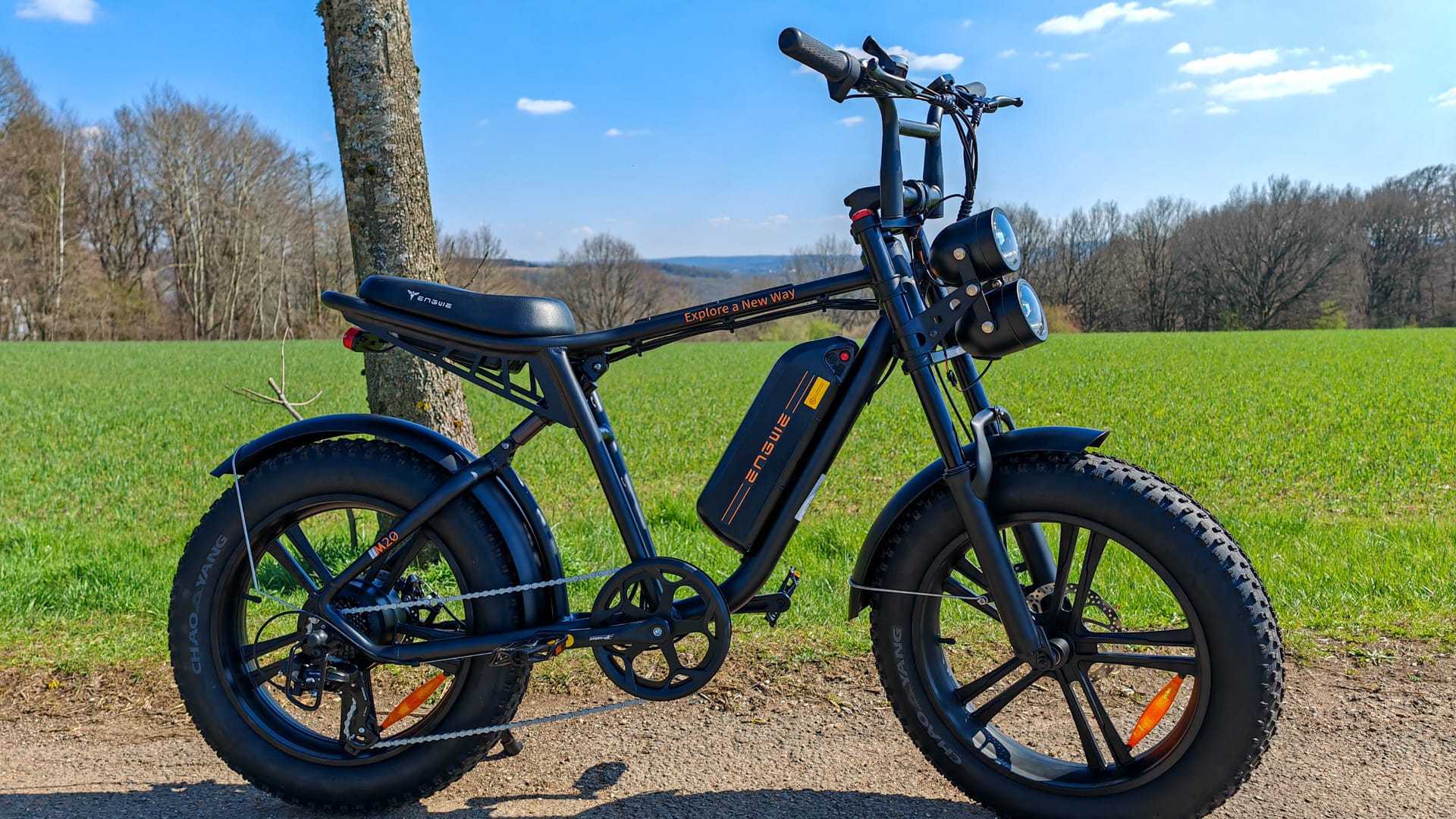
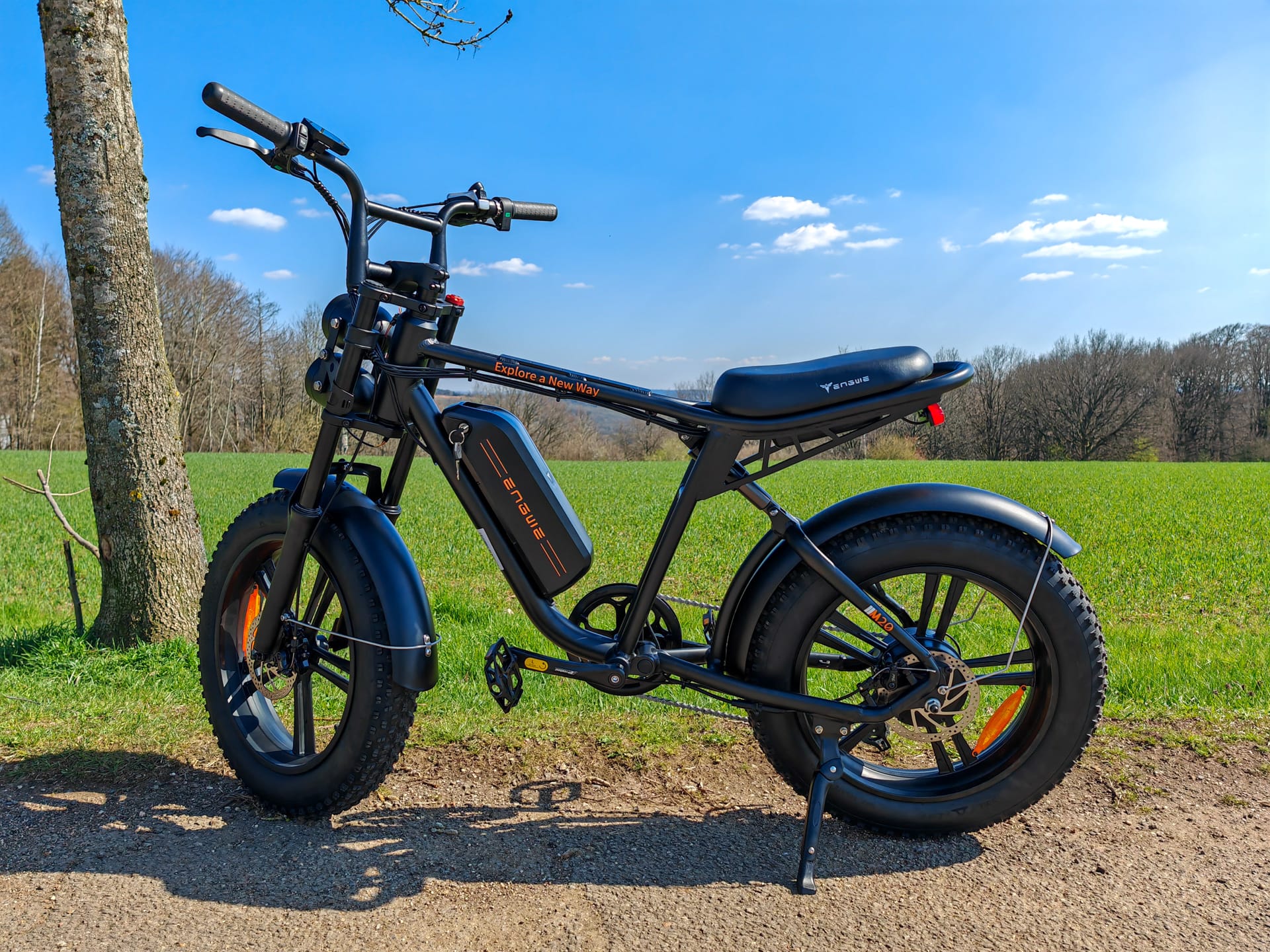
The aesthetics of the M20 combine raw energy with elegance. While its rugged appearance is reminiscent of a moped, it retains all the qualities of a conventional e-bike. A Shimano seven-speed system ensures dynamism, and the wide 4-inch tyres on 20-inch rims guarantee stability on every ride. The whole is completed by a front and rear suspension.
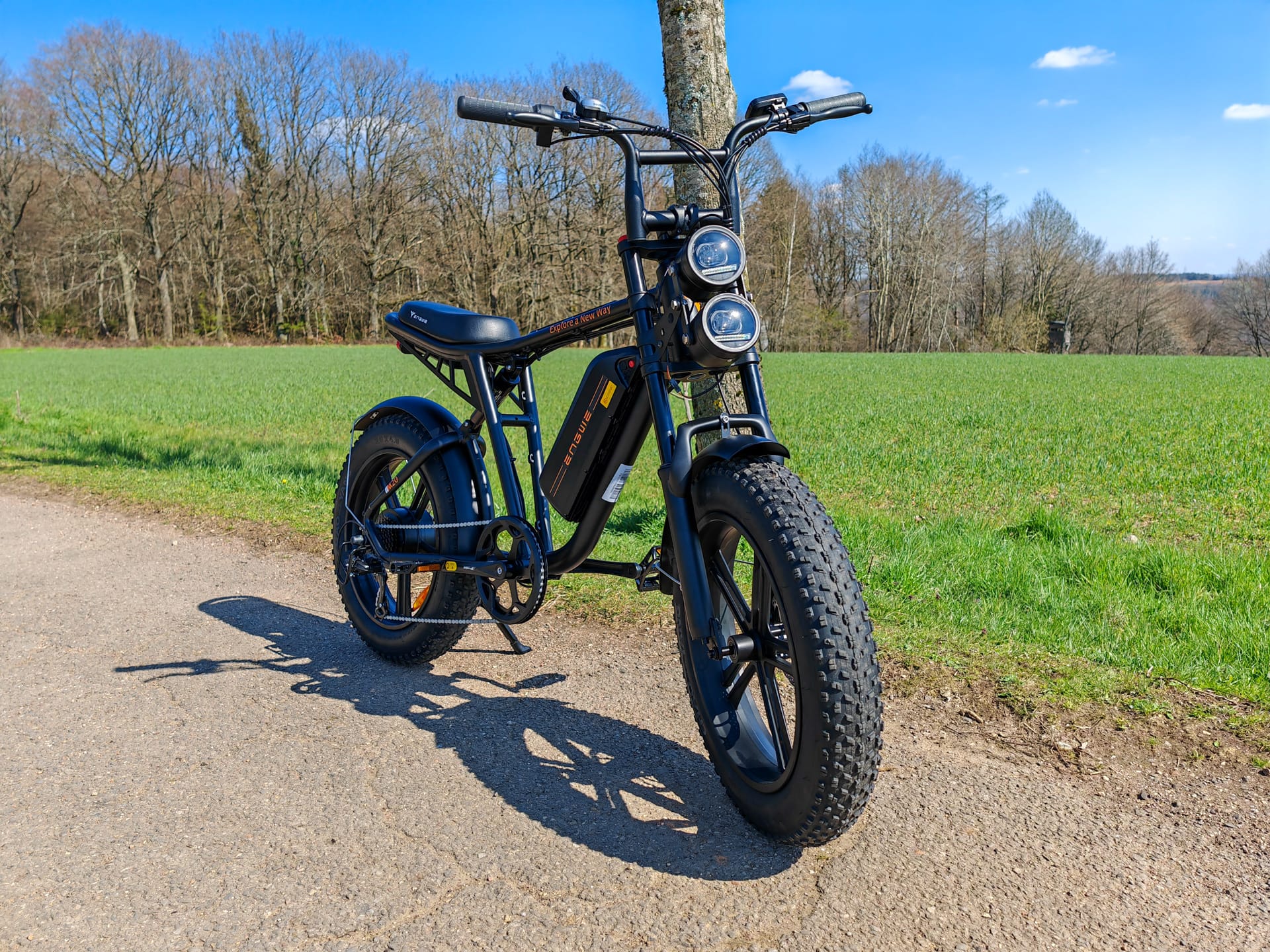
However, the real showpiece of the ENGWE M20 is its innovative dual-battery configuration. This makes it possible to use two batteries either together or independently of each other. With a combined range of up to 150 kilometres, the M20 sets new standards in the e-bike segment.
ENGWE M20: Unboxing and assembly
The ENGWE M2 arrived in perfect condition. This is undoubtedly thanks to the ample padding and the robust packaging typical of ENGWE. Environmental friendliness looks different, however.
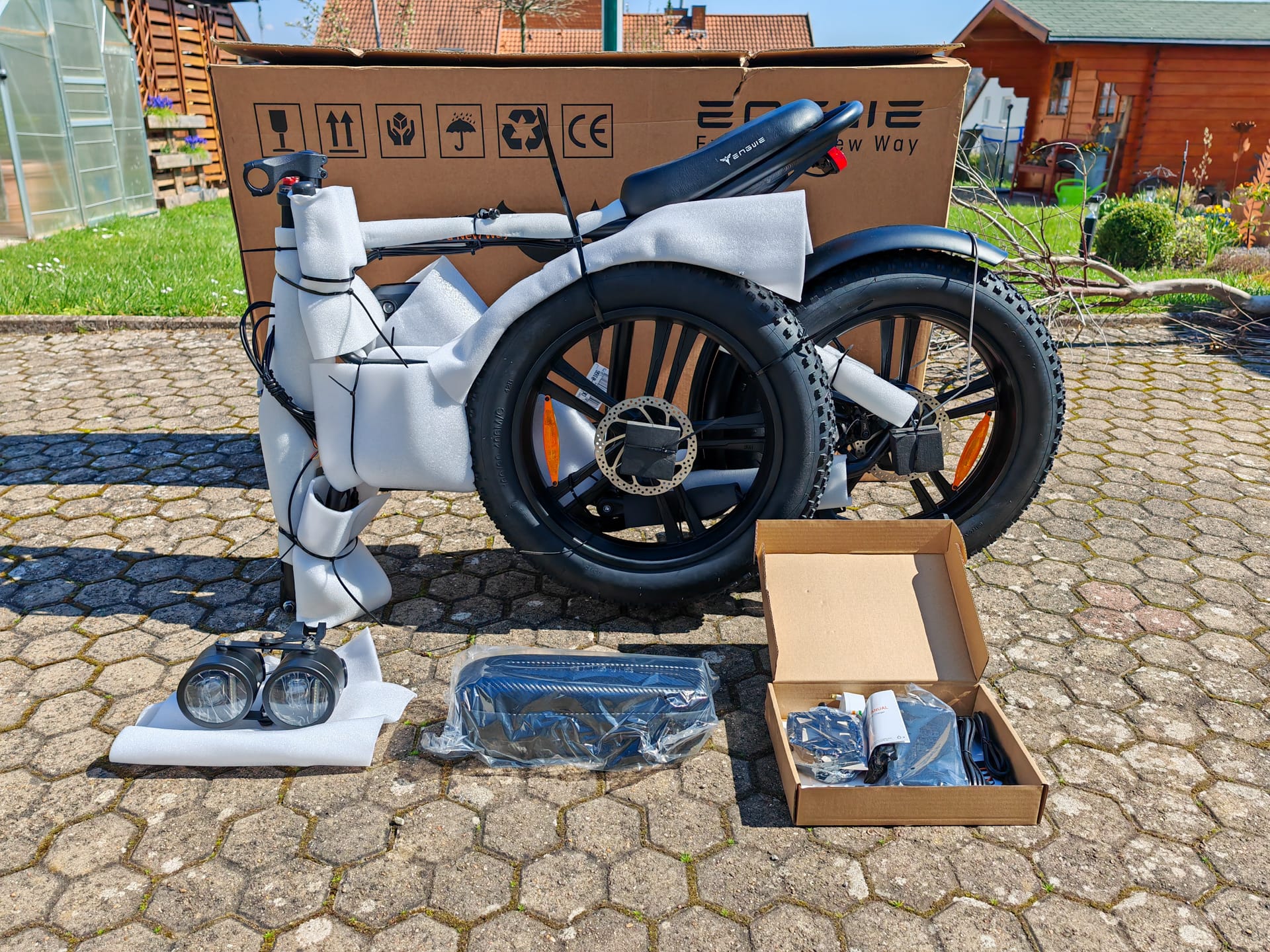
At first glance, it may appear that the bike is almost fully pre-assembled, but a few steps are still necessary before you can cruise around. The front wheel including the mudguard, the handlebars, the pedals and the headlight must be installed. The necessary tool is included in the scope of delivery, however, it is recommended to use your own, higher-quality tool.
Connecting the optional extra battery requires some additional work: the seat must first be unscrewed. Several cables are hidden underneath, which then need to be connected. Ideally, use cable ties to keep everything in place.
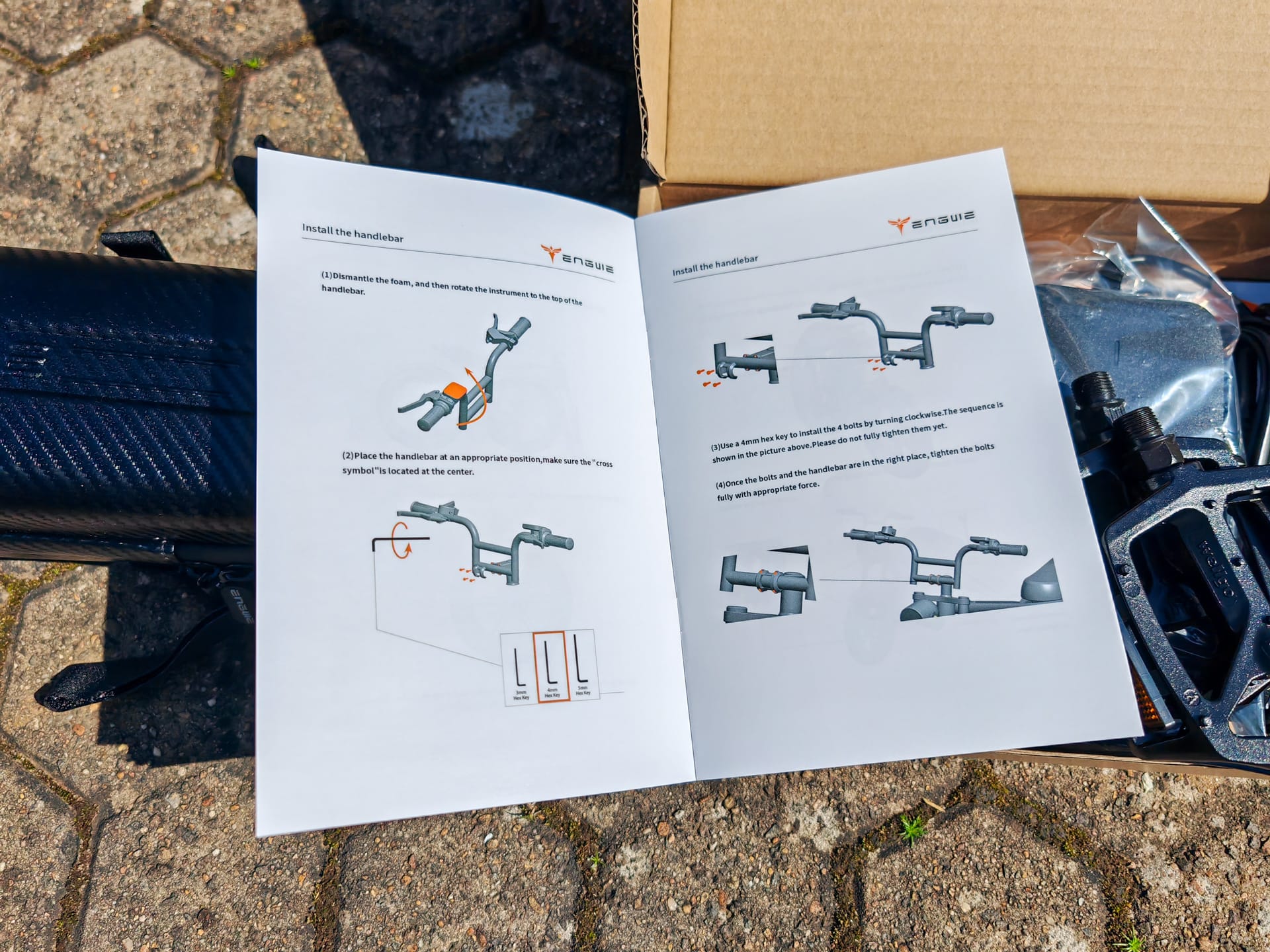
The included manual explains all steps clearly. As an alternative to the manual, ENGWE already provides an assembly video on the ENGWE YouTube channel that clearly illustrates the entire assembly process in less than three minutes. The entire assembly of the ENGWE M20 is completed after about 30 minutes.
ENGWE M20: Design and features
The ENGWE M20 stands out from conventional e-bikes due to its moped design, guaranteeing attention. This became clear after the first test ride, as the gazes of passing pedestrians practically followed me.
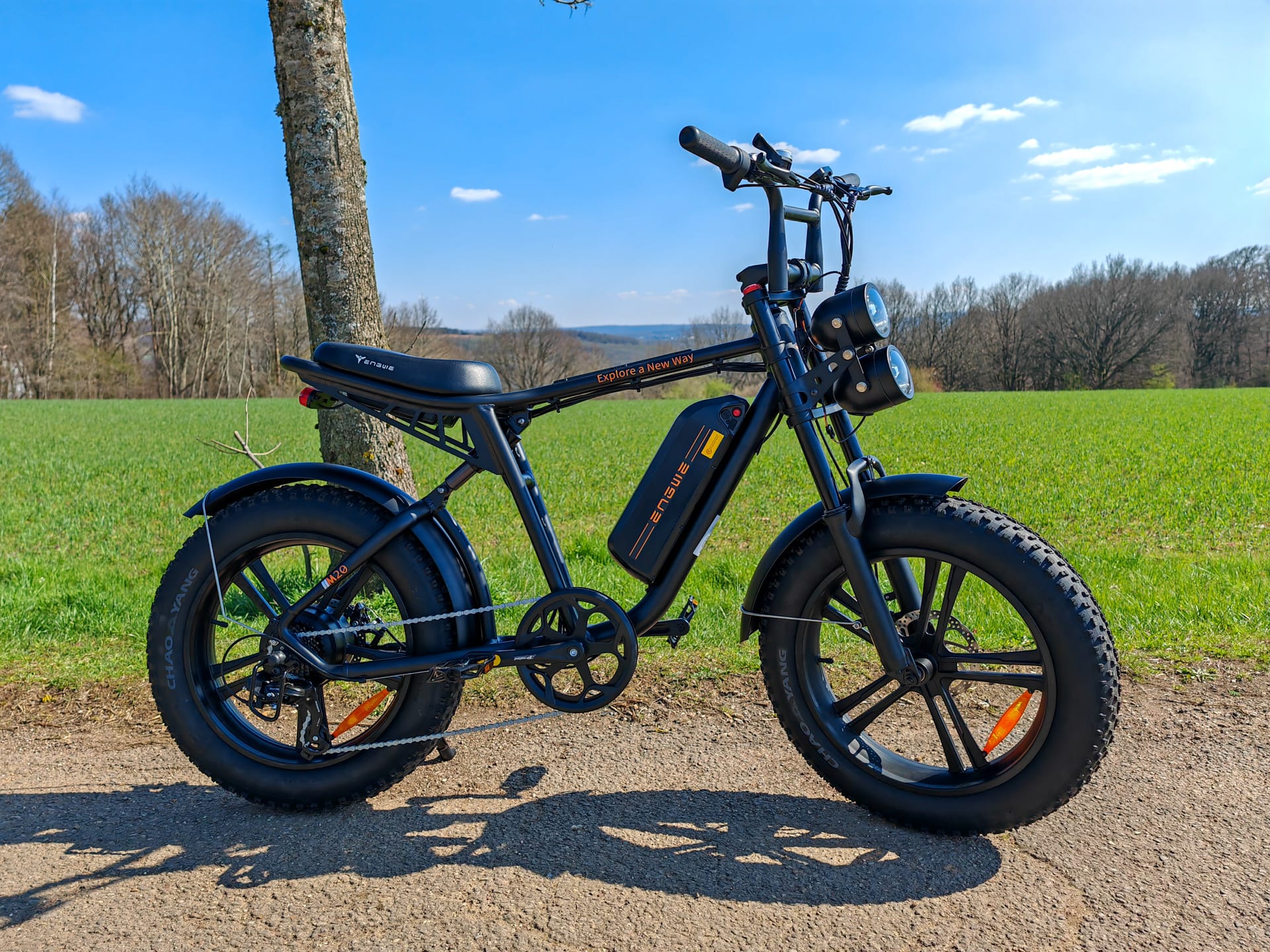
The frame is made of robust 6061 aluminium and is available in black, white or green. In terms of size, the M20 is a good 167 cm long and 114 cm high. With a weight of 42.7 kilograms, including the battery, the e-bike is already quite heavy. If an additional battery is added, the weight rises to a substantial 45.9 kilograms.
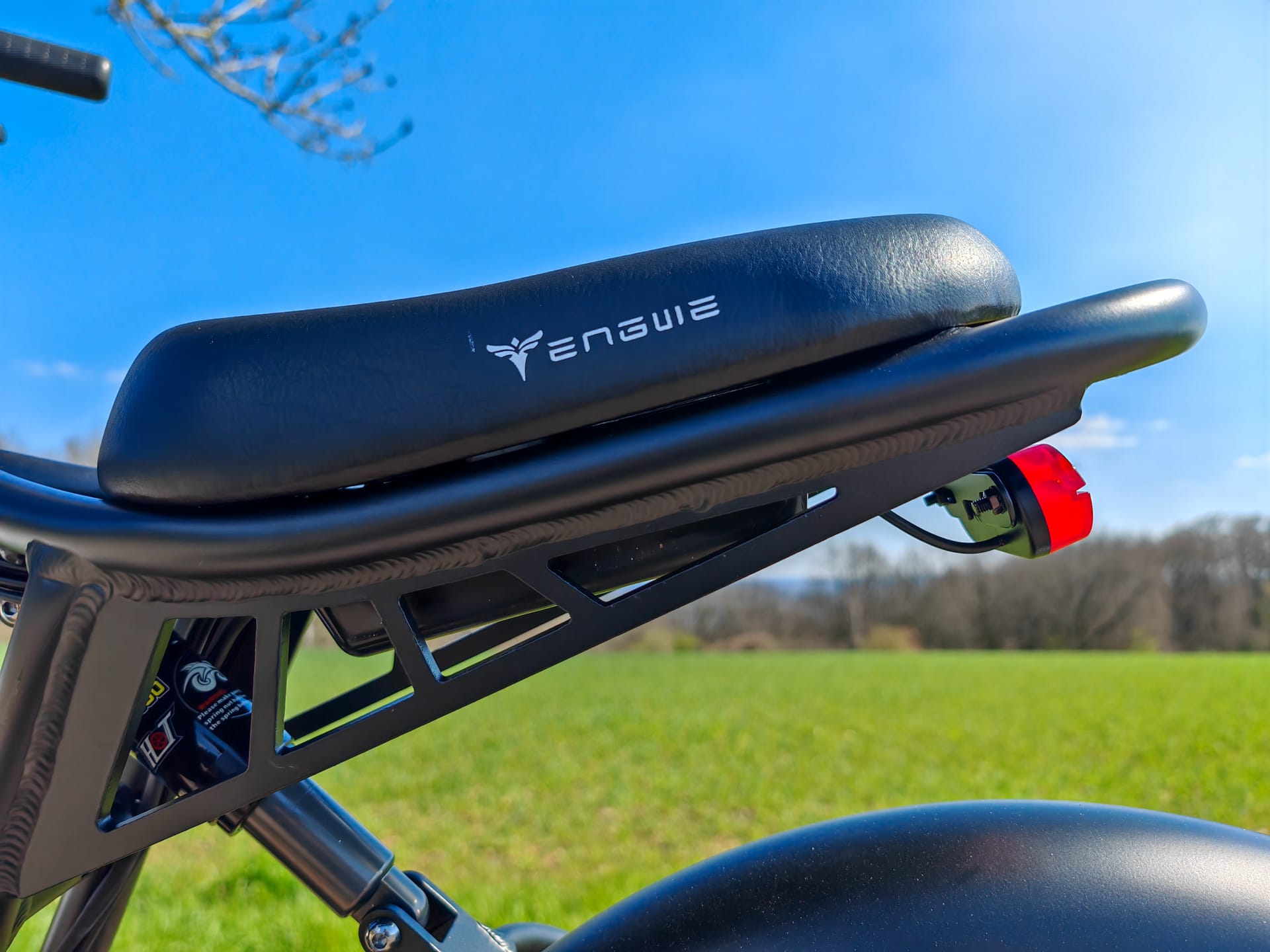
The seat design strongly resembles a motorcycle seat and is not height-adjustable. The handlebar stem can only be adjusted in tilt, not in height. Although I was able to ride the M20 at a height of 1.82 metres, the bike is designed for heights from 1.50 metres to 1.80 metres. Anything above this becomes uncomfortable over time and is anything but ergonomic when pedalling. The maximum load capacity of 120 kilograms should also not be exceeded.
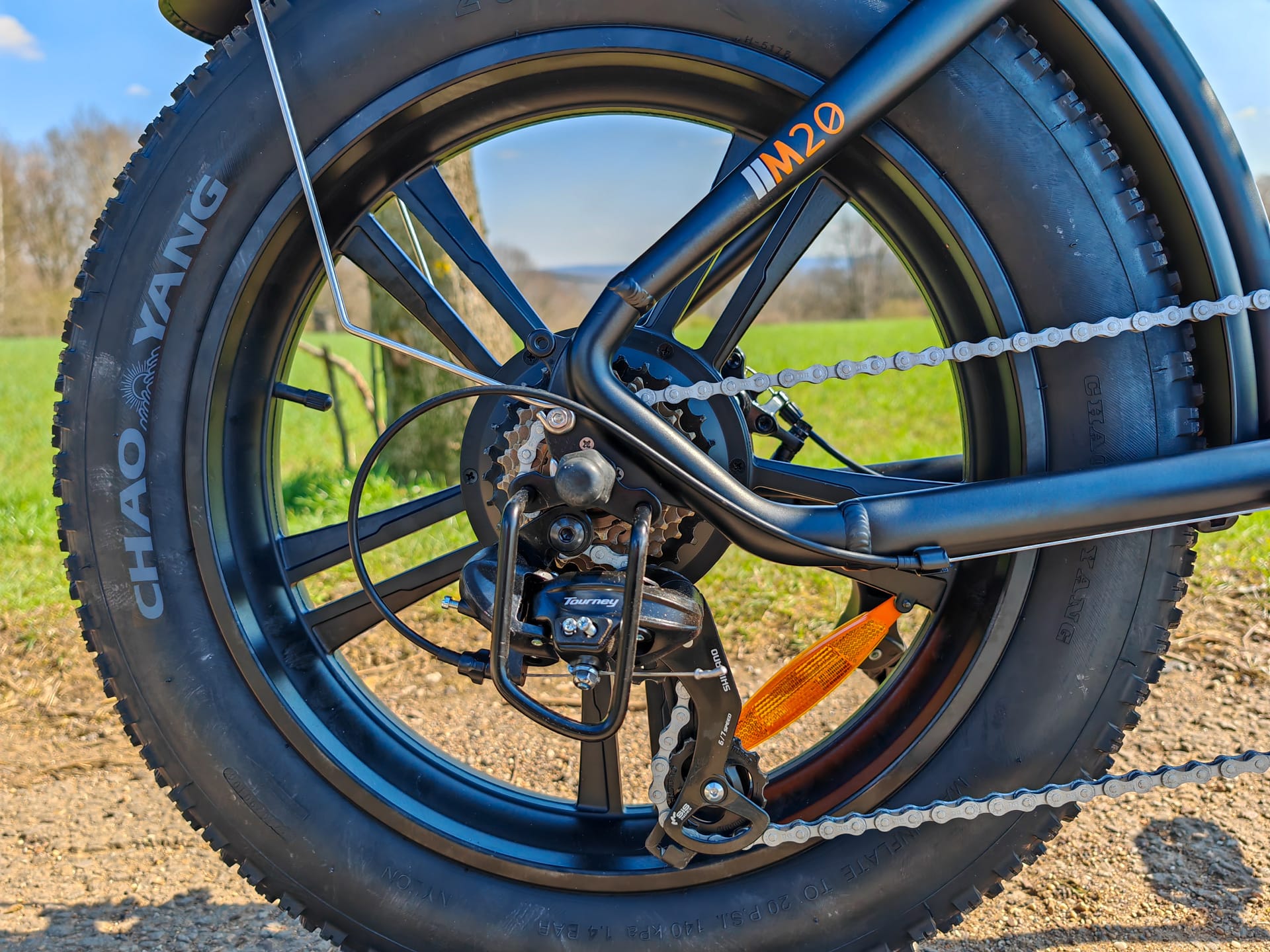
One particular detail that stands out are the bulky four-inch wide tyres from the more or less well-known brand Chaoyang. These are accompanied by matching metal mudguards, which leave a solid impression.
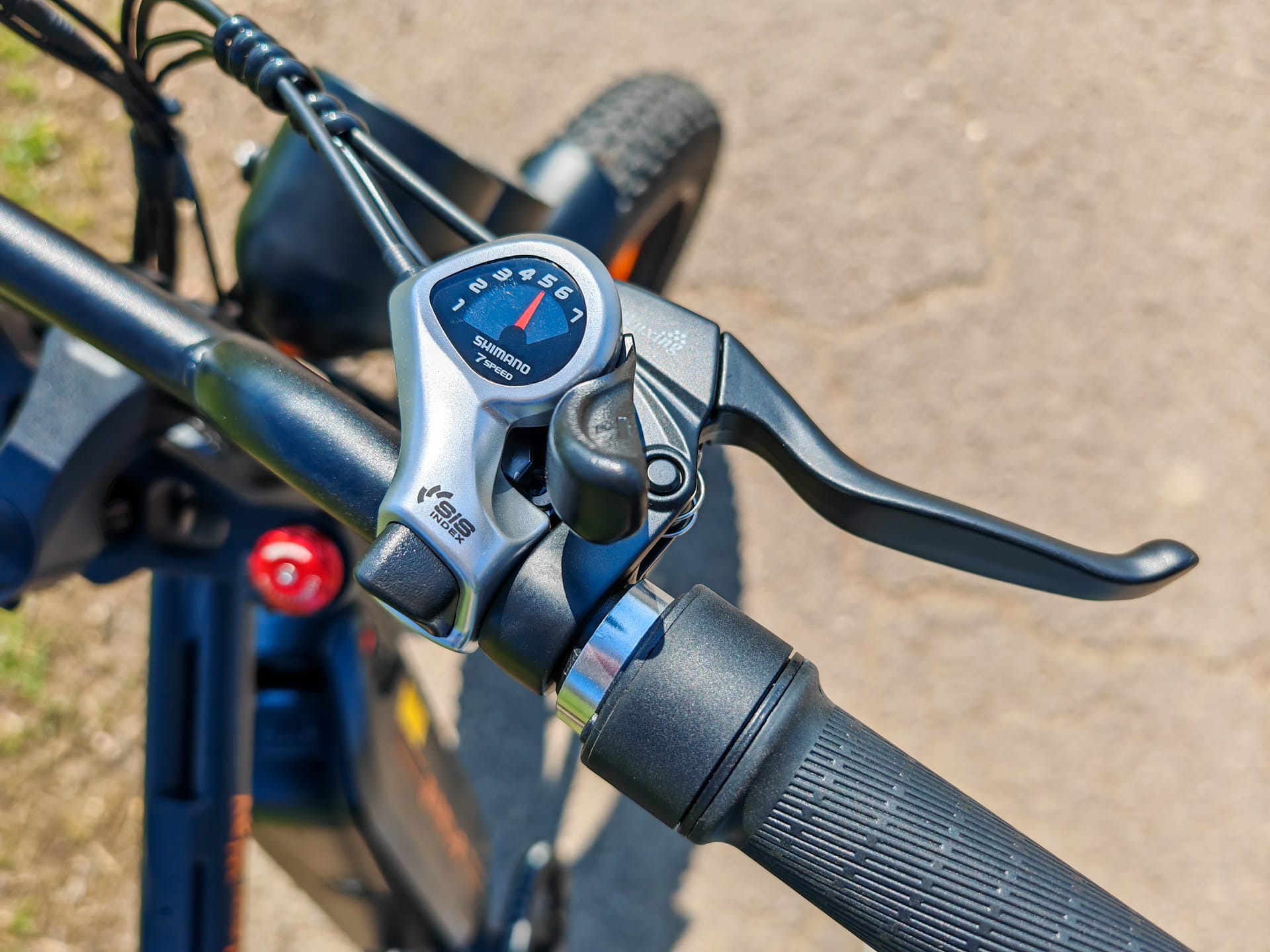
Regarding the rest of the equipment, ENGWE relies on components already used in other models from the brand. Worth highlighting are two 160 mm disc brakes with WUXING brake levers as well as a Shimano Tourney 7-speed derailleur, combined with a Shimano SL-TX50 thumb shifter. Both are more or less components that fulfil their purpose but are positioned in the lower price segment.
The motor power of the rear hub motor is impressive. With a rated output of 750 watts and a peak output of up to 1000 watts, the e-bike shows what it can do. However, it is not approved for road use in every country. In Germany, the ENGWE M20 may only be operated on private property. ENGWE provides an EU "Certificate of Conformity" on its website as a download.
The control system of the ENGWE M20 is a YL81C controller, which displays speed, total mileage (ODO), trip distance, battery level, and assistance level on a screen located on the left side of the handlebar. Switches for the lights and the electronic horn are additionally mounted on the handlebar. The right grip functions as a throttle grip along its entire length, similar to a moped. It can be deactivated in the controller options.
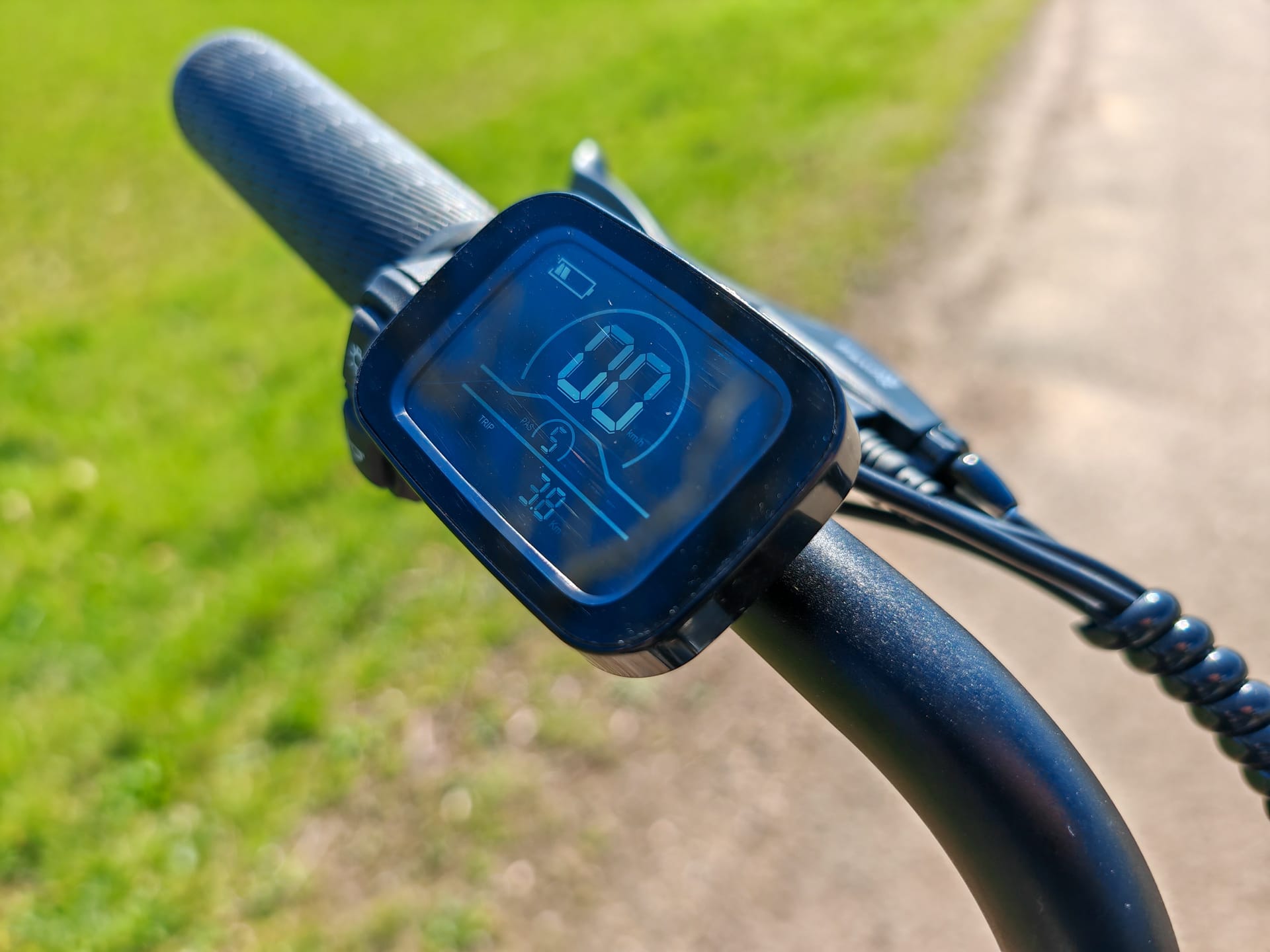
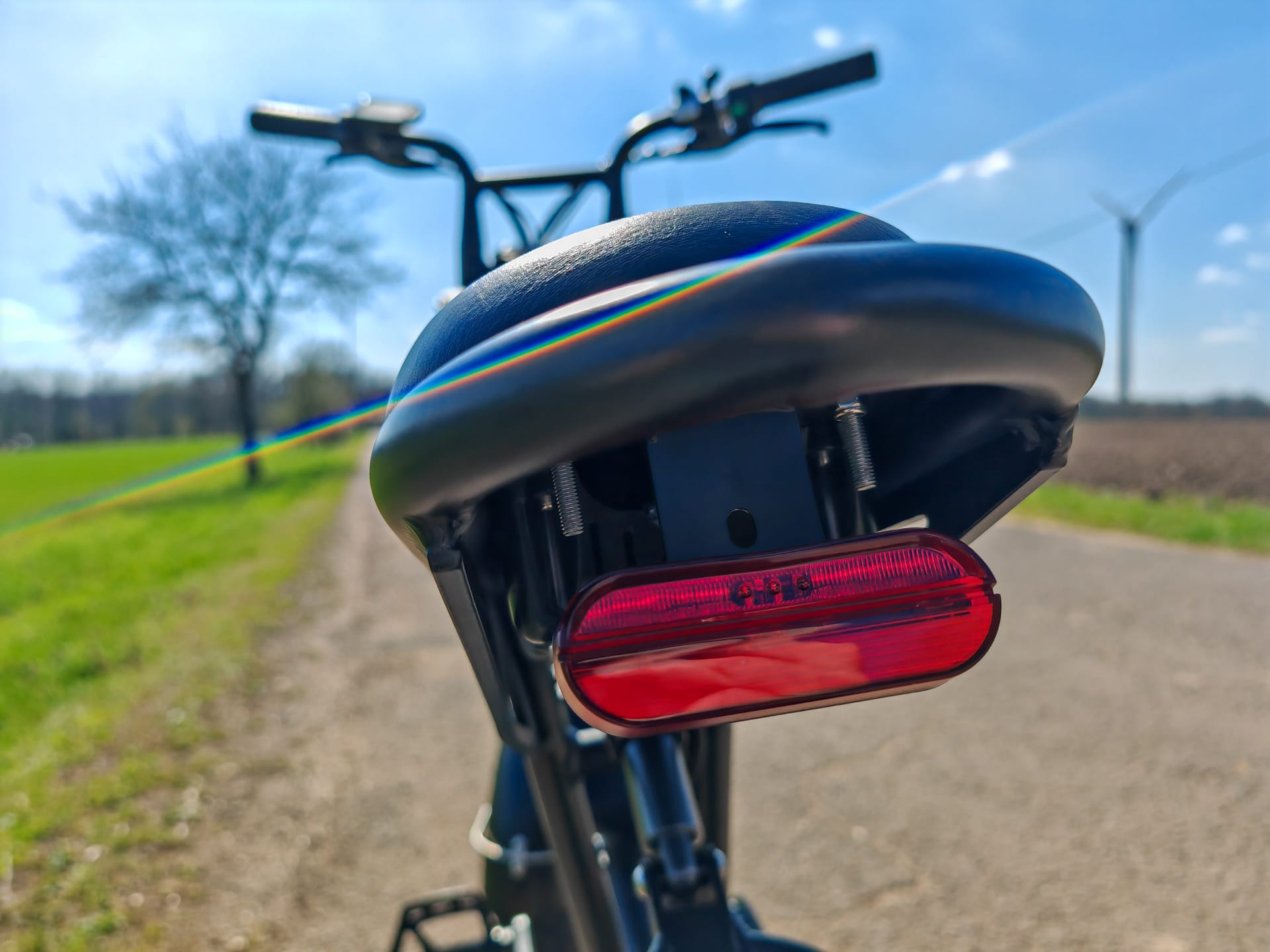
Other features of the ENGWE M20 include a robust side stand, which easily supports the bike's weight, as well as a brake light, whose brightness intensifies when the brake lever is applied, thus increasing safety during riding.
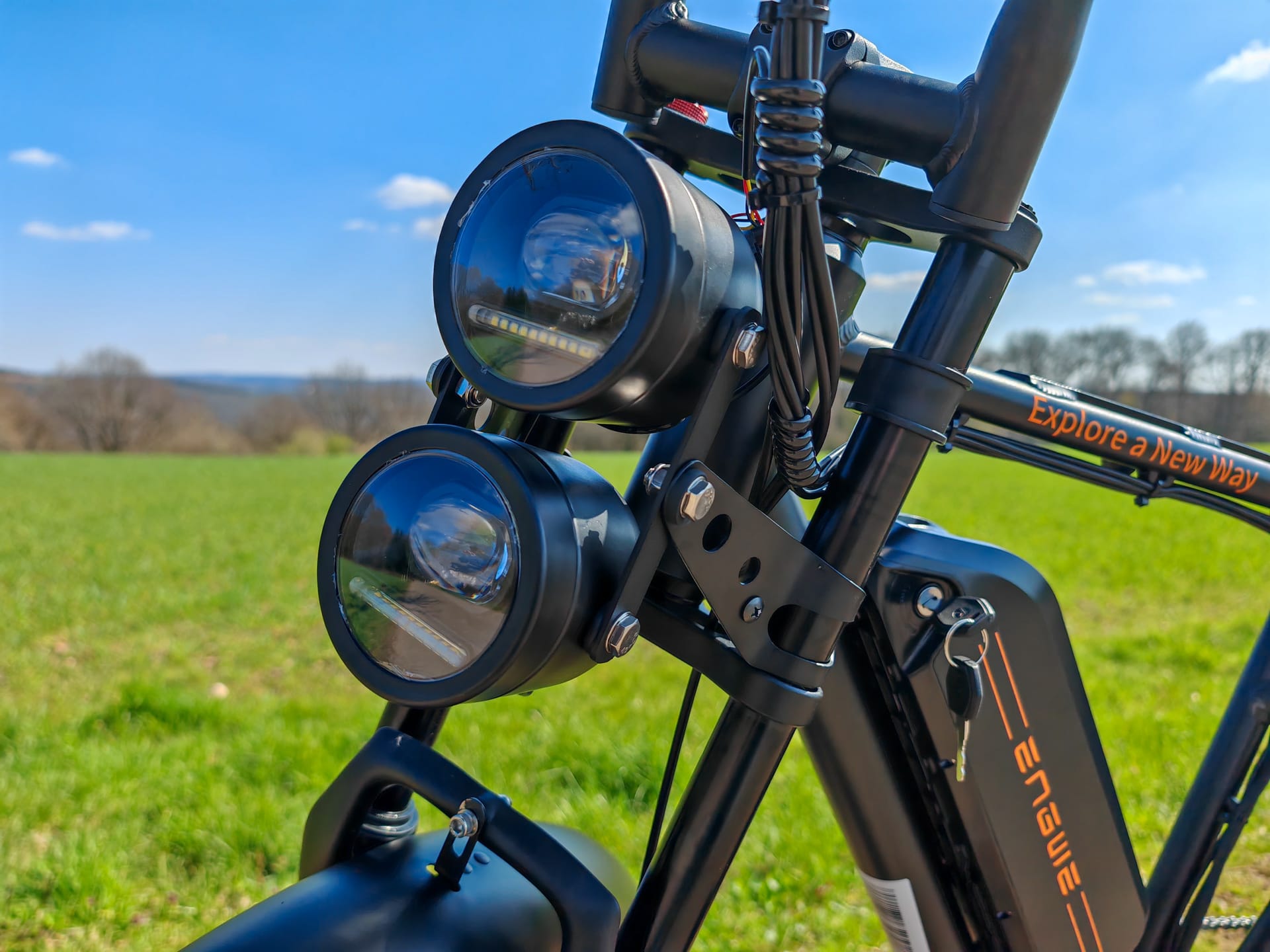
Two bright LED headlights, which contribute to the moped-style design of the e-bike, are angle-adjustable. This allows one headlight to be used as low beam while the other serves as high beam.
The most exciting feature of the ENGWE M20 is its dual-battery configuration. In addition to the 48V 13Ah battery on the down tube, it is possible to attach another 48V 13Ah battery on the top tube. This results in an impressive total capacity of 1,248 watt-hours, which is sufficient for extended rides.
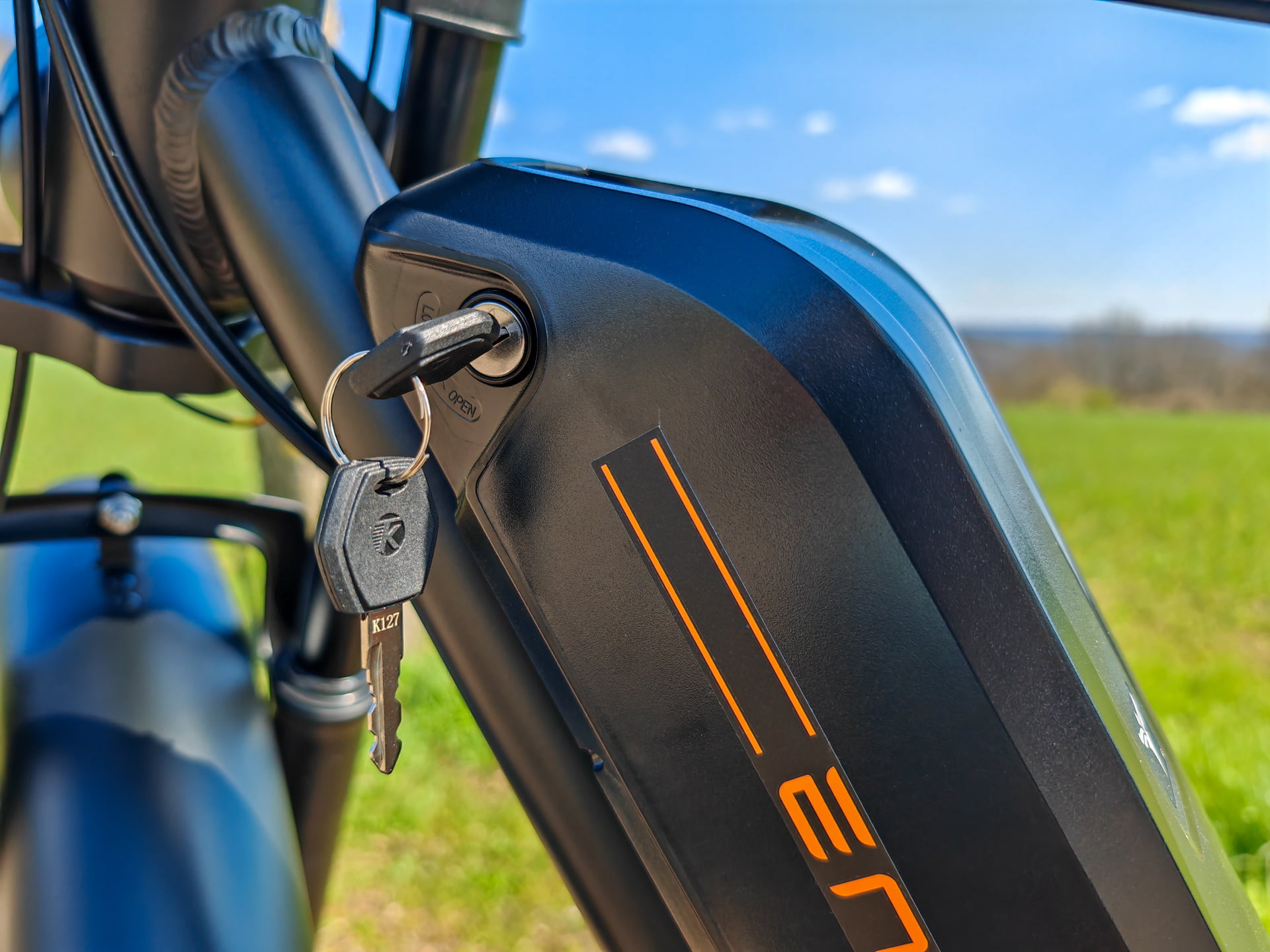
The battery level can be read directly on the battery with the press of a button. A particular plus point is the integrated USB-A output, which makes the battery usable as a power bank, although charging via it is rather slow. For security, each battery can be locked with its own key.
The batteries are also removable. Simply turn the key to the unlock position and slide out the battery. As charging can take up to 10 hours, it is recommended to charge overnight.
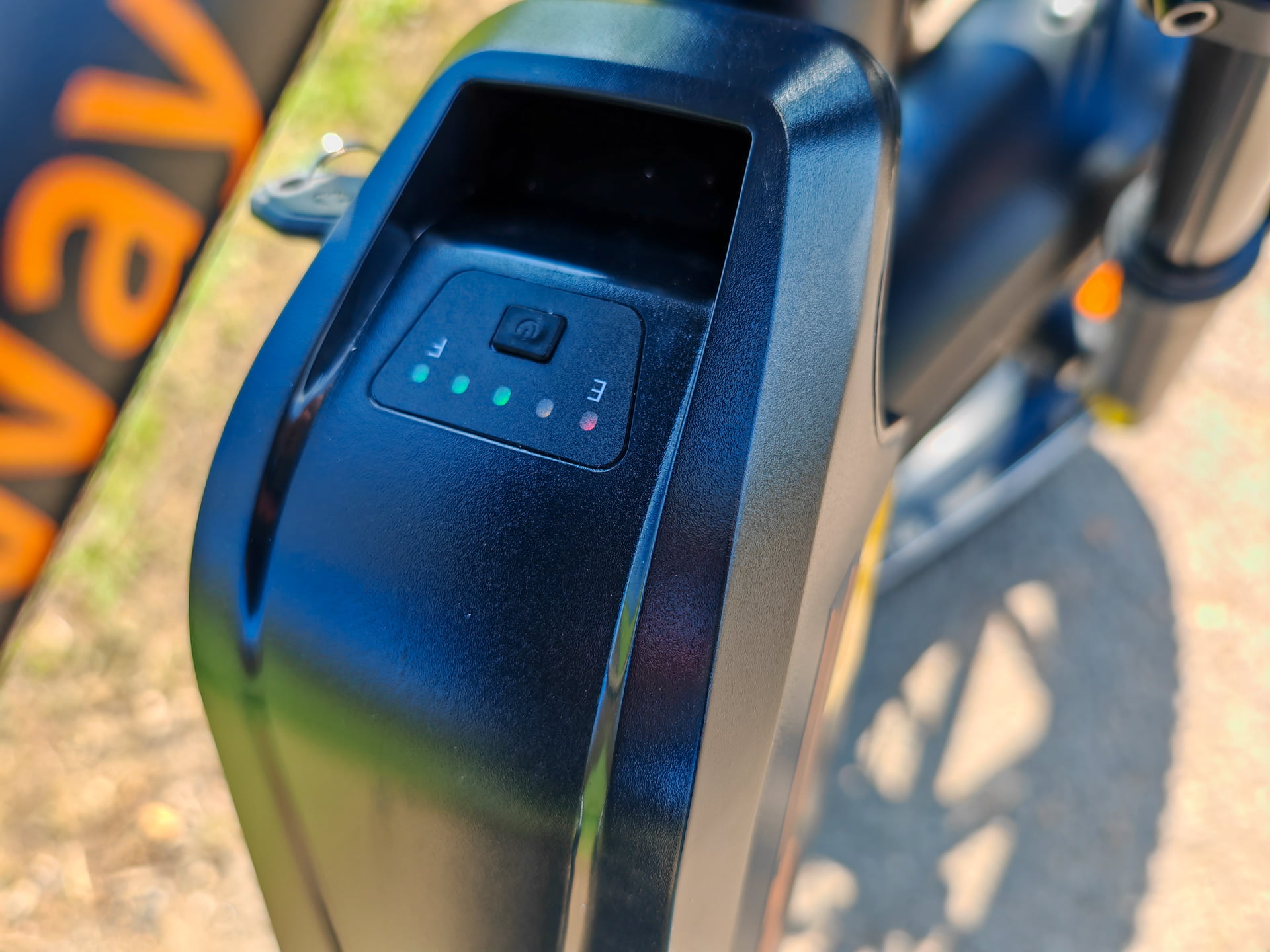
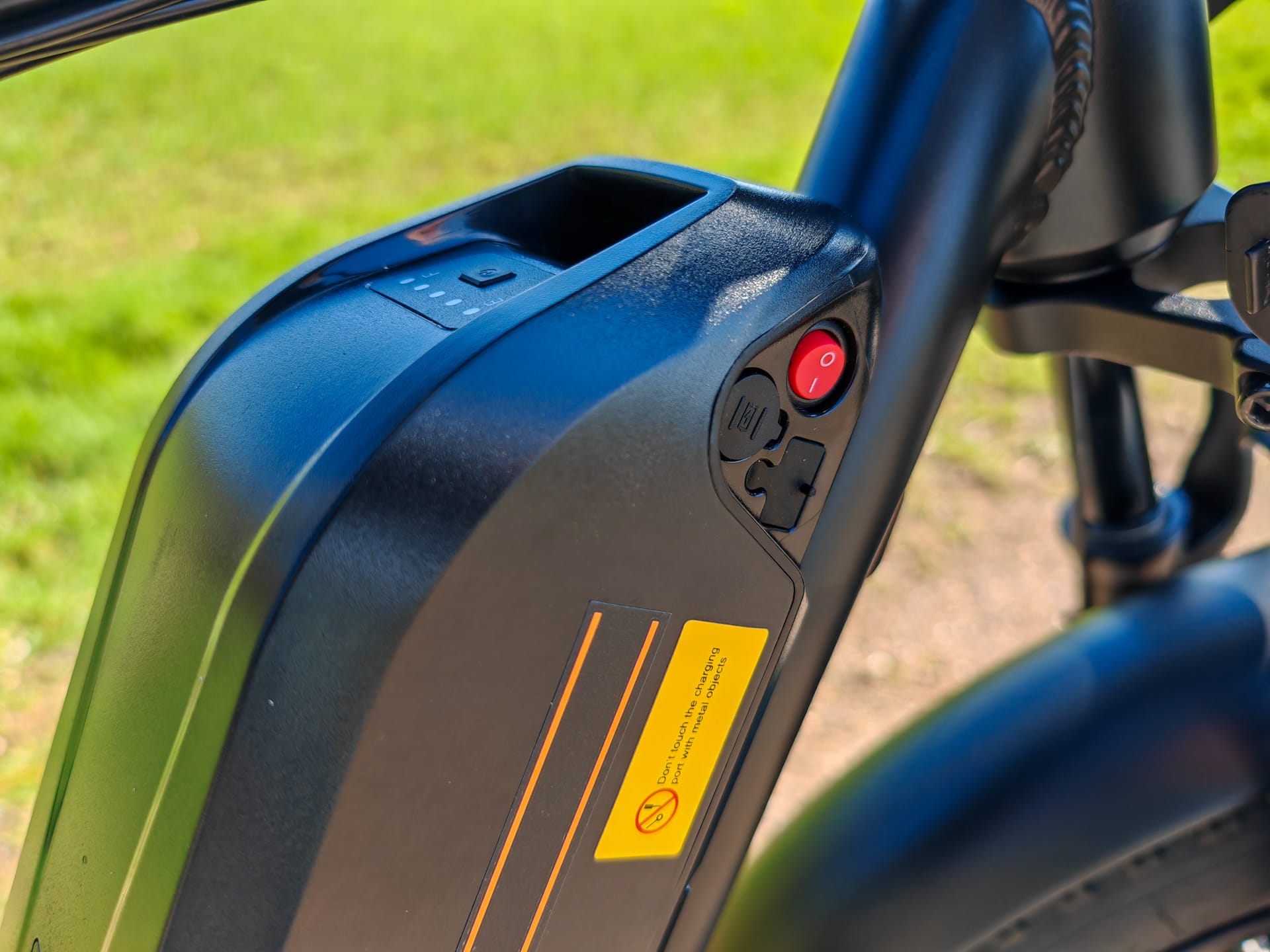
ENGWE shows clear progress in terms of quality control. In direct comparison to the ENGWE EP-2 Pro, one of the company's first e-bikes, the improved build quality of the ENGWE M20 stands out.
Although ENGWE has not yet reached the quality level of well-known brands, the progress is clearly recognisable. This is a promising sign and underscores the commitment to bringing solid and reliable products to market.
ENGWE M20: Field test
Let's move on to the practical test of the ENGWE M20, which is mainly about the riding characteristics of the e-bike. For this purpose, I tested the e-bike on different surfaces and inclines. With a power switch at the top of the display, we activate the e-bike, and with two buttons on the bottom edge of the display, we can change the motor's assistance level. Equipped with this knowledge, I start my first test ride.
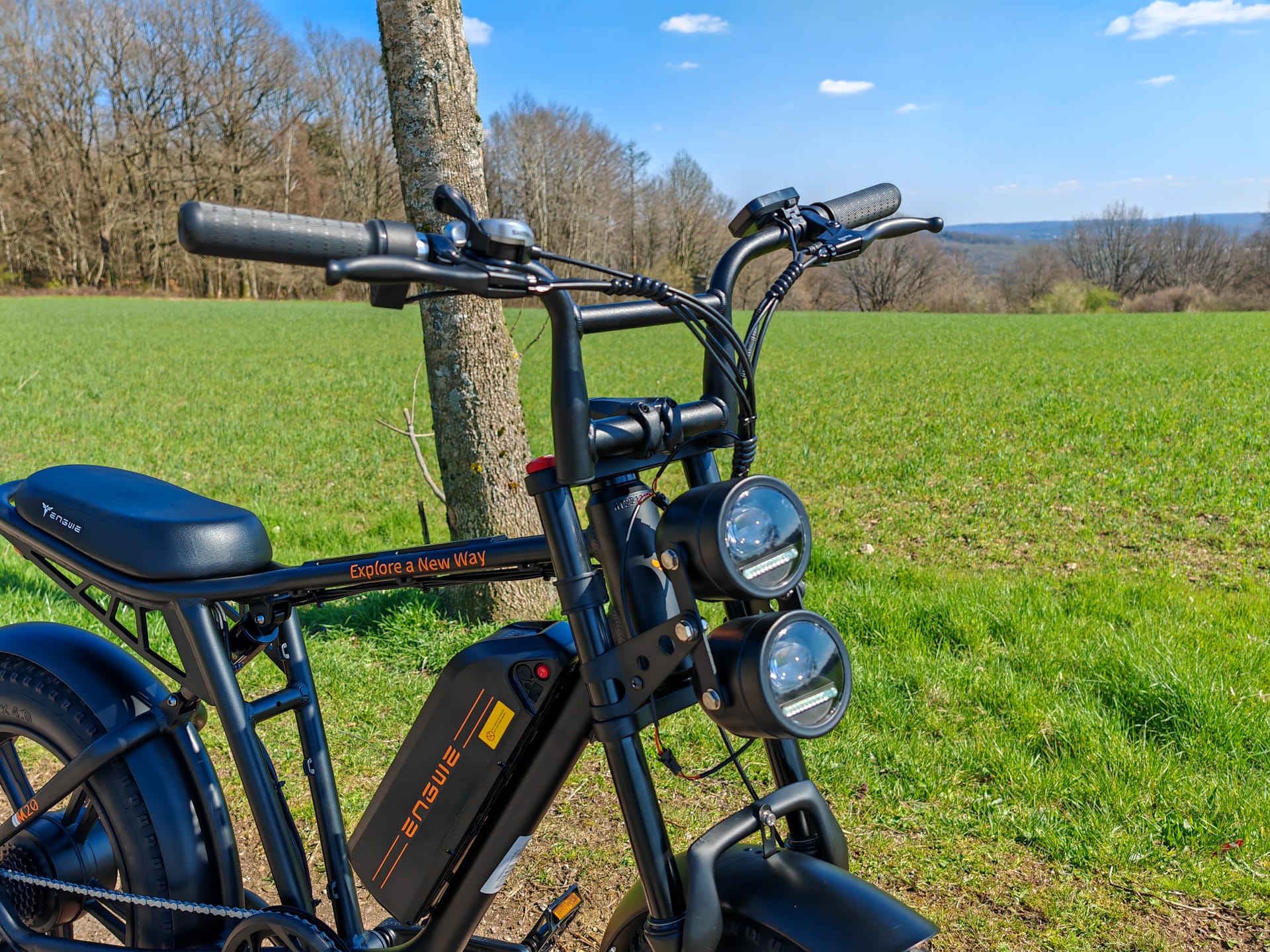
As soon as I start pedalling, the motor kicks in with a slight delay. This is characteristic of e-bikes with cadence sensors, which react less precisely than torque sensors. Similar to starting, the motor also switches off with a slight delay when pedalling stops.
On inclines, the 750-watt motor of the ENGWE M20 reveals its impressive power. The bike easily handles 20-degree gradients, although speed may decrease on steeper sections. Despite battery support, steep climbs remain a serious challenge and you should be prepared to pedal hard.
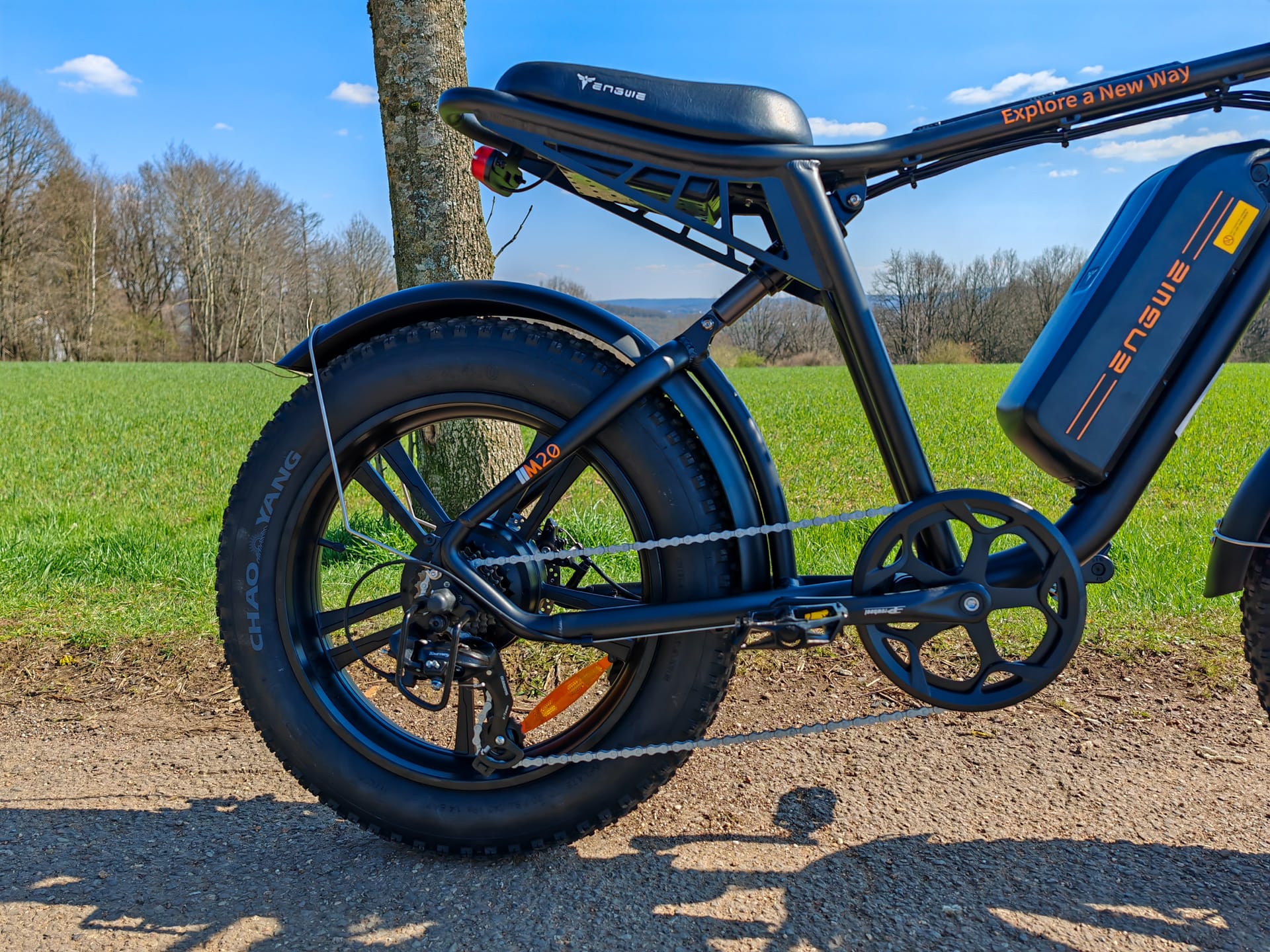
Without the speed limiter, the ENGWE M20 reveals its true potential: it reaches speeds significantly above the permitted 25 km/h. On my private test track, I achieved peak speeds of up to 40 km/h, and ENGWE itself states a possible top speed of 45 km/h. Thus, the ENGWE M20 is an e-bike that impresses not only with its appearance but also with its performance. The e-bike can be limited via the controller settings.
A potential hazard is the throttle, which is enabled by default. If you accidentally twist the throttle while getting on the e-bike, it may launch forward unexpectedly and uncontrollably. To prevent such incidents, it is advisable to set the assist level to 0 after your ride. This completely disables the motor.
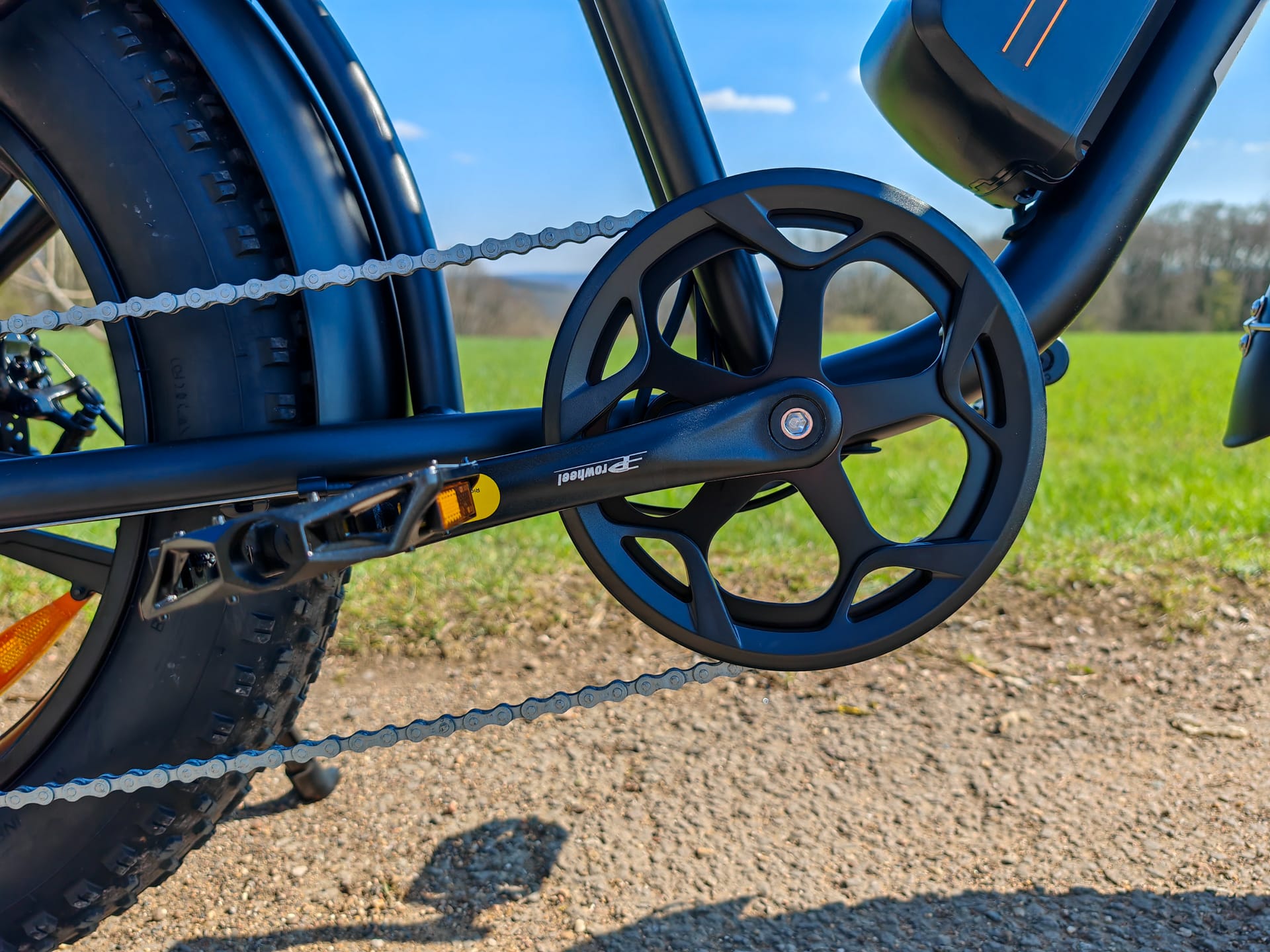
The fun you have riding the ENGWE M20 is enormous. Thanks to the wide tyres, the bike practically floats over the ground. The coarse tread provides optimal grip and although the tyres can be inflated to up to 20 PSI, I recommend settling for 11 to 12 PSI.
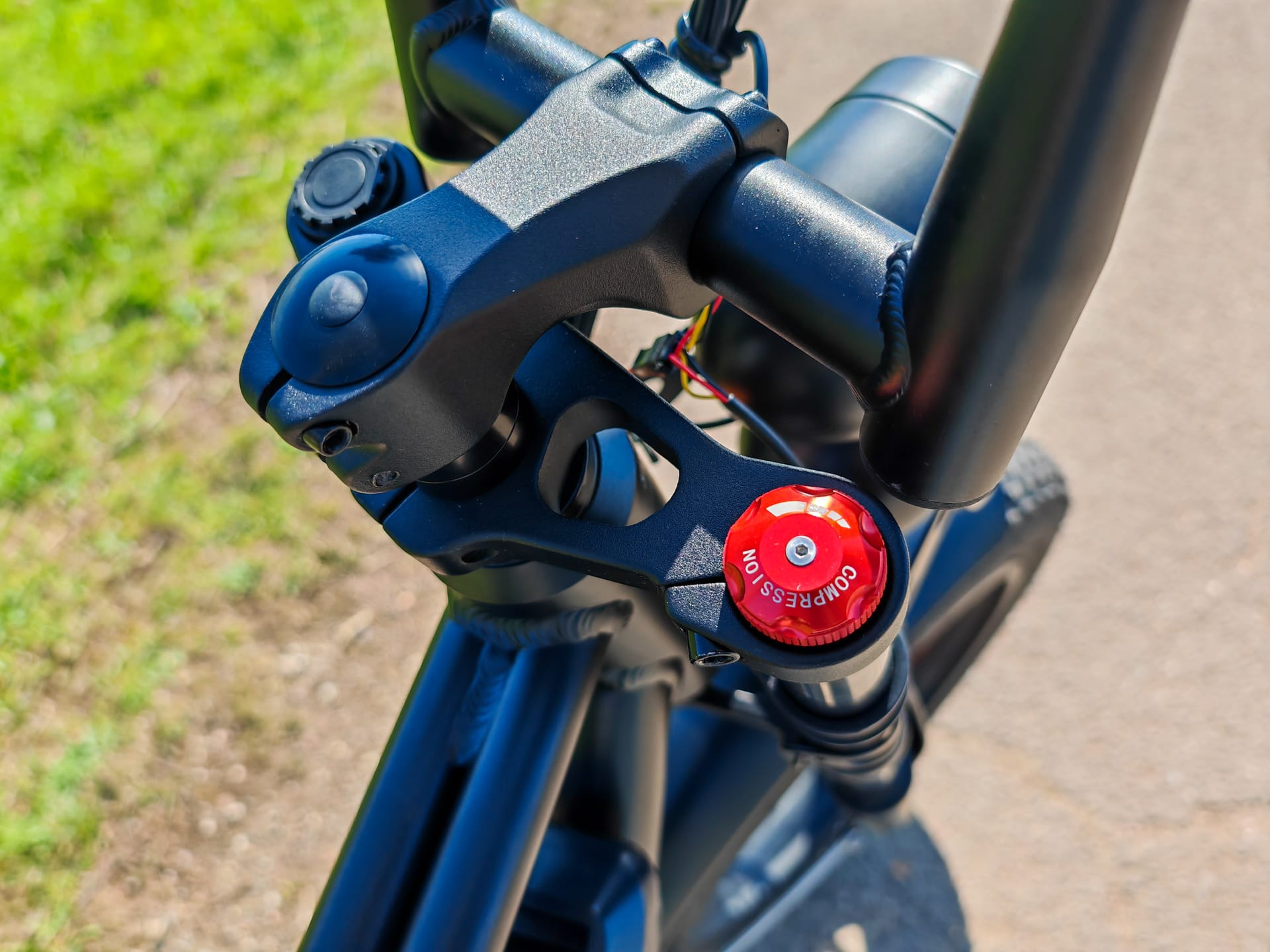
The ENGWE M20 easily absorbs larger bumps in the road. Additional comfort is provided by the suspension fork and the shock absorber on the rear frame. The compression damping can be adjusted via a knob on the right fork leg. Fully open, the travel is around 6 centimetres. This is not particularly much, but the well-cushioned tyres compensate for this and keep the riding experience smooth.
The Shimano derailleur worked reliably in our test and the gears shifted smoothly. The mechanical brakes also serve their purpose, although I would have preferred hydraulic disc brakes. In an emergency stop from 30 km/h, the e-bike stopped efficiently over a short distance.
To conclude our test, we want to take a look at the range of the ENGWE M20. According to the manufacturer, the battery should allow a range of up to 75 kilometres on the lowest assistance level, and with an additional battery it could even be up to 150 kilometres. Of course, the actual range depends on many factors, such as the terrain, the riding style or the load. And it is well known that manufacturer specifications are often based on ideal conditions.
In my test, however, I was able to cover approximately 60 kilometres before the battery needed to be recharged. This is a respectable figure, which should be sufficient for many everyday trips and even longer excursions. The ENGWE M20 thus convinces not only with its power and speed, but also with a practical range.
Our verdict
The ENGWE M20 impresses at first glance with its nostalgic moped design and impressive motor power. It offers a successful fusion of classic looks and modern technology, which is sure to appeal to lovers of both worlds.
On the positive side is the high power of the motor, which results in impressive acceleration figures. The design, which evokes memories of classic mopeds, is both appealing and functional, giving the e-bike a distinctive character.
But there are also downsides. The most significant criticism is the lack of EU certification, which means the ENGWE M20 cannot legally be ridden on public roads in most European countries. For most people looking for a means of everyday transport, this could be a decisive exclusion criterion.
Specifications
Motor
- Type
- Brushless
- Performance
- 750W
- Torque
- 55 Nm
- Speed
- up to 25 km/h (restricted)
Battery
- Type
- Lithium-ion
- Tension
- 48 V
- Charge
- 13 Ah
- Energy
- 624 Wh
- Range
- 55 - 75 km
- Charging time
- ~5 hours
Features
- Gears
- 7 (Shimano Tourney)
- Operating modes
- Manual, e-bike, (throttle when unlocked)
- Tires
- 20" x 4"
- Brakes
- Mechanical disc brakes
- Computers
- Yes
- Splash protection
- Yes
- Suspension
- Suspension fork + shock absorber
General
- Material
- Aluminium 6061
- Load capacity
- 150 kg
- Size
- 167 x 114 cm
- Weight
- 42.7 kg
Price comparison
| Store | Price | Link |
|---|---|---|
| ENGWE | 1.099,00 € | Go to store |
Comments (2)
Hello, I have a question
How do I properly charge the battery, as I can't find any reports on this? Can you help me with this? Do I need to switch it on when charging the battery or not, and why does the charger get so warm?
Is it possible to register the wheel as a 45 km/h moped and thus legally participate in traffic?
Voluntary registration like with speed pedelecs due to the THG quota previously?