
Contents
Review: Honor 9X Pro
The consequences of the US embargo imposed in 2019 hit Huawei and its subsidiary brand Honor particularly hard. Google also has to comply with the US government's tough stance, which is why all new smartphones from the Huawei Group must do without Google support.
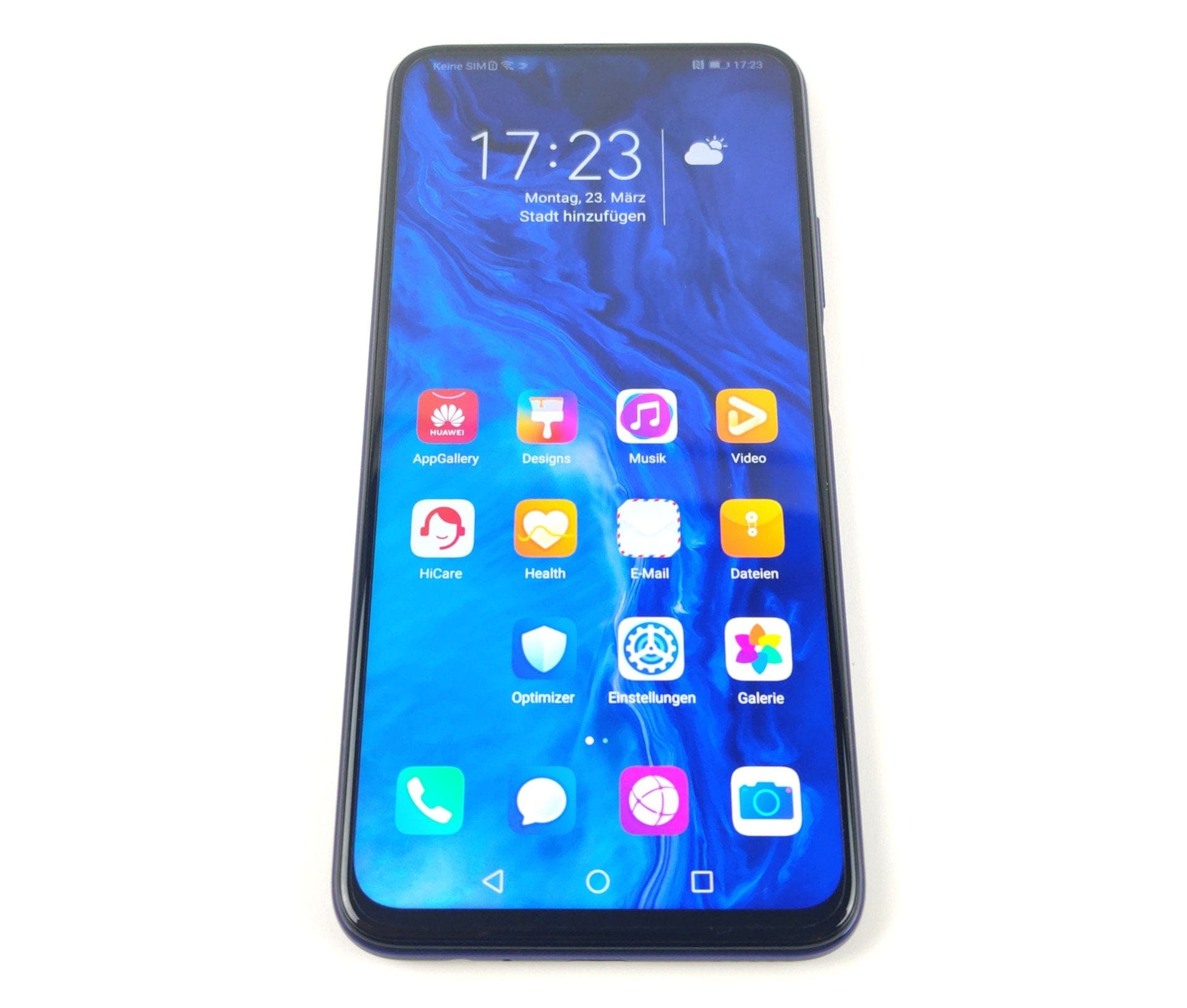
This affects not only Google and Huawei, whose business operations have been globally hindered, but also customers. Android without the Google Play Store, Google Apps and Google services is hard for many users to imagine.
Design, build quality, and included accessories
Dual-3D glass back
The Honor 9X Pro has an extravagant appearance, which is aimed primarily at a younger audience. The back is decorated with “Dual-3D Glass”. Coloured light reflections create a shimmering look on our Phantom Purple test unit, converging into an X in the centre.

The glass is slightly curved towards the sides, which again ensures a pleasant grip. An aluminium frame holds the glass back in position. Unfortunately, the gaps are somewhat large, meaning dirt easily accumulates there. There is no water protection. The smartphone is available in “Phantom Purple” and “Midnight Black”.
48MP triple camera
On the back, there is a vertically arranged triple camera in the top left. The camera consists of a 2 MP depth camera, a 48 MP main camera and a 8 MP wide-angle camera, in that order. An LED flash is located directly below the camera system.

Side-mounted fingerprint scanner
The fingerprint scanner is not located on the back nor under the display glass. Instead, it is integrated into the side power button. The position is well chosen, allowing the smartphone to be unlocked in no time. The scanner's detection rate is good, and you quickly reach the home screen.
Above it is the volume rocker. The right side of the frame is left empty. At the bottom are the USB-C port, a microphone, a 3.5 mm headphone jack and the mono speaker. At the top are another microphone, the hybrid SIM slot and the 16 MP pop-up front camera.

Notch-less display
The display of the Honor 9X Pro measures 6.59 inches diagonally. Punch-hole and notch are absent due to the pop-up front camera. The display edges are pleasantly rounded thanks to the curved glass. There is no notification LED.
Build quality and scope of delivery
The smartphone offers a pleasant key feel and feels high-quality. The substantial weight of 210 grams also contributes to this. Apart from the unsightly gap between the glass back and the aluminium frame, the build quality is impeccable.
The accessories included in the scope of delivery comprise a charger, a USB-C cable, a protective case, a SIM ejector tool and a quick start guide.

Display
Let's take a closer look at the display of the Honor 9X Pro. As already mentioned, it is a 6.59-inch LTPS IPS panel without a notch and without a punch hole. The resolution is 2340 x 1080 pixels, which corresponds to a sharp 391 DPI. The aspect ratio is 19.5:9.
Display measurement
Display measurements were carried out using a colorimeter. Testing was performed in the standard colour mode and the vivid colour mode.
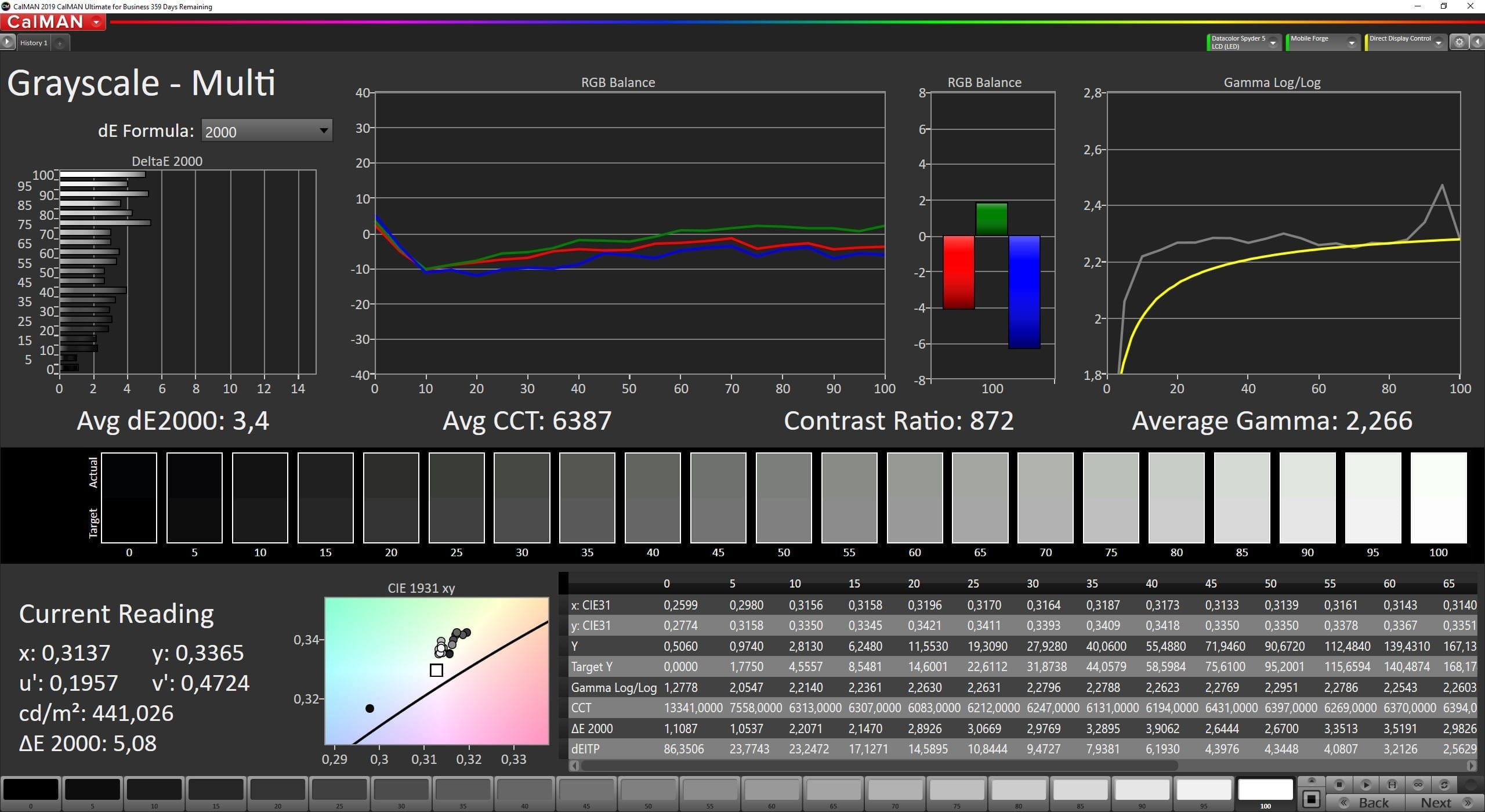

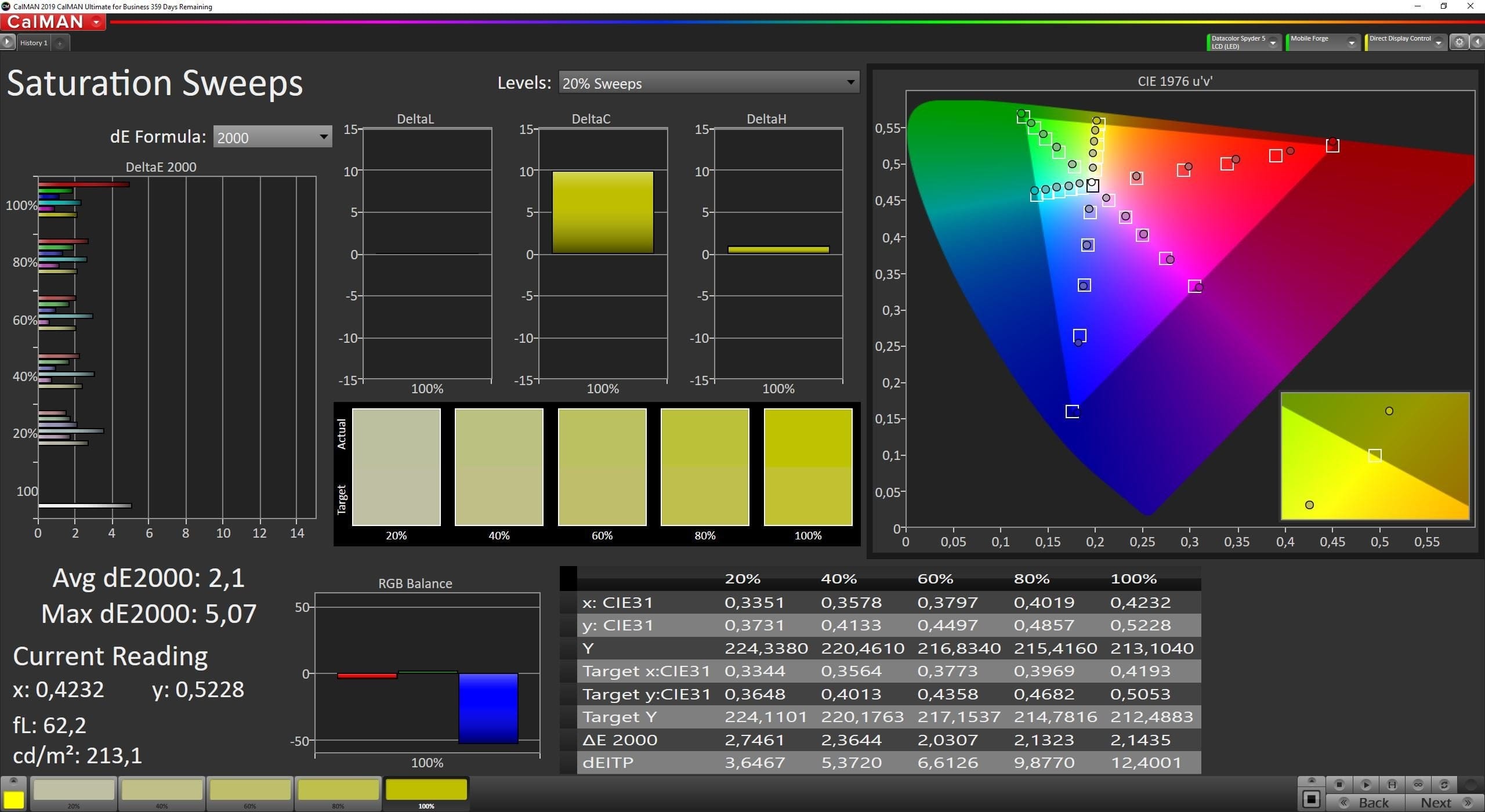
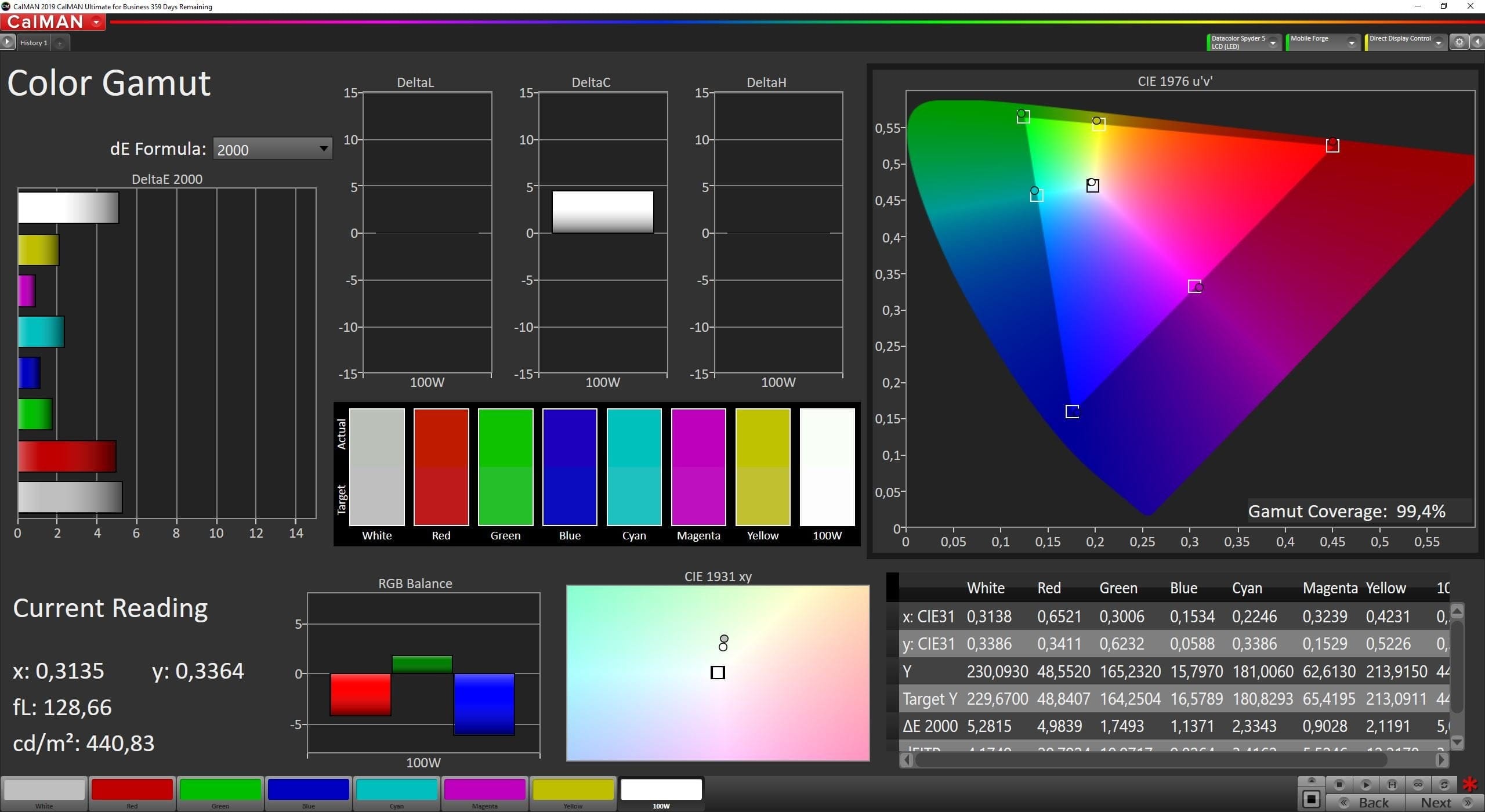
Starting with the display brightness, the maximum value is up to 515 cd/m². Across the panel, luminance varies by 12 per cent depending on the measuring point. The highest values were achieved in the upper section of the display, the lowest in the lower section. These deviations are not visible to the naked eye. On average, luminance is 491 cd/m². The contrast ratio is 1005:1.


In the standard colour mode, the Honor 9X Pro largely adheres to the sRGB colour space. Measurements showed an average Delta E of 2.58 and a maximum Delta E of 5.25. In Vivid colour mode, a high blue component is added. In this mode, deviations from the sRGB colour space are significant. Here, an average Delta E of 6.02 and a maximum Delta E of 10.98 were measured.

Display in everyday use
By default, the display is in Vivid colour mode. The high blue content, which can already be read from the display measurements, is also clearly visible to the naked eye. The display therefore delivers a cool tone with vivid colour reproduction and a glaring white tone. This matches the blue wallpaper that welcomes you after the smartphone's first start, but is extremely tiring on the eyes over time.
Display settings help to remedy this. In addition to the colour mode, the colour temperature can also be freely adjusted in 3 steps or via a colour wheel. Wide viewing angles do not lead to any change in contrast, colour intensity or sharpness. Outdoors, the display remains largely readable.
Display settings and features
In addition to the already mentioned settings for colour mode and colour temperature, there are further options affecting the display. The brightness can be adjusted manually or automatically. The brightness change in automatic brightness mode occurs without any noticeable delay.
The ‘Smart Resolution’ mode automatically reduces display resolution. Instead of FHD+ (2340 x 1080 pixels), the resolution is reduced to HD+ (1560 x 720 pixels). Users enabling this feature save power and gain extra battery minutes. There are also settings for sleep mode, font and display size, and full-screen display. An eye-friendly blue light filter is naturally also included.
Touchscreen
The touchscreen recognises a maximum of 10 simultaneous inputs. Input detection is precise. The type of display glass used is unknown. A particularly thin screen protector is fitted from the factory.
Performance
HiSilicon Kirin 810
Setting aside the Chinese Honor 9X, the Honor 9X Pro is the first Honor smartphone with a HiSilicon Kirin 810 mobile processor. The mid-range system-on-chip from Huawei is manufactured using a 7nm process and is a clear upgrade compared to the Kirin 710.
The CPU features eight processor cores, divided into 2 Cortex-A76 (2.27 GHz) and 6 Cortex-A55 (1.8 GHz) cores. The GPU is a Mali-G52. This is accompanied by 6GB or 8GB LPDDR4X RAM and 128GB or 256GB UFS 2.1 storage. If more storage is required, it can be expanded via a microSD card.
Benchmark
Running standard benchmarks on the Honor 9X Pro quickly reveals that the smartphone is equipped with one of the currently fastest mid-range system-on-chips. To provide some figures, it achieves 304,144 points in the AnTuTu benchmark. Only the Qualcomm Snapdragon 765G is slightly faster, with approximately 320,000 points. The memory installed by Honor is also fast. Our 6+256 GB test device achieves RAM speed of just under 22 GB/s. The UFS2.0 data storage reaches speeds averaging 450 MB/s for reading and 180 MB/s for writing.


Performance in everyday use
Without initially looking at the lack of Google support, the Honor 9X Pro does not have to hide behind more expensive smartphones in everyday use. Although the smartphone does not offer performance reserves like a high-end device, it is sufficient to run all current apps and games smoothly.
Multitasking works smoothly and the smartphone is generally fluid to operate. Apps remain in memory over the long term and are available instantly when switching frequently. Even when launching an app for the first time, long loading times are not to be expected. The combination of a powerful processor and fast storage types shows what it can do not only in benchmarks but also in everyday use.
Gaming
Demanding mobile games run smoothly on the Honor 9X Pro. High-resolution textures can be enabled without concern for most games. A liquid cooling system prevents thermal throttling, ensuring consistent performance. After half an hour of PUBG, a demanding game that can challenge a smartphone, the maximum measured temperature was 35°C.
User interface
Smartphones from Honor use the so-called EMUI user interface. Unlike stock Android, the user interface is heavily modified and expanded with numerous features. Despite this, the design remains minimalist and operation comfortable.


The problem with updates
Although Huawei had its Android licence revoked, EMUI is still based on Android. Specifically, it is based on the Android Open Source Project (AOSP), which is not affected by this restriction. Huawei also receives system updates and security patches via AOSP. However, new system versions and security patches are integrated into the open source code with a time delay, which is why users have to wait longer for updates here. This is also evident in the Honor 9X Pro, whose EMUI 9 is based on Android 9 and only uses security patches from 1 November 2019 (as of April 2020). Whether the smartphone will receive a system update to Android 10 at all remains to be seen.
The Problem with the Apps
Another limitation is the lack of Google apps and Google Play services. It is not possible to simply download an app from the Google Play Store. Instead, Huawei has developed its own apps and its own app store. However, the so-called Huawei AppGallery cannot compete with the Play Store. The selection of apps is (still) very limited, and the store overall has room for improvement. Frequently used apps such as WhatsApp, Facebook or Instagram are missing. Although these apps can be installed manually via APK, you have to painstakingly search for them online, and it is not uncommon to end up downloading the app from an untrustworthy source. It remains to be seen how the AppGallery will continue to develop.
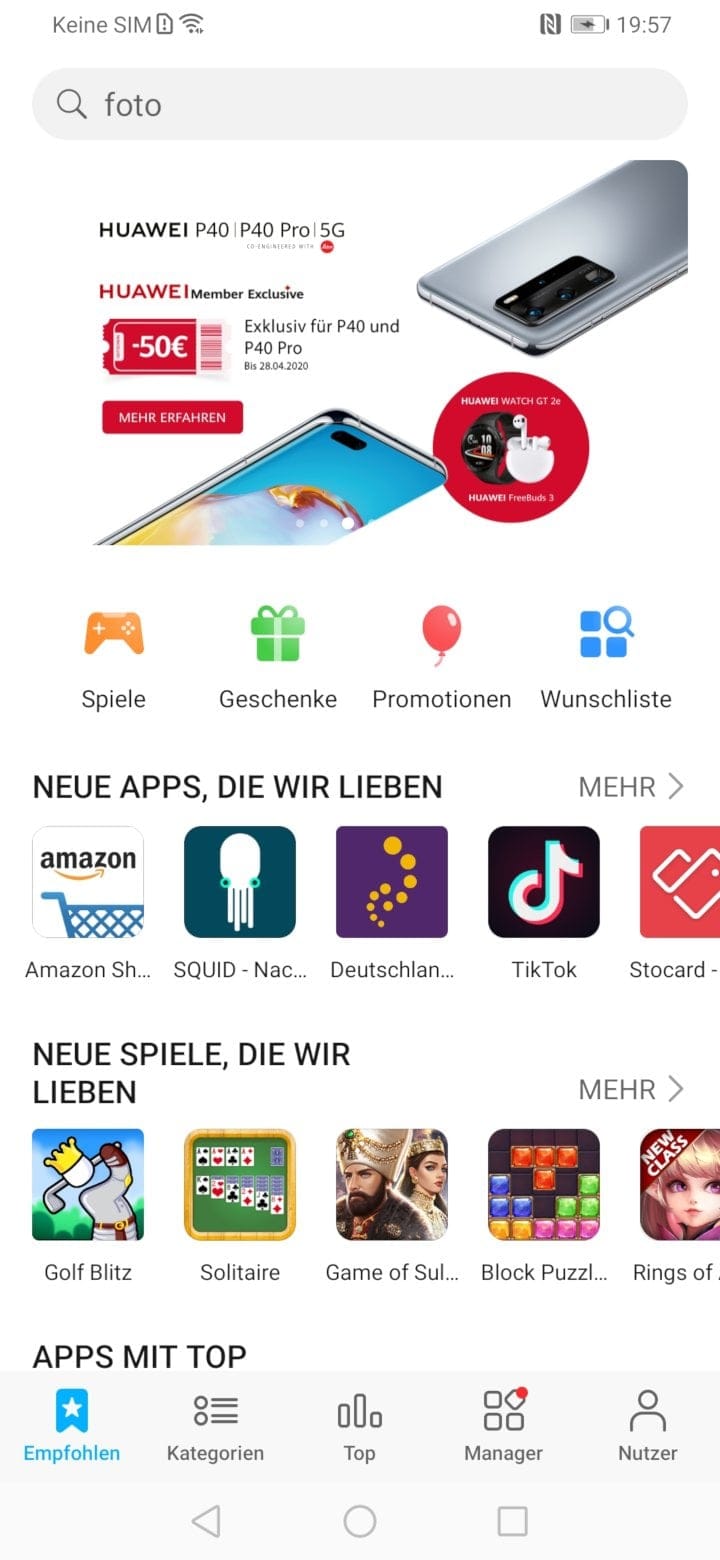

More serious are the missing Google Play services, which are required by many apps. This also includes non-Google apps. If, for example, you want to stream Netflix, you will fail due to Google's Widevine DRM, the support of which Netflix requires. The same applies to many other apps. If an app developer uses Play services in their app, it will not run on the Honor 9X Pro. Instead, the developer would have to offer an additional app free of Play services.
Google Play Store via workarounds
It is possible to get Google apps and the Google Play Store on the smartphone via workarounds. Numerous guides online explain exactly how this works. We will not go into detail here.
There are many ways to reach the goal, but one should bear in mind that this is a cat-and-mouse game. No one guarantees that the “Google modification” will last. Furthermore, one relies on unofficial installation packages, where one never knows exactly whose hands they have passed through.
Camera
The rear triple camera of the Honor 9X Pro consists of a 48 MP Sony IMX582 main sensor with an f/1.8 aperture, an 8 MP sensor with ultra-wide lens and a 2 MP depth sensor.
The 48 MP main sensor utilises Quad-Bayer technology. This combines four pixels into one, resulting in higher colour resolution per pixel. At the same time, the image resolution is reduced to 12 MP. The sensor of the pop-up front camera has a resolution of 16 MP and uses an f/2.2 aperture.
Main camera real-world test
12 MP recordings
In normal photo mode, photos can be taken at 12 MP, 48 MP and 48 MP AI Ultra Clarity. The 12 MP mode is active by default.





The test images are convincing due to vivid colour reproduction and a good dynamic range. HDR mode rarely needs to be activated. A weakness is the image sharpness, which is not always consistent. The main camera is quickly overwhelmed, especially with fine structures. Details tend to appear muddy due to strong noise reduction. The camera AI reacts quickly and identifies the subject in most cases.
48 MP AI Ultra Clarity
In 48 MP AI Ultra Clarity mode, it takes approximately 5 seconds until the shot is captured. To get a pristine photo, you must hold as still as possible during the capture. Furthermore, this mode only works under really very good lighting conditions. Unlike the 12 MP mode, the shots are indeed more detailed.


Zoom and wide-angle
Without a telephoto lens, optical zoom is also not possible. Zooming here is purely digital. With a 2x zoom, fine details in the image are still clearly visible. Photos remain pleasingly sharp. As zoom increases, image detail diminishes. Shots with a 10x zoom are barely usable.



The 8MP wide-angle shots are acceptable. Unlike the standard photo mode, the dynamic range is slightly lower, details are weaker, and lens correction causes visible blurring towards the edges.
Portrait mode
The portrait mode works somewhat imprecisely. In most cases, the portrait mode separates people or objects cleanly from the background. However, details such as hair are often affected by the blur effect. In addition to the standard blur effect, there are 7 other effects (hearts, circles, etc.) to choose from.


Night shots
In poor lighting conditions, the Honor 9X Pro can take detailed, sharp and vibrant photos. Provided you have a steady hand. Due to the lack of image stabilisation, even slight shakes quickly lead to blurry shots.


A special night mode is available. In this mode, the smartphone takes multiple consecutive photos with different settings and automatically combines them into a single image during post-processing. Shake is more forgiving in this mode, and details are rendered more effectively.
Video mode
The smartphone records videos in a maximum Full HD resolution. That's right, there is no 4K mode! The frame rate can be switched between 30 and 60 frames per second in the settings. At 30 frames per second, an electronic image stabilisation is active by default and cannot be disabled. Details are somewhat lost as a result.
More detail is achieved at 60 frames per second. In this mode, image stabilisation is not active. Overall, the recorded videos are convincing due to pleasing sharpness, good colour reproduction and sufficient detail. The audio quality is good.
Front camera practical test
The 16 MP pop-up front camera is capable of taking good selfies. However, it takes a moment for the camera to emerge from its hiding place and be ready for a quick snapshot. Selfies taken with the Honor 9X Pro are particularly convincing due to their natural colour rendition.


A portrait mode is available, but like the main camera, it struggles with detail extraction. One should also pay attention to the beauty filter. It is active by default at level 5 and leads to an unnatural softening effect. In the settings, the beauty filter can be completely disabled or increased to level 10. The front camera records videos in 1080p or 720p.
You can find these and other test shots in full resolution via this link.
Connectivity
Telephony
The Honor 9X Pro has a hybrid SIM slot. The smartphone can be equipped with two nano-SIM cards or one nano-SIM + microSD memory card. The 2G, 3G and 4G mobile radio bands common in Germany are available. Here is an overview:
GSM: B2/B3/B5/B8
WCDMA: B1/B4/B5/B8
LTE FDD: B1/B3/B8/B20/B28
LTE TDD: B38/B40/B41
However, the smartphone is not suitable for worldwide use because some country-specific bands are missing. LTE is supported on both SIM slots. VoLTE and VoWiFi or Wi-Fi calling unfortunately did not work during testing.
The reception quality is solid. The smartphone has strong reception and enables good mobile network reception even in areas with poor coverage. The voice quality is clear and speech is transmitted intelligibly in both directions. The noise-reducing microphones do an excellent job of blocking out background noise.

Wi-Fi and Bluetooth
Fast Wi-Fi connectivity is achieved via Dual-AC WiFi. Data throughput in immediate proximity to the router is 270 Mbit/s. Reception remains largely stable through several walls. Bluetooth is only available in version 4.2. In a Bluetooth network, the smartphone behaves unobtrusively and convinces with good transmission quality.
GPS and sensors
The smartphone finds a GPS fix in no time. Location determination is precise. During an hour-long test navigation, there were no significant deviations. Direction changes are quickly recognised by the e-compass. In addition to the usual smartphone sensors, the Honor 9X Pro also offers NFC. Mobile payment is fundamentally possible. However, users of Google Pay are left out in the cold.
Audio
The mono speaker delivers average sound. Weaknesses are apparent in the bass and treble, which are somewhat lacking. For quickly playing a song or watching a video, the Honor 9X Pro's speaker is more than sufficient.
Honor has not omitted the 3.5 mm jack socket despite the USB-C port. There is nothing to criticise about the playback quality via both connections.
Battery
The Honor 9X Pro battery has a capacity of 4000 mAh. In our test, we achieved a continuous screen-on time of 14 hours at medium display brightness. If the smartphone is used rather average for calls, web browsing and social media, the battery needs to be recharged every 1 ½ days. Under intensive use, it lasts only one day.
Using the supplied charger, the battery is charged by approximately 55 percent in one hour. A complete charging process takes two hours. Contactless Qi charging is not supported.
Our verdict
The Honor 9X Pro is visually and technically a decent mid-range smartphone. The lack of Google support is, however, a hurdle that is almost insurmountable for Honor. Most Android users have become so accustomed to Android with Google that they no longer want to do without the usability of Google services.
This is not achieved by Huawei's AppGallery either, which the Huawei Group promotes as a "new user experience". At least at this point in time, the AppGallery is still very much in its infancy.
How Huawei's and Honor's independence will develop in the coming months remains to be seen. Anyone who wants to follow this development live and is not bothered by the lack of Google support gets a lot of performance for little money with the Honor 9X Pro.
Specifications
Processor and memory
- CPU
- HiSilicon Kirin 810
- GPU
- Mali G52
- RAM
- 6GB / 8GB (LPDDR4x)
- Internal storage
- 128GB / 256GB (UFS2.1)
- Storage expansion
- Yes (Hybrid)
Display
- Display size
- 6.59 inches
- Display resolution
- 2340 x 1080 pixels
- Display type
- LTPS IPS
- Screen protector
- Unbekannt
- Multitouch
- 10 fingers
Cameras
- Main camera
- 48 MP Sony IMX 582 (f/1.8 aperture)
- Ultra-wide angle
- 8 MP (f/2.4 aperture)
- Depth sensor
- 2 MP (f/2.4)
- *AI mode
- *PDAF (autofocus)
- *LED flash
- Front camera
- 16 MP (f/2.2 aperture)
Mains
- Dual SIM
- Yes
- SIM size
- Nano SIM
- eSIM
- No
- GSM
- B2/B3/B5/B8
- WCDMA
- B1/B4/B5/B8
- LTE FDD
- B1/B3/B8/B20/B28
- LTE TDD
- B38/B40/B41
Wireless
- Wi-Fi
- 802.11 a/b/g/n/ac
- Bluetooth
- 4.2
- GPS
- Yes
Sensors
- *Ambient light sensor
- *Accelerometer
- *Proximity sensor
- *Hall sensor
- *E-compass
- *Gyroscope
- *Fingerprint sensor
- *NFC
Battery
- Battery
- 4.00 mAh
- Fast charging function
- No (10 watts)
- Qi charging
- No
Other
- Operating system
- Android 9 (EMUI 9)
- Connection
- USB-C, 3.5 mm audio
- Size
- 163 x 77 x 9 mm
- Weight
- 210g
What’s included
1x smartphone, 1x SIM pin, 1x charging cable, 1x charger, 1x protective case, 1x user manual
Price comparison
| Store | Price | Link |
|---|
Comments (8)
Thanks for the great test. The Honor website now states that the smartphone will be available from tomorrow. I am still torn between this one and the Redmi Note 9S. Which one would you recommend?
Hey Eugen, I'm glad to hear that. And thanks for the tip. I hadn't tested the Redmi Note 9S yet, so I can only refer to the datasheet. The Honor 9X Pro has more power. The question you should ask yourself is whether you can manage without Google. If so, I personally tend towards the Honor. Otherwise, check out the new Realme smartphones. They offer a lot in this price range.
Thanks Timo, you helped me a lot. It ended up being the Honor after all. It was released today and I got it on offer at HiHonor.
You can watch Netflix on the Honor 9X Pro. This works on all Huawei devices without Google if you install the app manually.
Hi Thez, that is correct, however Netflix is (still) not officially supported. Due to the missing Widevine LV, Netflix can only be streamed in SD quality. It is therefore worth waiting to see whether Netflix will develop its own app for AppGallery.
Hello, I bought the smartphone during the last promotion. Thez mentioned that Netflix can be installed there. Can anyone tell me how that works?
Hey Stefan, you need to install the Netflix APK "manually" on your smartphone. There are various (more or less reputable) app store alternatives online through which you can download apps as APKs. Whether the app can then be installed in a functional state on your smartphone is another matter. We'll take a look at APK Pure. This is one of those app store alternatives. Search for Netflix there and try until you find a functional APK.
Thanks, the tip with APK Pure worked. I can now watch Netflix on my smartphone. 🙂