
Contents
Preface: Xiaomi Mi Max 3
The term “phablet” describes smartphones that could pass as tablets due to their oversized displays. Since 2016, Xiaomi has maintained a phablet series under the name “Max”, which is particularly popular in Asia.
Design, build quality, and included accessories
The Mi Max 3 is definitely not a smartphone for small hands. The device, featuring a unibody design and largely made of metal, stands a substantial 176.15 mm tall and is 87.4 mm wide. At a thickness of just 7.99 mm, the handheld is relatively slim. The weight is also kept pleasingly low at just 221 g.

The smartphone is structured as follows:
The front is dominated by the 6.9-inch display. This means the display has grown by another 0.46 inches compared to last year's Xiaomi Mi Max 2. The casing has not grown. To accommodate the larger display, Xiaomi has reduced the display bezels and removed the capacitive buttons. Control is instead via virtual on-screen buttons. Features on the front include the front camera with LED flash and a notification LED, which, however, only lights up in white.
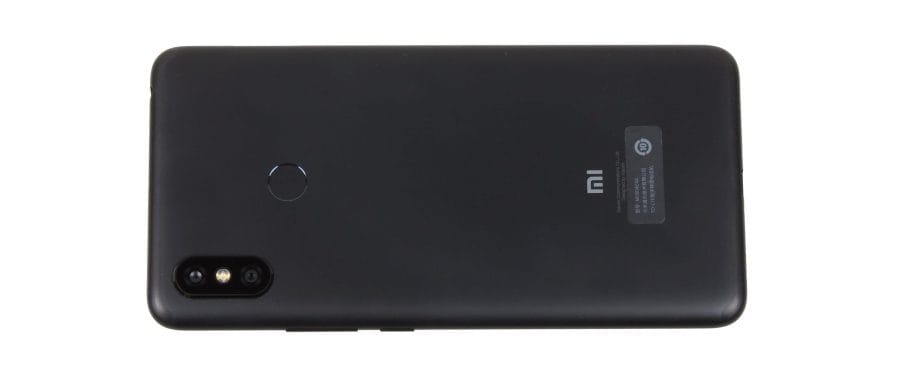
Due to the unibody design, the housing frame and the back panel are not separate but manufactured from a single piece. The front panel is offset by approximately 1 mm from the rest of the housing. The frame edges are rounded and transition seamlessly into the back panel. The left side of the housing frame includes the power button and volume rocker. On the opposite side is the dual-SIM slot, which can accommodate two Nano-SIM cards or one Nano-SIM and a MicroSD memory card. The Xiaomi Mi Max 3 connectivity options consist of a USB-C port and a 3.5 mm jack audio port. Additionally, an infrared transmitter is located on the top edge.

The layout of the back is comparable to the recently tested Xiaomi Mi A2. In the top left is the vertically arranged, slightly protruding dual main camera with the centrally located LED flash. A circular fingerprint scanner is located in the middle of the upper third of the back. The antenna bands made of plastic are unobtrusively integrated into the back.
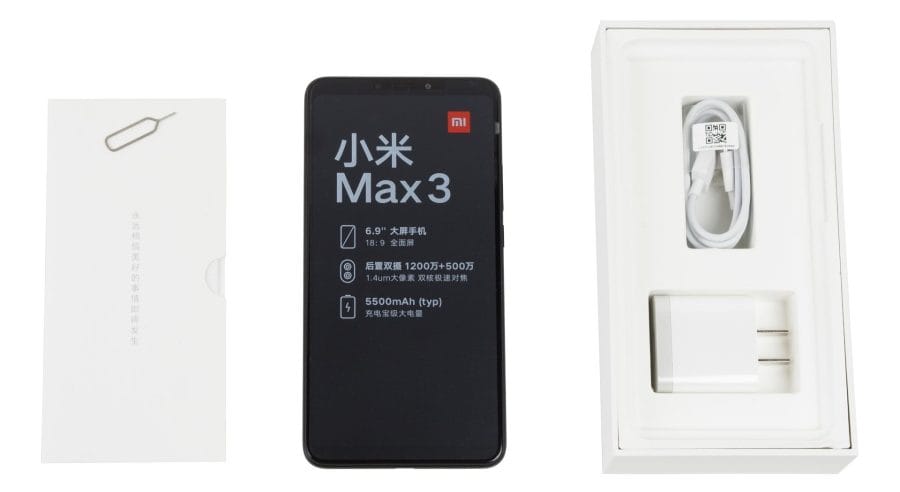
The Mi Max 3 is excellently built and feels comfortable in the hand despite its size. The delivery contents include, in addition to the smartphone, a fast charger (5V 3A – 9V 2A – 12V 1.5A), a USB-C cable, a SIM pin and a user manual. A protective case and screen protector are not included.
Display
The Xiaomi Mi Max 3's display is of the IPS type and resolves at a diagonal of 6.9 inches with 2160 x 1080 pixels. Thus, the display has an aspect ratio of 18:9 and a pixel density of 350 DPI.
Display measurement
Display measurements conducted with a colorimeter revealed, among other things, a maximum luminance of 475 cd/m². Xiaomi itself specifies the display with a luminance of 520 cd/m². The uniformity deviates by up to 45 cd/m² from the centre of the display to the edges.
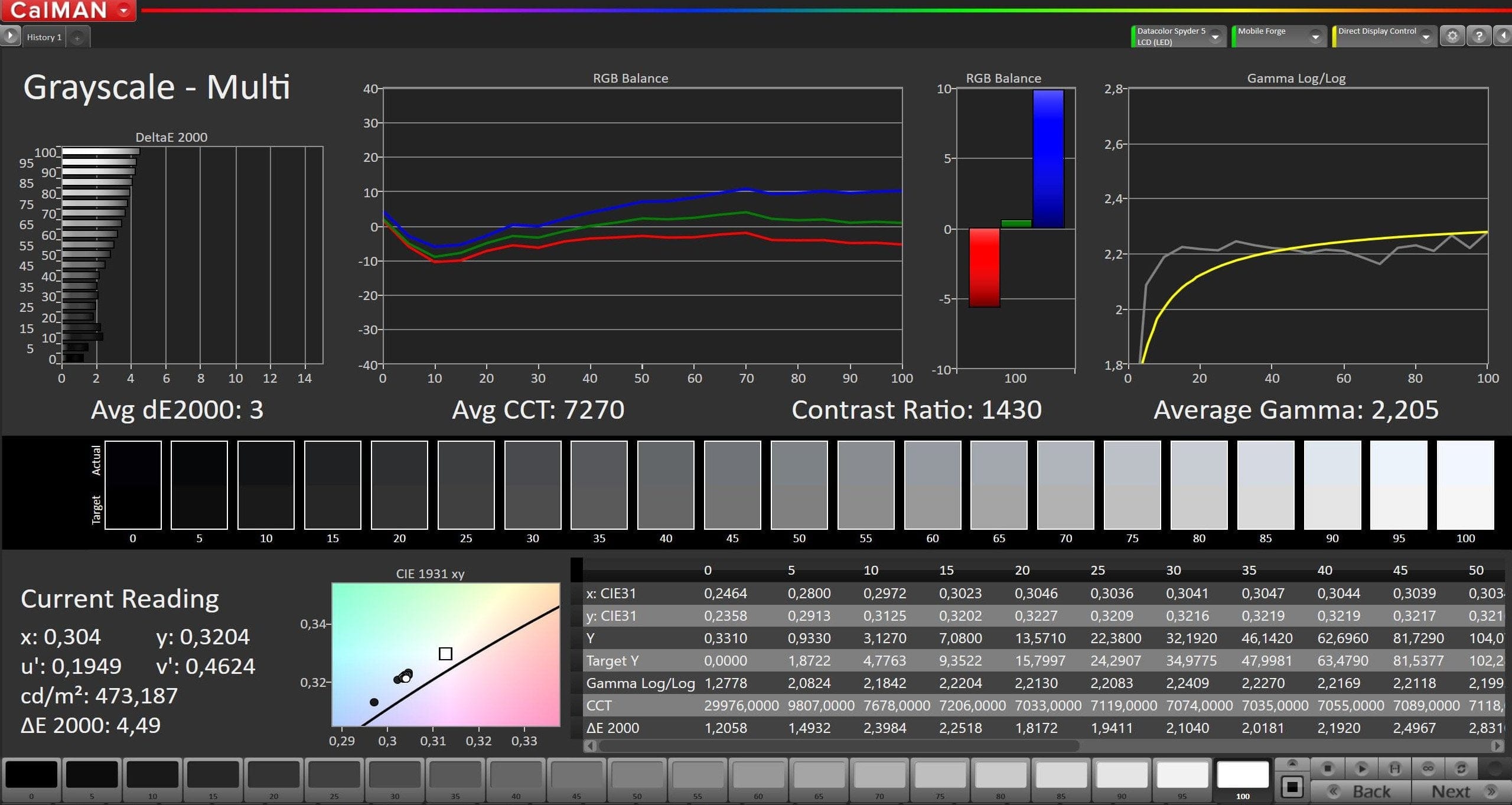

The black level of 0.33 cd/m² and the contrast ratio of 1,430:1 are appropriate for the price class. There are deviations in the colour and grey scale representation with an average DeltaE of 3.8 and a maximum DeltaE of 6.4. Due to the reduced red component and increased blue component, the colour temperature is rather cool. In particular, greys appear predominantly bluish-grey.


Display in everyday use
In everyday use, the display performs well. The image is extremely sharp despite the large display diagonal, so individual pixels are not visible to the naked eye. Outdoors, especially in sunlight, the display remains easy to read. Only the slightly reflective display glass can impair readability under direct light. It is also notable how much the display brightness can be reduced. Particularly in the dark, the display remains comfortably readable even at significantly reduced brightness.
The viewing angle stability is also faultless. The display remains stable even at flat viewing angles. The brightness deviation resulting from the display measurement is not noticeable in everyday use.
Display settings and features
Display settings are relatively extensive. In addition to manual and automatic brightness adjustment, there are night and reading modes that filter blue light. There are also advanced colour and contrast adjustment options with three colour profiles, as well as a text size adjustment feature.
Touchscreen
The touchscreen recognises a maximum of 10 simultaneous inputs. Detection accuracy is averagely good. Peculiar ghost touches do not occur. The display is protected by an unspecified hardened protective glass. A special coating reduces fingerprints and improves glide.
Performance
Qualcomm Snapdragon 636
Like in the Xiaomi Redmi Note 5, the Xiaomi Mi Max 3 uses a Qualcomm Snapdragon 636 system-on-chip (SoC). The CPU of this mid-range SoC operates with 8 Kryo 260 processor cores, clocked at up to 1.8 GHz. The graphics unit is an Adreno 509 GPU.


The smartphone is available in two storage sizes. Depending on the model, it comes with 4GB or 6GB LPDDR4X dual-channel RAM and 64GB or 128GB eMMC5.1 storage. Storage expansion via microSD card is possible, but requires giving up the second SIM slot.
Benchmark
The benchmark results are unremarkable and match those of other smartphones with identical specifications. The AnTuTu benchmark achieved a mid-range score of 119,097 points. The storage speeds are equally appropriate. Our test unit with 4+64GB storage reached an average 5.8 GB/s RAM speed and 210 MB/s write and read speed after several measurement runs.


Performance in everyday use
The Xiaomi Mi Max 3 shows no weaknesses in everyday use. The system is consistently smooth to operate. Apps start without delay and performance does not noticeably drop during multitasking. Thanks to the generous amount of RAM, already opened apps are kept in memory for longer and are available on demand. The system also renders web pages quickly, scrolling runs largely without stuttering and animations are displayed smoothly.
Gaming
Although the Mi Max 3 is not a high-end smartphone, it is certainly suitable for current mobile games. Graphically demanding games, such as PUBG or Asphalt 9, are playable smoothly. For some, however, it is advisable to choose medium graphics settings. While delays from the speaker do not remain, occasional frame drops can occur. The temperature reached after 30 minutes of PUBG was 37°C at the warmest point. A reduction in processor performance does not occur.

User interface
The smartphone ships with MIUI 9, based on Android 8.1. Since October, an update to MIUI 10 Stable has been available, although it is still based on Android 8.1 rather than Android 9. System updates and security patches are distributed regularly over-the-air (OTA).
In terms of functionality, MIUI is far from stock Android. Many features that are otherwise only available via additional apps are already integrated into the system. Among other things, a security centre is integrated, which allows obsolete data to be cleared, monitors battery consumption and allows apps to be protected with a password. Many of the pre-installed apps come directly from Xiaomi. The most important Google apps, including the Google Play Store, are also pre-installed on the smartphone.


Another feature of MIUI is the “Second Space”. If, for example, you want to separate business and private life, the Second Space allows you to create independent user accounts. In addition, apps can be duplicated, so that multiple user accounts can use one app.
Camera
The rear main camera is identical to the main camera of the Xiaomi Redmi Note 5. It features a 12 Megapixel Samsung S5K2L7 image sensor with 1.4 μm pixel size and f/1.9 aperture, as well as a 5 Megapixel Samsung S5K5E8 sensor with 1.12 μm pixel size. The secondary sensor is a pure auxiliary sensor that enables the so-called "bokeh effect". The 8 Megapixel front camera also comes from Samsung. The image sensor is a Samsung S5K4H7 with an f/2.0 aperture.
Main camera real-world test
Photo mode
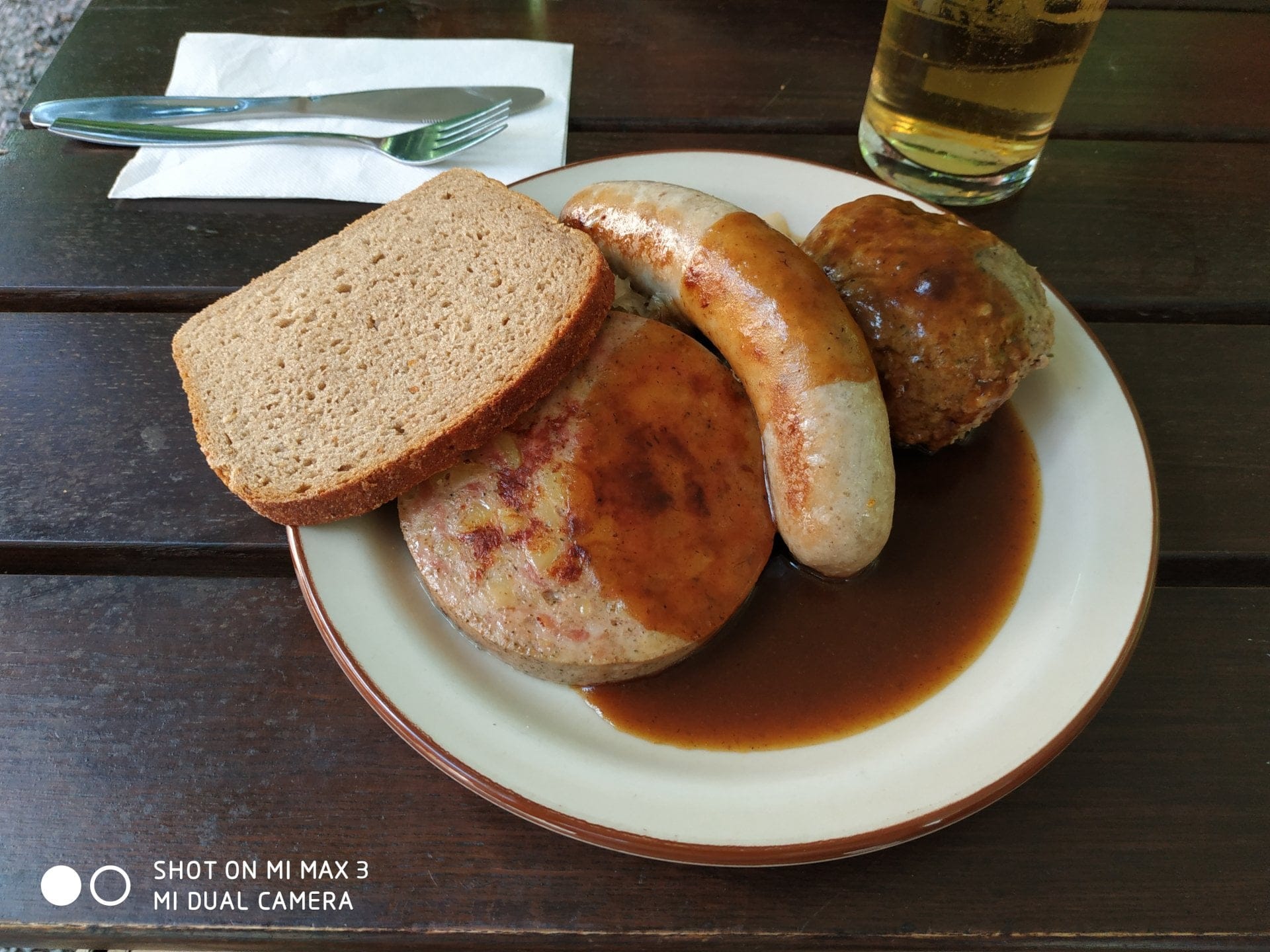
In direct comparison with the Xiaomi Mi Max 2, recording quality has improved significantly in both good and poor lighting conditions. Photo shots are tuned to look very natural in terms of colour. The motif in focus is depicted sharply, and details as well as fine structures are well preserved. Only more distant objects appear somewhat blurred and with reduced detail. Imaging errors in the form of chromatic aberration can occasionally occur, but are rather rare.





Dynamic range and HDR
The dynamic range is, as is often the case with smartphone cameras, rather narrow. Nevertheless, the Xiaomi Mi Max 3 copes well with high-contrast scenes and represents bright and dark areas in a balanced manner. An automatic HDR mode is available. The mode activates automatically according to the scene, but frequently delivers colour-distorted and unnatural results.


Low-light conditions
Recording quality deteriorates with increasingly poor lighting conditions. Details are lost, colours are slightly distorted and image noise increases. The HHT (Handheld Twilight) function stored in the MIUI Camera App is intended to improve recording quality at night. The emphasis is on *is intended*. The test showed no difference between the activated and deactivated HHT modes.

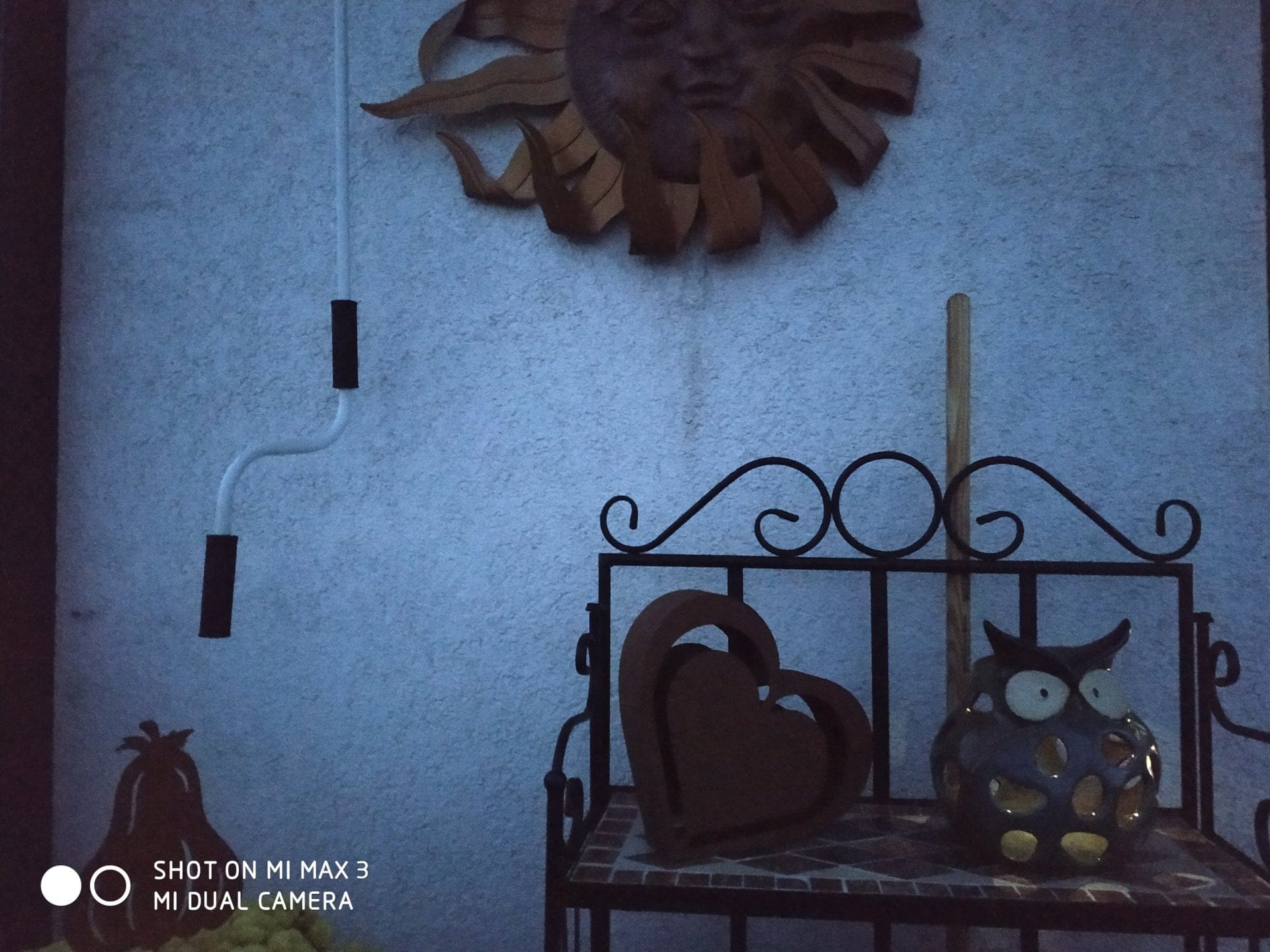
The HDR mode is what can improve capture quality in the dark. If you also enable this, colours are displayed less faded and image noise is also reduced.
Zoom
There is no loss-free telephoto zoom. Instead, a maximum 8x digital zoom is possible. Consequently, the zoom is limited in terms of image quality. Already from 2x magnification, the enlarged image is slightly blurry, with fine details being particularly lost.



Bokeh and AI
The portrait mode of the Mi Max 3 is very well implemented. In particular, people are cleanly isolated in the foreground. Complex objects are extracted less cleanly, so errors in the blur effect may occur here. The AI scene mode was not yet available at the time of testing and will only be fully implemented with MIUI 10.
Video mode
The MIUI Camera app allows video recording in 720p, 1080p and 4K. The 4K frame rate is limited to 30 frames per second. Up to 60 frames per second are possible at 1080p. The recording quality in video mode largely matches the photo capture quality. Video recordings are well colour-balanced. However, the colours appear slightly more saturated in 1080p recording mode than in 4K mode. In return, the level of detail in 4K mode is significantly higher and the image is sharper overall. The autofocus (Dual-Pixel) works quickly and precisely.
An electronic image stabilisation (EIS) is present. In 4K recording mode, however, the stabilisation has no effect. Here, it is recommended to switch to the Open Camera app, which stabilises 4K recordings cleanly. The audio is recorded in stereo (bitrate 96 kbit/s) and sounds clear and clean.
Front camera practical test
The 8 megapixel front camera produces acceptable photo and video recordings. However, some recordings are strongly overexposed and have distorted colours. With increasingly poor lighting conditions, increased image noise also becomes noticeable. At least there is a front LED flash that illuminates the subject evenly. Focusing is not possible due to the fixed focus. Videos are recorded in a maximum of 1080p at 30 frames per second.


Numerous beauty filters artificially enhance the selfies taken. In addition to various smoothing effects, the MIUI camera app offers an extended beauty mode that makes the face appear slimmer, enlarges the eyes and alters skin tones.
Connectivity
Telephony
Both the Chinese and global versions of the Mi Max 3 come with identical cellular support. All 2G, 3G and 4G cellular bands common in Germany are included. Here is an overview:
- GSM: B2, B3, B5, B8
- CDMA 1X / EVDO: BC0
- WCDMA: B1, B2, B5, B8
- TD-SCDMA: B34, B39
- TDD-LTE: B34, B38, B39, B40, B41 (120 MHz 2535-2655 MHz)
- FDD-LTE: B1, B3, B4, B5, B7, B8, B20
However, the smartphone is not suitable for worldwide use because some country-specific bands are missing. LTE is supported on both SIM slots. VoLTE is available and can be switched between the slots. VoWiFi or WiFi Calling is not supported.
Reception quality has positive aspects to report. The smartphone has very strong reception and enables sufficient mobile reception for calls and mobile browsing even in areas with poor signal strength where other smartphones struggle. Voice quality is good. The earpiece reproduces speech clearly. Only at maximum volume does the earpiece tend to slightly distort. The noise-reducing microphones effectively block out interference.
Wi-Fi and Bluetooth
The Mi Max 3 is equipped with a dual-AC WiFi and Bluetooth 5.0 module. Here too, the smartphone has a very strong signal. Even two floors away from the router, the reception is good enough that surfing the web is certainly not a torture. In terms of Bluetooth connectivity, the smartphone is equally unobtrusive and convinces with good transmission quality.
GPS and sensors
For position determination, the smartphone uses GPS, AGPS, GLONASS and Beidou. The European navigation system Galileo is not supported. A GPS fix is quickly established and the position is determined with an accuracy of a few metres. A GPS fix is possible even indoors, although it takes slightly longer to establish. Navigating with the Mi Max 3 is not a problem. Whether in rural or urban areas, the smartphone performs confidently and locates precisely. A well-functioning electronic compass is available.


The sensor suite includes an ambient light sensor, a proximity sensor, an accelerometer, a gyroscope, a hall sensor, the previously mentioned e-compass and an infrared transmitter. With the IR transmitter, the smartphone can control TVs or smart home devices. The matching Mi Remote app is pre-installed. Unfortunately, the smartphone lacks NFC.
The rear fingerprint scanner is easily accessible despite the phone’s size. The recognition rate is high and the smartphone unlocks quickly. A "Face Unlock" feature is already integrated into the system, depending on the ROM. In testing, face recognition worked reliably and could not be fooled by a photo.
Audio
The Xiaomi Mi Max 3 is capable of producing stereo sound. For this purpose, the mono speaker acts in conjunction with the earpiece. In terms of volume, however, the mono speaker outperforms the earpiece, so that a spatial stereo sound is only produced to a limited extent. The sound is dynamic, but, as often, lacks volume. The maximum volume is convincing and no unpleasant rattling occurs even at full volume. A 3.5 mm jack socket is present despite the USB-C port. There is nothing to fault in terms of playback quality via either connection.
Battery

Not only is the smartphone extremely large, but the battery also boasts a high capacity of 5500 mAh (measured: 5350 mAh). This is sufficient to achieve a runtime of at least two days with normal usage. The screen-on time measured at medium display brightness is just under 11 hours. In standby mode, the smartphone achieves a runtime of more than 10 days. Without usage, daily battery consumption is around 7-10%.


The Mi Max 3's battery supports fast charging thanks to Quick Charge 3.0. A full charge takes about 160 minutes. It takes just 50 minutes to charge the battery to 50%.
Our verdict
The Xiaomi Mi Max 3 is a successful successor to the Mi Max 2. The smartphone delivers good performance, offers solid mobile network coverage and impresses with its battery life. The display is extremely sharp and convinces with high brightness and good colour reproduction.
The recording quality of the main and front cameras is decent and consistent with the price bracket. Minor compromises arise regarding image quality in low-light conditions. Furthermore, software improvements to the camera app would be desirable. These should at least be implemented by MIUI 10.
So far, there are no major points of criticism. Anyone interested in a phablet should definitely take a look at the Xiaomi Mi Max 3!
Specifications
Processor and memory
- CPU
- Qualcomm Snapdragon 636
- GPU
- Adreno 509
- RAM
- 4GB / 6GB (LPDDR4X)
- Internal storage
- 64GB / 128GB (eMMC 5.1)
- Storage expansion
- Yes
Display
- Display type
- IPS
- Display size
- 6.9 inches
- Display resolution
- 2160 x 1080 pixels
- Screen protector
- Unbekannt
- Multitouch
- 10 fingers
- Cameras
- Main camera
- 12 megapixel Samsung ISOCELL S5K2L7 + 5 megapixel Samsung ISOCELL S5K5E8
- *Auto-HDR
- *Bokeh
- *Autofocus
- *LED flash
- Front camera
- 8 Megapixel Samsung S5K4H7
Mains
- Dual SIM
- Yes
- SIM size
- Nano SIM
- Bands
- 2G GSM
- B2, B3, B5, B8
- 3G CDMA 1X / EVDO
- BC0
- 3G WCDMA
- B1, B2, B5, B8
- 3G TD-SCDMA
- B34, B39
- 4G TDD-LTE
- B34, B38, B39, B40, B41 (120M 2535M ~ 2655M)
- 4G FDD-LTE
- B1, B3, B4, B5, B7, B8, B20
Wireless
- Wi-Fi
- 802.11 a/b/g/n/ac
- Bluetooth
- 5.0
- GPS
- Yes
- Sensors
- *Ambient light sensor
- *Accelerometer
- *Proximity sensor
- *Hall sensor
- *E-compass
- *Gyroscope
- *Infrared transmitter
- *Fingerprint sensor
Battery
- Battery
- 5,500 mAh
- Fast charging function
- Quick Charge 3.0
Other
- Connection
- USB-C, 3.5 mm jack
- Operating system
- Android 8.1 (MIUI)
- Size
- 176.15 x 87.4 x 7.99 mm
- Weight
- 221g
What’s included
1x smartphone 1x SIM pin 1x charging cable 1x charger 1x user manual

Comments (6)
Can I use the phone for navigation too? I'm looking for something with a large display that replaces my sat nav. But I don't know how these Chinese phones are. Whether they are any good or not. It does have GPS, but do the map programs work on it?
Hi Manfred, of course you can navigate with the smartphone. It is a completely standard Android smartphone, just with a large display. The GPS on the Mi Max 3 is actually quite solid.
All clear. I thought that only worked with the Chinese satellite system. I need that size for navigation. Do you have an alternative, or should I get this one?
No, it works with GPS, GLONASS and Beidou. If you are looking for a smartphone of this size, the market won’t offer much. I would get the Mi Max 3. It has a strong GPS signal and is well suited for navigation.
Hello, I have a question that perhaps one of you can answer. I am looking for a smartphone that can be connected to a display via USB-C with DisplayPort. Is the USB-C port of the Mi Max 3 capable of this?
Definitely not. I've tried it with numerous adapters because I wanted to use my Max 3 for presentations at university. You can mirror the display via the app, but it doesn't work via the USB port.