Contents
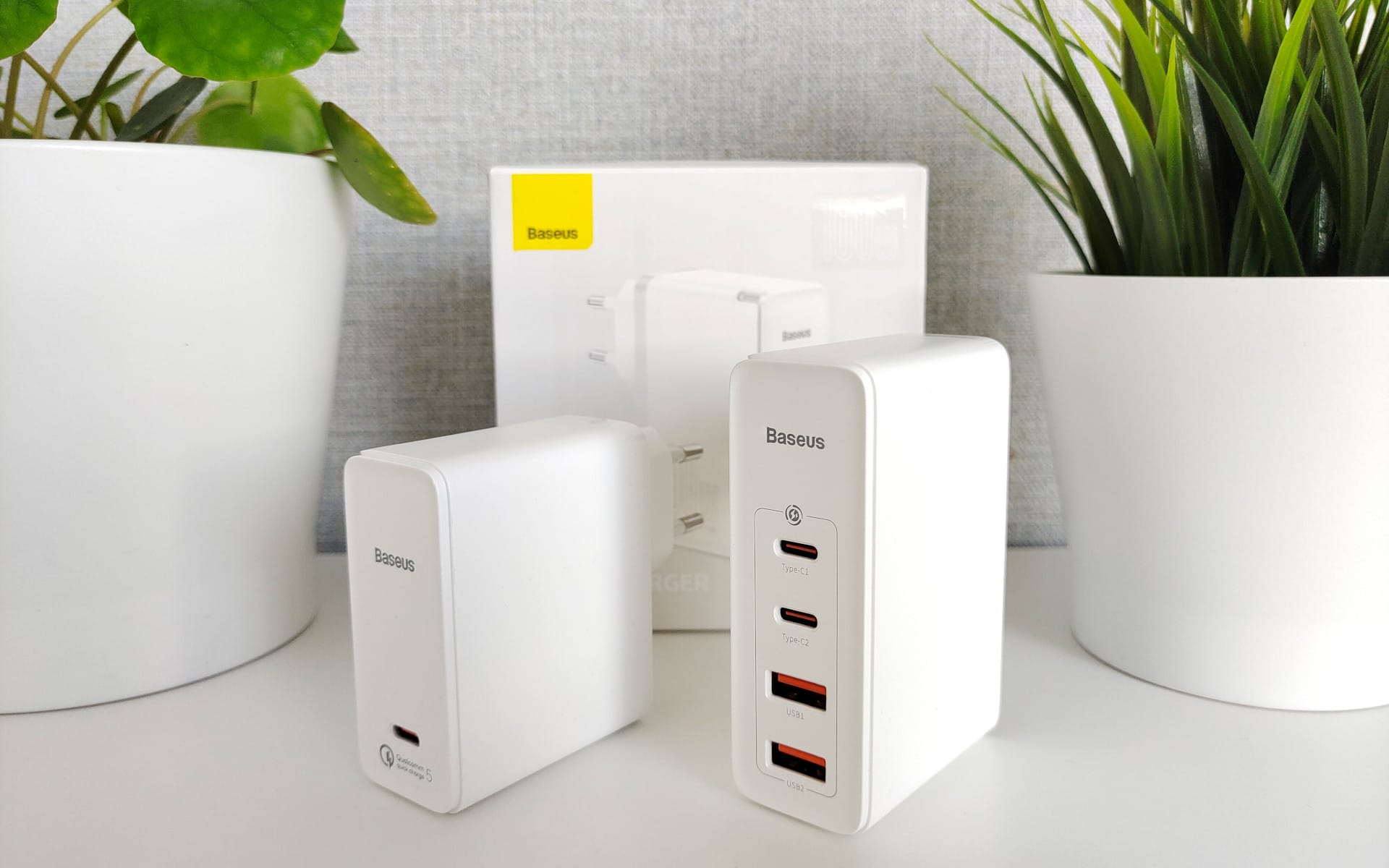
Baseus GaN2 Pro Quick Charger 2C+2U 100W
This is the name given to the Baseus 100W charger, and quite a lot can be deduced from it about its features.

GaN2
The term GaN2 indicates that this is a charger based on the latest gallium nitride technology. Gallium nitride is a crystalline, mostly colourless semiconductor used in chip production.

Unlike silicon, which is mostly used in conventional chargers, GaN chargers are significantly more efficient. Gallium nitride chips can handle much higher voltages with less heat generation and are smaller to produce.
This is already noticeable when we take the charger out of the packaging. Despite the high 100W output, it is extremely compact (92 x 30.5 x 54.8 mm – 215g) and hardly larger than an ordinary charger.
100W USB Power Delivery
Only the USB Power Delivery protocol makes it possible for a charging power of 100 watts to be achieved. The charger communicates with the connected device and together they determine the optimal charging power.

Conversely, this also means that not only the charger but also the combined device and even the charging cable must be PD-compatible. However, the protocol is now supported by many smartphones, tablets and laptops (Apple, Google, Samsung, etc.).
A compatible USB-C charging cable with E-Mark chip is pleasingly included in the scope of delivery.
2C+2U ports
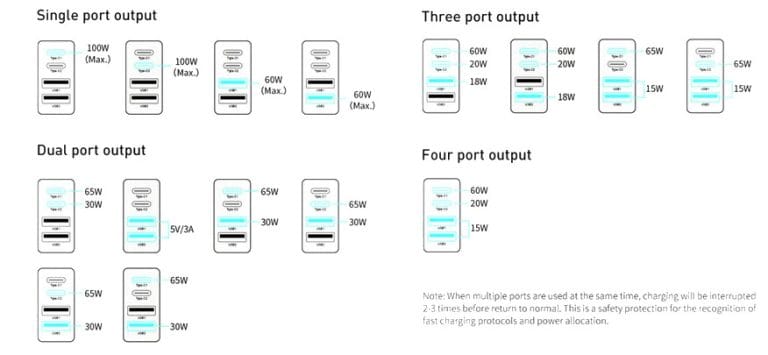
With 2C+2U, Baseus refers to the ports of the 100W charger. These consist of 2 USB-C ports (2C), both USB-PD compatible, and two additional USB-A ports (2U). This allows up to 4 devices to be charged simultaneously. However, if multiple devices are charged at the same time, the 100W charging power is distributed among the individual ports. The following image shows the distribution of charging power in different configurations.
In addition to Power Delivery (PD 3.0), further fast-charging protocols are supported. These include Quick Charge 4+ (QC4+), Quick Charge 3 (QC3) and Quick Charge 2 (QC2), as well as SCP, FCP, AFC and PE+. This also largely covers special charging protocols, such as those used by Huawei, Samsung, Apple and Xiaomi.
Practical test
To test the charging performance, the Baseus 100W charger was allowed to charge various devices. Among other things, an Apple MacBook Pro 16 had to serve for the test. The Baseus charger charged the MacBook's 100 Wh battery with 90 watts. During the charging process, the plastic housing did not become significantly hot (approx. 55°C), nor did the charger emit any noise. There were also no outages or the like.

If another device is connected during an ongoing charging process, the charging is briefly interrupted. The charger determines the optimal charging power for all connected devices and checks to what extent fast charging standards are supported.
Regarding other fast-charging standards, the charger had no problems triggering Quick Charge protocols and Xiaomi's Turbo Charge. The Baseus GaN2 charger does not support the proprietary fast-charging standards from OPPO (VOOC), OnePlus (Warp), and realme (Dart).
Our verdict
The Baseus 100W GaN2 charger offers a lot of power in a small space, making it a practical companion for on the go. The charger provides notebooks, smartphones and other devices with a wide range of fast charging standards. Although not all more specialised fast charging standards are supported, the Baseus charger charges the majority of devices quickly and efficiently with up to 100 watts.
Specifications
Charging power
- USB-C = 100 W (max.)
- USB-A = 60W (max.)
- USB-C1 + USB-C2 = 65W + 30W
- USB-A1 + USB-A2 = 15W + 15W
- USB-C + USB-A = 65W + 30W
- USB-C1 + USB-C2 + USB-A = 60W + 20W + 18W
- USB-C + USB-A1 + USB-A2 = 65W + 15W + 15W
- USB-C1 + USB-C2 + USB-A1 + USB-A2 = 60 W + 20 W + 15 W + 15 W
Fast charging protocols
- Power Delivery 2.0 / 3.0
- Quick Charge 4+ (QC4+)
- Quick Charge 3 (QC3)
- Quick Charge 2 (QC2)
- SCP
- FCP
- AFC
- PE+
Other
- Size
- 92 x 30.5 x 54.8 mm
- Weight
- 215g
What’s included
1x charger 1x charging cable with E-Mark chip 1x quick guide 1x sticker
Price comparison
| Store | Price | Link |
|---|
Comments