Contents
ECOVACS WINBOT W1 Pro: Unboxing
The WINBOT W1 Pro already scores its first point thanks to its generous scope of delivery, which can reasonably be expected for a price of over €300. The window-cleaning robot comes in a practical case in which it can be stored easily and safely.

On the left, the robot finds its place; on the right are the 4.5 m long power cable and the 1.5 m long safety rope; finally, the microfiber cleaning cloth and user manual can be stored in the net at the top.
Also included in the scope of delivery are 230 ml of cleaning fluid and a measuring cup. The reusable microfibre wiping cloth is included twice. Replacement wiping cloths are available on Amazon (link) and cost approximately 3 Euro each.

ECOVACS WINBOT W1 Pro: Appearance & Build Quality
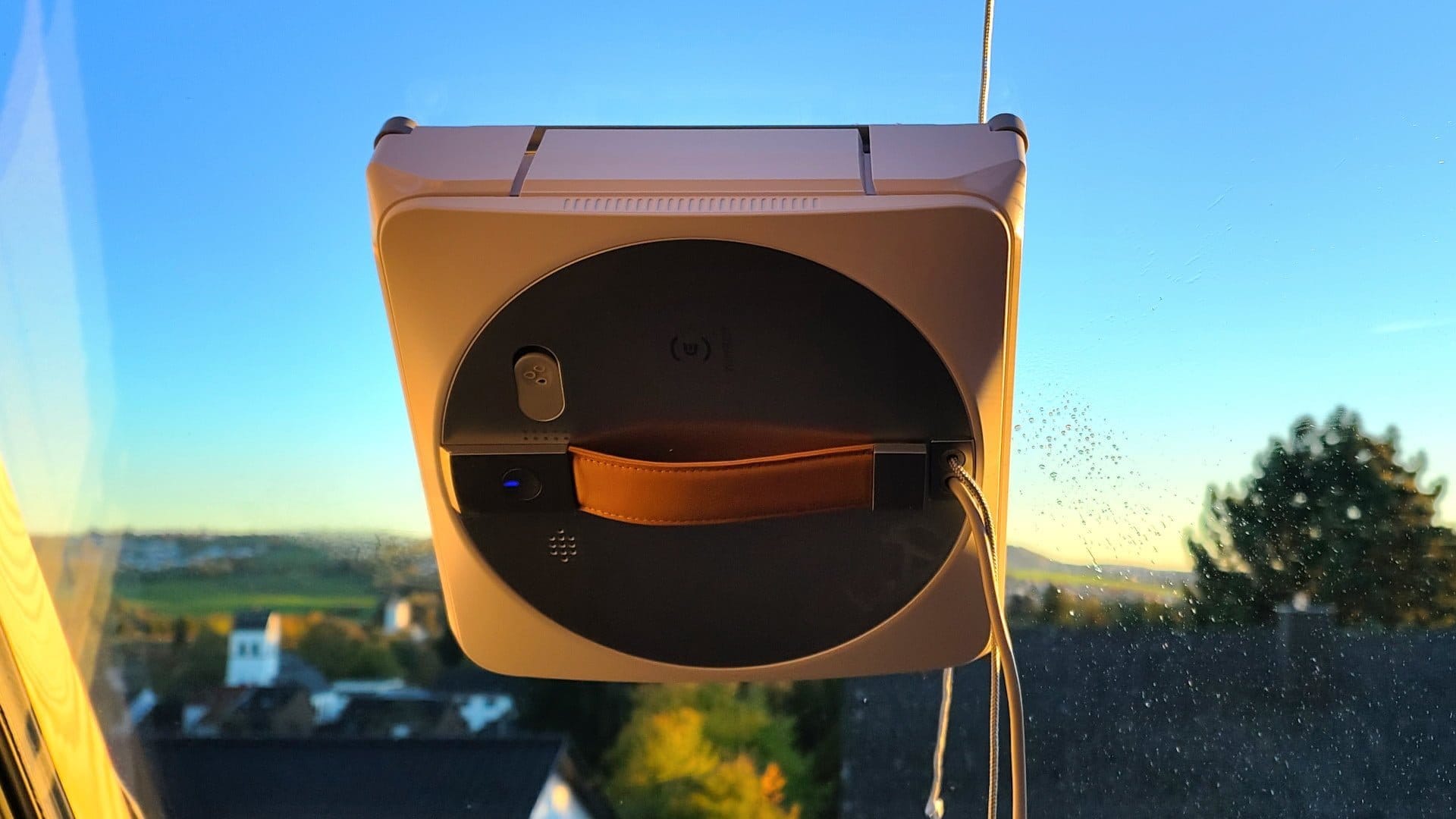
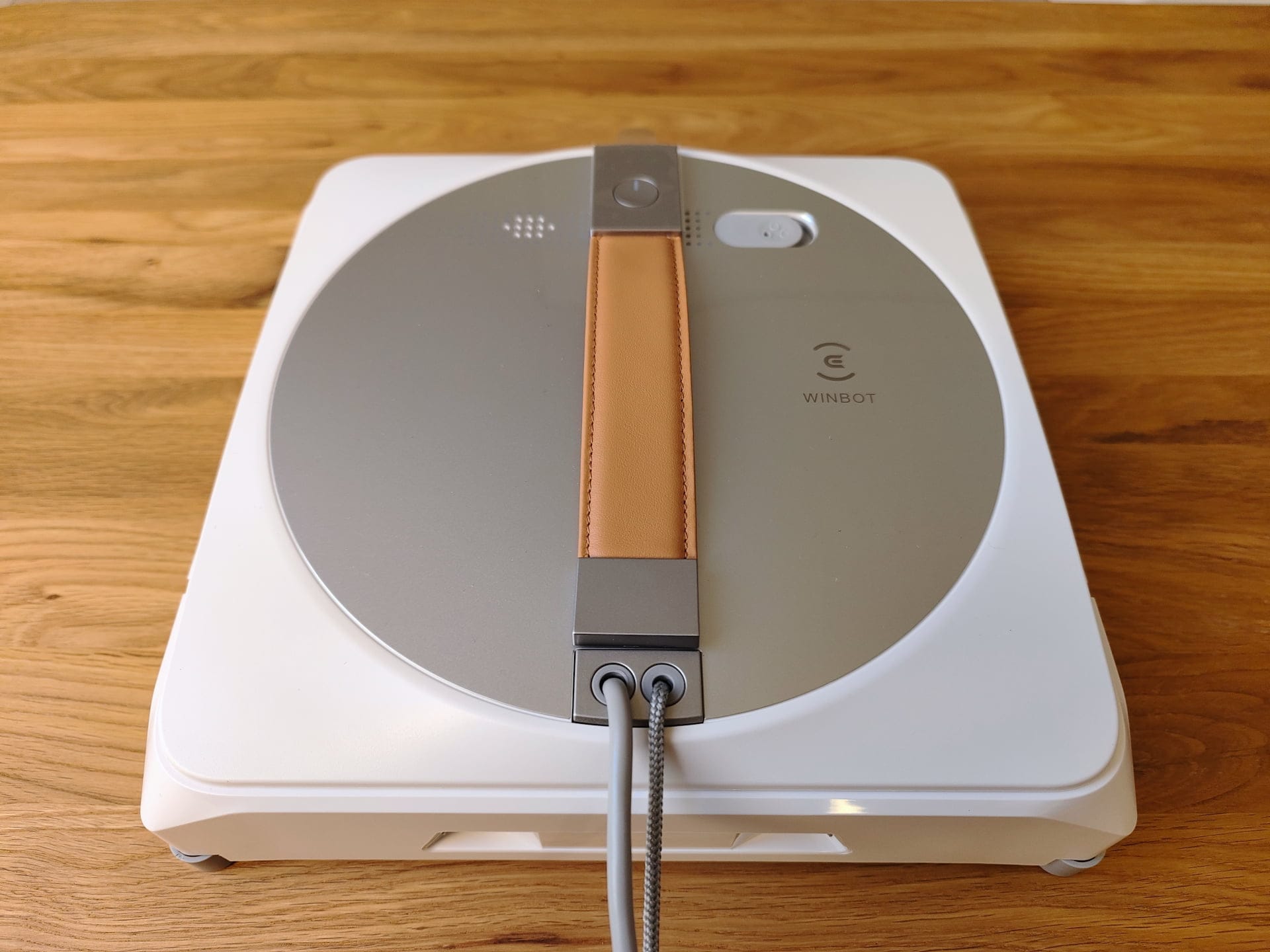
Appearance and workmanship are generally acceptable. The square robot measures 27 x 27 x 7.75 cm and weighs a light 1.53 kg due to its plastic casing. The faux leather handle ensures optical high quality.

Two spray nozzles are located on the sides, front and back, through which the WINBOT W1 Pro sprays out the cleaning fluid. The 60 ml tank is filled via an opening on the top. This is also where the power button is located, used to start or stop the cleaning process.

On the underside is the red device switch. Also visible are the rubber rollers, which move the cleaning robot across the window pane, and the Velcro fastening for the wiping cloth.
ECOVACS WINBOT W1 Pro: Initial setup
Setting up the WINBOT W1 Pro is straightforward and is explained in detail in the illustrated quick-start guide. Although connection with the ECOVACS App is recommended in point 1 of the manual, this step is initially optional.
The window cleaning robot's 60 ml tank can be filled with cleaning fluid through an opening on the top of the device. Incidentally, any standard supermarket window cleaner works here. You just need to ensure it is not the sticky type that could clog the spray nozzles.
The wiping cloth should be moistened with water before use. It is then aligned and attached to the hook-and-loop fastening on the underside.

Now connect the WINBOT W1 Pro to the power supply and flip the red device switch on the underside. If the integrated emergency battery is not charged, the device will not start. The charging process takes approximately 2 hours.

The battery actually serves only as a backup in case of a power outage. Operating the WINBOT W1 Pro without a power cable and solely on battery power does not work.
ECOVACS WINBOT W1 Pro: App
The ECOVACS app allows for more extensive control of the window-cleaning robot. Bluetooth is used as the connection standard. Unlike Wi-Fi, Bluetooth has a significantly shorter range, but this is by no means critical, as the window-cleaning robot should not be left running unsupervised in any case.
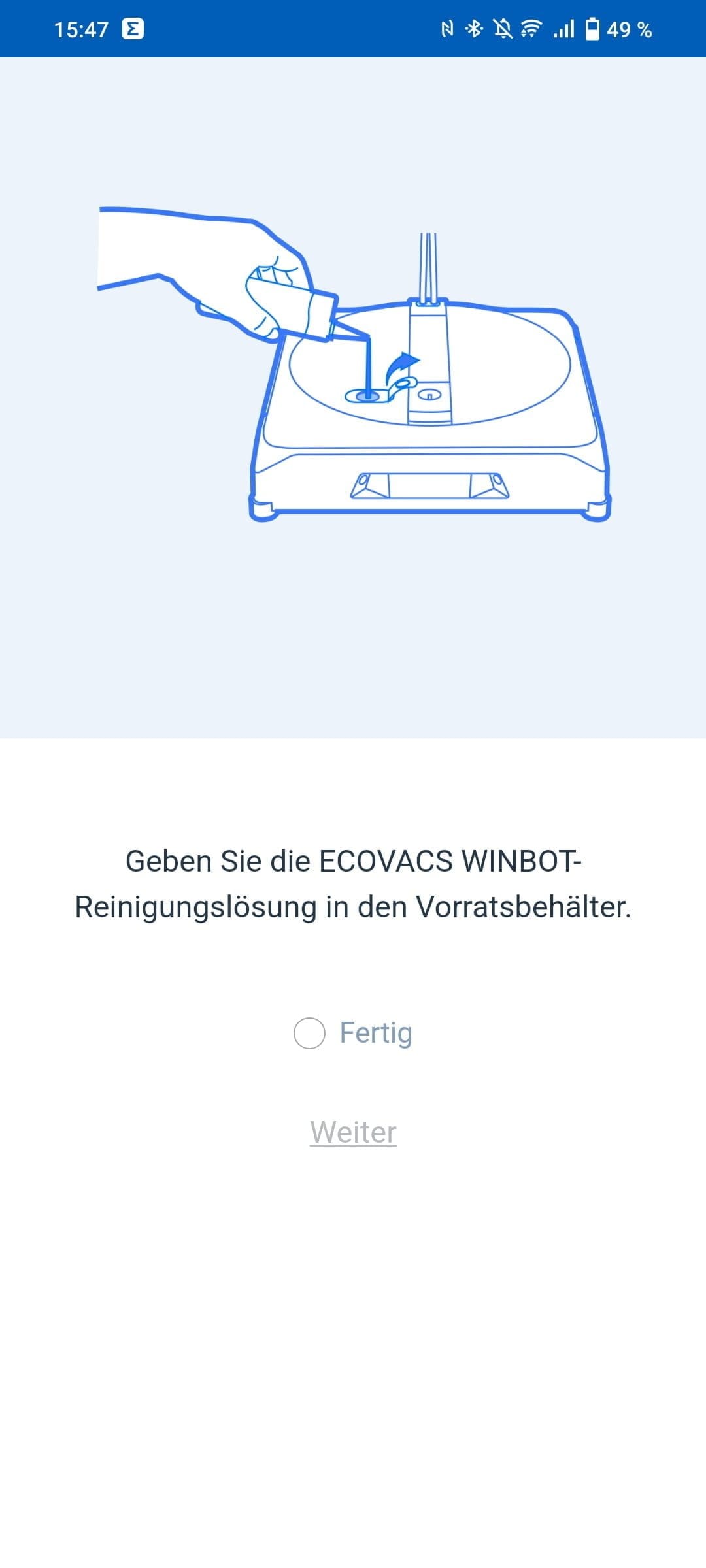
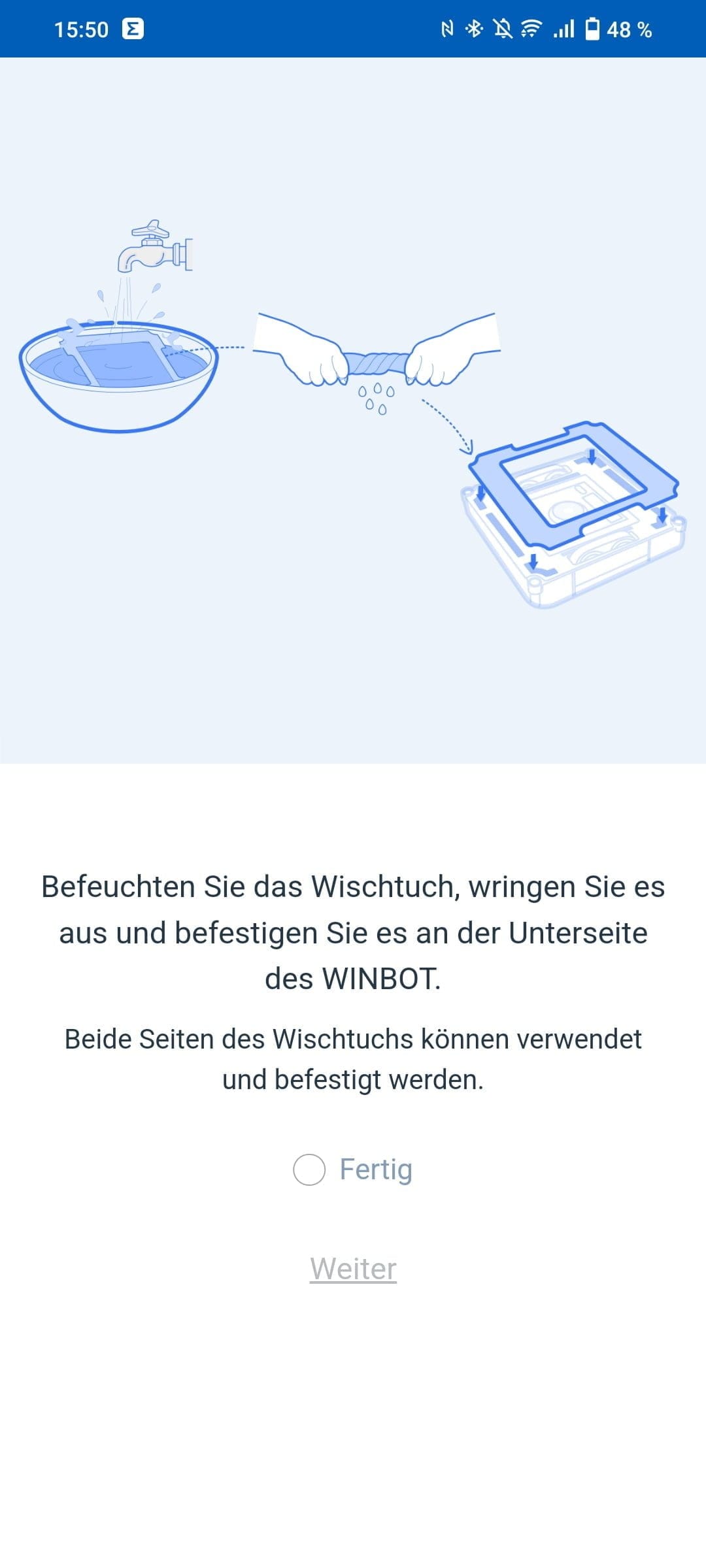
The cleaning mode can be adjusted via the app to the levels "Quick", "Deep" and "Spot". Depending on the selected cleaning mode, the cleaning pattern and cleaning speed change.
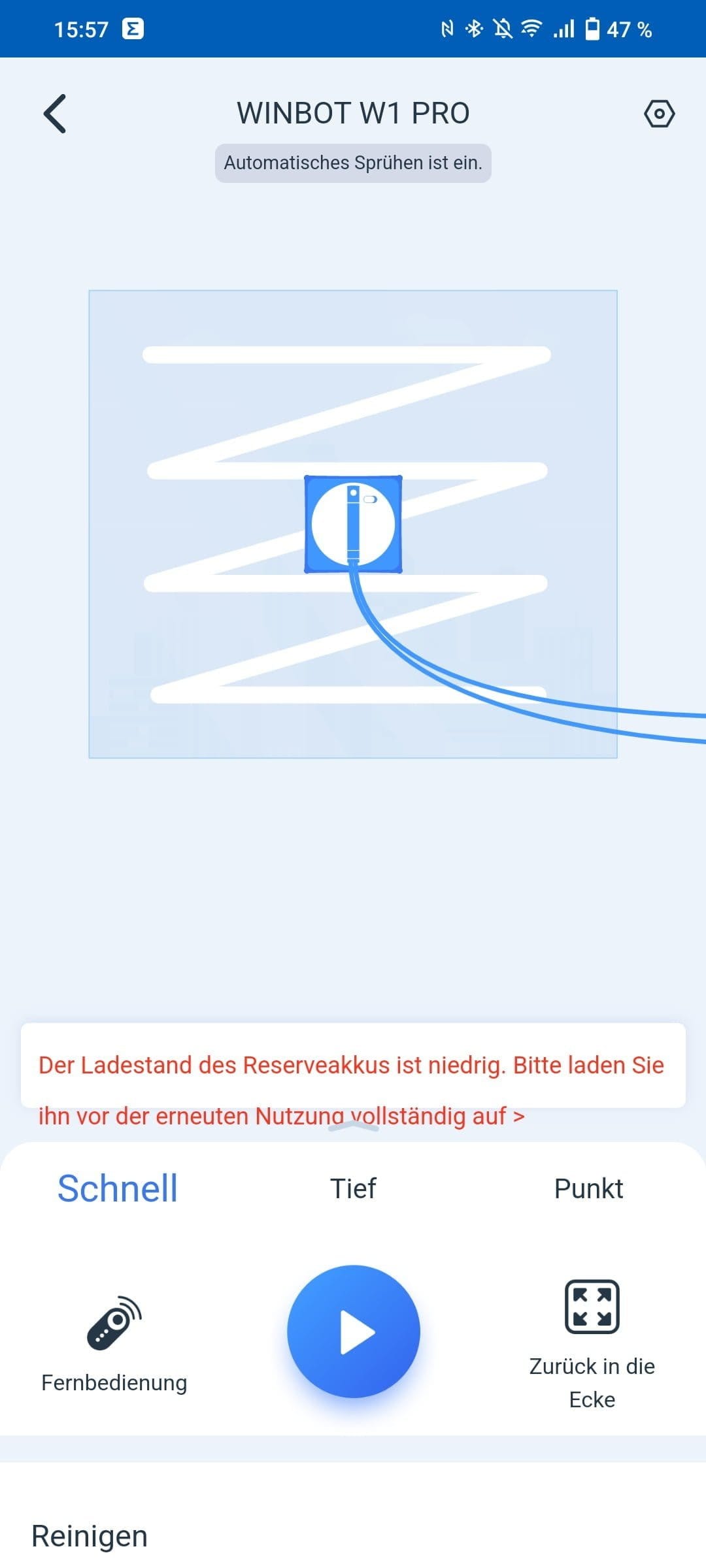
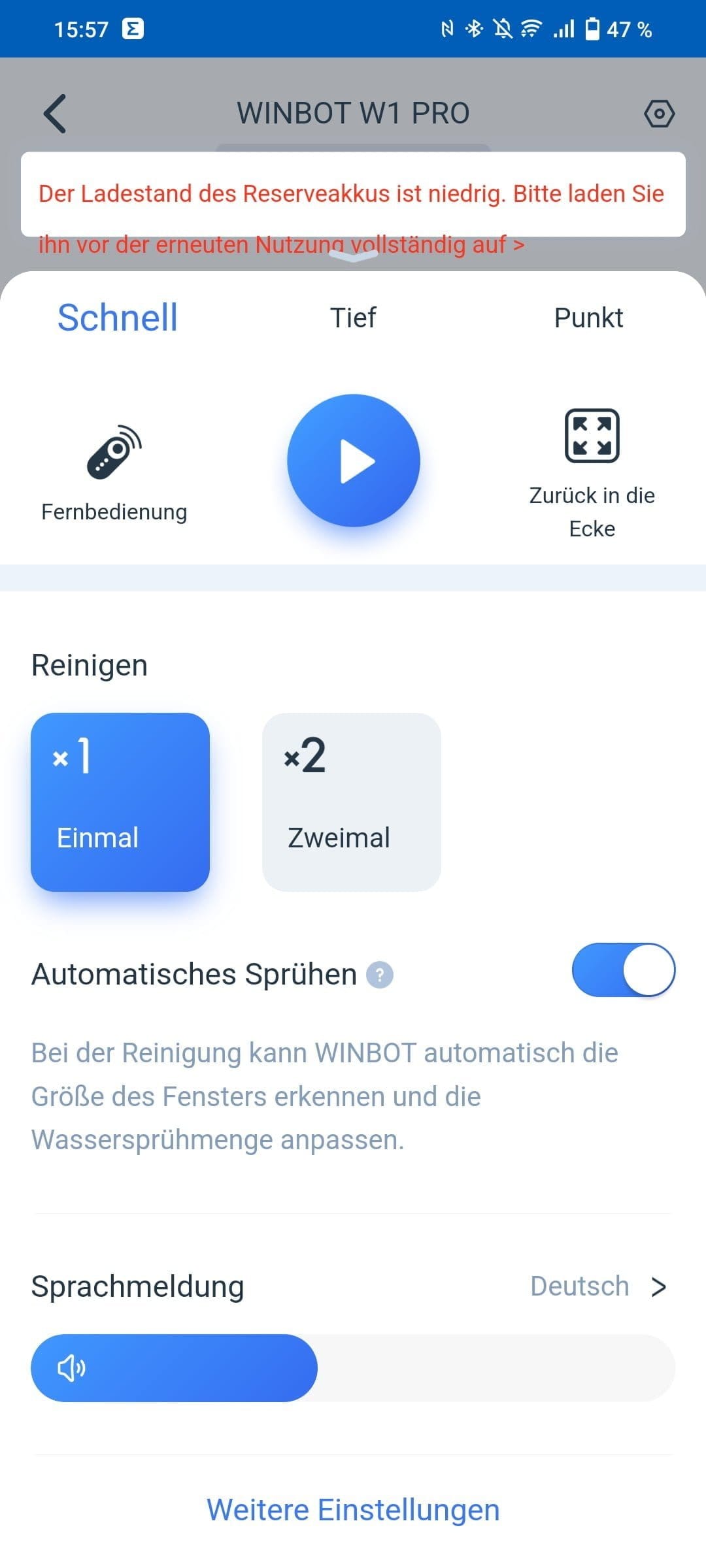
The “Automatic spraying” feature ensures that the WINBOT W1 Pro automatically determines its spraying behaviour based on the window size. In addition, the cleaning repetition can be switched between single and double, and there is a virtual joystick for manually navigating the robot.
ECOVACS WINBOT W1 Pro: practical test
Not every window is suitable!
Now we come to the most important part, the practical test. Before you "stick" the WINBOT W1 Pro to the window pane, you should be aware that the window cleaning robot does not work with all window panes or angles of inclination due to its position sensor.

Initially, the window should have a minimum size of 30 x 40 cm. In addition, the inclination angle between the glass and the horizontal plane must be between 60° and 120°.
In the test, I was able to try the WINBOT W1 Pro on various types of windows. To start the cleaning process, press the robot against the window pane and press the power button on the top. The window-cleaning robot then suction-cups to the glass and moves forward using the rubber tracks on the underside.
It can certainly make you feel uneasy during first use. After all, it seems like magic how the WINBOT W1 Pro attaches itself and moves along. Although the robot did not slip even once during the test, you should definitely use the safety rope, as neither the device, the tiles, nor the person below it (depending on the location of use) can withstand a fall.
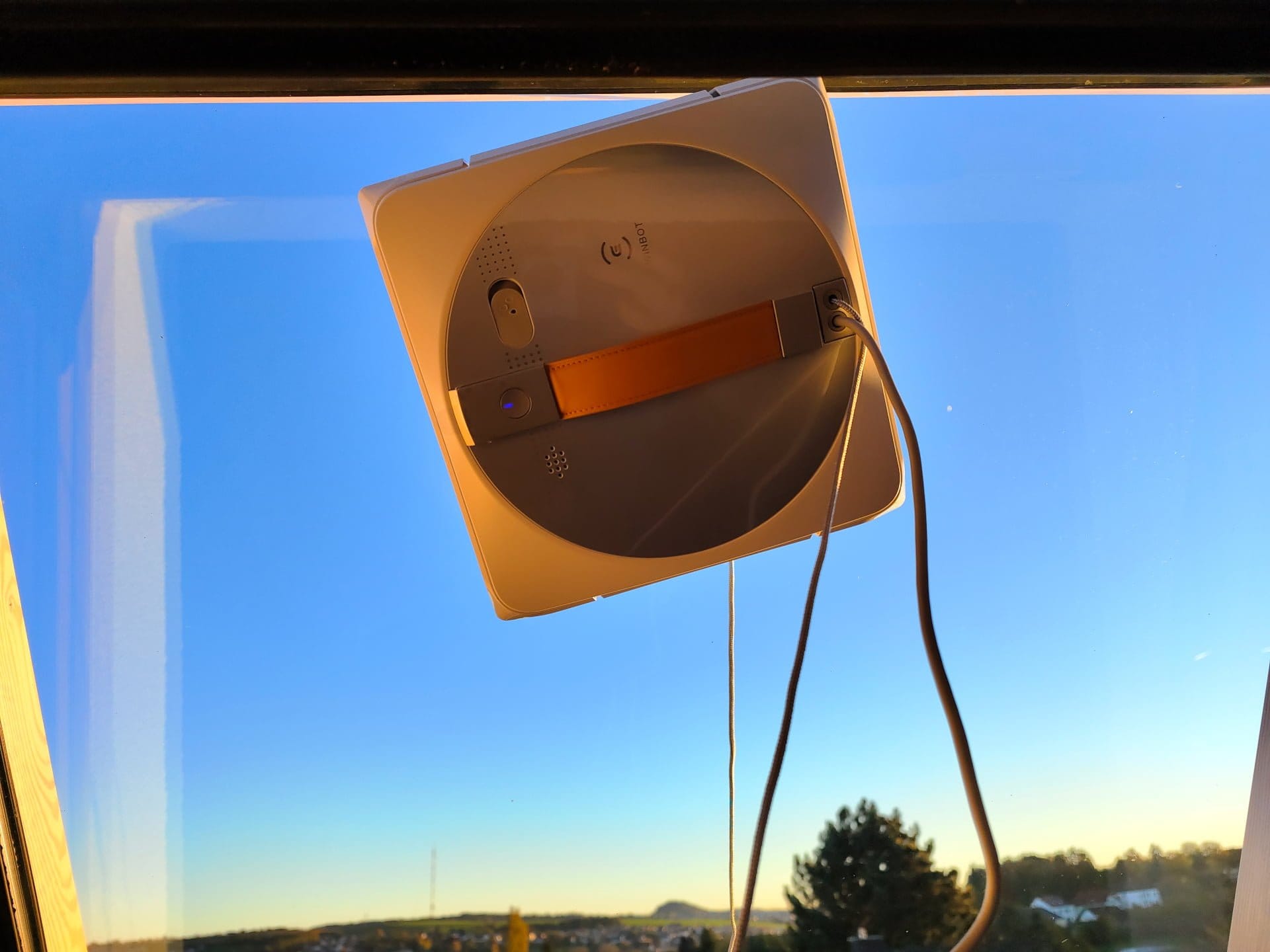
You find out very quickly whether a window is compatible or not, because on non-functioning windows, the window cleaning robot does attach itself, but just spins around in circles. Cleaning works without problems on vertical windows.
With slanted roof windows, it may be necessary to manually adjust the tilt angle of the (tiltable) window, which is why the WINBOT W1 Pro is generally less suitable or unsuitable for slanted windows, such as those found on roofs or in conservatories.
Free from smearing right into the corners?
Once the cleaning robot has suctioned itself to the window, it gets straight to work. This is clearly audible, as the motor with 2800 Pa suction power produces a volume (~72 dB) comparable to that of a vacuum robot.
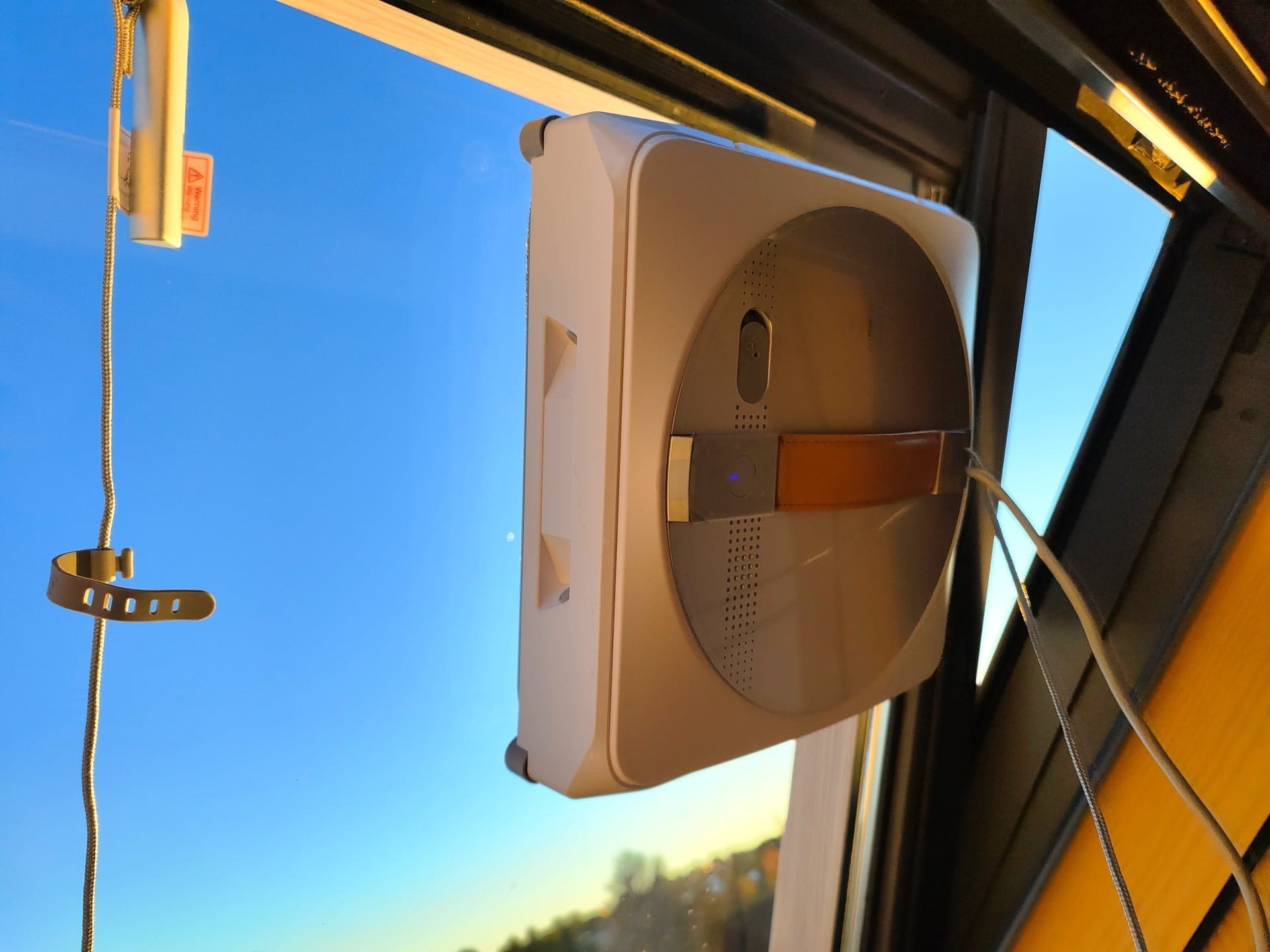
It dispenses cleaning solution onto the window via the spray nozzles on both sides and then wipes it with the microfibre cloth. It moves across the window in lanes. The cleaning robot indicates an empty tank via voice announcement.
The WINBOT W1 Pro removes dirt from the window pane properly, which is quickly visible on the dirty microfibre cloth. No streaks are created. Even heavily soiled windows with pollen dust are cleaned by the robot cleaner after at most two passes.
A typical window (1.23 m x 1.48 m) is cleaned within 2–4 minutes, depending on the cleaning mode. The dirty microfibre cloth can, among other things, be washed in a washing machine.
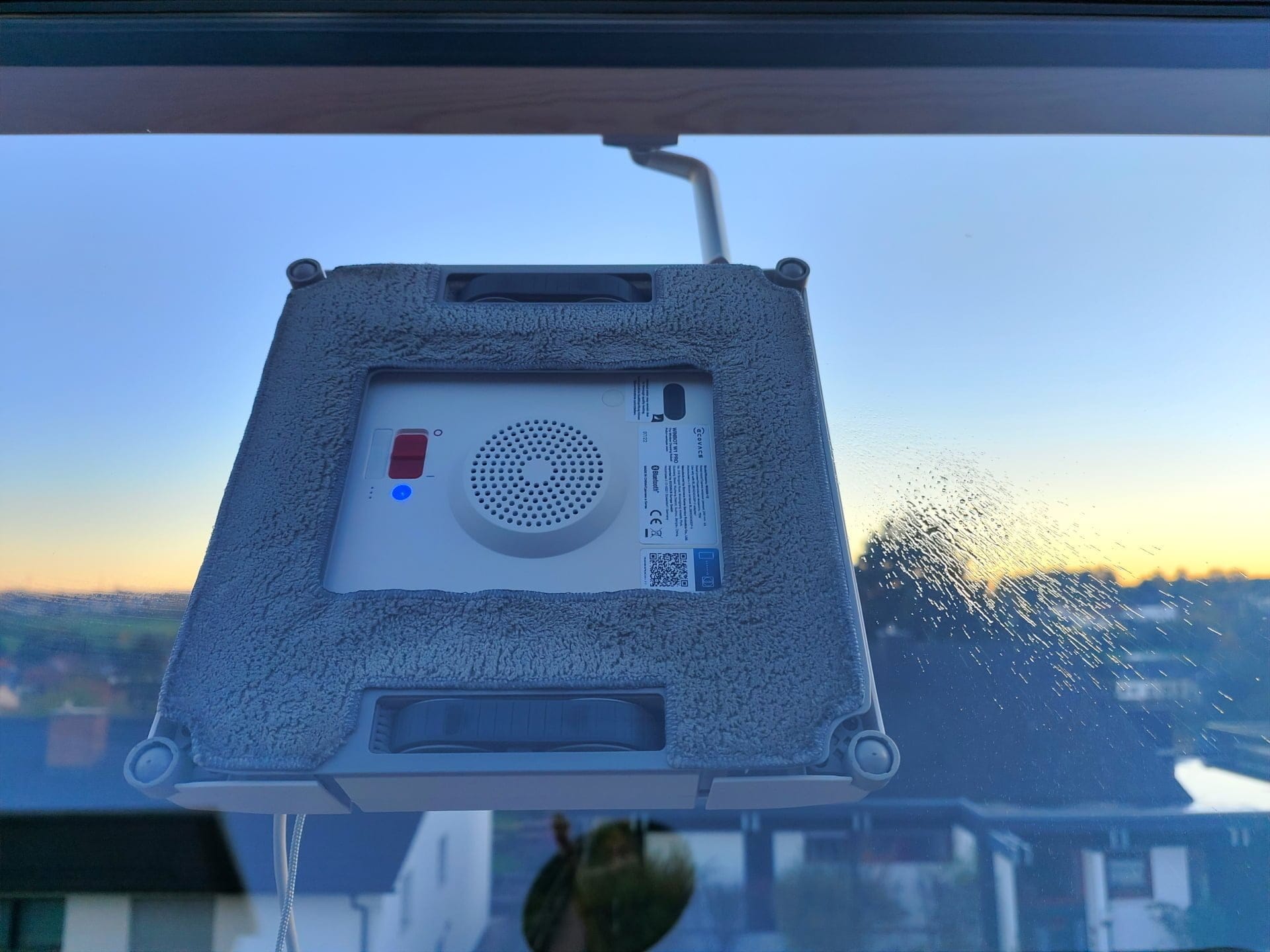
The cleaning robot doesn't quite reach every corner. A narrow strip usually remains along the edges and corners, which the WINBOT W1 Pro cannot reach due to its design. However, this problem affects almost every window-cleaning robot, not just the WINBOT W1 Pro. For a perfect view, you ultimately still have to reach for the cleaning cloth.
Our verdict
The WINBOT W1 Pro has proven particularly useful when cleaning rows of large and hard-to-reach windows. It saves you from having to use a ladder, and the window-cleaning robot gets to work with little preparatory effort.
However, buying a WINBOT W1 Pro should not be done without thought, as not all window types can be cleaned with the window-cleaning robot. Vertical windows are no problem, but the WINBOT W1 Pro refuses to operate on slanted windows with too shallow an angle.
Specifications
General
- Suction power
- 2800 Pa
- Noise levels
- 72 dB
- Water tank
- 60 ml
- Spray duration
- 60 minutes
- Window types
- min. 30 x 40 cm
- Power cable length
- 4,7 m
- Safety line length
- 1,5 m
Functions
- Cleaning modes
- Fast, deep, pinpoint
- Intelligent route planning
- Discharge protection (650 mAh battery)
- Automatic return to starting point
- Saving the cleaning path
- Voice messages
Other
- Rated power
- 96 W
- Nominal voltage
- 24 V
- Size
- 27 x 27 x 7.75 cm
- Weight
- 1.53 kg
Price comparison
| Store | Price | Link |
|---|---|---|
| MediaMarkt | 399,00 € | Go to store |
Comments (6)
Hi, could this theoretically be repurposed for scrubbing floors?
Hi DerPate,
That does not work. The WINBOT W1 Pro only works at an inclination angle of 60° – 120°.
Hello, thanks for the review. I would like to clean the top of my patio cover with the device (i.e. an almost horizontal surface). Could you tell me if that works?
Hello, unfortunately, this will not work. The robot requires an inclination angle of 60° to 120°.
The device does not spray, although the tank is filled!
Hello, I am also looking for a window cleaning robot for my terrace canopy. Unfortunately, I only have a slope of an estimated 15-20 degrees. Could you perhaps suggest a reasonable alternative to the Winbot?
Best regards