Contents
EEG-based impulses target deep sleep
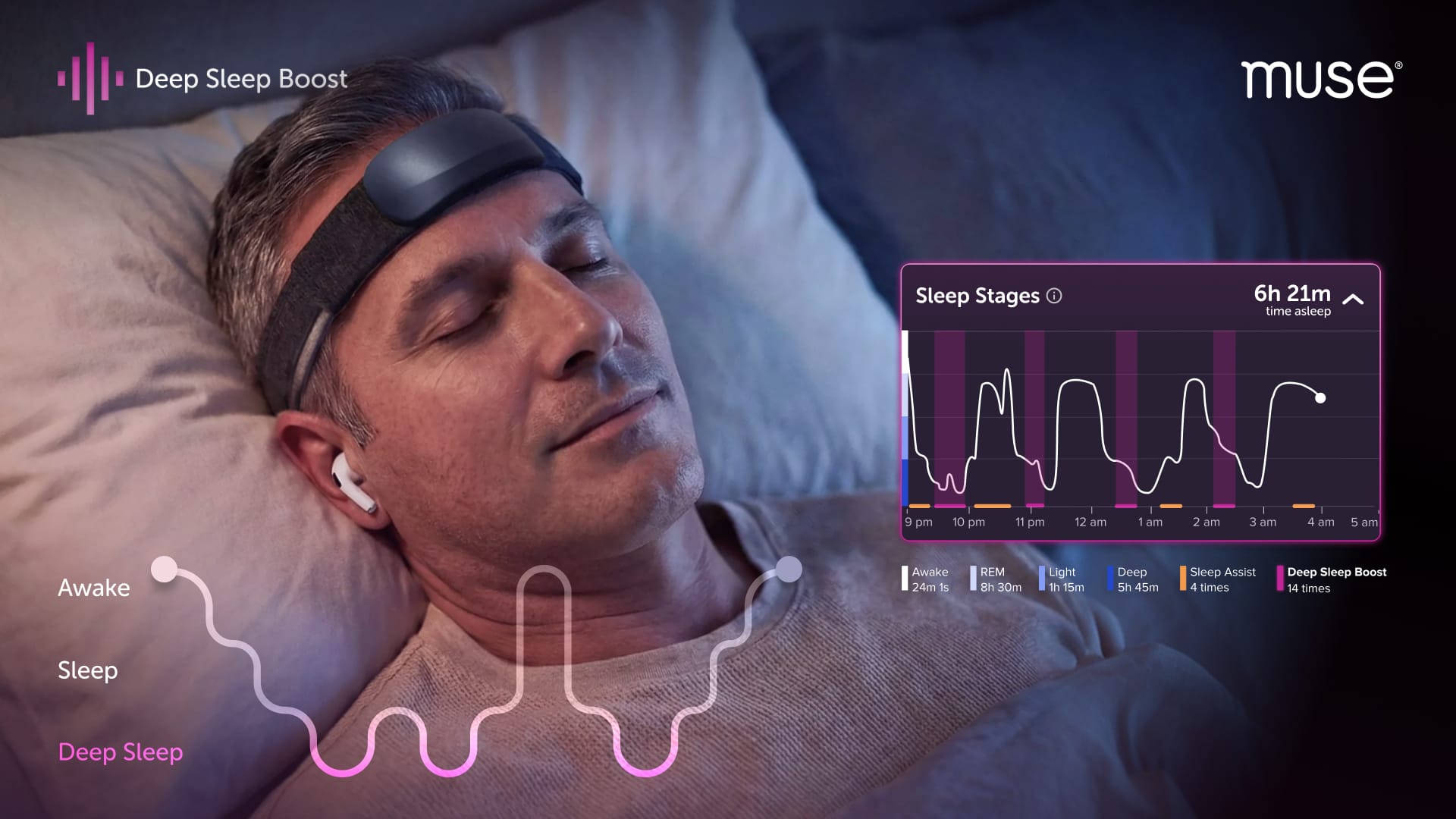
The Muse S Athena continuously monitors brain activity throughout the night. When the system detects the onset of a deep sleep phase, it emits nearly silent pink noise signals synchronized precisely with slow brain waves. These acoustic impulses are intended to improve the stability and depth of slow-wave sleep without interrupting sleep.
Muse uses AI-powered models trained on extensive EEG datasets. They not only recognise when deep sleep occurs, but also analyse its structure and dynamics. This allows the system to determine the optimal time for stimulation.
An integrated safety system automatically stops stimulation if signs of interrupted sleep occur. The intensity and timing can be adjusted individually.

EEG and fNIRS combined for detailed brain data
Unlike traditional sleep trackers, which primarily measure movement and heart rate, Muse combines EEG with fNIRS. The latter measures the brain’s oxygen supply. This produces a much more precise picture of neural activity during sleep.
This data forms the basis for personalised recommendations, guided exercises and adaptive sleep support. According to the manufacturer, more than 500,000 users worldwide use Muse devices, and the technology has also been examined in more than 200 scientific studies.
Studies show significant improvements in deep sleep
The underlying method is based on scientific research into acoustic stimulation during deep sleep. In controlled studies, deep-sleep activity increased by nearly 50 per cent. At the same time, memory performance improved by around 20 per cent overnight.
Internal beta tests of Deep Sleep Boost have also shown measurable effects:
- around 24 per cent longer deep-sleep sequences
- around 42 per cent more stable deep-sleep periods per minute
- up to 76 per cent more structured deep sleep overall
Alongside duration, the continuity of deep sleep phases is particularly important. Fragmented deep sleep is considered less restorative than stable, uninterrupted sequences.

Holistic sleep system with additional EEG feature
Deep Sleep Boost is part of a more comprehensive sleep ecosystem within the Muse S Athena. This includes several features that support different stages of the sleep cycle.
Sleep Assist uses EEG-based sound pulses to make it easier to fall asleep. According to the manufacturer, users report falling asleep up to 55 per cent faster.
A Smart Alarm is set to use EEG signals from 2026 to determine the optimal time to wake up. This is intended to reduce morning grogginess.
In addition, the AI-powered “Enso” coach analyses individual sleep data and provides easy-to-understand assessments and recommendations.
Availability
Deep Sleep Boost is now part of the Muse S Athena and is available to iOS and Android users at no extra cost. Further information can be found on the official Muse website.
Source: Press release
Comments