
Contents
Xiaomi 17: Compact with a huge battery

The basic model of the series retains a 6.3-inch display diagonal. The AMOLED panel has a resolution of 2656 × 1220 pixels, supports up to 120 Hertz and, according to the manufacturer, reaches a peak brightness of 3500 nits. The screen is protected by Xiaomi's own Dragon Crystal Glass.
Despite its compact design, a 7000 mAh battery is installed, significantly surpassing competitors such as Samsung's Galaxy S25 or Apple's iPhone 17 Pro. It charges wired at 100 watts and wirelessly at 50 watts.

In terms of camera technology, the Xiaomi 17 features a triple setup with Leica tuning. The main camera works with the Light Hunter 950 sensor (50 MP, f/1.7, OIS), complemented by a 50 MP ultra-wide angle and a 50 MP telephoto lens with threefold zoom.
Leica once again delivers the "Authentic" and "Vibrant" picture styles, which produce natural or more vivid colours respectively. In practice, this should provide the standard model with a solid all-round camera that does not have to hide from other flagships. The 50 MP front selfie camera is also unusually well specified and supports 4K video.
The processor used is Qualcomm's new Snapdragon 8 Elite Gen 5, combined with 12 or 16 GB of RAM and up to 512 GB of storage.
In China, the Xiaomi 17 starts at an equivalent of around €540.
Xiaomi 17 Pro: Rear display and stronger zoom

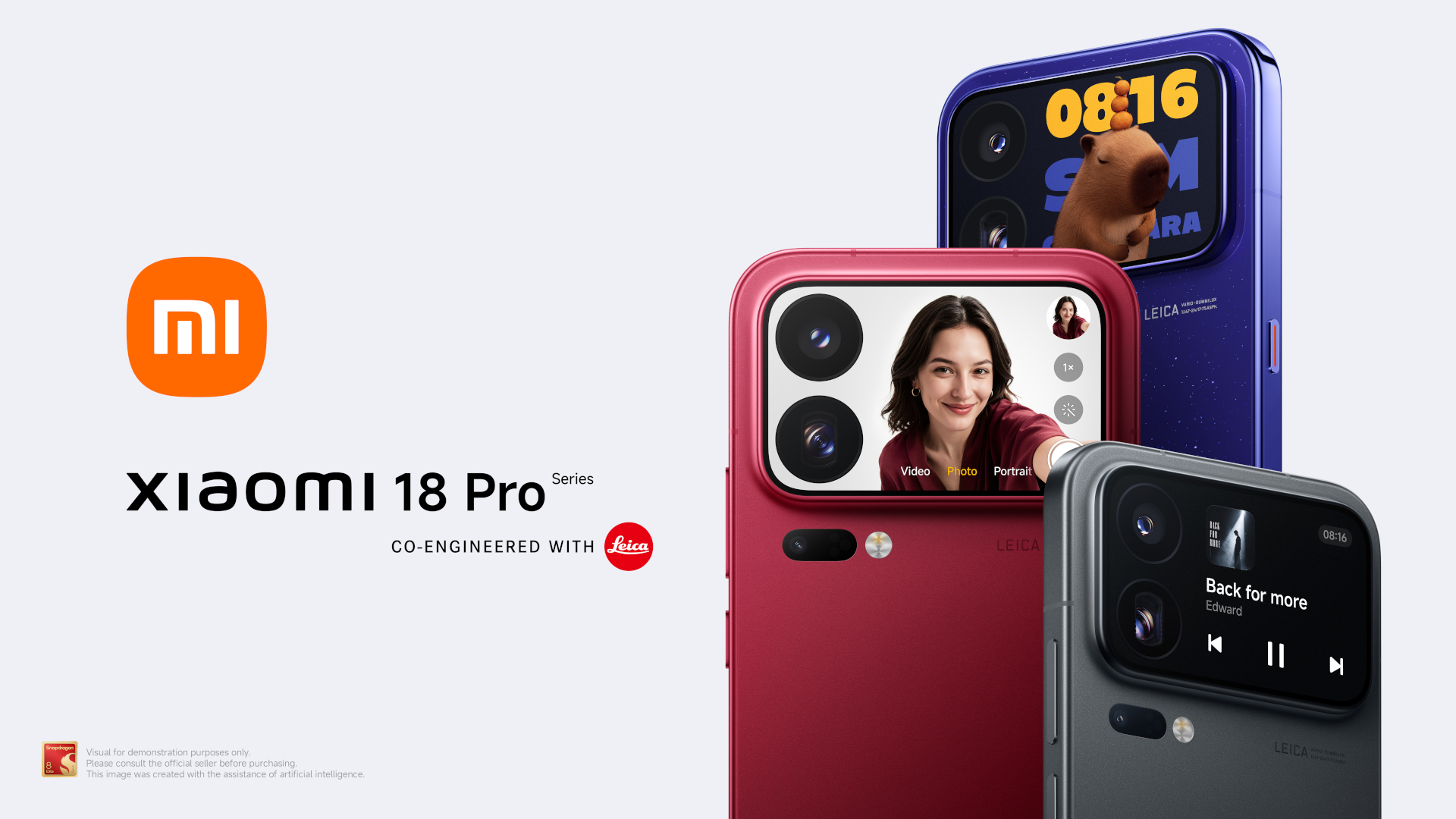
Visually, the Pro strongly resembles the base model, but brings a striking difference, with a 2.7-inch OLED panel on the back. The additional display shows notifications, acts as a selfie viewfinder and can display QR codes or notes. Xiaomi also promotes it with customisable watch faces, interactive widgets and even small gimmicks like a virtual panda pet.
The 17 Pro improves the camera. Instead of triple optical zoom, the telephoto lens now offers five times zoom. It also uses a slightly improved main sensor (Light Hunter 950L). The rest of the equipment, 6.3-inch main display, 50 MP front camera and Snapdragon 8 Elite Gen 5, remains identical.
Because the second display takes up space, the battery shrinks to 6300 mAh. It is also charged at 100 watts wired and 50 watts wirelessly.
In China, the Pro starts at just under €600, with the top variant with 1 TB of storage costing around €720. Whether the model will be released in Europe remains to be seen. So far, Xiaomi has not always released its Pro versions globally.

Xiaomi 17 Pro Max: large, heavy and with a 7500 mAh battery
Those who value screen size and maximum battery life should find what they are looking for in the Pro Max. The panel grows to 6.9 inches, with the resolution dropping slightly to 2608 x 1200 pixels. Here too, it offers 120 Hz and 3500 nits of brightness. On the back, there is a 2.9-inch OLED auxiliary display.
At 219 grams, the Pro Max is noticeably heavier, but it houses a 7,500 mAh battery. One of the largest in a current smartphone! Like the other models, it charges via 100 watts wired and 50 watts wireless.
The camera largely corresponds to the Pro model. The 50 MP Light Hunter 950L is used here as the main sensor, along with a 50 MP ultra-wide angle and a 50 MP periscope telephoto lens with five-fold zoom. The difference lies in the wider aperture of the telephoto lens (f/2.6 instead of f/3.0). This promises even better results in low light.
Prices start at around 720 euros, with the top version with 1 TB costing about 840 euros. This positions the Pro Max from Xiaomi in the price range of Samsung's Galaxy S25 Ultra, albeit with significantly larger battery reserves.

Snapdragon 8 Elite Gen 5 in detail
All three models run on Qualcomm's Snapdragon 8 Elite Gen 5. According to Qualcomm, the chip is around 20 percent faster than its predecessor and up to 35 percent more efficient. There are also improvements to the GPU with ray tracing support and to the NPU for AI functions.
Xiaomi has also revamped the cooling system. Instead of a traditional vapour chamber, the company relies on a ring-shaped cold-pump solution, which according to its own statements works up to three times more efficiently. This is intended to keep performance stable even during longer gaming sessions or AI workloads.
In terms of connectivity, all key standards are supported: 5G, WiFi 7, NFC and dual-SIM. However, Ultra-Wideband (UWB), which Apple and Samsung increasingly use for smart-home and key functions, is missing in China.
Technical specifications at a glance
| Category | Xiaomi 17 | Xiaomi 17 Pro | Xiaomi 17 Pro Max |
| Display | 6.3-inch AMOLED, 2656 x 1220 px, 120 Hz, LTPO, up to 3500 nits, Dragon Crystal Glass | 6.3-inch AMOLED, 2656 x 1220 px, 120 Hz, LTPO, up to 3500 nits, Dragon Crystal Glass + 2.7-inch AMOLED rear display, 904 x 572 px, 120 Hz |
6.9 inch AMOLED, 2608 x 1200 px, 120 Hz, LTPO, up to 3500 nits, Shield Glass 3.0 + 2.9 inch AMOLED rear display, 976 x 596 px, 120 Hz |
| Processor | Qualcomm Snapdragon 8 Elite Gen 5 | ||
| RAM | 12 GB / 16 GB LPDDR5X | 12 GB / 16 GB LPDDR5X | 12 GB / 16 GB LPDDR5X |
| Storage | 256 GB / 512 GB UFS 4.1 | 256 GB / 512 GB / 1 TB UFS 4.1 | 512 GB / 1 TB UFS 4.1 |
| Rear camera | 50 MP main sensor (Light Hunter 950, f/1.7, OIS) 50 MP ultra-wide angle 50 MP telephoto 3x zoom |
50 MP main sensor (Light Hunter 950L, f/1.7, OIS) 50 MP ultra-wide angle 50 MP periscope telephoto with 5x zoom |
50 MP main sensor (Light Hunter 950L, f/1.7, OIS) 50 MP ultrawide 50 MP periscope tele 5x zoom, f/2.6 |
| Front camera | 50 MP, f/2.2, 4K video | 50 MP, f/2.2, 4K video | 50 MP, f/2.2, 4K video |
| Battery | 7000 mAh | 6300 mAh | 7,500 mAh |
| Charging power | 100 W wired, 50 W wireless, reverse charging | 100 W wired, 50 W wireless, reverse charging | 100 W wired, 50 W wireless, reverse charging |
| Operating system | Android 15 with HyperOS | Android 15 with HyperOS | Android 15 with HyperOS |
| Connectivity | 5G (incl. Band 20), 4G LTE, Wi-Fi 7, Bluetooth 5.4, NFC, GPS | 5G (incl. Band 20), 4G LTE, Wi-Fi 7, Bluetooth 5.4, NFC, GPS | 5G (incl. Band 20), 4G LTE, Wi-Fi 7, Bluetooth 5.4, NFC, GPS |
| Safety | In-display fingerprint sensor, Face Unlock | In-display fingerprint sensor, Face Unlock | In-display fingerprint sensor, Face Unlock |
| Protection rating | IP68 | IP68 | IP68 |
| Dimensions | 151.1 × 71.8 × 8.1 mm | 151.1 × 71.8 × 8.0 mm | 162.9 × 77.6 × 8.0 mm |
| Weight | 191 g | 192 g | 219 g |
| Colors | White, pink, black, blue | Black, white, purple, green | Black, white, purple, green |
| Price China (launch) | from 4,499 Yuan (~€540) | from 4,999 yuan (~€600) | from 5,999 Yuan (~€720) |
Global version and price estimate for Europe
Traditionally, Xiaomi releases slightly adapted versions of its Chinese models in Europe. Typical differences concern the battery capacity (often slightly smaller), the charging speed, supported mobile network bands and software features such as Android Auto or eSIM.
Whether the Pro models will make it to Europe remains to be seen. In the past, Xiaomi focused more on the standard and Ultra models. However, the additional display of the Pro series is likely to pique the curiosity of many buyers in Europe.
Expect a significant price increase. In addition to VAT, Xiaomi's positioning in the premium segment results in higher entry prices. A realistic figure is around €800 for the standard model, while the Pro Max is likely to approach the €1,000 mark.
Comments