Contents
Introduction: Xiaomi Mi Gaming Headset
After Xiaomi recently unveiled the Xiaomi Gaming Notebook and the Xiaomi Black Shark gaming smartphone, another product designed specifically for gamers followed. The Xiaomi Gaming Headset was introduced at the end of April 2018 via the company's own “Youpin” store and is priced at 349 Yuan, which corresponds to around EUR 45.

Design, build quality, and included accessories
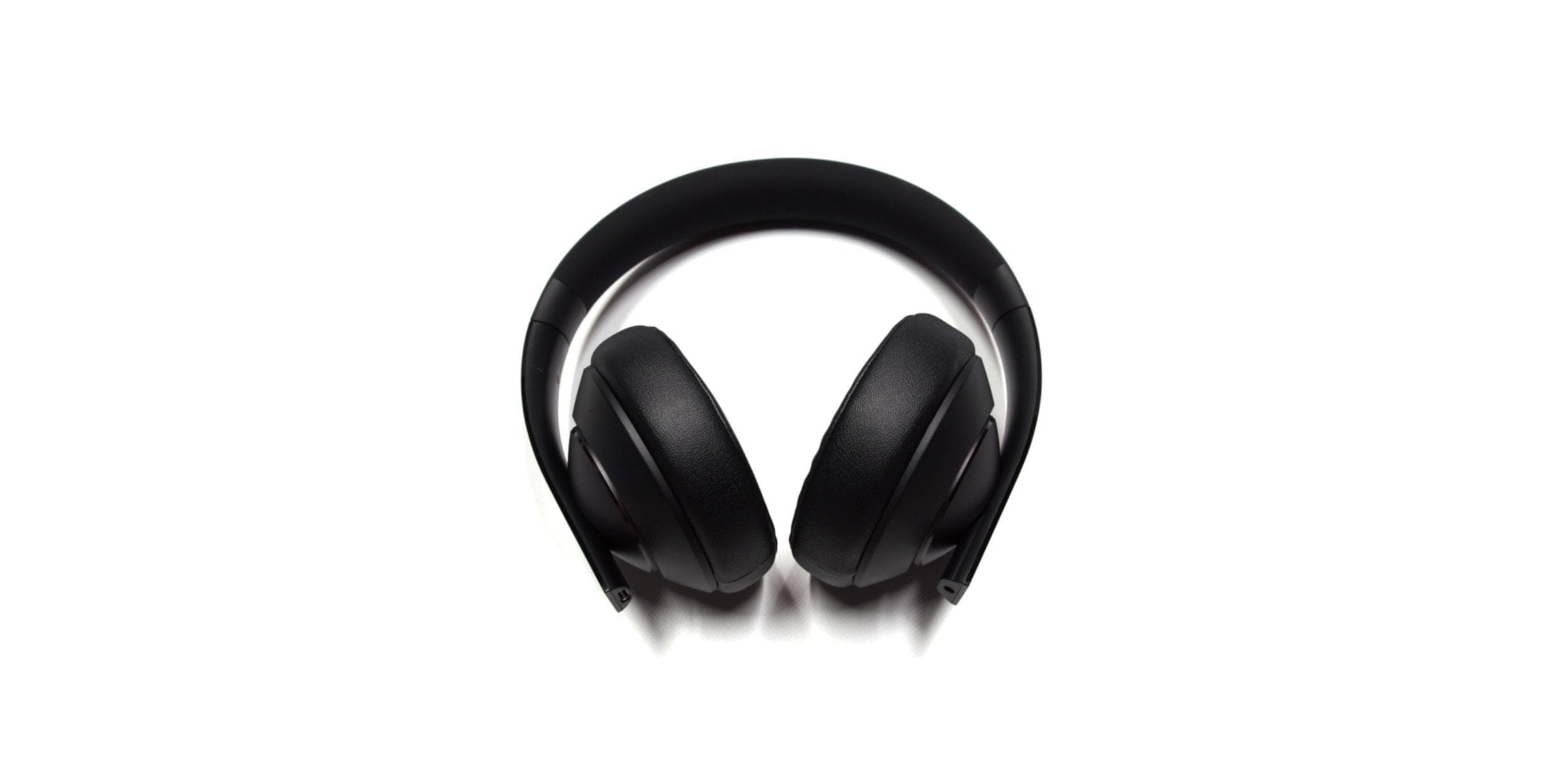
The Mi Gaming Headset presents itself as a closed-back headphone with a restrained design. The headband and ear cups are in matte black. The height-adjustable part of the band, however, shines in piano lacquer finish. Visually, the headset matches the recently released Xiaomi gaming products.
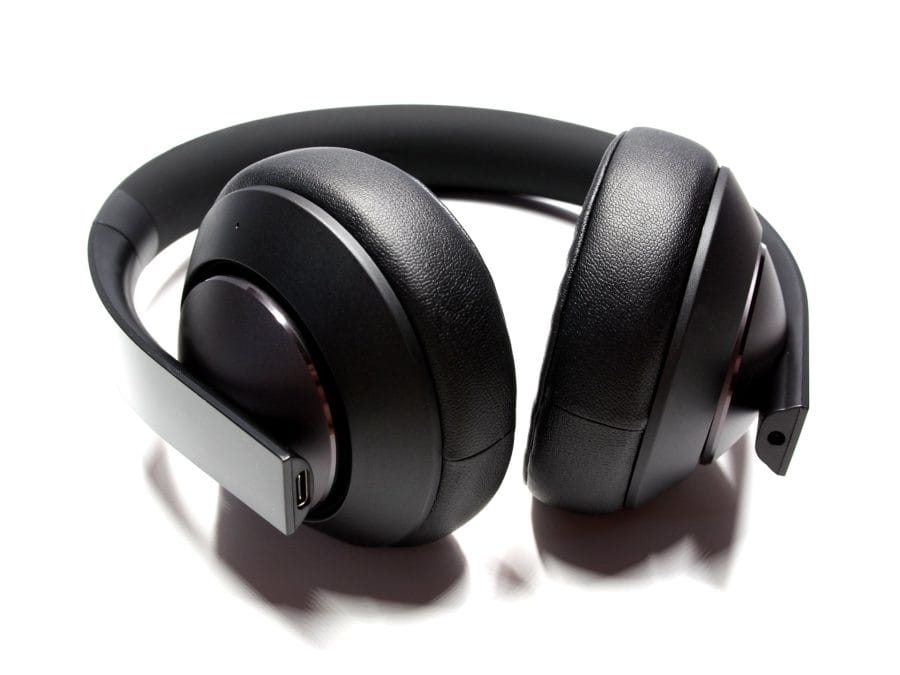
Xiaomi promises an optimal fit and corresponding long-lasting wearing comfort thanks to the adjustable and padded headband, combined with over-ear and elastic ear cushions. The padding consists of breathable faux leather. The finishing touch towards a gamer design are the LED strips located on the left and right of the ear cups, which light up in configurable colours. The headset can be operated via USB or 3.5 mm jack. The cables are detachable. The USB-C connection cable also comes with an inline remote control. This allows for manual muting of the microphone and adjustment of playback volume.
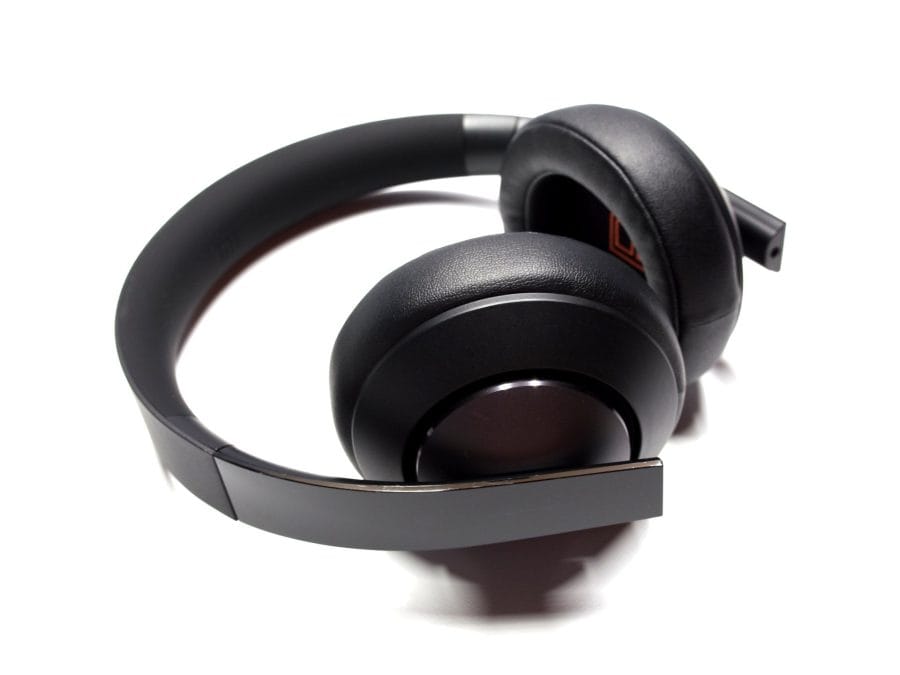
The build quality is impeccable and matches a headset in the €100 price range. Despite the large amount of plastic, the headphones do not look cheap at all. The scope of delivery includes, in addition to the headset, a USB-C headphone cable with inline remote control, a 3.5 mm jack headphone cable and a Chinese user manual.

Initial setup and drivers
As a plug-and-play device, the Xiaomi gaming headset can be used on PC, Mac or console without drivers. The same naturally applies to use with a mobile device. Under Windows, the headset is recognized as a conventional speaker. If you want to use all the headset's functions, installing the “Mi Gaming Headset” software (download link) is recommended. This is only available for Windows 10. The software's user interface is in Chinese by default. However, we were able to translate the software. You can find instructions in the following box.
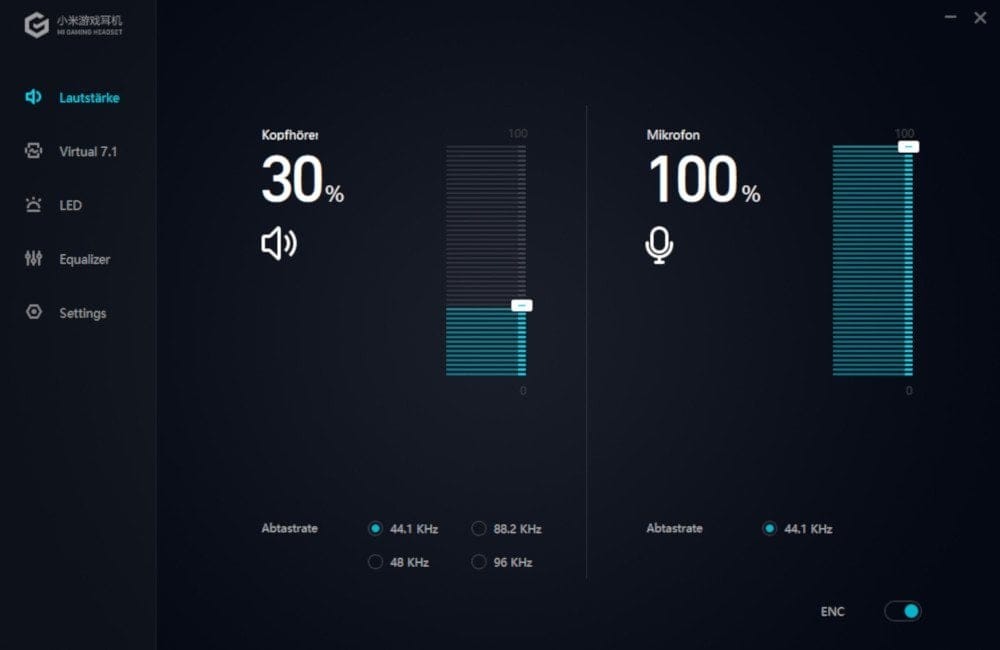
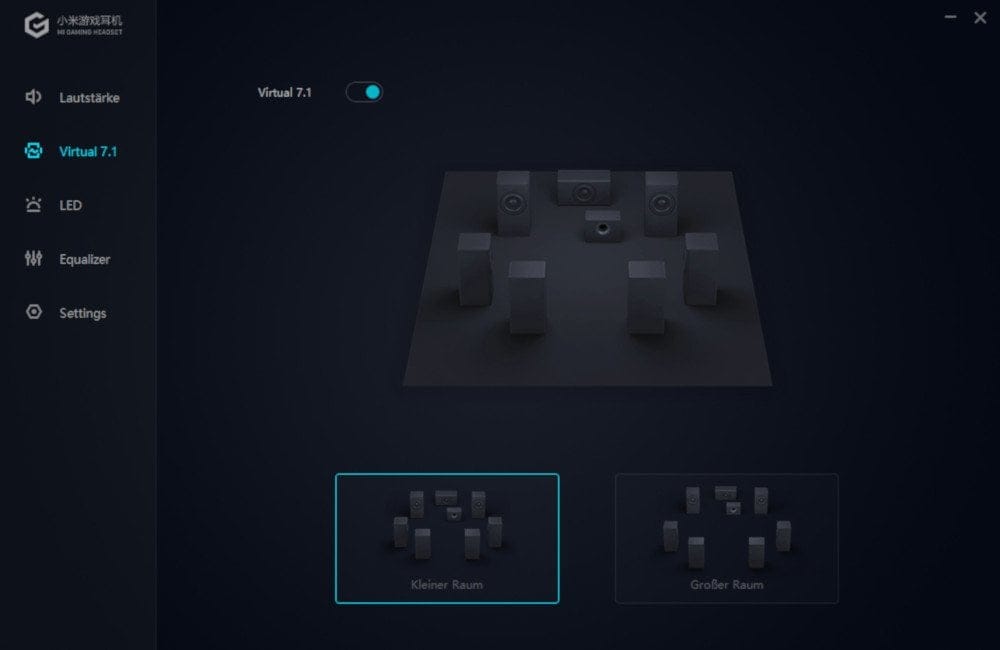
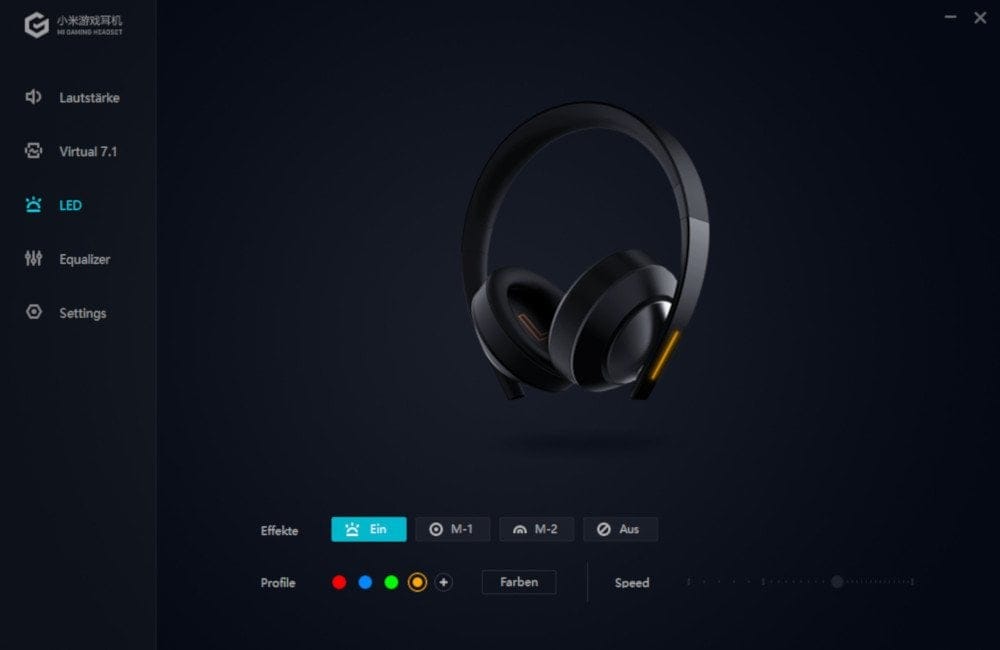
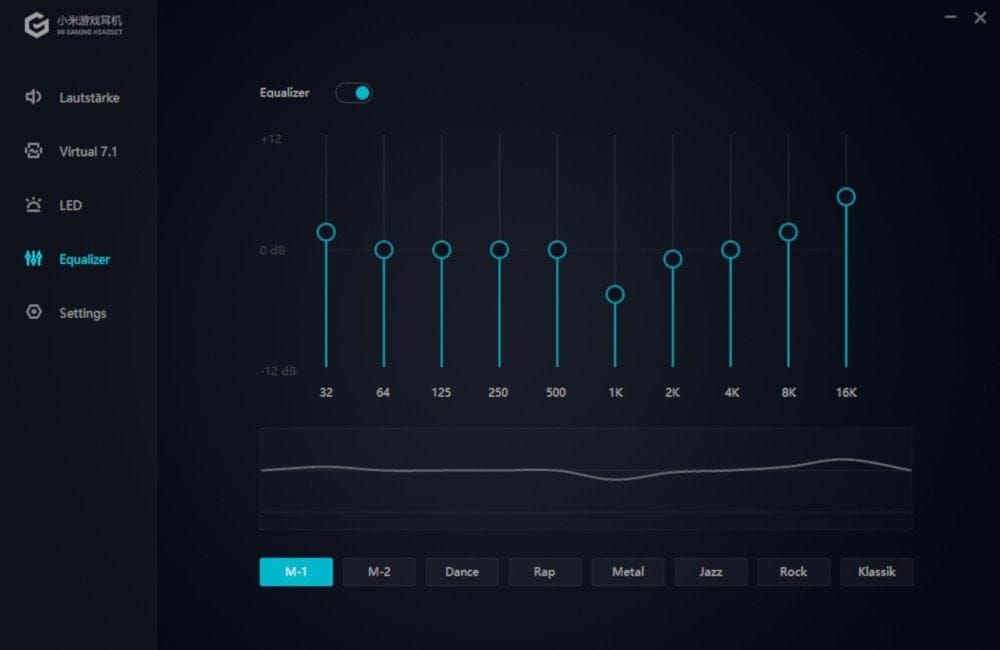
Within the general software settings, playback volume and recording volume can be controlled. It is also possible to choose the sample rate from 44.1 kHz to 96 kHz. The second menu item allows you to activate a virtual 7.1 surround sound. Item 3 covers the control of the LED strips. These can be configured regarding lighting mode (e.g. pulsating) and also the light colour, which can be freely selected via a colour wheel. Also included is an equalizer that already includes common music profiles.
Practical test of the Xiaomi gaming headset
Two dynamic 40 mm drivers with graphene membranes ensure rich sound. High-quality yet relatively expensive graphene drivers are still comparatively new to the market. Researchers at UC Berkeley only succeeded in constructing a graphene membrane suitable for the audio sector in 2013. Unlike the commonly used paper, plastic, aluminium, or titanium membranes, a graphene membrane is easier to set into vibration, has significantly higher tear resistance and allows for a smaller structural size. Acoustic advantages include, among other things, significantly higher volume without membrane damping as well as distortion-free sound reproduction across all frequency ranges.

Sound – Gaming
Crucial for a good gaming headset is high detail reproduction accompanied by accurate sound localization. However, a gaming headset should also provide impactful sound in action-packed single-player games. In testing, the Xiaomi Gaming Headset had to face off against the tactical shooter 'CS:GO', the survival title 'PUBG' and the single-player hit 'GTA V'.
There are definitely audio differences between USB-C and 3.5 mm jack operation! USB-C connection is particularly suitable for gaming mode. Only in this connection mode does the Mi Gaming Headset software work, including virtual 7.1 surround sound and the microphone!
The Xiaomi Gaming Headset scores in gaming tests with particularly clear and highly detailed sound. With 7.1 Surround Sound enabled, subtle audio details can be located with precise positional accuracy. The sound tuning is comparatively neutral, with a slightly emphasised midrange. This means that even distant footsteps and gunshots in titles like CS:GO come across very well. In fast-paced games, the headset sounds a bit flat with standard settings. However, with a little fine-tuning via the equalizer, a powerful sound can be conjured up that reaches well into the bass range. One shouldn't expect overly voluminous sound that makes the headset actually vibrate!
A disadvantage of the USB-C connection is interference, which manifests itself as white noise, a slight background hiss. However, the background noise is not overly significant and disappears already at normal playback volume.

Sound – Music
In our music test, the Xiaomi Gaming Headset proved to be a sonic all-rounder. Via the 3.5mm jack connection, the headphones deliver a pleasant sound with a V-shaped sound signature. The bass reproduction is punchy without being boomy. The mid-range is textured and warm, while highs are rendered clearly and cleanly. The same applies to the USB connection as noted above. The audio is accompanied by a slight background hiss, and sibilance in the high frequencies is also more pronounced.
How well the Xiaomi headset handles individual frequency ranges (3.5 mm!) is particularly well illustrated by Muse – Madness. The song is driven by powerful bass and Matt Bellamy's versatile vocals, which turn into euphoria towards the end. The gaming headset delivers very good separation with a great soundstage without getting lost towards the euphoric end. The bass is voluminous and Matt Bellamy's vocals sound airy and free without sibilants being emphasized. Whether in powerful moments or gentle sounds, the headphone delivers an appropriate sound image.

Microphone
Unlike most gaming headsets, the microphones of the Mi Gaming Headset are hidden within the ear cups. You won't find a microphone boom. It features two MEMS (Microelectromechanical System) microphones, one of which is for voice transmission, and the other for environmental noise cancellation (ENC). MEMS microphones are commonly used in mobile devices and offer an omnidirectional polar pattern.
The microphone's recording quality is average to good. Despite the lack of positioning options, speech is transmitted loud enough and understandably. Fans of mechanical keyboards, especially those with blue switches, can breathe a sigh of relief. The headset's 'Environmental Noise Cancellation' (ENC) feature actively filters out disruptive noises. A disadvantage of ENC, however, is that speech sounds noticeably more muffled.

Comfort and noise isolation
The comfort of wear is convincing. The circumaural ear pads are softly padded and enclose the ears comfortably without pressing. Heat buildup remains limited even after prolonged wear, ensuring that continuous gaming sessions do not become a torture. Due to the use of breathable artificial leather, the ear pads can be easily cleaned. The headphone band is also padded, adjustable in several steps for size, and covered with artificial leather.
The passive noise isolation is average. Ambient noise remains clearly audible despite the over-ear, closed-back headphone design. There is no active noise cancellation (ANC).
Our verdict
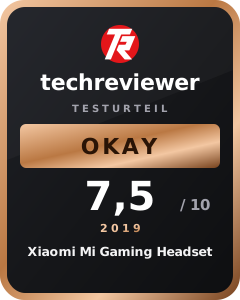
Gaming headsets are often criticised for being mediocre. Manufacturers usually focus more on extravagant design than on headphone drivers that sound good. In contrast, the Xiaomi Gaming Headset combines a simple, modern gamer design with two good-sounding dynamic 40 mm drivers featuring high-quality graphene diaphragms.
Whether on PC, Mac, console or mobile device, the USB and 3.5 mm jack connections make the headset versatile. In terms of sound, too, the Xiaomi headset is a true all-rounder. For gaming, the headphones impress with high detail reproduction and accurate sound positioning. The V-shaped sound signature will also please traditional music listeners. Xiaomi cleverly hides the microphone in the ear cups. The voice quality is convincing.
The headset receives criticism for its limited software support. Users of Linux and Mac systems cannot unfortunately access the Mi Gaming Headset software, which means they are denied ENC and 7.1 virtual sound. Also noticeable is a slight background noise when connected via USB, reduced voice quality with ENC activated, and rather mediocre (external) noise isolation.
Specifications
Headphones
- Driver type
- Dynamic
- Driver diaphragm
- Graphene
- Driver size
- 40 mm
Microphone
- Microphone type
- MEMS
- Polar pattern
- Omnidirectional
Cable
- USB
- Yes
- Jack audio
- Yes
Other
- Headphone type
- Closed
- Design
- Over-ear
- Adjustable size
- Yes
Comments