Contents
Xiaomi Mi 8
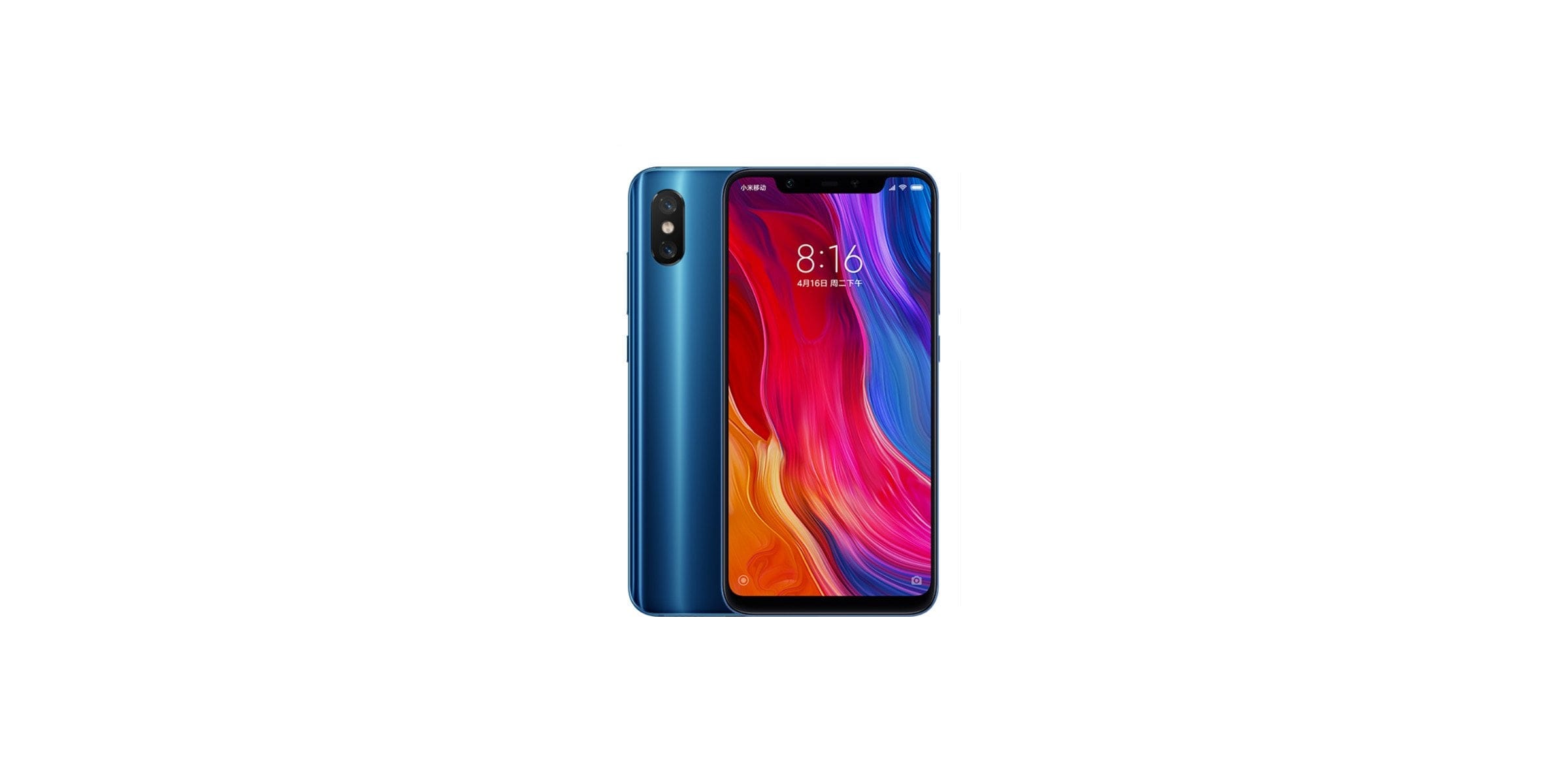
On 31 May, Xiaomi presented the new Mi flagship "Xiaomi Mi 8". The powerful smartphone has been released in 3 versions. The standard model of the Xiaomi Mi 8 is hardware-wise strongly oriented towards the recently released Xiaomi Mi Mix 2S. With the premium model, the so-called Xiaomi Mi 8 Explorer Edition, Xiaomi shows us new technologies, such as an in-display fingerprint sensor. The Xiaomi Mi 8 SE is, in turn, a mid-range device from the manufacturer that is based on the new Qualcomm Snapdragon 710 system-on-chip.
Notch and AMOLED display
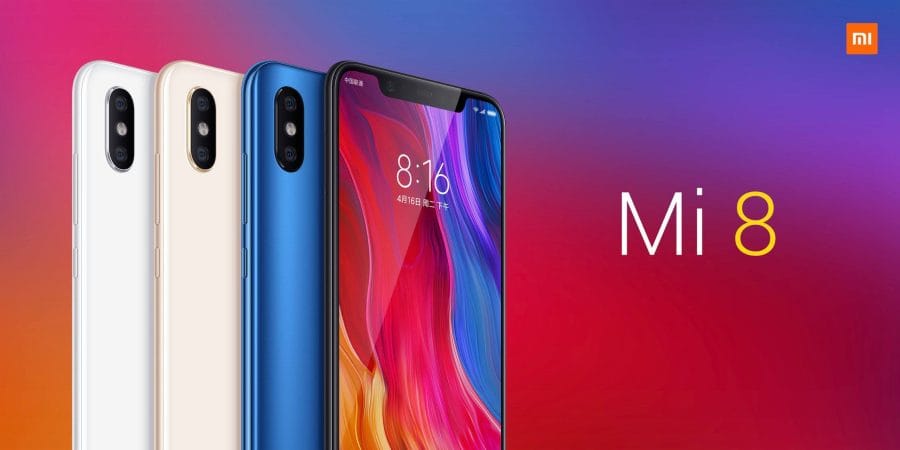
The Xiaomi Mi 8 is the first Mi smartphone with a "notch". It is also the first Mi smartphone with a AMOLED display panel. The panel is manufactured by Samsung. The display resolution is 2248 x 1080 pixels, with a display diagonal of 6.21 inches. The aspect ratio is an unusual 18.7:9. Xiaomi states the screen-to-body ratio is 86.68%.
Despite the huge display, the smartphone measures 154.9 x 74.8 x 7.6 mm and is not much larger than a standard 5.5-inch mobile device. With an above-average brightness of up to 600 cd/m², the Mi 8 is guaranteed to be clearly readable outdoors. The panel's colour accuracy follows the DCI-P3 colour space. A pixel density of 403 DPI ensures razor-sharp image representation. Other display features include a contrast ratio of 60,000:1 and the output of Mobile HDR (HDR10), which further enhances the display quality with corresponding HDR content.

The so-called "notch" is currently very trendy. This is a cut-out in the upper part of the display, creating space for the front camera and sensors. On the Xiaomi Mi 8, quite a bit is hidden behind the notch. Standardly accommodated there are the front camera, the earpiece and the proximity sensor. Also included are an infrared sensor and infrared light, which are intended to improve the face unlock function. This enables unlocking the smartphone in poor lighting conditions or even at night.
Processor and memory
Like the Xiaomi Mi Mix 2S, the Mi 8 is equipped with the current high-end SoC 'Qualcomm Snapdragon 845'. The system-on-chip consists of a total of 8 Kryo 385 processor cores that clock at up to 2.8 GHz. Compared to last year's SoC, the Snapdragon 835, the new Snapdragon 845 works up to 30% faster. In current AnTuTu benchmarks, the smartphone achieves an outstanding score of 301,472 points, making it even faster than the Xiaomi Mi Mix 2S (273,741 points) and the Xiaomi Black Shark (279,464 points). Despite the additional performance, Qualcomm has further optimised energy efficiency. The processor graphics of the SoC are also new. The Adreno 630 GPU promises enough power to play current mobile and AR games smoothly.
The memory configuration is also impressive. The "standard model" comes with 6GB LPDDR4X RAM and optionally 64GB, 128GB or 256GB UFS2.1 flash storage. Smooth multitasking is ensured by the ample and fast memory configuration. Storage expansion via microSD card is not supported.
Camera

Main camera
The dual main camera of the Xiaomi Mi 8 is no different from the main camera of the Xiaomi Mi Mix 2S. The smartphone relies on a 12-megapixel Sony IMX363 main sensor with an f/1.8 aperture and optical image stabilisation (4-axis OIS). The secondary sensor is a 12-megapixel Samsung S5K3M3 with an f/2.4 aperture and a telephoto or portrait lens. In the DxOMark, the Mi 8 scores marginally better than the Mi Mix 2S. It achieves 105 points in the photo benchmark and 88 points in the video benchmark.

DxOMark particularly praised the accurate colour reproduction, the lightning-fast autofocus, the very low noise level, and the very well-functioning bokeh effect. Criticism was directed at undesirably occurring colour fringing, deviations in white balance and sometimes loss of detail even in good lighting conditions. You can find the full DxOMark camera review of the Xiaomi Mi 8 at the following link: dxomark.com/xiaomi-mi-8-camera-review-challenging-best/

Also included is the Artificial Intelligence (AI) camera function. This enables a dynamic bokeh effect, image enhancement through scene detection, as well as automatic detection and translation of business cards, currencies and other texts. Videos are recorded by the main camera in maximum 4K resolution at 30 frames per second. Unfortunately, the Full HD video recording function is limited to 30 frames per second. Slow-motion recordings are possible in Full HD at up to 240 frames per second!
Front camera
The front camera features a 20 megapixel image sensor. Various beauty filters and a "Beauty-AI" artificially enhance selfies. Further features include an HDR shooting mode, face recognition, a bokeh effect mode, a mirror function and a 1080p video recording function.

Connectivity
The Xiaomi Mi 8 supports the most common global mobile network frequencies and bands. Here is an overview of the individual frequency bands.
| Mobile network frequencies / bands |
| GSM: B2 / B3 / B5 / B8 CDMAlX / EVDO: BC0 WCDMA: B1 / B2 / B4 / B5 / B8 TD-SCDMA: B34 / B39 TD-LTE: B34 / B38 / B39 / B40 / B41 FDD-LTE: B1 / B2 / B3 / B4 / B5 / B7 / B8 / B12 / B17 / B20 |
The smartphone is well equipped for the German market in terms of mobile network support. All LTE bands commonly used in Germany are supported. As a dual-SIM smartphone, the device can be fitted with two SIM cards. Both slots are LTE-capable. For wireless data transmission, the smartphone is equipped with a dual-AC MU-MIMO Wi-Fi module and a Bluetooth 5.0 module.
MIUI 10, Dual GPS and more
Xiaomi's user interface appeared in version 10 with the launch of the Xiaomi Mi 8. The so-called MIUI 10, based on Android 8.1, has been visually polished and expanded with in-depth features. For example, a control option for all the manufacturer's smart home devices has been implemented. As "Powered by AI", MIUI 10 also includes useful AI functions, such as the Camera AI, which creates a software-side bokeh effect and improves images even on older devices from the manufacturer.

Also new is the first-time use of a dual-frequency GPS. Dual GPS is intended to enable more precise positioning along with better navigation accuracy, even in urban areas. Other sensors include an ultrasonic distance sensor, a gyroscope, a barometer, an accelerometer, an e-compass, a Hall sensor, and an ambient light sensor. NFC is available, and the smartphone also features a rear fingerprint scanner. A 3.5 mm jack audio port is omitted. Xiaomi states the capacity of the (non-removable) battery as 3400 mAh. It can be charged via wire using USB-C. Quick charging supports Quick Charge 4.0.
Xiaomi Mi 8 Explorer Edition
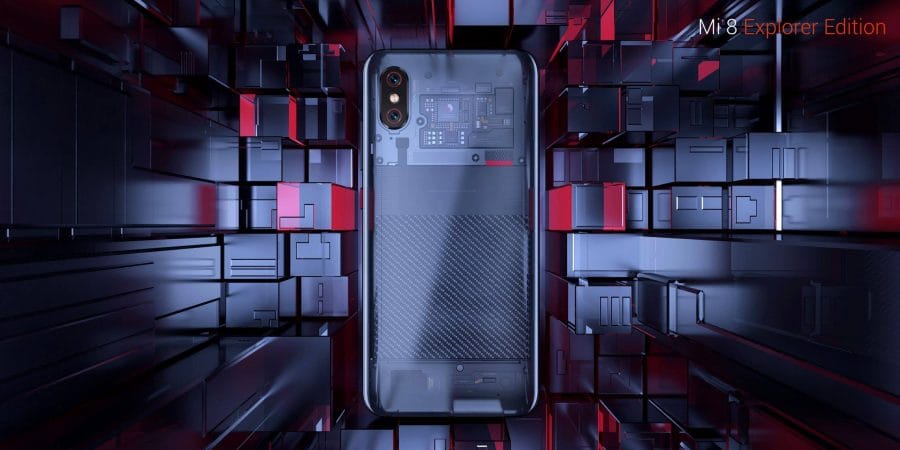
The Explorer Edition of the smartphone is the flagship model of the new Mi 8 smartphone series. There are already differences to the standard model in the design. The smartphone comes with a transparent back that gives insights into the inside of the smartphone. At the same time, the manufacturer presents two new technologies with the Xiaomi Mi 8 Explorer Edition. The smartphone has integrated the fingerprint sensor into the display, so it does not drop away on the back unlike the standard model.
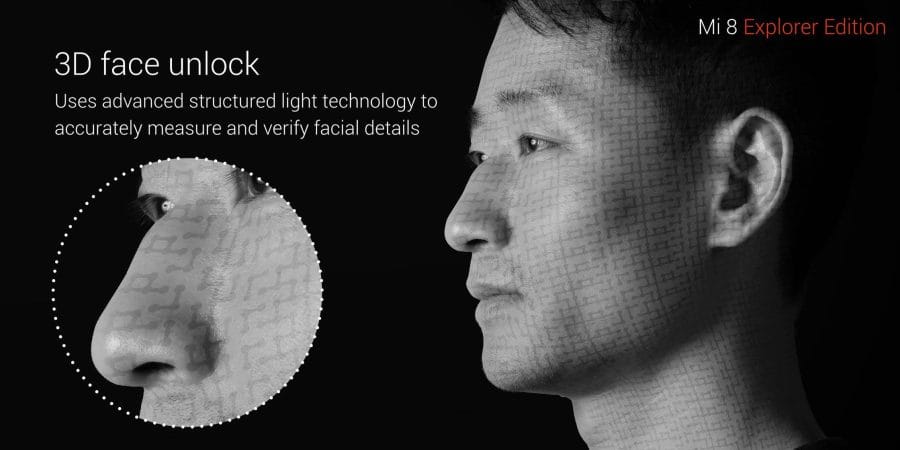
Another exclusive feature of the Explorer Edition is the 3D face recognition ("Face ID"). Using dot matrix projections, a 3D image of the face is created, enabling even more secure unlocking of the smartphone. Additionally, Xiaomi's Face ID recognises facial muscle movements, which is why Xiaomi could not resist implementing its own version of Apple's well-known "Animojis".

There are minor differences regarding the storage and the battery. For instance, the Mi 8 Explorer Edition comes with a larger 8GB LPDDR4X working memory and a 128GB UFS2.1 data storage. By contrast, the battery capacity is only 3000 mAh compared to the standard model. This is presumably a space-saving measure due to the additional sensors. It remains to be seen how the lower battery capacity affects battery life.
Price and availability
The Xiaomi Mi 8 is available in blue, gold, black and white. The model with 6GB+64GB storage is already available for 2,699 yuan, equivalent to €360, while the model with 6GB+128GB storage costs 2,999 yuan, equivalent to €403. The model with 6GB+256GB storage costs 3,299 yuan or €443. The Explorer Edition of the Xiaomi Mi 8 is expected to cost 3,699 yuan, equivalent to just under €494.
As soon as we receive test units of both Xiaomi Mi 8 models, detailed reviews will follow in due course!
Specifications
Processor and memory
- CPU
- Qualcomm Snapdragon 845
- GPU
- Adreno 630
- RAM
- 6GB / 8GB (LPDDR4X)
- Internal storage
- 64 GB / 128 GB / 256 GB (UFS 2.1)
- Storage expansion
- No
Display
- Display size
- 6.21 inches
- Display resolution
- 2248 x 1080 pixels
- Screen protector
- Tempered glass screen protector
- Multitouch
- 10 fingers
Cameras
- Main camera
- 2 x 12 megapixels
- *Aperture f/1.8 and f/2.4
- *4-axis OIS
- *AI mode
- *Autofocus
- *Dual-tone LED flash
- Front camera
- 20 megapixels
- *Bokeh
- *HDR
- *AI-Beauty
Mains
- Dual SIM
- Yes
- SIM size
- Nano SIM
- GSM
- B2 / B3 / B5 / B8
- CDMAlX / EVDO
- BC0
- WCDMA
- B1 / B2 / B4 / B5 / B8
- TD-SCDMA
- B34 / B39
- TD-LTE
- B34 / B38 / B39 / B40 / B41
- FDD-LTE
- B1 / B2 / B3 / B4 / B5 / B7 / B8 / B12 / B17 / B20
Wireless
- Wi-Fi
- 802.11 a/b/g/n/ac MU-MIMO
- Bluetooth
- 5.0
- GPS
- Yes, dual
Sensors
- *Ultrasonic proximity sensor
- *Ambient light sensor
- *Accelerometer
- *Proximity sensor
- *Hall sensor
- *E-compass
- *Barometer
- *Gyroscope
- *Fingerprint sensor (in display)
- *NFC
- *(3D Face-ID)
Battery
- Battery
- 3,400 mAh (3,000 mAh)
- Fast charging function
- Quick Charge 3.0
- Qi charging
- Yes
- Connection
- USB-C
Other
- Operating system
- MIUI 10
- Size
- 154.9 x 74.8 x 7.6 mm
- Weight
- 175g (177g)
Comments (7)
Hey, does wireless charging work on both phones or only the expensive one? Would be great to hear about this.
According to my information, no model in the Mi 8 series offers wireless charging.
Hi Ring, Vollkaracho is right. None of the Mi 8 models support Qi charging. Here you can find all the smartphone specs: http://www.mi.com/mi8/specs/ (use Google Translate to translate).
All clear, thanks!
Hi
, that is an exclusion criterion for me personally.
It works with the Mi Mix 2s as well.
Well then – too bad.
I will probably go with the one above after all.
An exclusion criterion simply because wireless charging is not supported? Come on. That is ridiculous.
No, I don't think so. It's the same for me; without Qi, count me out. It's just too convenient.