
Contents
First impression of the Xiaomi Redmi 3S
Introduction
Anyone interested in the Xiaomi Redmi 3 series will quickly lose track. Besides the Redmi 3 and the Redmi 3 Pro, there is now also the Redmi 3S and the Redmi 3X. The main difference between the four smartphones mentioned lies in the processor. The first two use a Snapdragon 616 Octa-Core processor, while the latter two use a Snapdragon 430 Octa-Core, which clocked slightly lower in a direct comparison. There are also other differences between the individual models. Xiaomi usually releases its smartphones in two versions. Where other retailers offer the same model with different storage sizes, Xiaomi additionally offers more RAM. The Xiaomi Redmi 3S is thus available as a 2GB/16GB variant and as a 3GB/32GB version. The model with 3GB of RAM was tested by us.
What’s included
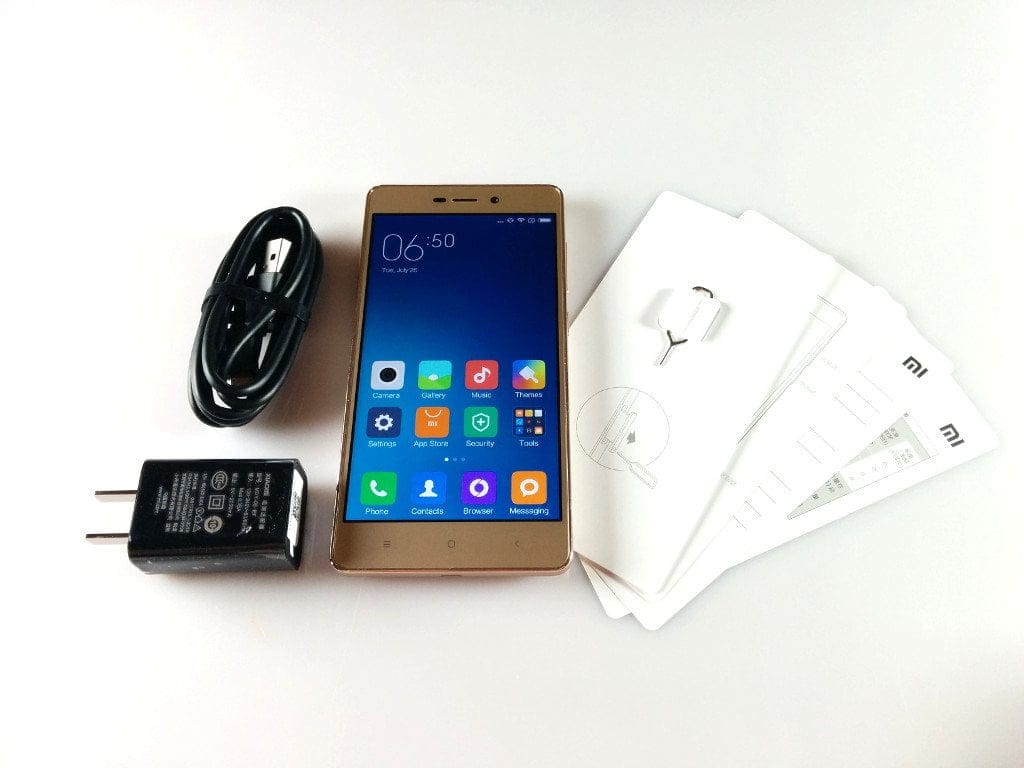
Xiaomi never includes much accessories with its smartphones. In addition to the smartphone, a charger, a USB cable, a SIM pin and a user manual are included. The manual is entirely in Chinese, and the charger also has a Type-A plug that can only be used in this country with an adapter. Most retailers, however, include such an adapter.

Build and design
Unibody
I have tested many Chinese smartphones across various price ranges, but with Xiaomi I have never been disappointed by the build quality or design of any device. Although the Xiaomi Redmi 3S is priced at around €120, the build quality is impressive and even makes some established brands look old. The “almost” metallic unibody casing is cleanly finished. There are no gaps or rough edges.
Why “almost” unibody? The top and bottom housing closures are made of plastic, presumably due to better connectivity. However, this detail is hardly noticeable visually. Because of the unibody design, the back panel is not removable. The battery cannot be replaced!


Hybrid SIM
The SIM card tray is located on the left side of the case. This dual-SIM slot is compatible with one micro SIM and one nano SIM. If, however, you want to use the storage expansion option via a SD memory card, you must sacrifice one SIM slot due to the „hybrid slot“.
Control buttons and notification LED
The side-mounted control buttons also sit firmly in the housing without any play. Even if you shake the smartphone vigorously, there is no rattling. In addition to the two physical control buttons, the power button and the volume rocker, the smartphone also has three capacitive buttons located below the display. Unfortunately, these buttons are not illuminated. Underneath the central "Home" button, there is a notification LED that lights up in various colours and can be programmed via the settings.
Other
Above the display are the earpiece, front camera and proximity sensor. The smartphone also has two microphone inputs, an infrared sensor, a 3.5mm audio jack and a micro USB port. The two microphones ensure clear voice transmission without noise interference. With the infrared sensor and the appropriate TV app, the Xiaomi Redmi 3S can be used as a remote control. On the back are a 13-megapixel main camera with LED flash and a fingerprint scanner.


Display
The Xiaomi Redmi 3S has a 5-inch IPS HD display with a resolution of 1280x720 pixels. The pixel density is 294 PPI. This results in a razor-sharp display, where individual pixels are no longer visible.
The display representation could hardly be better. All colors are displayed vividly and the contrast is excellently balanced. The viewing angle stability of the Redmi 3S is convincing. No matter how you turn or tilt the smartphone, text remains clearly legible even at extreme viewing angles, and the colors remain unchanged. The maximum display brightness is sufficient to guarantee good legibility even in direct sunlight.
In the multitouch test, the Redmi 3S achieves 5 simultaneous inputs. The Redmi 3, released a few months ago, supported multitouch with a maximum of 10 fingers. This does not mean the touchscreen of the Xiaomi Redmi 3S is any worse. All inputs are recognised precisely. Unfortunately, there is no information about the display glass used. However, one can assume that Corning Gorilla Glass 3 is not being used here!
Performance
Xiaomi continues the Redmi 3 series with a Snapdragon 430 processor. This is an octa-core processor clocking at 4x1.4 GHz and 4x1.1 GHz. The graphics unit consists of an Adreno 505 GPU. In a direct comparison with the Snapdragon 616 processor of the Redmi 3 and Redmi 3 Pro, no performance difference is noticeable. On the datasheet, however, the Snapdragon 430 of the Redmi 3S is weaker.
The model with 3 GB RAM and 32 GB internal storage performs well. Apps open promptly, and even graphically intensive games run smoothly on the Redmi 3S. Even when multitasking with numerous open apps, app switching is seamless and performance is maintained. Overall, the Xiaomi Redmi 3S's system is very well tuned to the hardware. Frame rate drops only occurred in games with very high graphical demands.


User interface
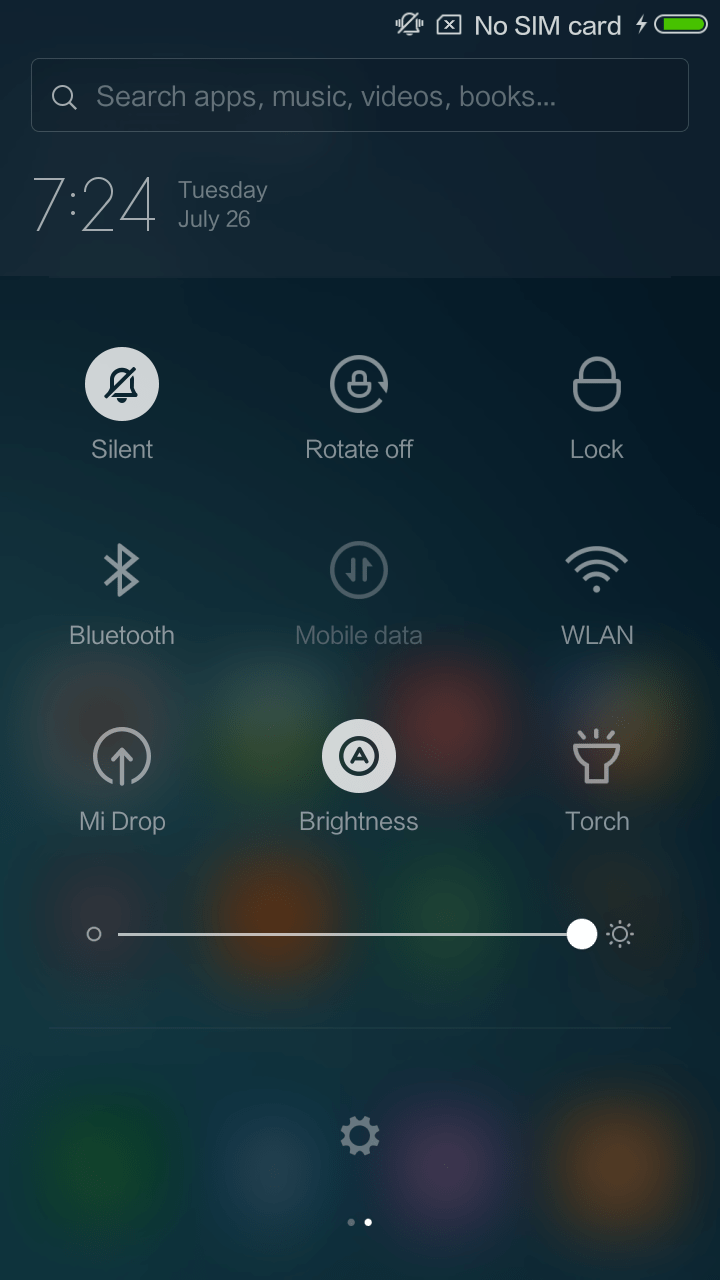
The Xiaomi Redmi 3S uses MIUI 7 based on Android 6. Those unfamiliar with MIUI 7 and accustomed to clean stock Android must first familiarise themselves with the heavily modified user interface. Xiaomi’s MIUI offers numerous extensions and settings options, making many apps redundant. The language can be switched to English and also to German, although occasional translation errors may occur.
The pre-installed apps are partly in English, but also in Chinese. The Chinese apps can partly be uninstalled, but it is advisable to subsequently install a custom ROM or the MIUI Global ROM. Google Apps and the associated Play Store are not pre-installed by default! The Play Store can, however, be installed subsequently using the so-called “Google Installer”.
MIUI is very customisable. Various themes are pre-installed but can also be downloaded via the Mi AppStore. Within the settings, there are, among other things, specific settings for the notification LED, but a comprehensive "Security Center" has also been integrated into MIUI. Overall, the design of the MIUI user interface is very modern and somewhat reminiscent of Apple's iOS.
The new MIUI 8 will soon be available for the Xiaomi Redmi 3S. According to the manufacturer, it could happen in the coming weeks!
Update: MIUI 8 is now also available for the Global ROM. First custom ROMs (e.g. CyanogenMod 14) and kernels have also been released. Flashing instructions and download links for the available ROMs can be found in the XDA-Developers Forum.


Camera
The main camera of the Xiaomi Redmi 3S has a resolution of 13 megapixels. The image sensor used is unknown. However, details about the aperture and lens are available. The aperture is f/2.0 and the lens is a 5P lens. An autofocus system (PDAF) and an LED flash are also included.
Xiaomi uses a camera app exclusive to MIUI that offers a considerable range of features. In addition to various shooting modes, such as the panorama mode or the "Beauty Mode", this app also offers integrated filters, similar to the well-known "Retrica app".
The main camera of the Redmi 3S impresses with noise-free images, natural colour representation and pleasant sharpness under good lighting conditions. Only in poorer light does the image become increasingly blurred and noise increases. The autofocus works accurately and focuses above-average quickly. The shutter delay is also comparatively short. From a price-to-performance perspective, the Xiaomi Redmi 3S offers one of the best cameras in this price range.
The front camera has a resolution of 5 megapixels. The aperture is f/2.2. The selfies taken during testing were mostly usable. Image noise is only noticeable in poorer lighting conditions.


Fingerprint scanner
The fingerprint scanner of the Redmi 3S is easy to configure. Once an unlock method is set up, finger profiles can be created. To improve accuracy, it is recommended to scan the finger used primarily for unlocking multiple times. The fingerprint scanner then works accurately and also recognises a finger placed slightly sideways. The unlock time is still average, but could certainly be faster!
Telephony, Wi-Fi and Bluetooth
Xiaomi does without LTE Band 20 to the detriment of German and many European users, which is why Xiaomi smartphones, including the Redmi 3S, cannot be used fully in the German LTE network.
The call quality and signal strength are convincing, and mobile surfing is sufficiently fast with HSDPA. Thanks to the additional microphone, hands-free calling is also possible without interference.
The Redmi 3S also performs well in terms of Wi-Fi. In the 2.4GHz network, the range is above average and the signal strength remains very well maintained. Unfortunately, the 5GHz network is not supported. There were also no problems with Bluetooth during the testing phase. Bluetooth devices connected easily and data transfer proceeded without interference.
GPS and sensors
A GPS fix was acquired within just a few seconds. With the “GPS Test” app, positioning was accurate to within 3 meters. I could not determine why a more precise value was not displayed. However, navigation via Google Maps worked smoothly, and the position was determined precisely.
The Xiaomi Redmi 3S integrates a very large number of sensors. In addition to the usual brightness, proximity and acceleration sensors, the smartphone also features a gyroscope and an e-compass. Furthermore, an infrared sensor has been installed, allowing the smartphone to be used as a remote control with a "Remote App".


Battery
All Redmi 3 models are battery powerhouses despite their compact size (69.6 mm x 139.3 mm x 8.5 mm). The Redmi 3S has a 4100mAh battery that offers above-average battery life. The battery charges in approximately 2-3 hours, depending on the charger used. Battery life is a good 2-3 days with normal usage. With intensive use (hello, Pokémon Go!), I didn't have to recharge the smartphone until noon the next day.
Our verdict
The Xiaomi Redmi 3S is another excellent device in the Redmi 3 model series. The smartphone is convincing in almost every respect, which is why only the missing LTE band 20 represents the biggest criticism.
The build quality could hardly be better, and the design is convincing thanks to high-quality materials and a cohesive, gold-coloured housing. The main camera takes impressive images in good lighting conditions, and the front camera is also convincing in good light.
The MIUI 7 user interface is perfectly adapted to the hardware, enabling a smooth user experience. Combined with the powerful battery, the Redmi 3S becomes an excellent everyday smartphone.
Specifications
General
- Display
- 5-inch IPS HD
- Resolution
- 1280x720 pixels
- Processor
- Snapdragon 430 Octa-Core
- GPU
- Adreno 505
- RAM
- 3GB (2GB)
- Storage
- 32GB (16GB)
- Main camera
- 13 megapixels, f/2.0, PDAF, LED flash
- Front camera
- 5 megapixels
- SIM
- Micro & Nano SIM (Hybrid)
- Mains
- 2G, 3G and 4G
- *GSM 900/1800/1900MHz
- *WCDMA 850/900/1900/2100MHz CDMA 2000 BC0
- *FDD-LTE 1800/2100/2600MHz
- Fingerprint scanner
- Yes
- GPS
- Yes
- Sensors
- *Brightness, proximity, acceleration, infrared sensor
- *E-compass and gyroscope
- Battery
- 4100mAh
What’s included
1x Xiaomi Redmi 3S 1x charger (Type-A plug) 1x USB cable 1x SIM tool 1x user manual

Comments (7)
Hi, does the Redmi 3S have a notification LED?
Hi Fred,
yes, below the home button is the notification LED. The LED lights up in different colours and can be configured via the settings!
Many thanks for the review and the great sample images. I have also ordered the Redmi 3 with 3GB and am really excited.
The genius part is that there is now the Band 20 version. Goodbye Samsung
Yes, specifically Band 20
Hello,
What about voice quality or sound quality when using a hands-free system in the car via Bluetooth with two SIM cards inserted?
Today I noticed several times that the quality was rather poor, sometimes to the point of being unintelligible. My conversation partner, however, can hear me perfectly. I had not experienced such problems before, so I suspect it is due to the end.
I would also be interested to know if there is a possibility in MIUI 8 to adjust notification and call volume separately from each other? Furthermore, I miss the setting option for the general vibration intensity. Preferably also adjustable separately.
I am not currently using the Redmi 3S, but I have never had any problems with dual SIM in combination with Bluetooth. The volume control in MIUI 8 is largely comparable to that of stock Android. You can adjust the ringtone, media, and alarm volumes. Settings for vibration strength are also available (Off, Weak, Medium, Strong).