Contents
Xiaomi Redmi 5 (Plus)
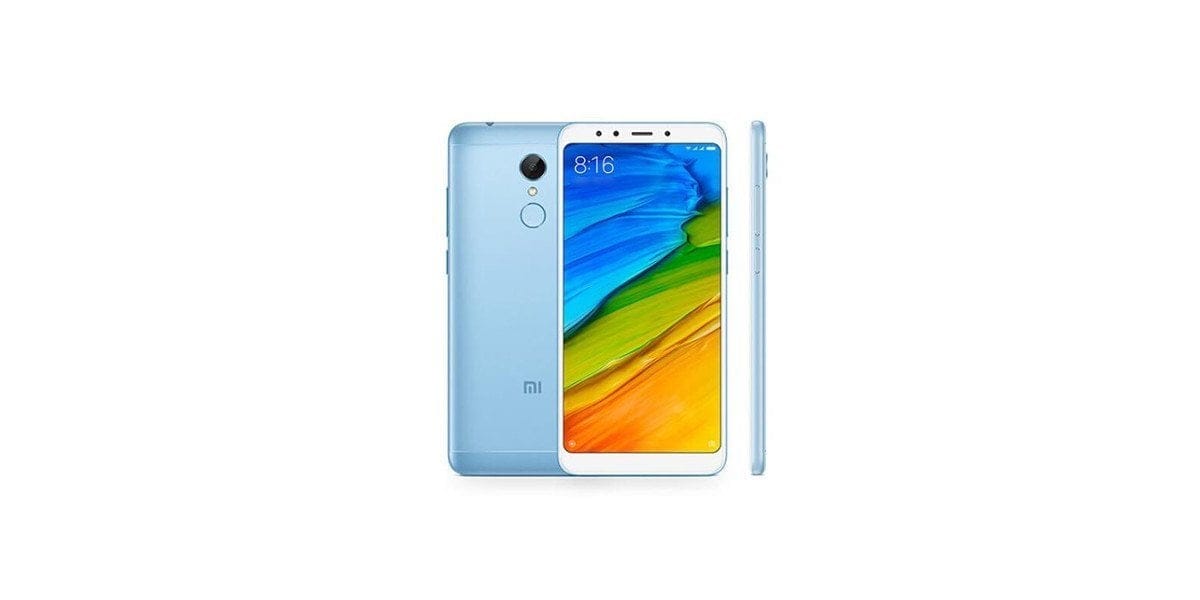
Following numerous previous leaks, Xiaomi has officially unveiled its two new Xiaomi Redmi models, the Redmi 5 and Redmi 5 Plus. Xiaomi Redmi models are known for offering the usual high Xiaomi build quality and adequate hardware specifications for under 200€. Details on the specifications of the two smartphone models, how they differ, and their price and availability will be covered in the following sections!
Display
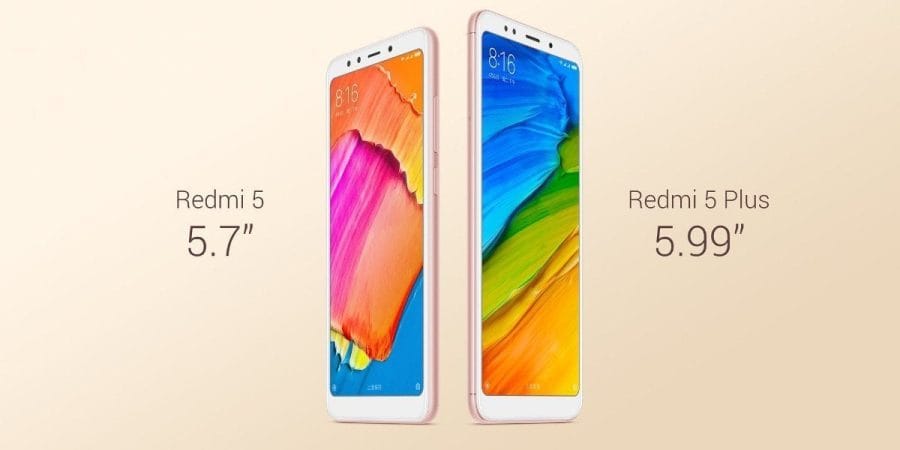
Smartphones with a high-resolution display in 18:9 format are a trend this year. The two Redmi 5 models also feature such an 18:9 display. The Redmi 5's display has a diagonal of 5.7 inches and a resolution of HD at 1440 x 720 pixels. The pixel density is 282 PPI. The Xiaomi Redmi 5 Plus, on the other hand, has a slightly larger display with a diagonal of 5.99 inches. The resolution is 2160 x 1080 pixels, resulting in a pixel density of 403 PPI.
Despite the large display diagonal, smartphones in the 18:9 format are comparatively compact and similar in size to smartphones with a 5.5-inch display in 16:9 format. The contrast ratio of both displays is 1000:1. The brightness is exceptionally high for both models at 450 nits, which means that readability should hardly be impaired even on sunny days. The display of the Redmi 5 covers 72% of the NTSC colour space. The display of the Redmi 5 Plus covers 84% of the NTSC colour space. Thanks to MIUI 9, software-side implementations include a night and reading mode, as well as extensive display correction options.
Processor and memory
The two new Redmi models also differ in terms of processor and memory specifications. The smaller Redmi 5 is equipped with a Qualcomm Snapdragon 450 processor, which belongs to the lower mid-range. The processor consists of 8 Cortex-A53 processor cores clocking at up to 1.8 GHz. The processor graphics are provided by an Adreno 506 GPU. The Xiaomi Redmi 5 is one of the first mobile devices equipped with the processor, which was first presented in June 2017. The memory configuration consists of either 2GB or 3GB RAM (LPDDR3) and 16GB or 32GB eMMC5.1 flash storage. How the new hardware performs in practice will have to be shown in the test. However, a smoothly operable system can be expected.
 Play video on YouTube
The Xiaomi Redmi 5 Plus, on the other hand, features a Qualcomm Snapdragon 625 processor released in early 2016, which has already been used in other Xiaomi smartphones, such as the Xiaomi Redmi Note 4 or the Xiaomi Mi Max 2. This is also an octa-core processor, with its 8 Cortex-A53 processor cores clocking at up to 2 GHz. The processor graphics, as with the smaller Redmi 5, consist of an Adreno 506 GPU. Further differences lie in the storage options, which for this model come with either 3GB or 4GB RAM (LPDDR3) and 32GB or 64GB eMMC5.1 flash storage. It is reasonable to assume that the performance jump from the weaker Snapdragon 450 to the slightly faster Snapdragon 625 will hardly be noticeable in everyday use. The storage on both smartphones can be expanded using a MicroSD memory card!
Camera
There is consensus regarding the camera equipment. Both models offer a 12 megapixel main camera with a (currently) unnamed image sensor. However, the sensor's pixel size is known, which Xiaomi specifies as 1.25 μm, which in turn, in combination with the 12 megapixel resolution of the sensor, suggests a Sony IMX286 image sensor. The manufacturer specifies the aperture as f/2.2. An LED flash is present on both models, with the Redmi 5 Plus using a dual-tone LED flash. The autofocus is of the "PDAF" type. The front camera has a resolution of 5 megapixels. The "Smart Beauty 3.0" mode allows various beauty filters to be applied to the image.

Design, battery and other
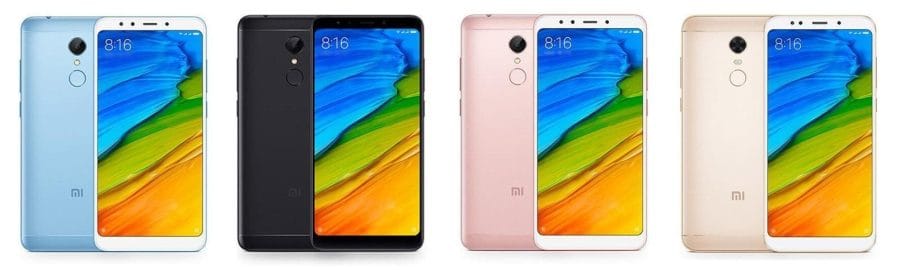
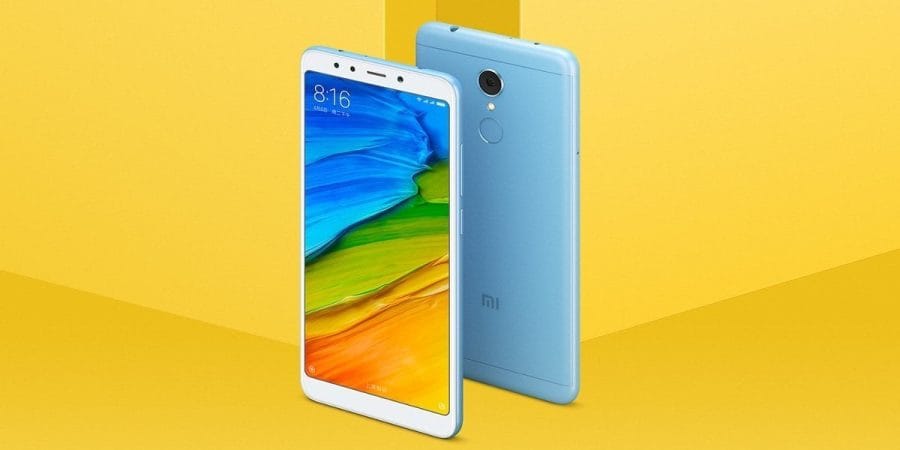
Both models come in a high-quality metal housing. The Redmi 5 series is available in the colours "Gold", "Light Blue", "Rose Gold" and "Black". The housing dimensions of the Redmi 5 are 151.8 x 72.8 x 7.7 mm, those of the Redmi 5 Plus are 158.5 x 75.45 x 8.05 mm. The weight is 157g or 180g respectively. Further features include a rear fingerprint scanner, located below the main camera. The USB connection is of the Micro-USB type. A 3.5 mm audio jack is present. There are two microphones in total. Another feature of both models is an infrared transmitter unit. The sensor equipment consists of a distance sensor, an ambient light sensor, an acceleration sensor and a gyroscope. Additionally, the Redmi 5 Plus offers a Hall sensor.
In terms of wireless connectivity, the Redmi 5 works with 2.4 GHz Wi-Fi, and the Redmi 5 Plus also works with 5 GHz Wi-Fi. Bluetooth is supported in version 4.2. GPS, GLONASS and Beidou are supported for positioning and navigation. As dual-SIM smartphones, both devices can be equipped with two nano-SIM cards. In the mobile network, 4G LTE is only usable to a limited extent due to the missing band 20. The battery of the Xiaomi Redmi 5 has a capacity of 3.300 mAh. The battery capacity of the Xiaomi Redmi 5 Plus is 4.000 mAh.
Pricing and availability
In China, the Redmi 5 (2GB) is already available from 799 yuan, which corresponds to approx. €102. The model with 3GB costs 899 yuan, equivalent to just under €115. If you opt for the larger Redmi 5 Plus, the variant with 3GB starts at 999 yuan, or about €130. The Redmi 5 Plus with 4GB of RAM costs 1299 yuan, which corresponds to a price of €166. First import shops have already listed both smartphones. Import prices are currently still slightly higher than the China prices. Shipping is expected from the end of December. As soon as we receive a test unit, the detailed test report will follow at this point!
Specifications
Processor and memory
- CPU
- Qualcomm Snapdragon 450 (Snapdragon 625)
- RAM
- 2GB / 3GB (3GB / 4GB)
- Internal storage
- 16 GB / 32 GB (32 GB / 64 GB)
- Storage expansion
- Yes
Display
- Display size
- 5.7 inches (5.99 inches)
- Display resolution
- 1440 x 720 pixels (2160 x 1080 pixels)
- Luminance
- 450 Nits
- NTSC colour gamut
- 72% (84%)
Cameras
- Main camera
- 12 megapixels
- *Aperture f/2.2
- *PDAF
- *LED flash
- Front camera
- 5 megapixels
Mains
- Dual SIM
- Yes
- SIM size
- Nano SIM
- GSM 2/3/5/8
- CDMA 1x BC0
- CDMA 2000 BC0
- WCDMA 1/2/5/8
- TDS-CDMA 34/39
- TDD-LTE 34/38/39/40 / 41
- FDD-LTE 1/3/5/7/8
Wireless
- Wi-Fi
- 802.11 b/g/n (802.11 a/b/g/n)
- Bluetooth
- 4.2
- GPS
- Yes
- Sensors
- *Distance sensor
- *Ambient light sensor
- *Accelerometer
- *Gyroscope
- *Fingerprint sensor
- *Infrared transmitter
- *(Hall sensor)
Battery
- Battery
- 3,300 mAh (4,000 mAh)
- Connection
- Micro-USB
Other
- Operating system
- Android 7.1.1 (MIUI 9)
- Size
- 151.8 x 72.8 x 7.7 mm (158.5 x 75.45 x 8.05 mm)
- Weight
- 157g (180g)
- *The values in brackets refer to the Redmi 5 Plus
Comments (4)
Removing dual-channel WiFi from the Redmi 5 was a really poor decision. The Plus has it, but it is just too big for me. Apart from that, the specs read really well.
No LTE band 20. I'm out.
What did you expect? It was obvious that the smartphone would initially be available without band 20. Even with the European launch, it will still take some time until Xiaomi phones are released with all frequency bands. Give them another 3 months and you can order it from Amazon with band 20.
I call it really lame to build such an old processor into the Redmi 5 Plus. It's just another stopgap until the next generation. I was hoping for more and would rather wait for the Redmi Note 5.