
Contents
Foreword: Redmi 7
The Redmi smartphone has reached its 7th generation. Like its predecessors, the Redmi 7 also aims to offer good specifications at a low price. Nevertheless, much has changed at Redmi. Instead of a high-quality metal case, there is now only plastic. The difference in size compared to the Redmi Note models has also disappeared. Rather than being compact and handy, the Redmi 7 is a 6.26-inch phablet.
Design, build quality, and included accessories
Small and light is yesterday's news. The Redmi 7 is a true phablet, with a size of 15.87 x 7.56 x 0.85 cm and a weight of 180g. Apart from the front, which is protected by Corning Gorilla Glass 5, the casing is made entirely of plastic. The frame has a black-matt finish, while the back is available in shiny black, blue and red.
The smartphone is structured as follows:
On the front is the 6.26-inch IPS display. Following the trend, it features a teardrop notch surrounding the 8-megapixel front camera. Above the front camera is the narrow but wide earpiece.

The smartphone is operated via virtual on-screen buttons or gestures. A white-glowing notification LED is present and located on the right side of the lower frame. The display bezels are 3 mm wide on the sides and 8 mm wide at the bottom of the frame.
The housing frame has a power button and volume rocker on the right-hand side. The dual-SIM slot is located on the left-hand side. At the bottom are a microUSB port, the mono loudspeaker and a microphone. At the top, the smartphone is equipped with a 3.5 mm audio jack, another microphone and an IR blaster.

The back of the Redmi 7 is glossy and offers an interesting colour gradient, at least in red and blue. Unfortunately, the back is not made of glass but of plastic. This makes it particularly susceptible to scratches, which is why you should definitely use the protective case supplied. But otherwise, the back is also very susceptible to fingerprints and dirt. Further features of the back include a vertically arranged main camera with an LED flash and a centrally located fingerprint scanner.
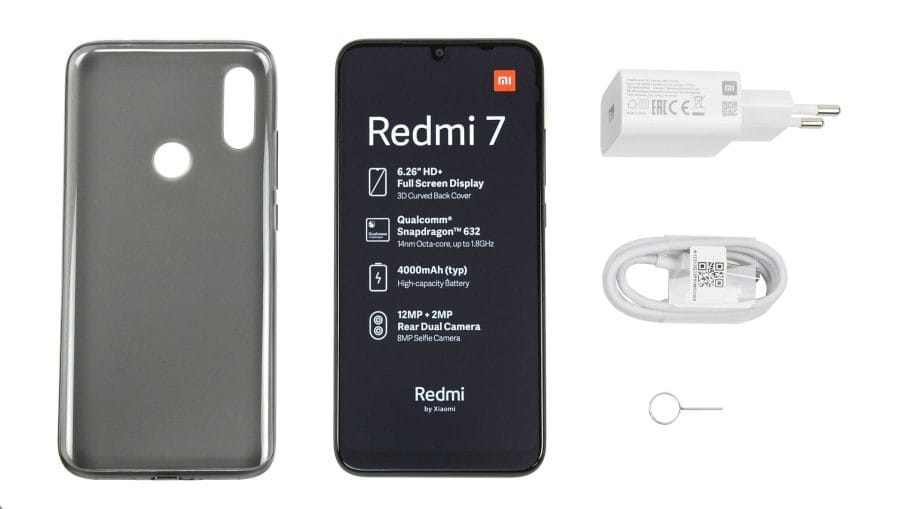
The build quality is good for the price. However, the smartphone feels cheap to the touch, which in turn is due to the extensive use of plastic and the very thick casing. The package contents include, in addition to the smartphone, a silicone protective case, a charger, a charging cable, a SIM pin and an information leaflet.
Display
Xiaomi opted for a 6.26-inch IPS display in the Redmi 7. The resolution is 1,520 x 720 pixels, equating to 269 pixels per inch. Despite the comparatively low pixel density, individual pixels only become visible upon very close inspection. The aspect ratio is 19:9, which is typical for a notch smartphone.
Display measurement
Xiaomi specifies the display with a maximum luminance of 450 cd/m². A display measurement performed with a colorimeter showed a display brightness of a maximum of 415 cd/m². The brightness deviation distributed across the display is a maximum of 20 cd/m². The black level is 0.29 cd/m². The contrast ratio is 1:1454.


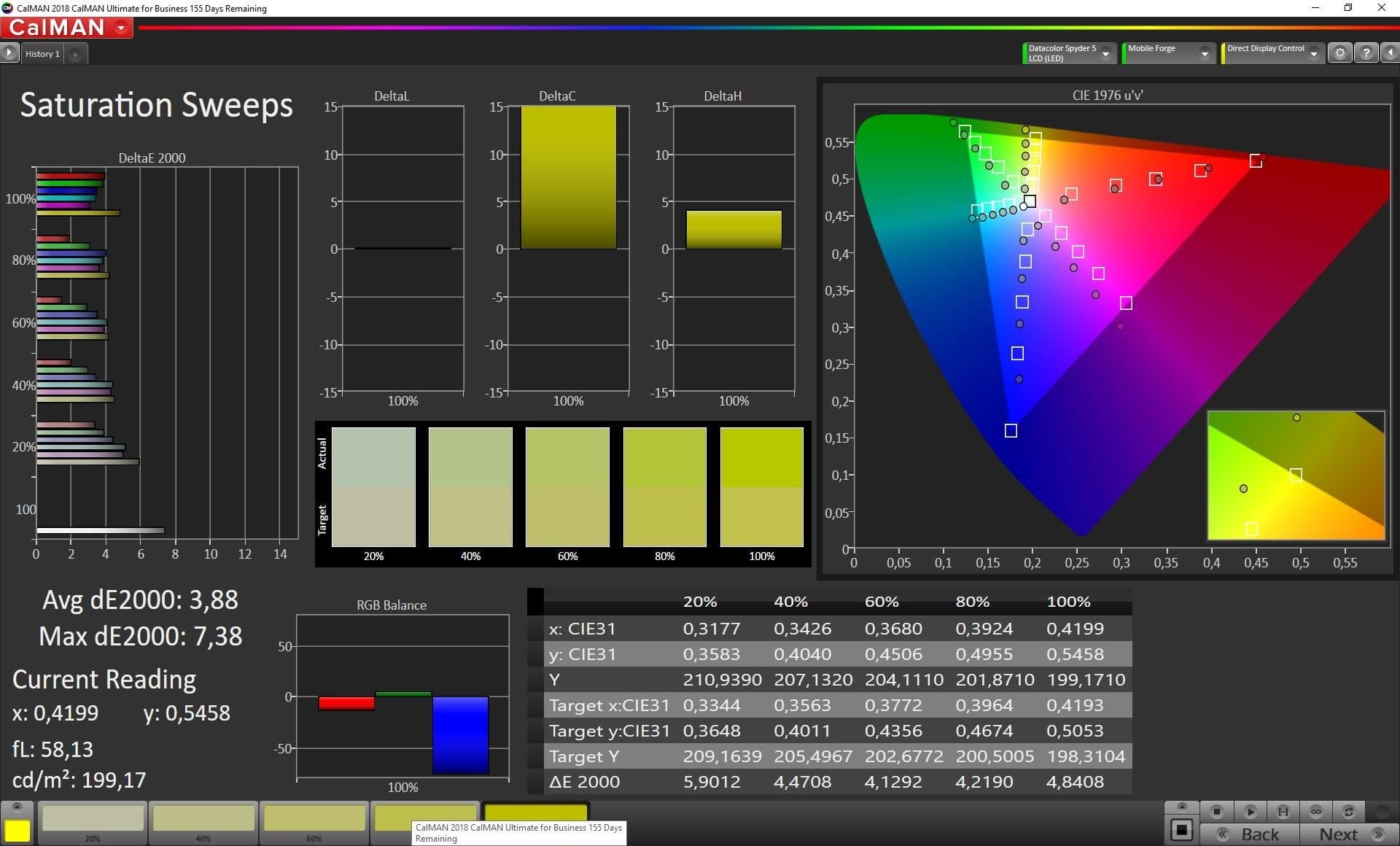
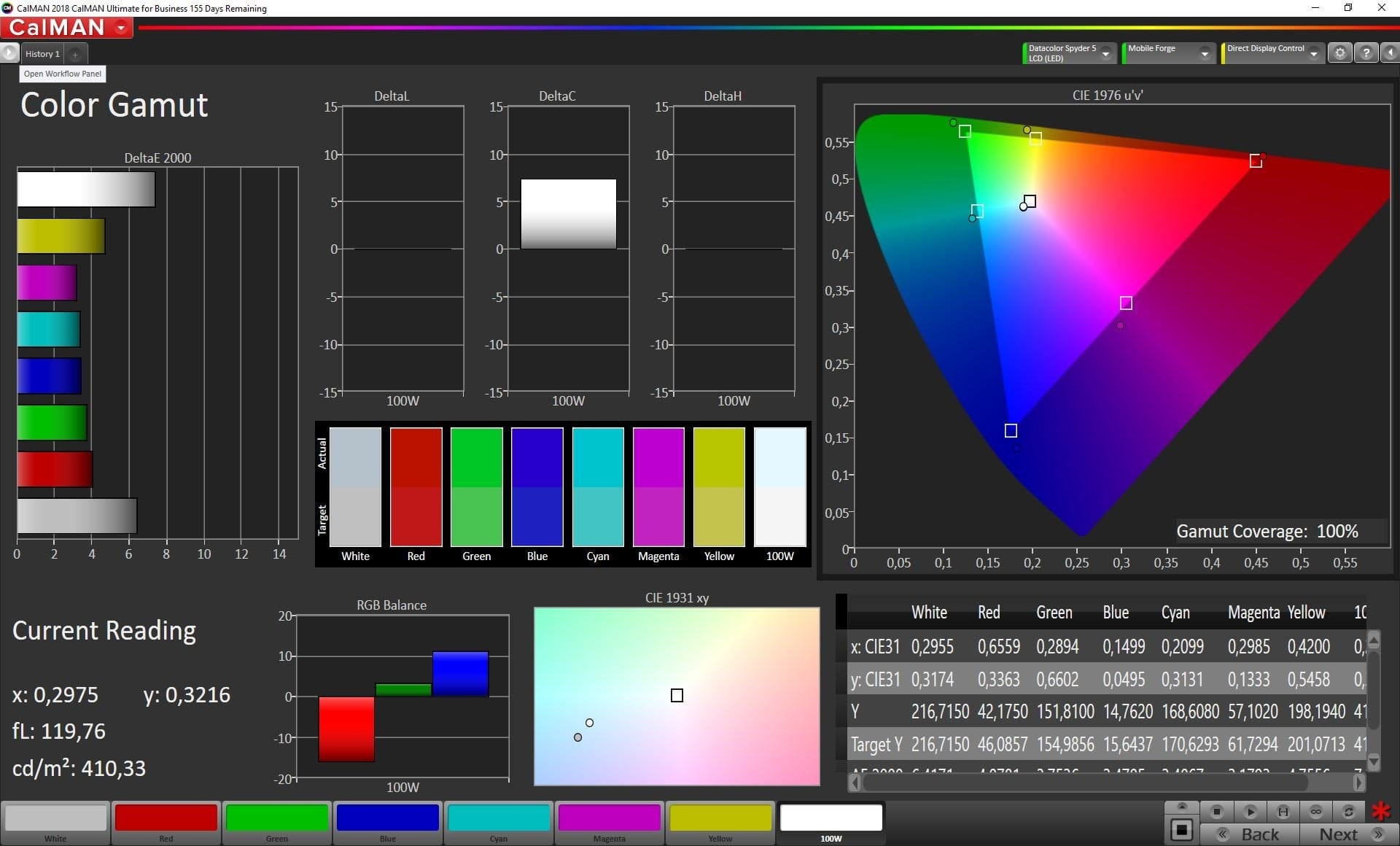
The colour deviations measured in standard colour mode against the sRGB colour space average a Delta E of 4.35, with a maximum Delta E of 7.37. The Redmi 7 displays grey tones with a slight blue tint.
Display in everyday use
Considering the price, the Redmi 7 is equipped with a quite good display. Despite the low resolution, no pixels are visible at normal viewing distances. The colour reproduction appears pleasantly natural to the naked eye. Colours are displayed neither too warm nor too cold. Only black appears rather dark grey.
The viewing angle stability is also convincing. Tilting the smartphone reveals slight brightness changes. Colour fidelity largely remains intact. The Redmi 7 is well readable outdoors. Only in direct sunlight does the reflective display glass impair readability.
Display settings and features
The display settings include various options for adjusting brightness, colours and contrast. There is an automatic brightness mode, three colour profiles including a manual colour mode, and an automatic contrast mode.
The font size can be adjusted in several steps. A reading or night mode filters blue light, which is significantly more comfortable for the eyes. The mode can be activated according to a schedule, and the filter intensity can be customised to suit your needs.
Touchscreen
The touchscreen recognises up to 10 simultaneous inputs. Unfortunately, inputs are registered with a slight delay, which is noticeable especially when typing quickly. The recognition accuracy is good. The display is protected by Corning Gorilla Glass 5. The anti-fingerprint coating makes the display glass easy to clean.
Performance
Qualcomm Snapdragon 632
The Qualcomm Snapdragon 632 built into the Redmi 7 is a mid-range processor released in mid-2018. Manufactured using a 14 nm process, the chip replaces the Snapdragon 630 released in 2017. Qualcomm promises a performance increase of nearly 30%. The CPU consists of 4 Kryo 250 Gold cores (Cortex-A73) and 4 Kryo 250 Silver cores (Cortex-A53), clocked at up to 1.8 GHz. The GPU is an Adreno 506.
The system-on-chip (SoC) uses an LPDDR3 memory controller. Accordingly, the Redmi 7 is available with either 2GB, 3GB or 4GB (CN version) RAM. For the data storage (eMMC), you can choose between 16GB, 32GB and 64GB. Storage expansion via microSD card is supported up to 512GB. Fortunately, it is a triple-slot design that does not impair dual-SIM capability.
Benchmark
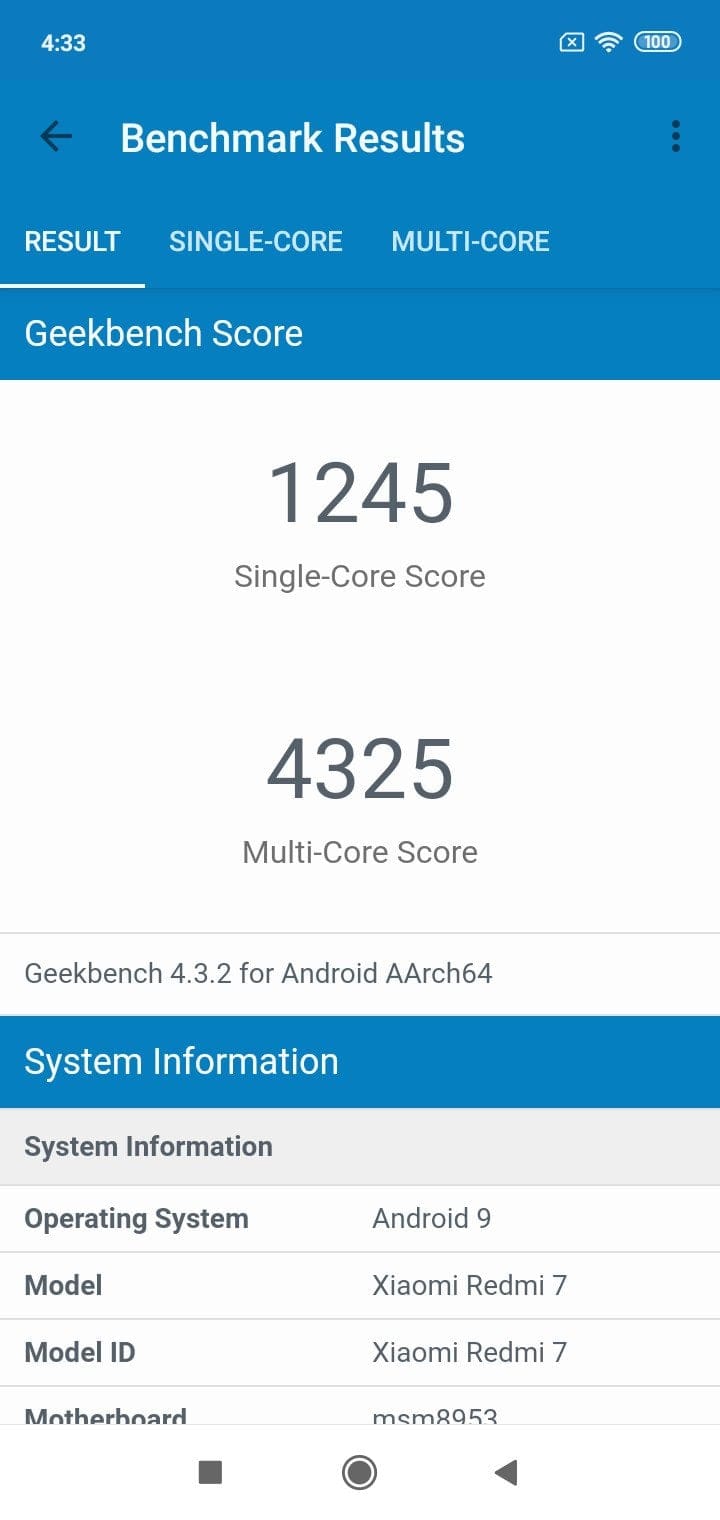
In the benchmark tests conducted, the Redmi 7 performs well. In the AnTuTu benchmark, which tests the entire system, a score of 103,788 is achieved. In Geekbench, a processor benchmark, the Snapdragon 632 achieves a single-core score of 1,245 and a multi-core score of 4,325. The smartphone also holds up well in 3D applications, particularly in the 3DMark benchmark, which tests graphics performance. In the demanding Sling Shot Extreme test, 514 or 547 (Vulkan) points are achieved.


The storage in the tested 3+32GB model achieves RAM speeds of 5,233 MB/s. The data storage operates within a write speed of just under 90 MB/s and a read speed of approximately 280 MB/s.
Performance in everyday use
In everyday use, the Redmi 7 operates smoothly. The user interface responds quickly to input, animations run mostly fluidly, and app loading times are appropriate for the specifications. Multitasking is possible to a certain extent. Depending on the memory configuration, the number of apps kept in memory may eventually be limited.
Rendering web pages takes slightly longer compared to high-end models, but does not impair the user experience at all. Scrolling works without annoying stutters.
Gaming
Casual gaming is no problem for the Redmi 7. The low display resolution in particular allows most mobile games to run smoothly. However, those who prefer demanding titles (e.g. PUBG) must reduce the graphics settings accordingly. Thermal throttling resulting in a reduction in system performance does not occur.
User interface
The tested Redmi 7 is the Global Version (M1810F6LG). The smartphone comes with MIUI 10.2 Global Stable. The operating system is based on Android 9 Pie. The security updates are from 01.03.2019. Future updates can be conveniently received Over-The-Air (OTA).


In the Global version, MIUI is adapted to the Western market. The system is multilingual and can be fully used in German. Unlike the Chinese version, the Google Play Store and Google apps come pre-installed. Chinese bloatware is omitted. Third-party apps on the device include Facebook, Opera and Aliexpress. If you do not need the apps, you can uninstall them via the app manager.
You can love or hate MIUI. The user interface differs significantly from Stock Android in both structure and appearance. The system offers a wealth of additional features, such as a security manager, the use of dual apps, or Mi Cloud integration.
Camera
The dual main camera of the Redmi 7 uses a 12 MP OmniVision OV12A10 main sensor with an f/2.2 aperture and PDAF autofocus. The secondary sensor is a 2 MP OmniVision OV02A10, which only supports the visual depth effect. The front camera uses an 8 MP Samsung S5K4H7 image sensor.
Main camera real-world test
Photo mode
Considering the price class, the main camera of the Redmi 7 convinces with decent recording quality. In good lighting conditions, it produces vibrant images with adequate dynamic range and good detail representation. A slight blurring becomes noticeable towards the edges of the image. The PDAF autofocus reacts quickly and focuses precisely. HDR is available in an automatic mode.


The camera AI recognizes up to 27 scenes and adjusts the recording accordingly. For example, plants are recognized by the AI and colors are slightly boosted for even more vivid green. The bokeh mode works surprisingly well and extracts objects and people cleanly for the most part. However, the Redmi 7 reaches its limits with complex contours.


With increasingly poor lighting conditions the recording quality decreases. Colours fade slightly, image noise increases and the autofocus also reacts a little sluggishly.
You can find all test shots at full resolution via this link
Video mode
The MIUI camera app records videos at a maximum of 1080p resolution at up to 60 frames per second. The autofocus also works extremely well in video mode and exposure is adjusted continuously. Unfortunately, the camera does not offer optical or electronic image stabilisation. With alternative camera apps, such as OpenCamera, videos can also be recorded in high-resolution 4K.
Front camera practical test
The 8-megapixel front camera delivers good results. As with the main camera, the photos provide adequate detail reproduction in good lighting conditions, but quality declines rapidly as lighting worsens. Colour reproduction could be somewhat more vibrant.
A bokeh mode is available and extracts people precisely. Various beauty filters can be switched on via the MIUI camera app. The front camera records videos in 1080p at 30 frames per second.
Connectivity
The Redmi 7 Global is well equipped for local mobile networks. The dual-SIM smartphone supports the mobile frequencies common in this region. VoLTE and HD Voice are available. VoWiFi, however, is not. The following bands are offered by the smartphone:
- GSM: B2, B3, B5, B8
- WCDMA: B1, B2, B4, B5, B8
- TDD-LTE: B38, B40
- FDD-LTE: B1, B2, B3, B4, B5, B7, B8, B20, B28
The voice quality is decent. Speech is transmitted clearly and understandably in both directions. Due to the strong noise reduction, speech can become slightly distorted. The signal strength is very good. This is primarily due to the completely plastic housing.
Wi-Fi and Bluetooth
The smartphone only supports single-band WiFi (802.11 b/g/n). Bluetooth is available in version 4.2. The smartphone has a strong signal on WLAN. Data throughput is average at around 50 Mbit/s.
GPS and sensors
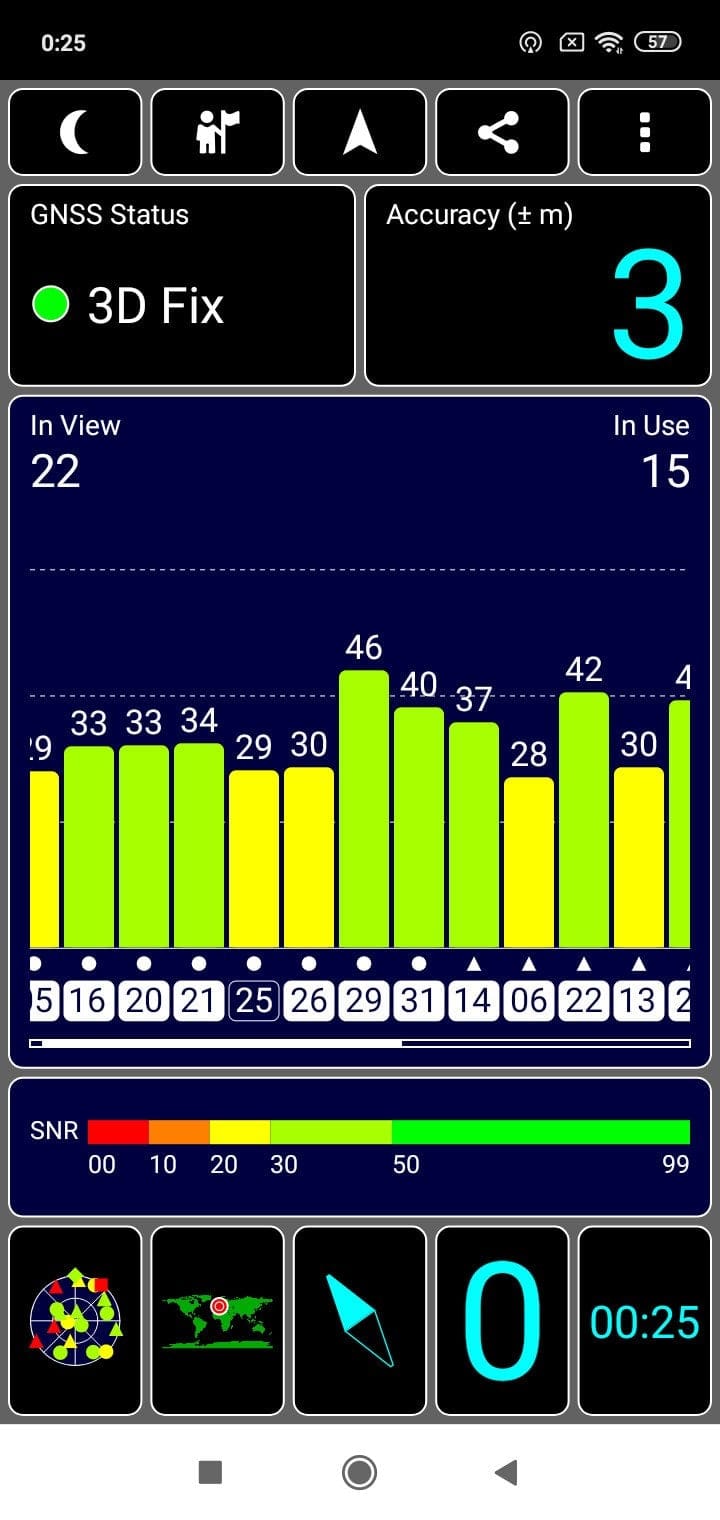
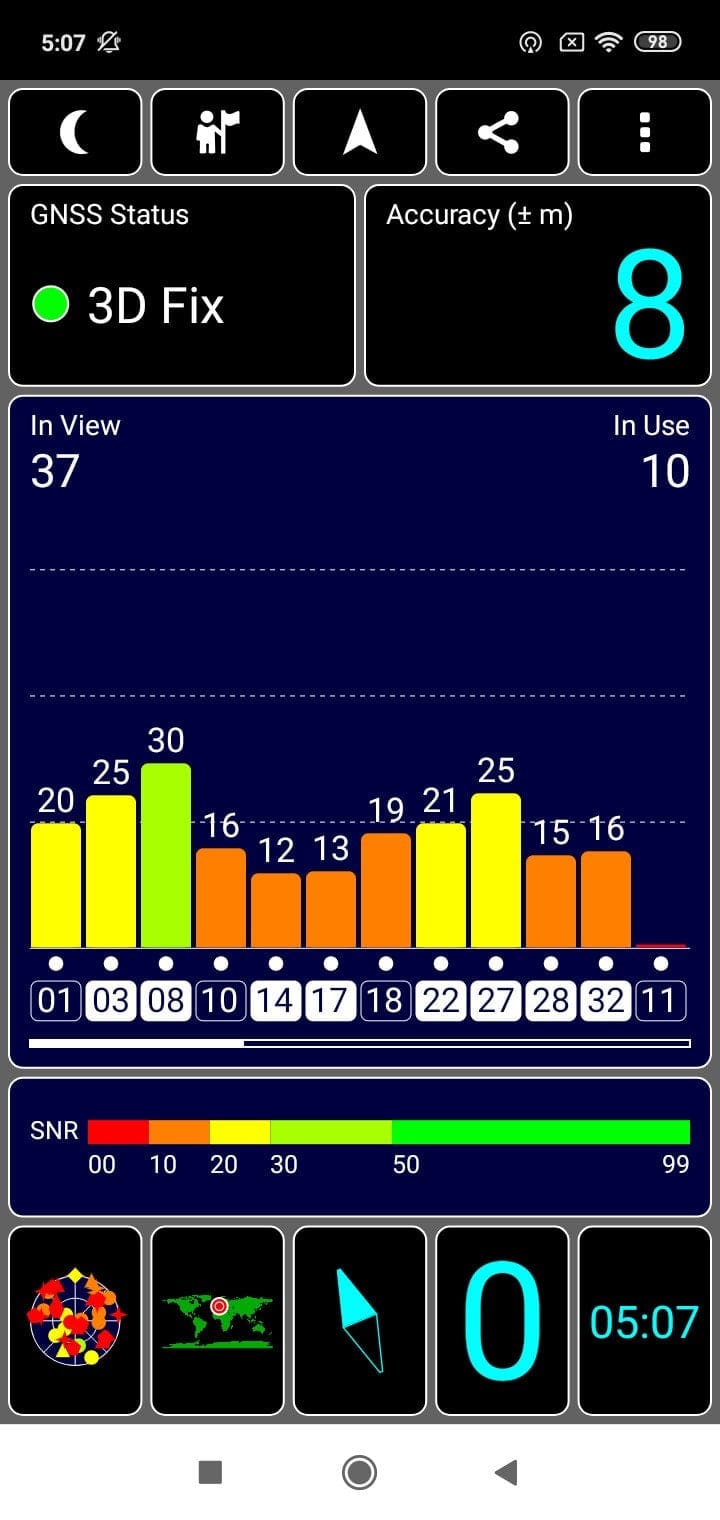
GPS positioning works both outdoors and indoors. Outdoors, the Redmi 7 quickly gets a GPS fix. The positioning accuracy is approximately 3 meters. Indoors, it takes significantly longer to get a GPS fix. Here, accuracy fluctuates between 8 and 15 meters. Navigation with Google Maps worked without issues in the test.
Further sensors include a brightness sensor, a gyroscope, a proximity sensor and an electronic compass. NFC is not available. A small special feature is the included FM receiver. An IR blaster allows you to control TVs and other IR receivers via app.
Fingerprint scanner and Face Unlock
On the back of the smartphone is a circular fingerprint scanner. This unlocks the smartphone reliably and quickly. As an additional unlocking method, face unlock is integrated into the system. Face recognition is carried out using the front camera. The unlocking process via face recognition is slightly slower, but in testing, it could not be tricked with a photo. Good lighting conditions are required, however.
Battery
The battery has a capacity of 4,000 mAh. The generously sized battery gets the user safely through the day. With some web surfing, watching YouTube videos, WhatsApp messaging and phone calls, the battery life is just over 2 1/2 days. In standby mode, the smartphone is also very efficient and loses only 1-3% overnight. Unfortunately, the Redmi 7 only has a MicroUSB port. Qualcomm's Quick Charge is not supported. The battery is charged with 5V 2A in approx. 2 hours.
Our verdict
For just under €150, Xiaomi again offers a satisfactory low-budget smartphone. The Redmi 7 Global impresses with excellent battery life, a smooth Android user experience, an appealing design and good camera equipment.
Points are deducted for the outdated MicroUSB connection, the lack of dual-band WiFi and the scratch-prone plastic rear panel.
Specifications
Processor and memory
- CPU
- Qualcomm Snapdragon 630
- GPU
- Adreno 506
- RAM
- 2GB / 3GB / 4GB (LPDDR3)
- Internal storage
- 16GB / 32GB / 64GB (eMMC 5.1)
- Storage expansion
- Yes
Display
- Display type
- IPS
- Display size
- 6.26 inches
- Display resolution
- 1520 x 720 pixels
- Screen protector
- Corning Gorilla Glass 5
- Multitouch
- 10 fingers
Cameras
- Main camera
- 12 MP OmniVision OV12A10 + 2 MP OmniVision OV02A10
- Front camera
- 8 MP Samsung S5K4H7
Mains
- Dual SIM
- Yes
- SIM size
- Nano SIM
Mobile network
- *GSM
- B2/B3/B5/B8
- *WCDMA
- B1/B2/B4/B5/B8
- *LTE FDD
- B1/B2/B3/B4/B5/B7/B8/B20
- *LTE TDD
- B38/B40
Wireless
- Wi-Fi
- 802.11 b/g/n
- Bluetooth
- 4.2
- GPS
- Yes
Sensors
- *Ambient light sensor
- *Accelerometer
- *Proximity sensor
- *E-compass
- *Gyroscope
- *Fingerprint sensor
- *IR transmitter
Battery
- Battery
- 4,000 mAh
Other
- Connection
- MicroUSB
- Operating system
- Android 9
- Size
- 158.73 x 75.58 x 8.47 mm
- Weight
- 18ßg
What’s included
1x Smartphone 1x Protective case 1x SIM tool 1x Charger 1x Charging cable
Comments (3)
Hello, I have had the Redmi 7 for a week as well. It is a really great smartphone and I can only recommend it at this price. What I haven't managed to do yet is set up the Wi-Fi. I enter my details, but it simply won't connect. It connects without problems at work. Does anyone have a tip for me on how to solve this problem?
Hey Samuel, could it be that your Wi-Fi is only on 5 GHz? The Redmi 7 only supports 2.4 GHz Wi-Fi. You should be able to adjust the frequency band and channel in your router settings.
Thanks for your quick reply. It was indeed down to my WLAN only being set to 5 GHz. With 2.4 GHz it works perfectly! Regards Samuel