
Contents
Xiaomi WiFi 6 Router (2024)

Xiaomi AX9000
The Xiaomi AX9000 was launched in early April 2021. As the design already reveals, the router was designed specifically for gamers.
The Qualcomm IPQ8072 WiFi 6 chip, supported by 1GB of RAM, enables a WLAN transmission speed of up to 9000 Mbit/s (1125 MB/s), distributed among up to 1000 clients. However, it should be borne in mind that this is the theoretical total speed across all bands (tri-band). A total of 12 antennas distribute the signal evenly and over a wide area.

Qualcomm 4K-QAM is supported, as are MU-MIMO + OFDMA, mesh and 2.5 Gbit/s Ethernet on 3 ports. With the help of the existing USB 3.0 port, the OpenWRT (MiWiFi) based AX9000 router can also be used as external storage.
Xiaomi AX6000
At the beginning of January 2021, Xiaomi introduced the Xiaomi AX6000 router. As a WiFi 6 Enhanced Router, the AX6000 promises (theoretical) transfer rates of up to 6,000 Mbit/s (750 MB/s). With 4096QAM (4K QAM), the router delivers 12 instead of the previous 10 bits per symbol, resulting in a 20 percent higher data rate. Speeds of up to 2.5 Gbit/s are even possible via the Ethernet port.
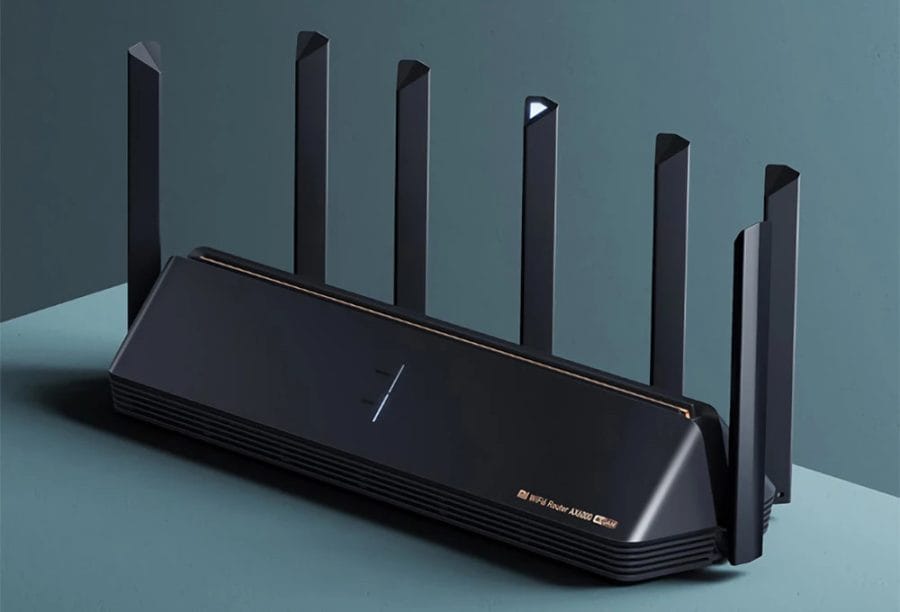
The core of the router is the Qualcomm IPQ5018, a chip specifically designed for Wi-Fi 6 routers, capable of supplying Wi-Fi to more than 248 devices simultaneously. The RAM is 512 MB. The current WPA3-SAE encryption makes the Xiaomi AX6000 significantly more secure than models with WPA2 certification. For the operating system, this router also relies on the OpenWRT-based MiWiFi.
Xiaomi AX3600
The first WiFi 6 router from Xiaomi is simultaneously the most powerful model. This is the Xiaomi AX3600 router, which we already reported on a few months ago. The router is currently only available as an import from China. At the end of March, Xiaomi also announced the global market launch. When this will happen, however, is not yet known. The RRP is expected to be 119.99 euros.

The AX3600 router is the top model in the new router series. Xiaomi has equipped the router with impressive hardware, which comprises a Qualcomm IPQ8071A CPU (4 Cortex-A57, 1 GHz clock rate), a dual-core NPU chip and 512 MB of memory. As the name suggests, this is a router that supports all current Wi-Fi protocols, including IEEE 802.11ax. Theoretically, 6 GHz Wi-Fi would also be possible, but this is not currently enabled. The operating system is MiWiFi, which is based on OpenWRT. Resourceful developers are already working on an alternative firmware, which makes the router all the more interesting.
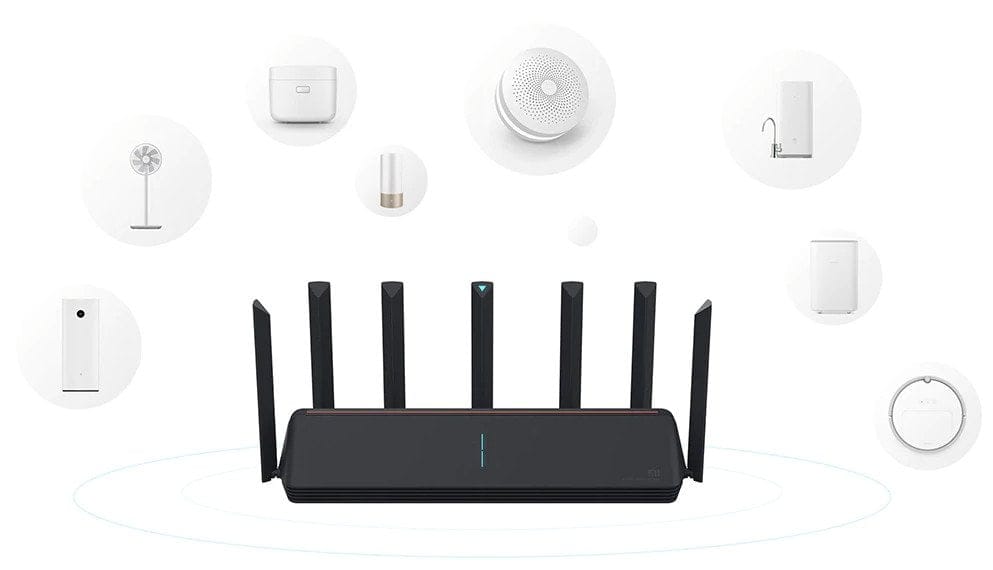
A total of 7 external antennas ensure excellent transmission and reception performance, radiating the signal omnidirectionally over long distances. One of the antennas is a special AIoT antenna, which is solely responsible for integrating and controlling network devices. Further features include OFDMA (Orthogonal Frequency Division Multiple Access), MU-MIMO (4x4), BSS Coloring and support for the new WPA3 encryption protocol. Fans of wired network transmission will be pleased with a Gigabit WAN port and three Gigabit LAN ports. Auto MDI-X identifies the transmit or receive line of the connected cable.
Xiaomi AX1800

The Xiaomi AX1800 is another WiFi 6 router that is positioned slightly lower than the top-of-the-range model. The differences lie not only in the design but also in the installed hardware. The core component is a Qualcomm IPQ6000 (4 Cortex-A57 cores, 1.2 GHz clock speed) with a dual-core NPU chip and 256MB of memory. At first glance, the CPU is indeed somewhat faster than that of the AX3600, but the differences lie in the details. The new IEEE 802.11ax WiFi protocol is supported. OFDMA is also present. MU-MIMO is included too, although only in a 2x2 configuration. External antennas are absent. Instead, there are 2 internal dual-frequency antennas inside the router. There is no special AIoT antenna.

Features such as BBS Coloring, WPA3, Band-Merge and Beamforming are available. The operating system is also MiWiFi based on OpenWRT. From the end of June 2020, the router is also set to receive a major software update that makes the router Mesh compatible. The ports are identical to the top model, featuring a Gigabit WAN port and three Gigabit LAN ports.
Xiaomi Redmi AX5

Another router in the lower price segment is the Redmi AX5 router. Redmi is Xiaomi's "young brand" that promises quality at the best price. The Redmi AX5 comes in a plain white casing and is equipped with 4 external antennas that spread the signal omnidirectionally

The hardware, software and functionality are almost identical to the slightly more expensive Xiaomi AX1800 router. The Qualcomm IPQ6000 chip is also installed here, but it is only supported by a single-core NPU (1.5 GHz clock). The memory size is 256MB. The router is already advertised with an integrated mesh function.
Xiaomi Redmi AX6

In September 2020, Xiaomi released another Redmi router. The Redmi AX6 is largely comparable to the Xiaomi AX3600 router. The hardware comprises a Qualcomm IPQ8071A processor with a dual-core NPU and 512MB of memory. The router supports the new WiFi 6 standard and achieves (theoretical) speeds of up to 2976 Mbit/s. Beamforming, BSS Coloring, Dual Frequency, WPA3 and other functions are extensively supported.

Six omnidirectional antennas spread the Wi-Fi signal over a large area. IoT devices can be particularly easily integrated into the network with Xiaomi Easy Connect. Products from the Xiaomi ecosystem especially benefit from this function.
Conclusion
The new Wi-Fi 6 wireless standard is gaining traction only slowly. Only a few routers supporting the IEEE 802.11ax protocol have reached the market so far. Entry-level models from established brands are already available for around 80 euros, but these routers cannot lure you with convincing features. It is different with the less well-known Xiaomi routers. Starting prices of less than 50 euros make the Wi-Fi 6 router range particularly attractive, which is why importing is also worthwhile.
The only obstacle is the customization for the Chinese market. Those who decide to import it also decide on a MiWiFi user interface in Chinese. However, as is known from other Xiaomi imported routers, the user interface can be easily translated using Google Translate. Provided there is an internet connection.
Alternatively, one can hope for a global launch of the router series. Xiaomi has, after all, already announced this. The routers are expected to arrive in Europe later this summer. The prices will naturally be higher then.
Price comparison
| Store | Price | Link |
|---|---|---|
| Geekbuying | 159,09 € | Go to store |


Comments