Contents
JIMMY R9 Pro: What's new?
The basic concept remains largely unchanged. It is still a countertop water purifier with a reverse osmosis filter, an integrated clean-water tank and an instant hot water function, with no permanent water connection. The difference is active cooling, which for the first time provides genuine cold water at around 10 to 15 °C at the touch of a button.
Design and build quality
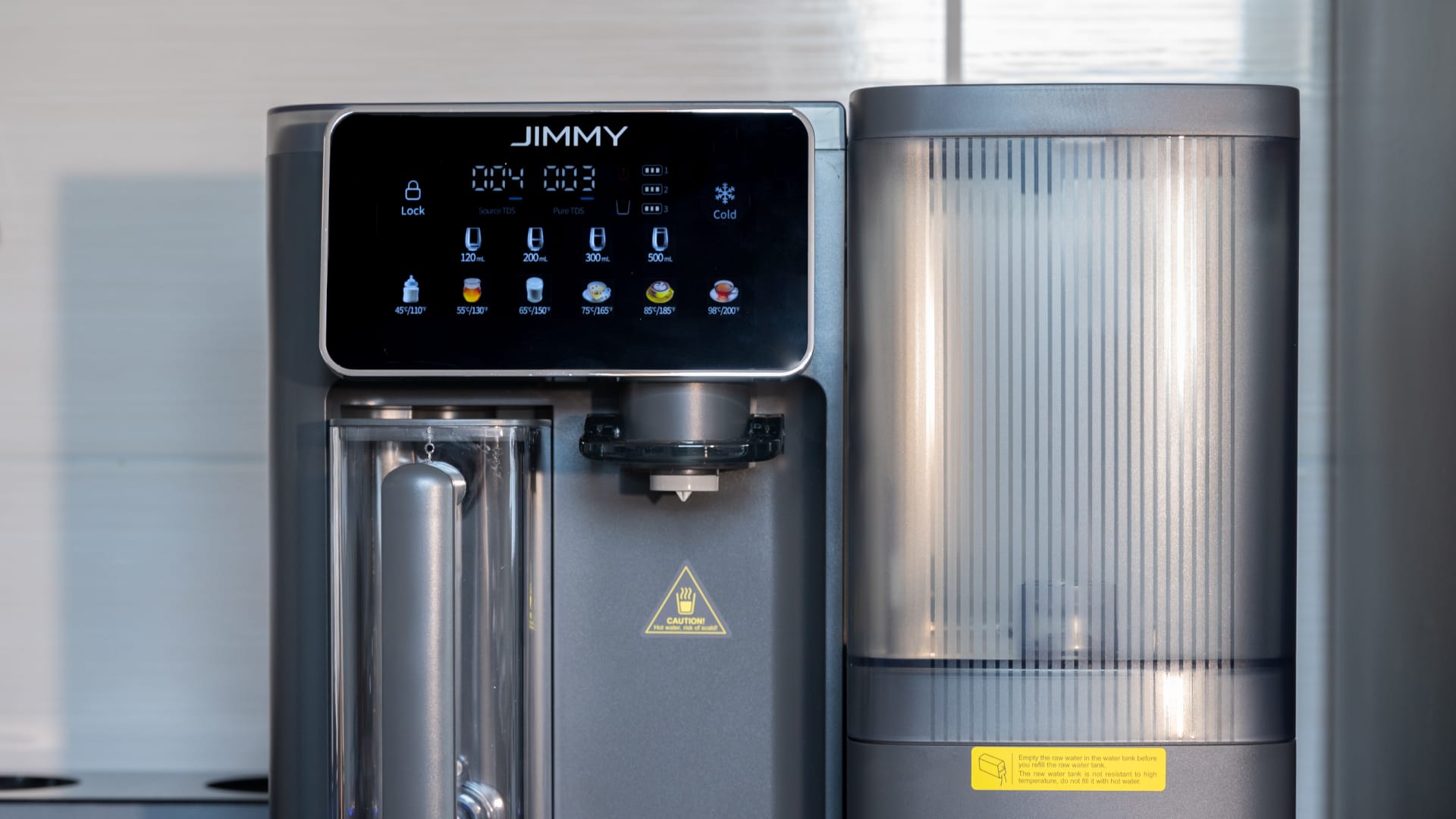
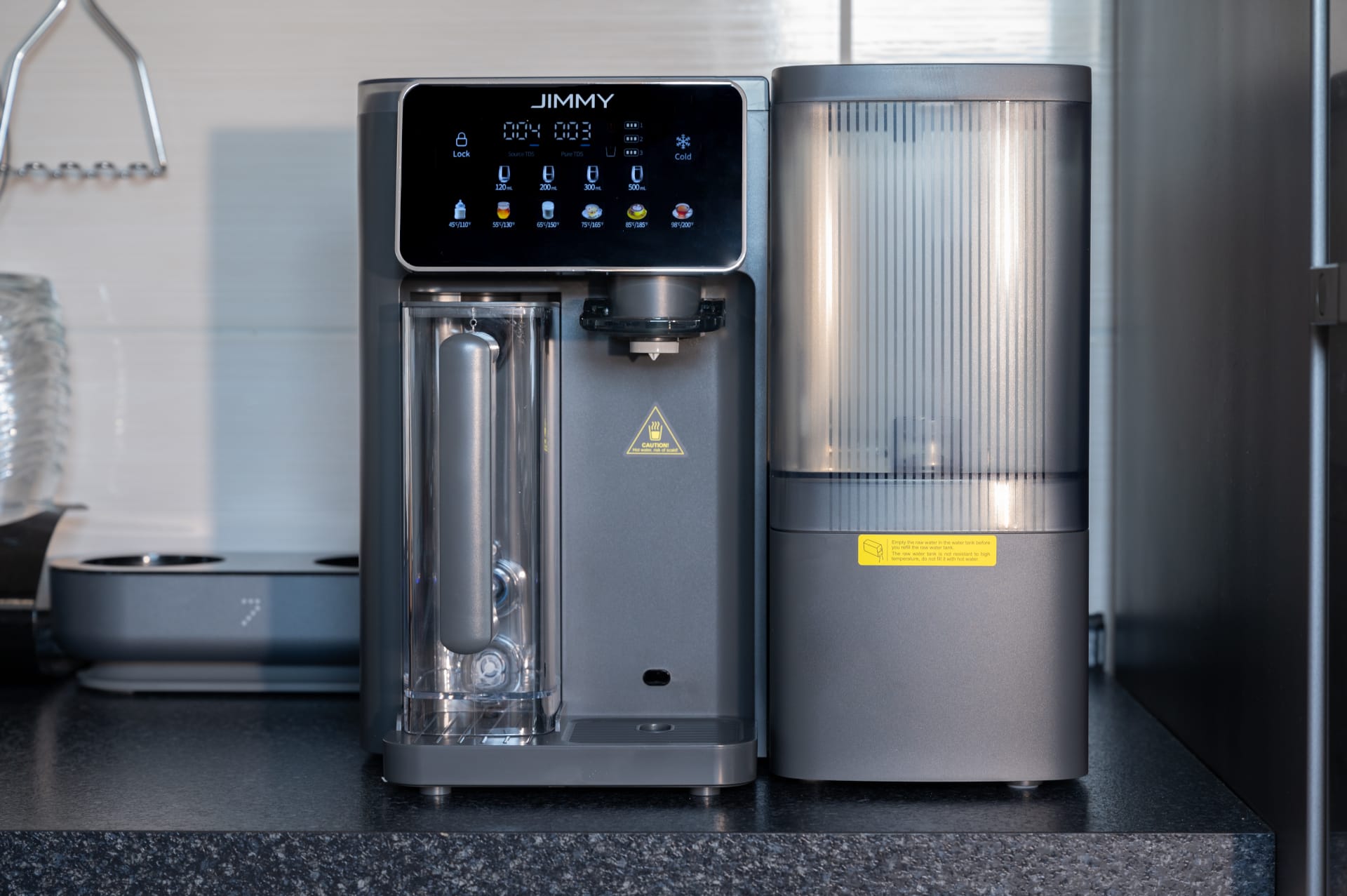
Visually, the JIMMY R9 Pro is very similar to the already familiar R9. It remains a compact countertop water dispenser with clean lines, a large touchscreen and a raw water tank fitted at the side. However, the additional integrated cooling system makes the housing slightly deeper and heavier, which should be taken into account when placing it on a kitchen worktop.

The build quality still leaves a high-quality impression. The housing is made of food-grade plastic, and the two included 1-liter Tritan pitchers feel sturdy and practical for everyday use. The modular tank design remains convenient. The 5.5-liter raw water tank can be removed from the side and easily filled at the tap, without having to move the entire appliance.
Permanent installation is not necessary. All you need is a power connection; water treatment then starts automatically as soon as the purified water jug is inserted.

Filtration system and water treatment
The R9 Pro retains almost all of the filtration system used in the previously tested R9. JIMMY continues to use a multistage reverse osmosis system, with several purification stages combined into three cartridges.
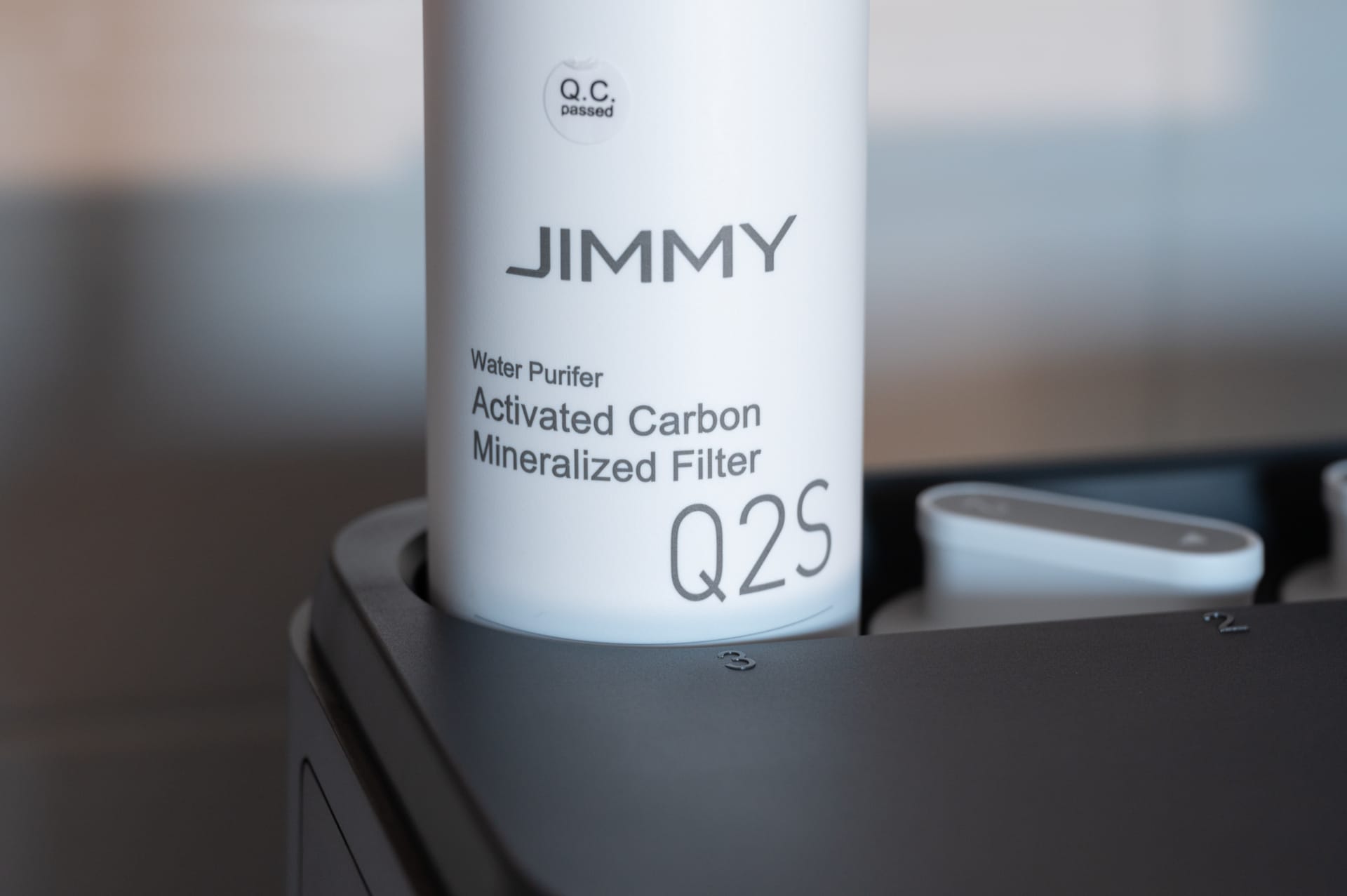
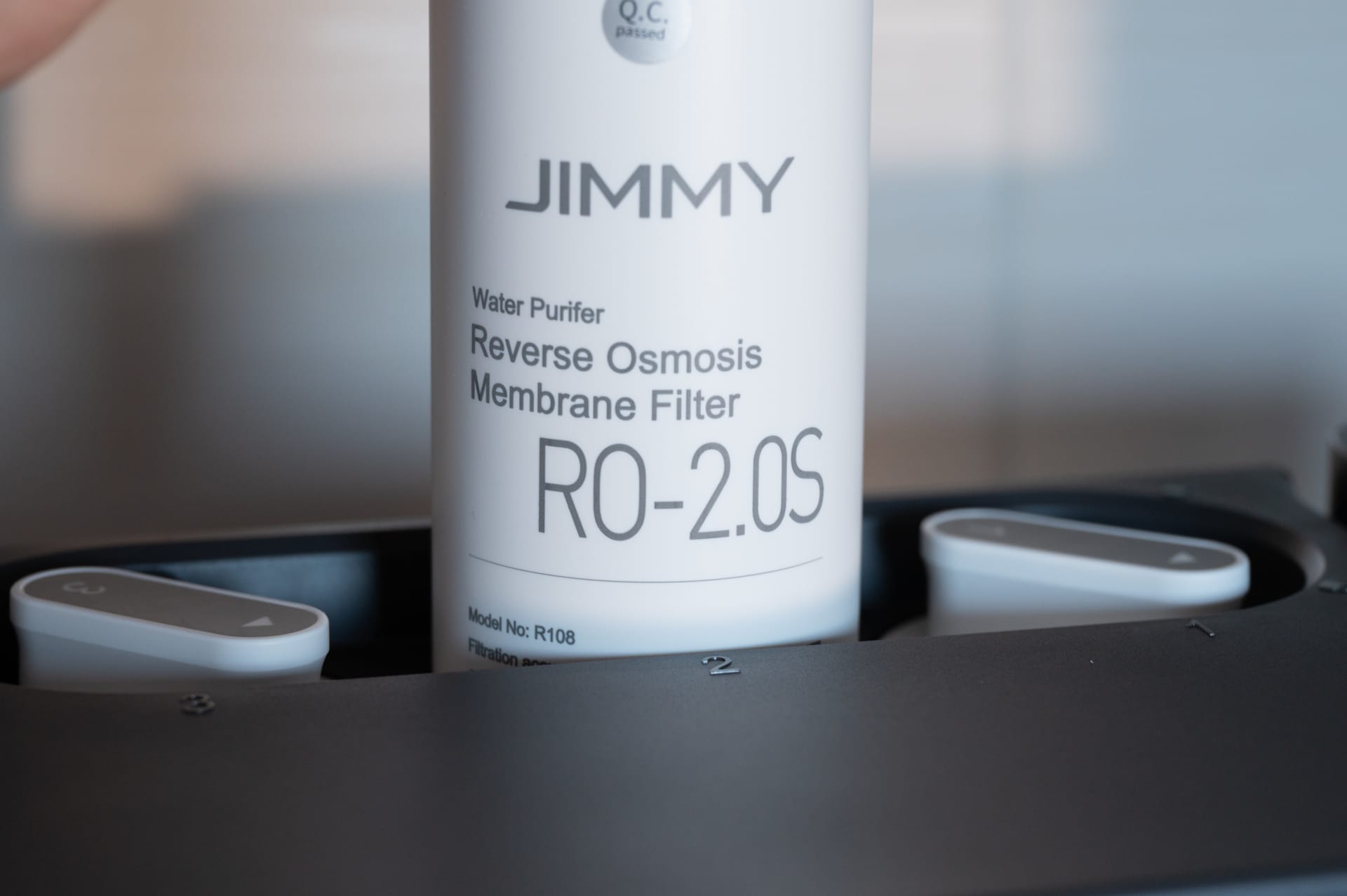
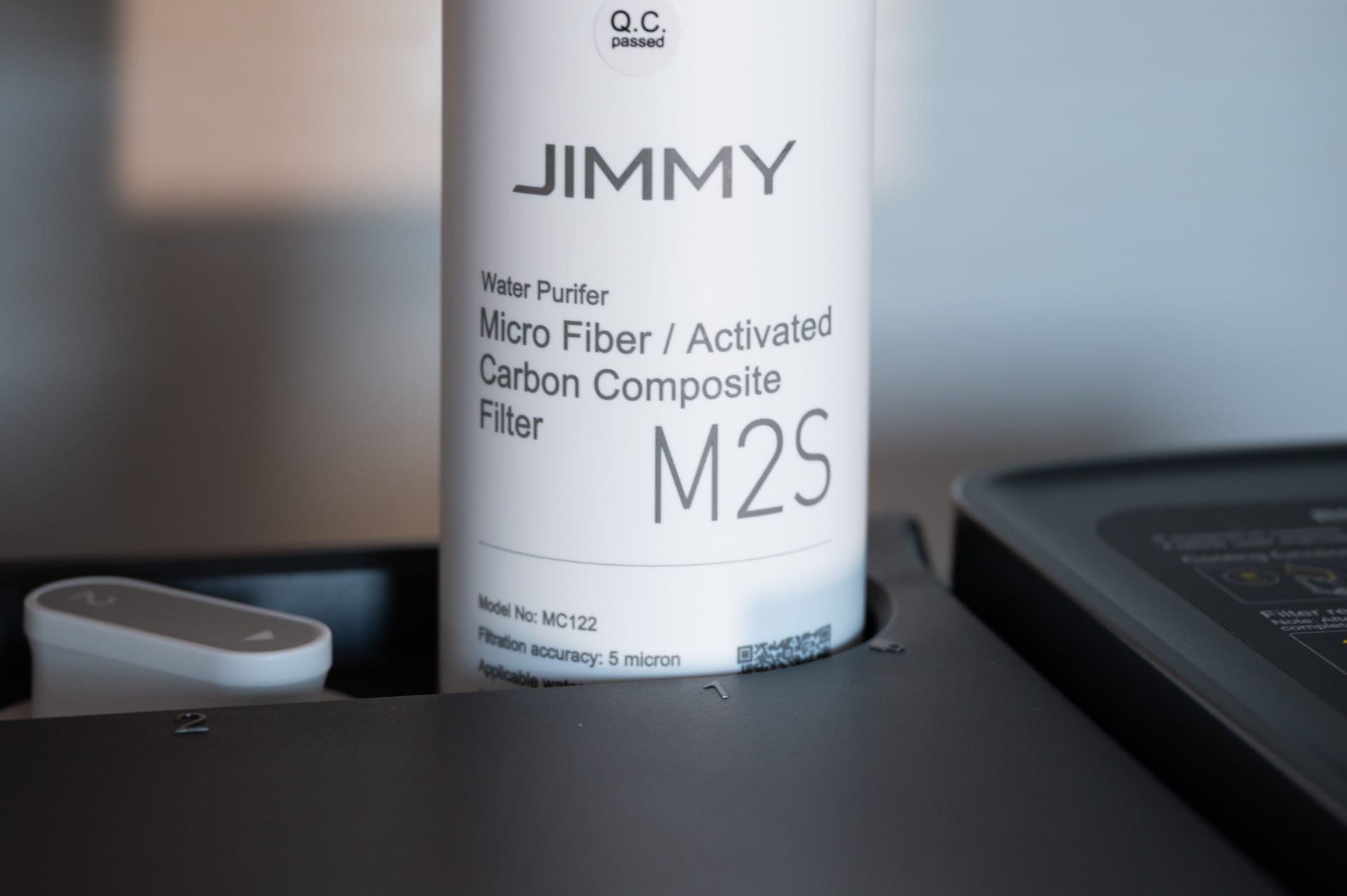
A composite filter first removes sediment such as rust or sand, as well as chlorine and odours. The RO membrane then filters dissolved substances such as heavy metals, nitrate, PFAS, bacteria and limescale, with a pore size of 0.0001 microns. Finally, an activated carbon post-filter stabilises the taste and slightly remineralises the water.
As with the R9, the treated water is also kept sterile with UV-C light in the clean-water tank to prevent recontamination. According to the display, reverse osmosis filtration significantly reduces the water's TDS level, which in everyday use is most noticeable in a distinctly softer, more neutral taste.

However, during the R9's long-term test, we noticed that the transparent Tritan pitchers can become slightly cloudy over time due to the continuously active UV light. This is purely a visual change to the material and has no effect on its stability or water quality, but it is noticeable in everyday use.
The R9 Pro works in the same way as the R9. Once the raw water tank has been filled, the device automatically starts filtering and keeps the clean-water pitcher supplied with water on its own. No manual activation is required. When water is taken out, treatment starts again in the background. Water is dispensed via the central touchscreen.
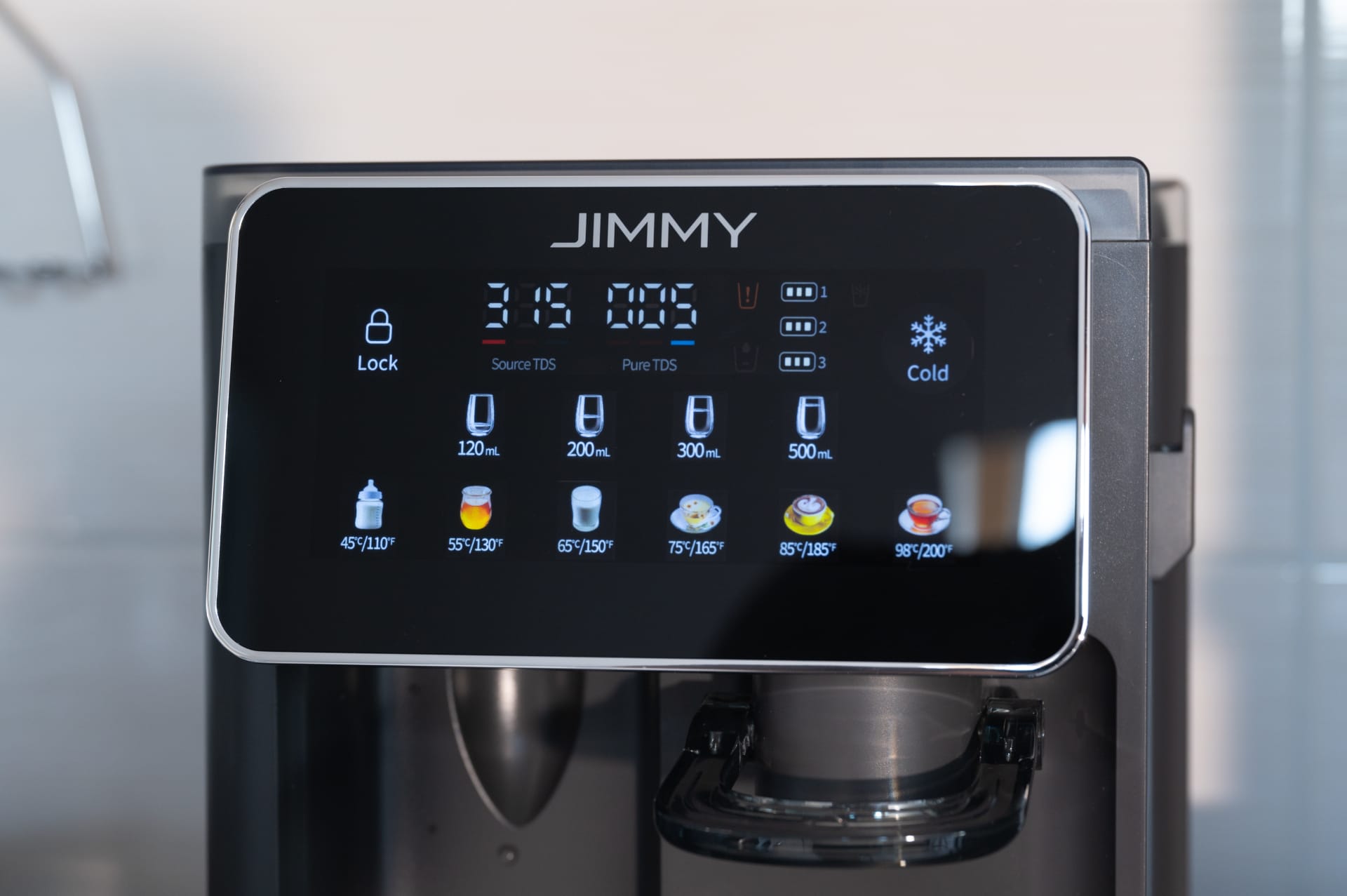
You can set the temperature and output volume in advance; then, with a press of a button, the device dispenses the desired amount precisely into a cup or bottle. Fixed volume settings are available between 120 and 500 millilitres. The integrated instantaneous water heater continues to deliver hot water within seconds, making a traditional kettle virtually unnecessary.

The new cooling function in detail
Inside, a separate cold-water circuit actively cools the water after it has been filtered. Unlike simple water dispensers, the water is not cooled only when it is dispensed; instead, it is kept at the target temperature continuously in a small internal tank. Technically, JIMMY uses a thermoelectric cooling system with a fan and circulation pump that does not require a compressor.
Cooling is disabled by default and must be switched on manually the first time. The system then takes around 15 to 20 minutes to provide cold water for the first time. After that, cooling operates automatically in the background and keeps the temperature constant.
Peltier cooling systems are typically designed to maintain temperature rather than chill water quickly. It takes around 15 to 20 minutes for the water to reach 10 °C. If a lot of cold water is dispensed in quick succession, the appliance needs a little time to cool it back down to the target temperature. On the plus side, it operates relatively quietly and with little vibration.
Cooling is disabled by default and must be switched on manually by pressing and holding the cooling button. The fan and cooling module make a slight background hum audible on the R9 Pro, similar to a very quiet mini-fridge.
TDS measurement and water quality
As with the R9, the R9 Pro also has integrated TDS sensors at the inlet and behind the RO membrane. The display shows at any time how much the dissolved substances in tap water have been reduced. TDS stands for Total Dissolved Solids and describes the total amount of dissolved minerals and salts in water.
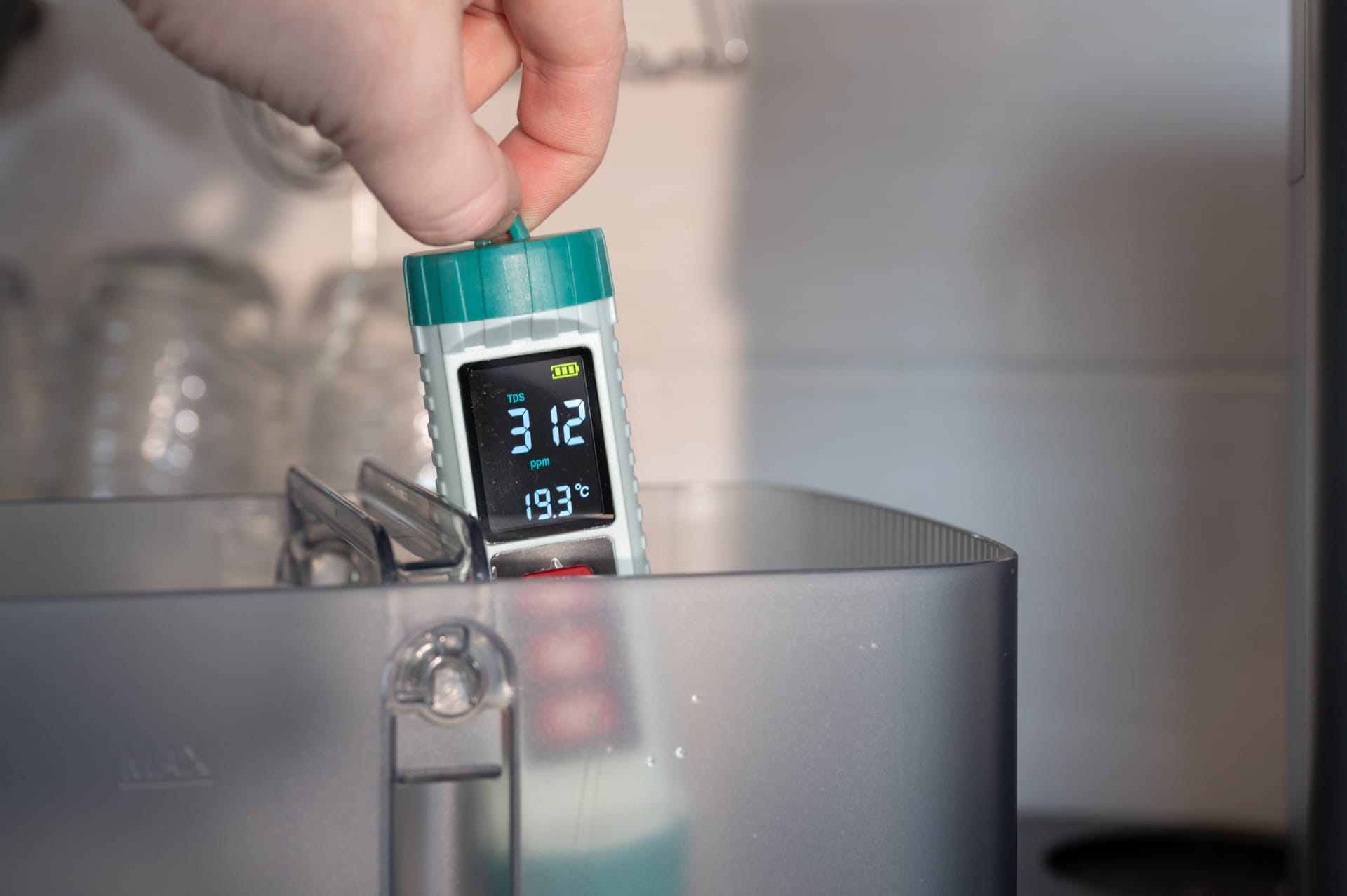
The test once again showed that the reverse osmosis membrane significantly reduces the TDS value. Depending on the local water hardness, readings typically fall by over 90 per cent after filtration. The result is noticeably softer, almost neutral drinking water with no chalky aftertaste.
As with its predecessor, the reading is displayed before the remineralization stage, which is why external meters usually show slightly higher values in the finished drinking water. Nevertheless, the water tastes balanced and clean rather than flat.

Wastewater ratio and tank management
Like every reverse osmosis appliance, the R9 Pro produces a concentrate containing the filtered-out substances. The ratio of purified water to concentrate remains about 3:1, which is a good level for countertop appliances. Unlike permanently installed osmosis systems, however, the R9 Pro does not drain this water. Instead, the concentrate is returned to the raw water tank.
The concentration of dissolved solids increases with each filtration cycle until it reaches a defined limit. Only then does a message on the display prompt you to empty the tank and refill it with fresh tap water. Depending on the water hardness and how much the system is used, the raw water tank may need refilling sooner or later. In our test, this usually happened after filling three or four pitchers.
Running costs
As with the R9 Pro, the main ongoing costs come from the filters. The three-stage system still consists of a composite filter, an activated carbon post-filter, and an RO membrane, with the same replacement intervals as before. The two pre- and post-filters are designed to last around twelve months, while the RO membrane generally only needs replacing after around two years.
The actual replacement interval depends heavily on water quality and intensity of use, but is monitored reliably via the filter indicator on the display. According to the manufacturer, the recommended retail prices for the filters are €29.99 for the composite filter (link) and activated carbon post-filter (link), and €49.99 for the RO membrane (link).
Based on the filter prices, ongoing costs work out to approximately 85 euros per year, or 75 euros with the current offer. This puts the R9 Pro in a price range roughly between discount-store bottled water and premium branded water, but without the heavy crates or plastic waste.
There are also electricity costs for filtration, hot water preparation and cooling. While the instant heater draws high power only briefly, the cooling system runs continuously in the background. In realistic continuous use, annual electricity costs of around 35 to 50 euros can therefore be expected.
Our verdict
With the R9 Pro, JIMMY has sensibly improved on the already impressive R9 without changing its proven operating concept. Filtration, the hot-water function and automatic operation remain the device’s key strengths, but they are now joined by a feature that offers a surprising amount of added value in everyday use.
The integrated cooling turns the reverse osmosis filter into a fully fledged water dispenser for the first time. Instead of having to store filtered water in the fridge as well, all temperature options are now available directly from the device. In everyday use in particular, this means the device gets used much more often than a water filter alone.
The larger footprint, slightly higher power consumption, and ongoing filter costs remain typical drawbacks inherent to countertop systems like this. However, for anyone who values convenient access to filtered water and wants to replace several kitchen appliances, the R9 Pro offers a well-designed all-in-one solution.
For first-time buyers, choosing the Pro version is clearly the more sensible option. Owners of the R9, on the other hand, should consider upgrading primarily if chilled drinking water is important in their daily routine.
Specifications
General
- Type
- Smart UV reverse osmosis water purifier (countertop device)
- Enclosure material
- Plastic, food-grade
- Clean water tank
- Tritan, BPA-free
- Heating power
- 2200 W
- Cooling performance
- 100 W
- Standby power
- approx. 1 W
- Purified water-to-wastewater ratio
- 3:1
- Production rate
- approx. 0.3 L/min
- Water temperatures
- Cold (10–15 °C), ambient, 45 °C, 55 °C, 65 °C, 75 °C, 85 °C, 98 °C
- Dispensing volumes
- 120 / 200 / 300 / 500 ml
- UV sterilization
- Yes (purified water and cold water tanks)
- Touchscreen
- Yes (LED)
- Child lock
- Yes
- TDS measurement
- Pre- and post-filtration, real time
- Size
- 381 × 252 × 367 mm
- Weight
- approx. 9 kg
Water tanks
- Raw water tank
- 5.5 liters
- Purified water pitchers
- 2 × 1 litre, removable, Tritan material
- Tank design
- removable from the side
Cleaning system
- Levels
- 7-stage filtration
- RO membrane
- 0.0001 µm
- Filter types & lifespan
- – Microfibre/activated carbon composite filter (M2S)
- 12 months
- – Activated carbon mineral filter (Q2S)
- 12 months
- – RO membrane filter (RO-2.0S)
- 24 months
Hot water function
- Heating type
- Instantaneous water heater
- Heating time
- approx. 3 seconds
- Temperature settings
- Room temperature / 45 / 55 / 65 / 75 / 85 / 98 °C
Cold water function
- Cooling system
- Thermoelectric cooling (Peltier)
- Cold water temperature
- approx. 10–15 °C
- Cooling mode
- continuously temperature-controlled internal cold water tank
Filter costs
- Cost of all 3 filters (annual set + prorated membrane)
- approx. €180
Electrical specifications
- Tension
- 220–230 V ~ 50–60 Hz
- Rated power
- 2200 W
Certifications
- CE
- CB
- SGS / ITS, according to the manufacturer
- RO membrane compatible with NSF/ANSI standards
What’s included
Jimmy R9 Pro reverse osmosis device 2 Tritan water jugs Raw water tank (5.5 L) Filter unit (installed) Power cable User manual Filter replacement information sheet
Price comparison
| Store | Price | Link |
|---|---|---|
| Amazon | 424,99 € | Go to store |
| Jimmy | 499,00 € | Go to store |


Comments