Contents
JYU Hornet 2
"JYU" is a comparatively young company that first made headlines in 2016. The JYU Hornet S, also released in 2016, was the manufacturer's first drone with a modular design. The drone can be used for aerial photography, as an FPV drone and as a conventional quadcopter. Although the Hornet S pursued an interesting concept, it found little reception in the steadily growing drone market. With the JYU Hornet 2, JYU is making a new attempt and has again released a modular drone, available as a standard version, FPV version, 4K gimbal version and 4K Pro-gimbal version.
Hornet 2 Standard version
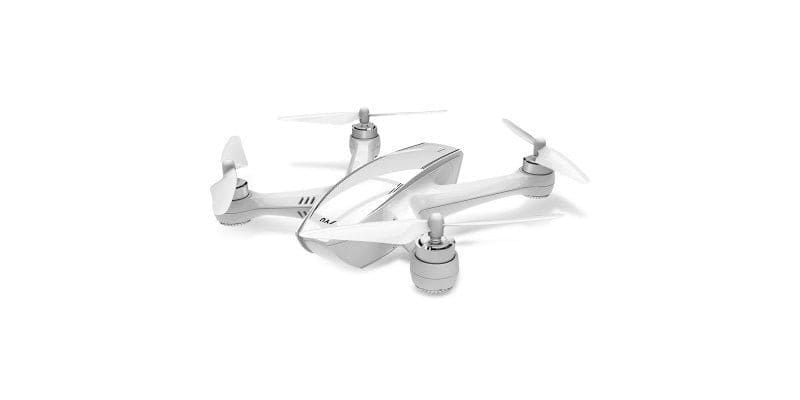
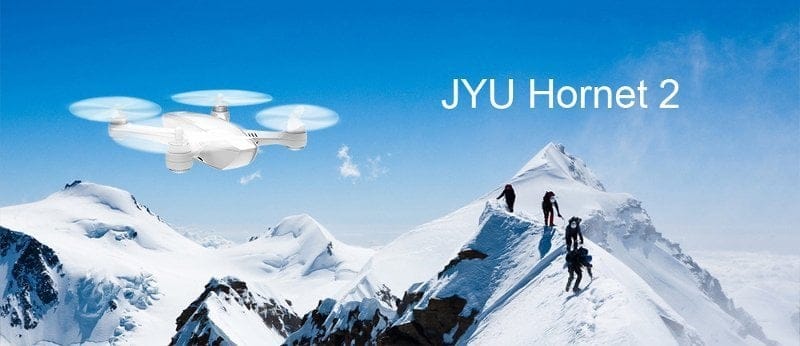
First, we look at the standard model of the Hornet 2, which is already available from around €230. This version includes no camera, allowing for pure visual flight. The drone's fuselage is, however, removable, so camera modules can be added later. The different modules are available separately.
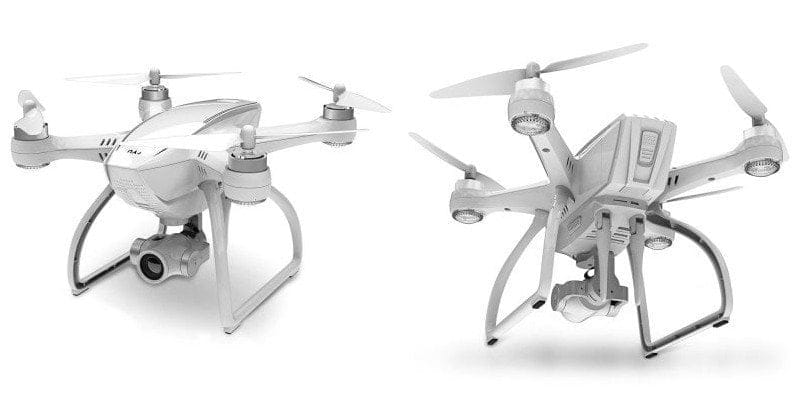
The basic model of the Hornet 2 measures 23.30 x 23.30 x 17.20 cm and weighs 800g including the battery. The maximum take-off weight is 1,800g. The maximum flight altitude is specified by JYU as a theoretical 4,000 metres, while the radio range of the remote control at 2.4 GHz and 5.8 GHz is 2,000 (FCC) or 800 metres (CE). All models are equipped with a GPS / GLONASS module, allowing the drone to fly waypoints autonomously and land at the push of a button. The JYU drone does not have an optical vision system, as known from DJI drones. The forward flight speed is a maximum of 10 m/s, which is significantly lower than a DJI Mavic Pro (18 m/s) and even lower than a DJI Spark (13 m/s). The ascent speed and descent speed are also comparatively low at 4 m/s and 2 m/s respectively. The capacity of the 4S LiPo is 3,600 mAh. The maximum flight time possible on a single charge is 28 minutes.
Hornet 2 FPV
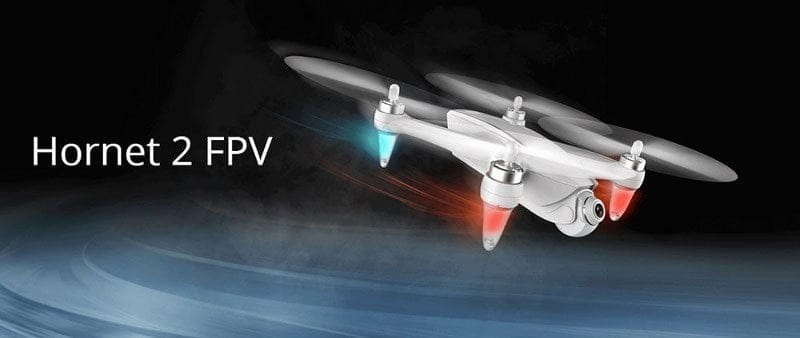
The FPV version (First-Person-View) is intended for hobby pilots who want to follow the drone flight with a live image. The Hornet 2 FPV is equipped with an 8 megapixel camera for this purpose, which transmits the video signal in 1080p at 30 frames per second and in 720p at 60 frames per second. Thanks to the 150° wide-angle lens, a particularly comprehensive image can be transmitted. Additionally, the camera can be tilted by 118°. The video signal is transmitted via 5.8 GHz. The transmission range is 500 meters. The scope of delivery includes a 5-inch monitor to receive it, which has a resolution of 800 x 480 pixels. Alternatively, it is also possible to transmit the Hornet 2 FPV's video signal to FPV glasses. The Hornet 2 FPV costs around €340.
Hornet 2 Aerial
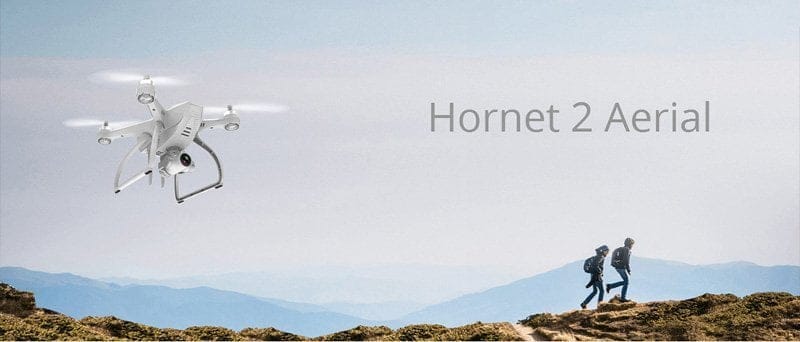
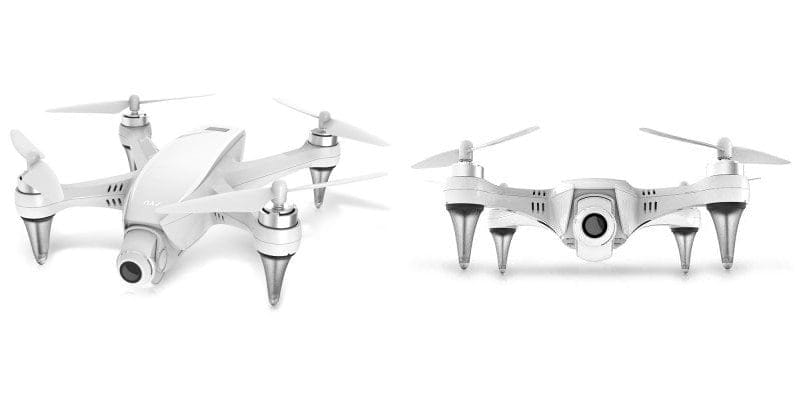
The JYU Hornet 2 Aerial is in turn divided into two variants. Both versions share a 3-axis gimbal, which is intended to ensure stabilised image and video recordings. Additionally, the gimbal can rotate by 110°. There are differences in the camera equipment. Both cameras are capable of recording 4K videos. The Pro model uses a 12-megapixel image sensor with 100° wide angle and achieves up to 30 frames per second at 4K resolution and up to 120 frames per second at 1080p resolution. The standard model instead uses a 16-megapixel image sensor with 112° wide angle and achieves 25 frames per second at 4K resolution or 60 frames per second at 1080p. Recordings can be saved directly to an SD memory card and transferred live to a smartphone via WiFi with the JYU App. The recording format is MP4 or JPG. The price of the 4K standard model is around €395. The 4K Pro variant is available from €519.
Manufacturer's product page: en.jyu.com
Specifications
Drone
- Size
- 23.30 x 23.30 x 17.20 cm
- Weight
- 800 g (with battery)
- Climbing speed
- up to 4 m/s
- Sink rate
- up to 2 m/s
- Flight speed
- up to 10 m/s
- Flight altitude
- up to 4000 m
- Flight time
- up to 28 minutes
- Sensors
- GPS / GLONASS
Radio transmitter
- Frequency
- 2,400–2,483 GHz and 5,725–5,825 GHz
- Transmission range
- FCC 2km - CE 800m
- Radiant power
- 2,400 – 2,483 GHz
- 26 dBm (FCC); 17 dBm (CE)
- 5,725 - 5,825 GHz
- 28 dBm(FCC);14 dBm(CE)
- Battery
- 2200 mAh LiPo
- Operating voltage
- 0.5A @3.7V
Battery performance
- Battery type
- LiPo 4S
- Capacity
- 3600 mAh
- Tension
- 14.8V
- Energy
- 54Wh
- Weight
- 190g
FPV Version
- Sensor
- 8 megapixels
- FOV
- 125°
- ISO
- 50 - 800
- Resolution
- 1080P@30FPS
- 720P@60FPS
4K standard
- Sensor
- 16 megapixels
- FOV
- 112°
- ISO
- 50 - 800
- Resolution
- 4K@25FPS
- 2.7K@30FPS
- 1080P@60FPS
- 720K@120FPS
4K Pro
- Sensor
- 12 megapixels
- FOV
- 110°
- ISO
- 400 - 1600
- Resolution
- 4K@30fps
- 1080P@120fps
- 720P@240fps
Gimbal
- Stabilization
- 3-axis
- Inclination
- -90° to +20°
- Accuracy
- +/- 0.05°
Comments