Contents
Review: Roborock Q7 Max+
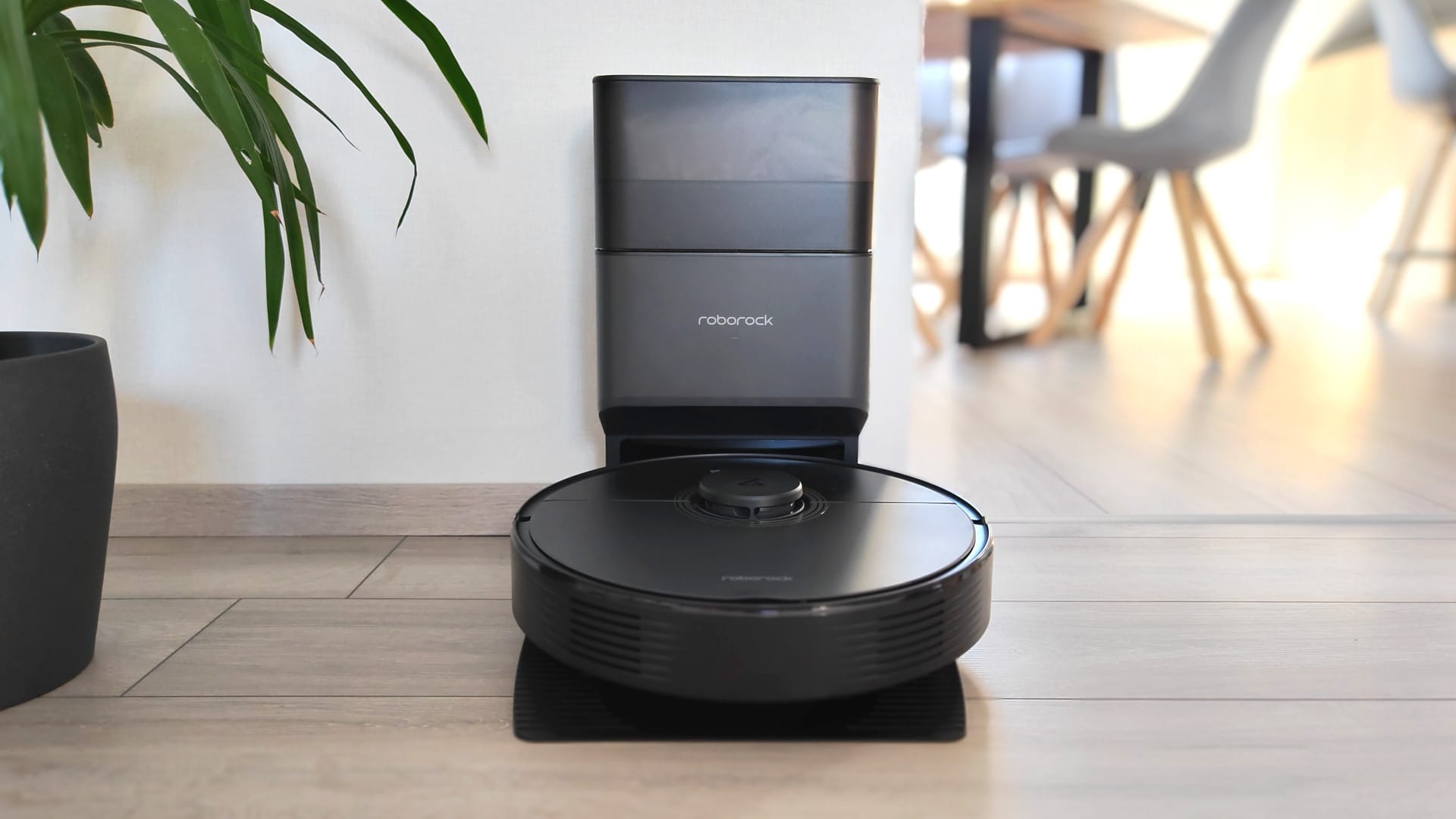
With the launch of the Roborock Q7 Max+, Roborock simultaneously launched a new robot vacuum series. The new Q series positions itself functionally and in terms of price below the models of the S series and is aimed primarily at budget-conscious buyers who nonetheless expect a cohesive complete package for a robot vacuum.
The Roborock Q7 Max+ is most functionally comparable to the Roborock S5 Max, introduced back in 2019, which still remains a bestseller in its class. In the following comparison, we have contrasted key data and features.
Comparison: Roborock S7 vs. S6 Max V vs. S5 Max
| Model | Roborock Q7 Max | Roborock S7 | Roborock S5 Max |
| Suction power | 4,200 Pa | 2,500 Pa | 2,000 Pa |
| Volume (max) | 67 dB | 67 dB | 65 dB |
| Dust container | 470 ml | 470 ml | 460 ml |
| Water tank | 350 ml | 300 ml | 290 ml |
| Battery (Runtime / Charging time) | 5200 mAh (3h / 5h) | 5200 mAh (3h / 5h) | 5200 mAh (2.5 hours / 5 hours) |
| Gradient | 2 cm | 2 cm | 2 cm |
| Dimensions | 35.3 x 35.0 x 9.65 cm | 35.3 x 35.0 x 9.65 cm | 35.3 x 35.0 x 9.9 cm |
| Weight | 4.7 kg | 4.7 kg | 3.5 kg |
| Special features |
|
|
|
Roborock Q7 Max+: Unboxing
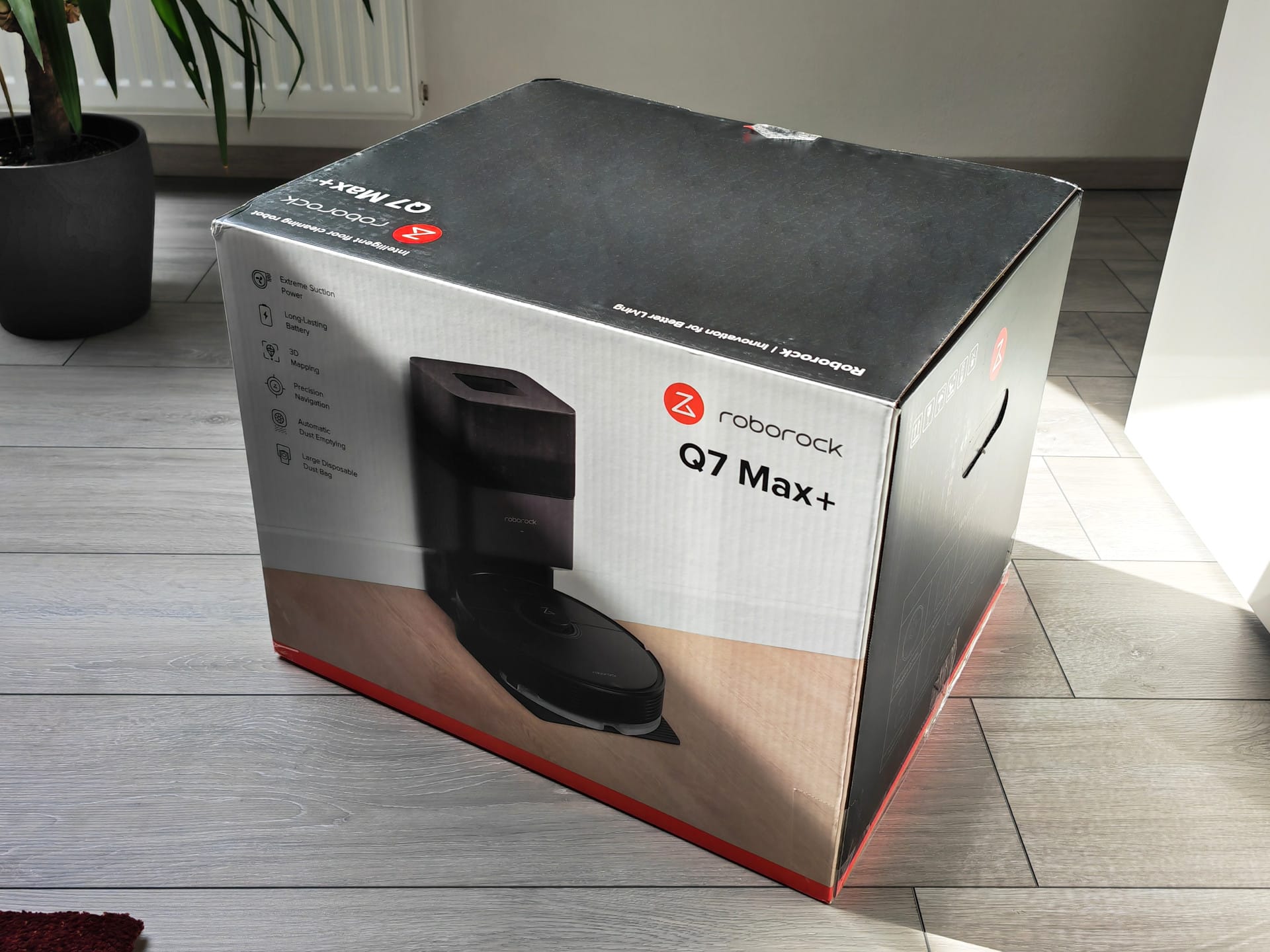
Let's start the test. The Roborock Q7 Max+ (emphasis on the "+") is delivered in a large cardboard box, as the matching suction station is directly included in the scope of delivery.
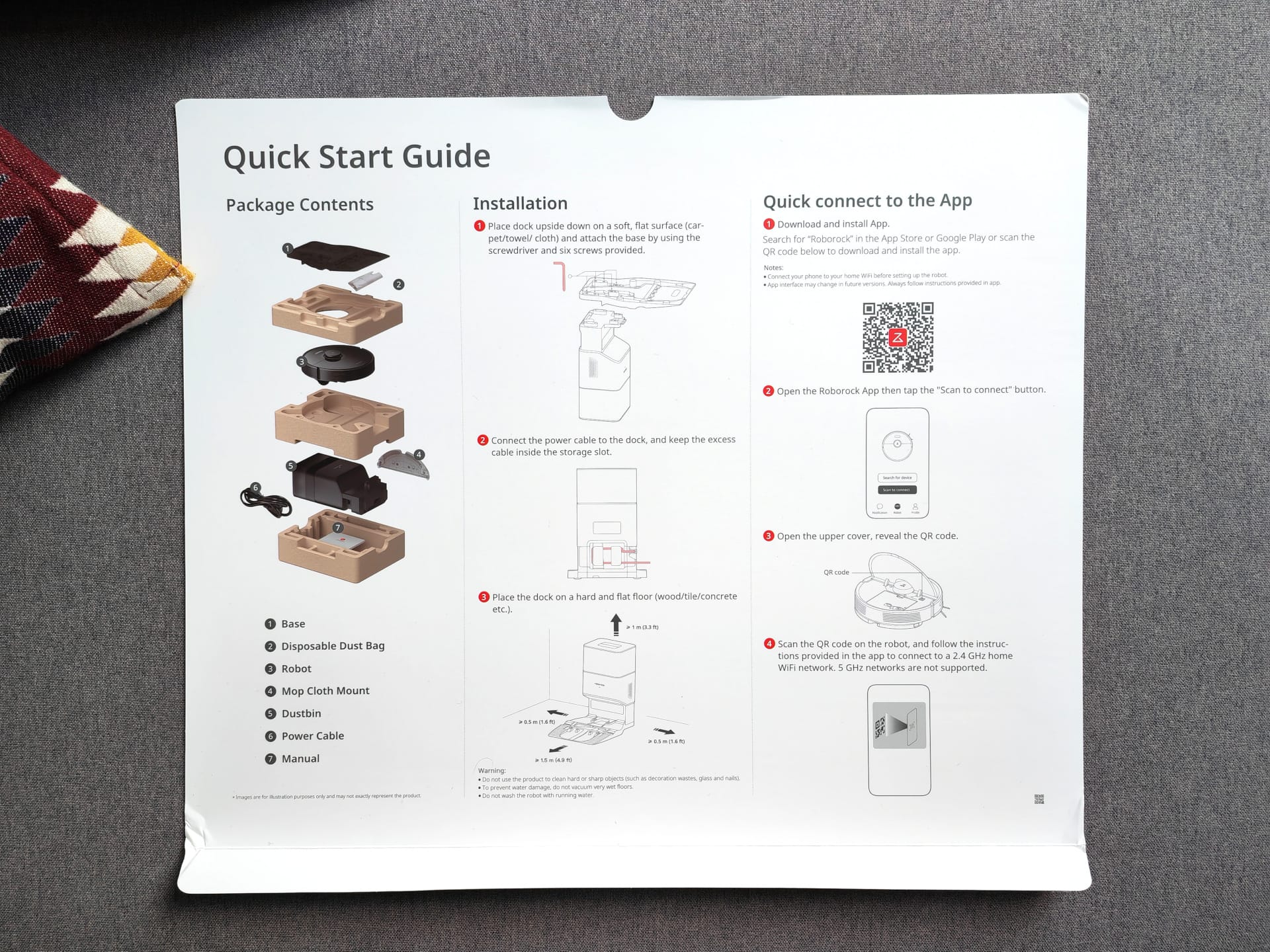
When unpacking, the first thing you are greeted with is a huge quick start guide that explains the individual steps from setting up the extraction station to connecting with the app. Although the explanation is entirely in English, it is easy to understand even for someone who doesn't speak English, thanks to the detailed illustrations.
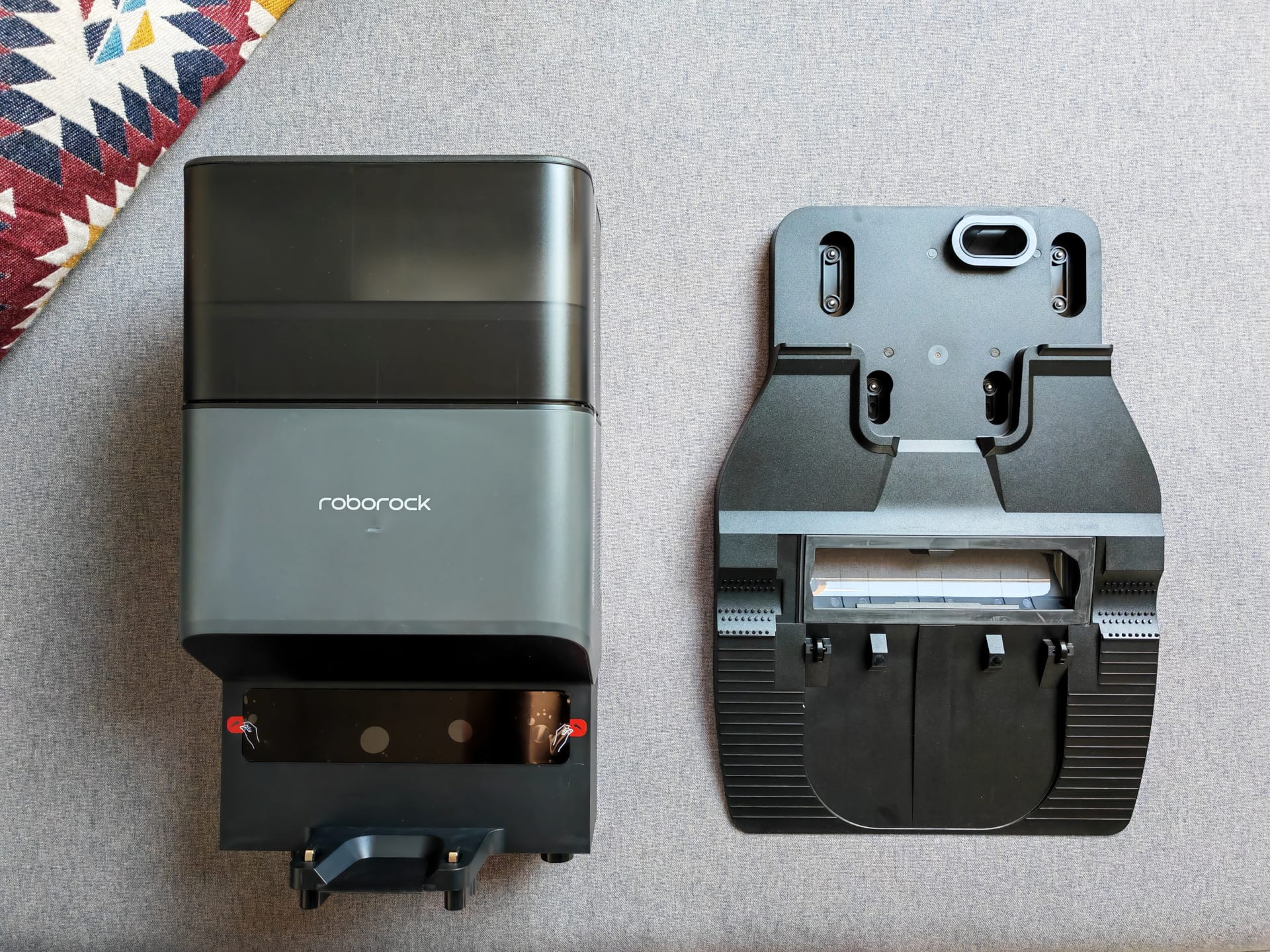
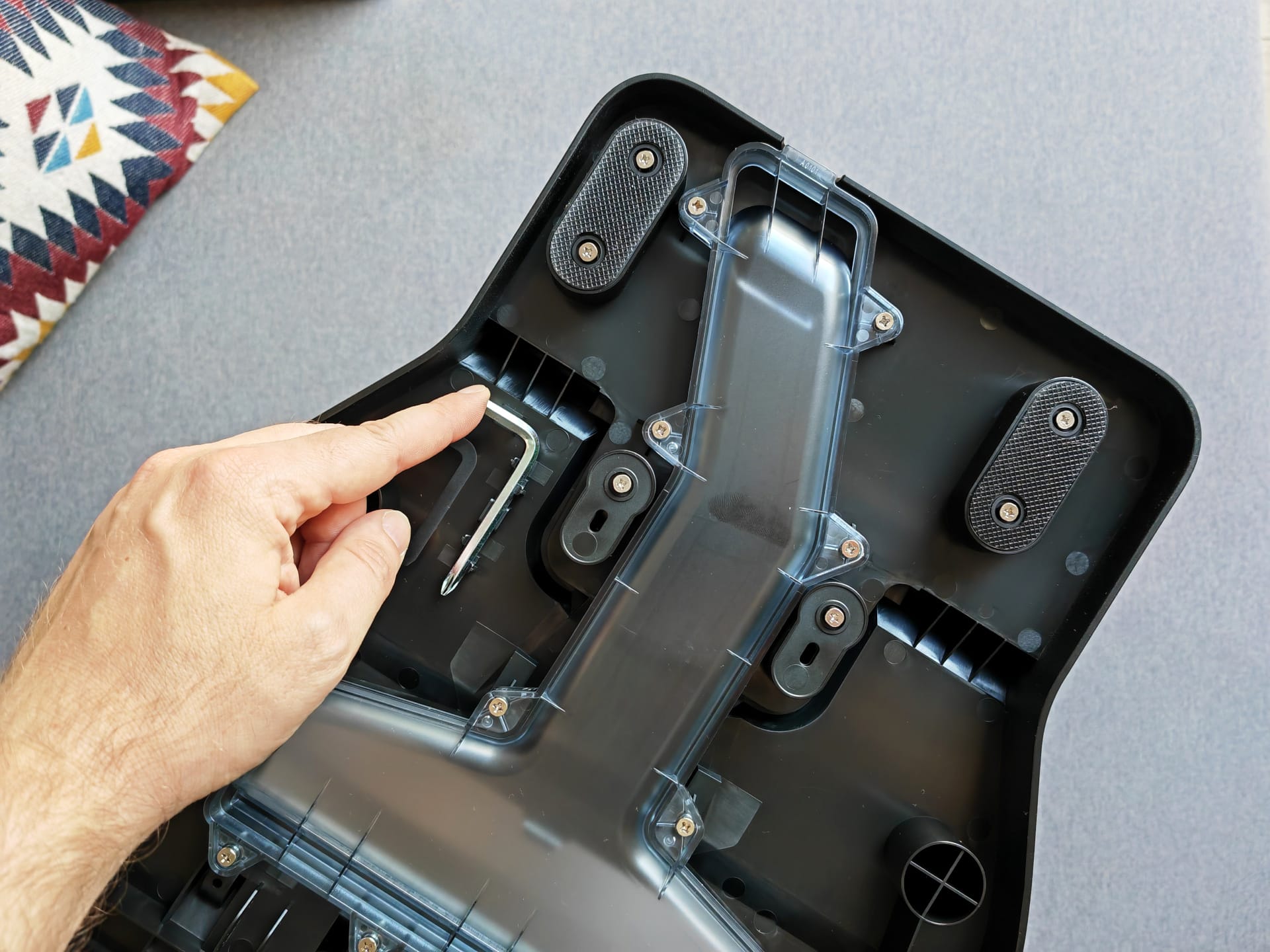
The robot vacuum, docking station and accompanying accessories are neatly stacked in the box. The docking station consists of two parts and must first be assembled. Assembling the Roborock Q7 Max+ involves tightening six screws. The necessary tool is readily available on the underside of the docking station.
The included accessories are limited. In addition to the vacuum robot and the dust collection station, the package includes a 1.5 metre long EU power cable with an IEC connector, two dust bags, one of which is already in the station and one is included as a spare, the mopping attachment with a mop cloth, and the user manual, which is also printed in English.
Roborock Q7 Max+: Design and build quality
Robot vacuums
Roborock remains faithful to its classic design with a round body and raised laser tower, also with the Q7 Max+. With a height of 9.65 centimetres and a diameter of 35 centimetres, the robot vacuum has exactly the same dimensions as a Roborock S5 Max.
Variations are available in the colour, which can be chosen between glossy white or matte black. Regarding susceptibility to dust and fingerprints, neither colour variant has an advantage.
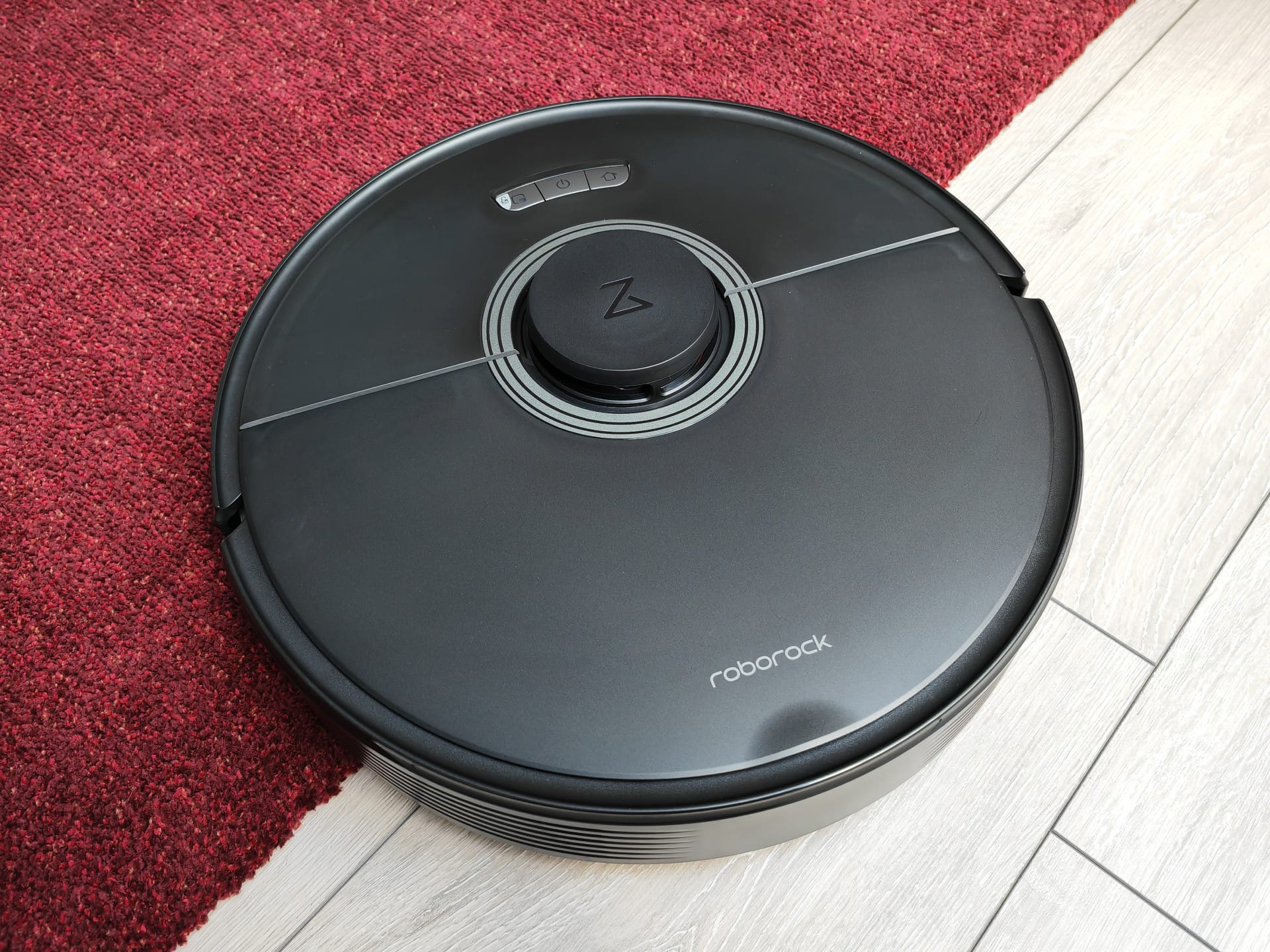
Viewed from above, you immediately see the slightly offset laser tower, which helps the vacuum robot navigate the room safely. In the direction of travel, there are also three control buttons to start or pause cleaning, send the robot back to the charging dock, or start area cleaning (or hold them for 3 seconds to activate child lock). This is practical when we don't have the app at hand but still want to start a cleaning cycle.
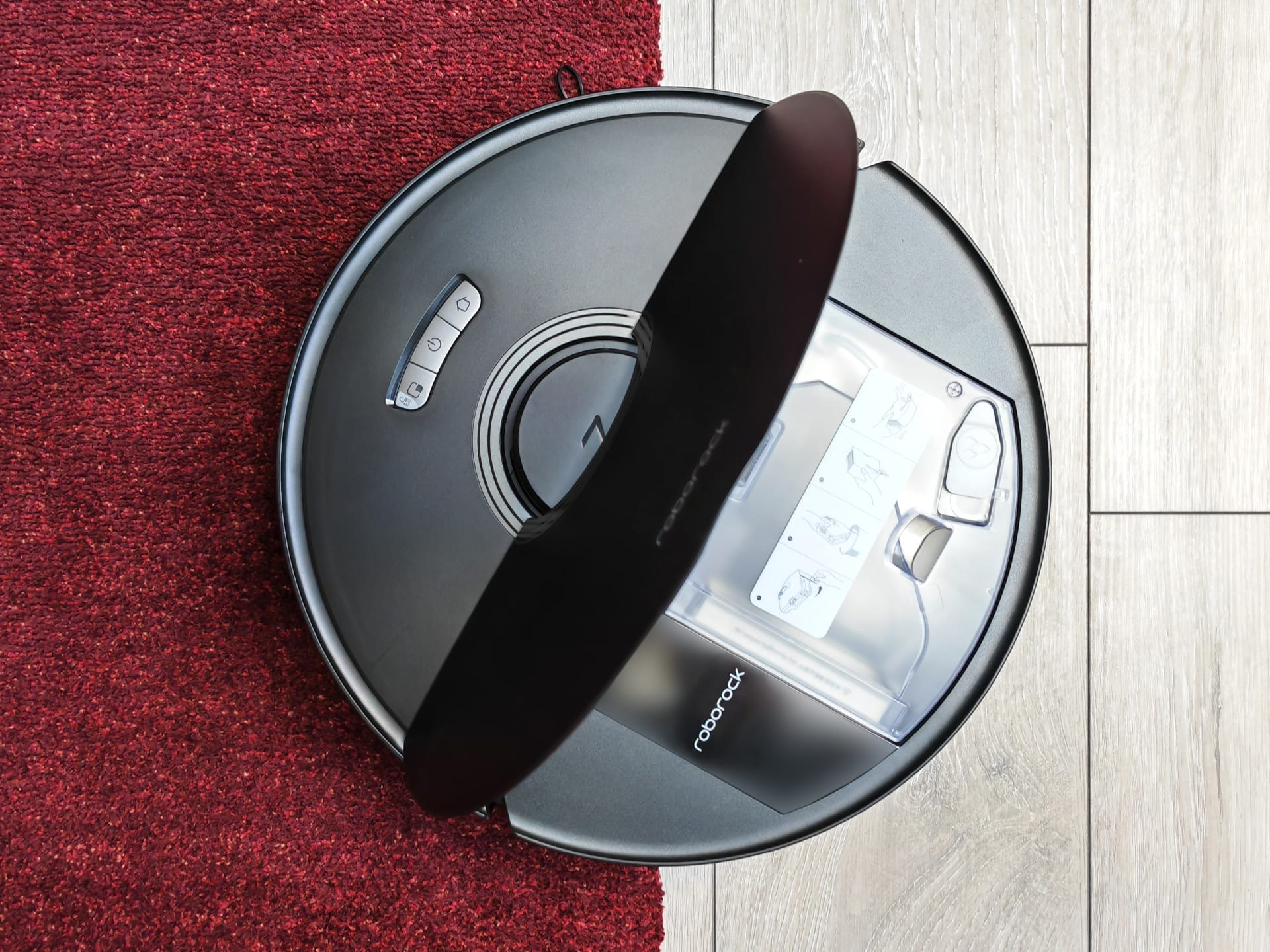
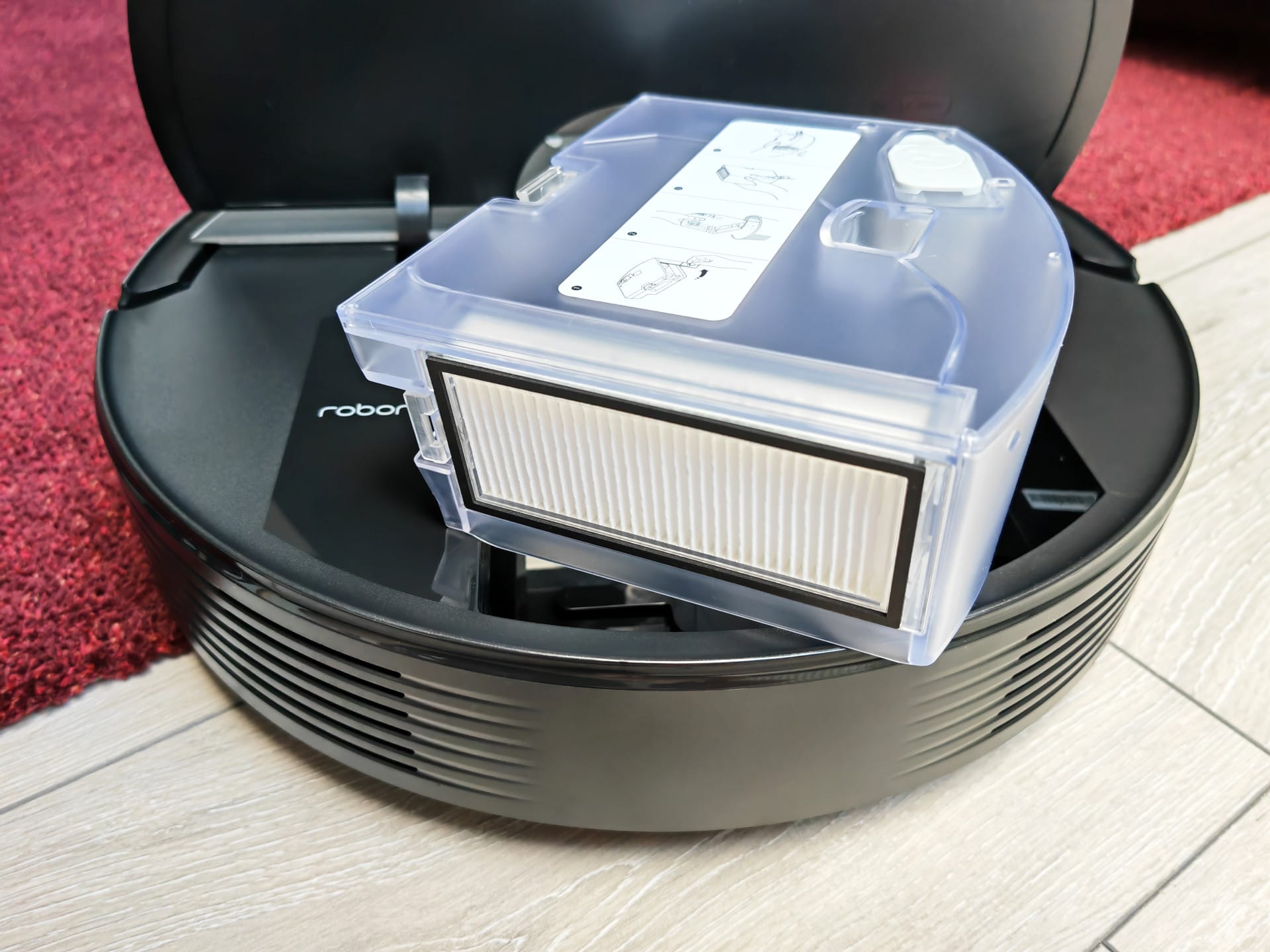
On the other side is the flap, which gives us access to the dust and water container and where the reset button is located. Unlike the Roborock S5 Max, the dust and water containers are no longer separate, but combined. This looks smarter because the water tank is no longer visible from the outside, but it also makes it harder to see the water level, as the flap must be opened to check it. The capacity of the dust chamber is 470 millilitres. The water tank has a volume of 350 millilitres.
The sides feature the usual sensors, including bumpers, with which the Roborock Q7 Max+ orients itself against walls and obstacles.
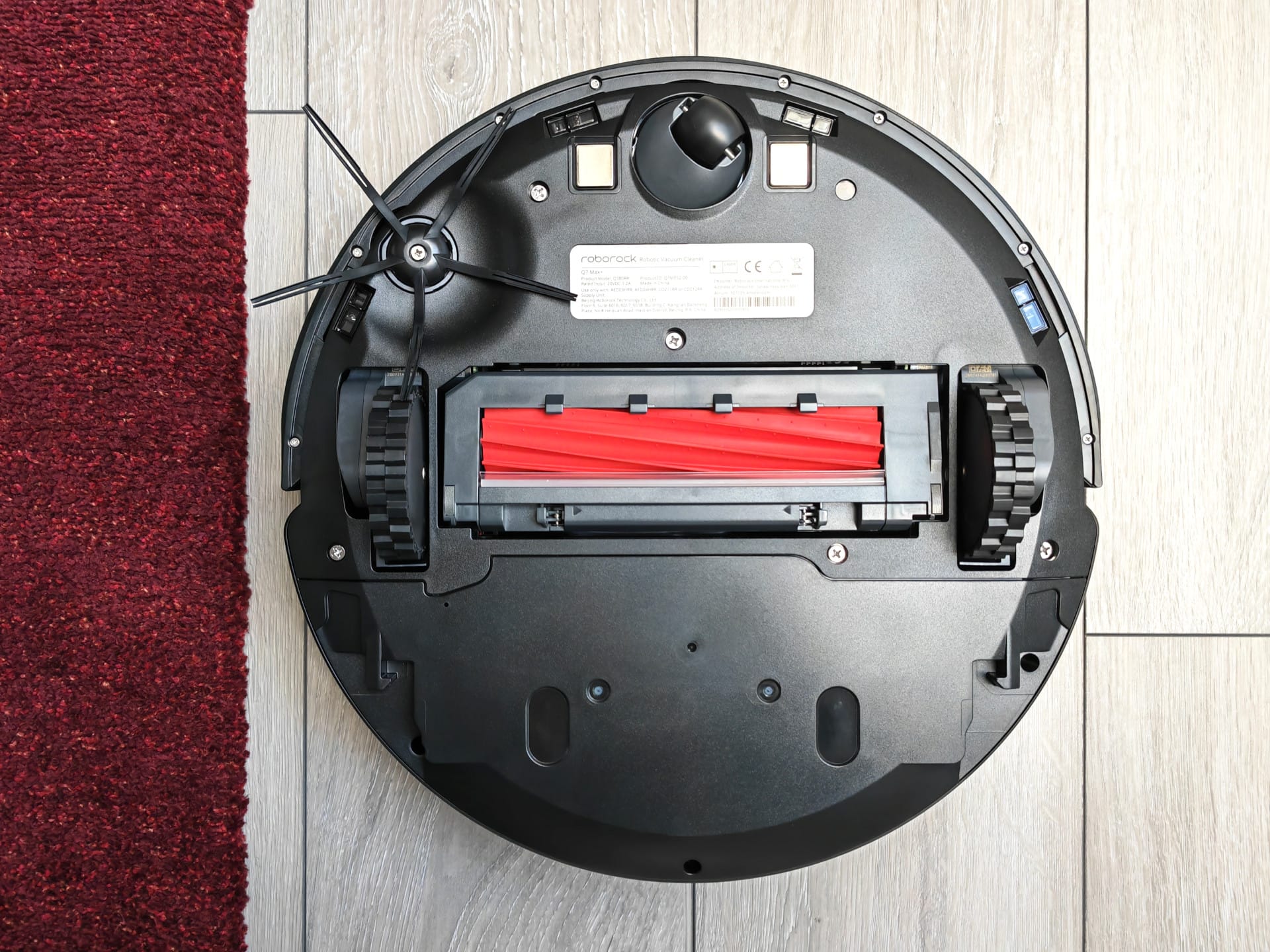
A look at the underside also reveals little new compared to other Roborock models. In the centre is the main brush, which uses rubber fins instead of bristles, a side brush, also made of rubber, the caster wheel, charging contacts and other sensors that prevent falls down stairs.
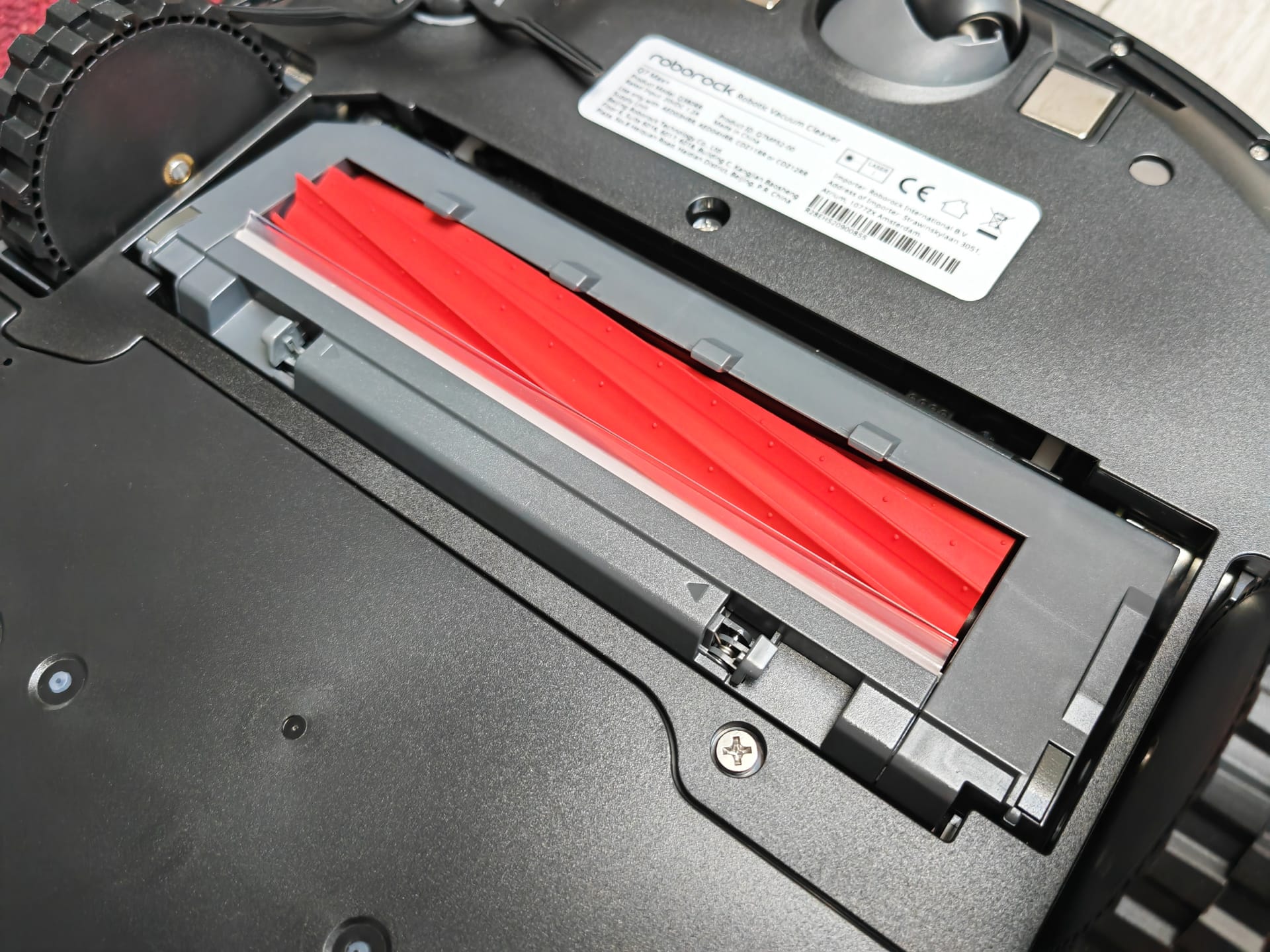
The main brush with rubber fins is another difference from the Roborock S5 Max, which still used a combination of rubber fins and bristles. Roborock made the switch with the introduction of the Roborock S7. The advantage lies in better handling of hair, which gets tangled less quickly and is easier to remove. By the way, the different brush types are not interchangeable. So don’t even try it!
Emptying station
In the case of the Plus model, the suction station also serves as the charging station. Anyone who has only purchased the Roborock Q7 Max can buy the suction station separately, turning their Q7 Max into a Q7 Max+.
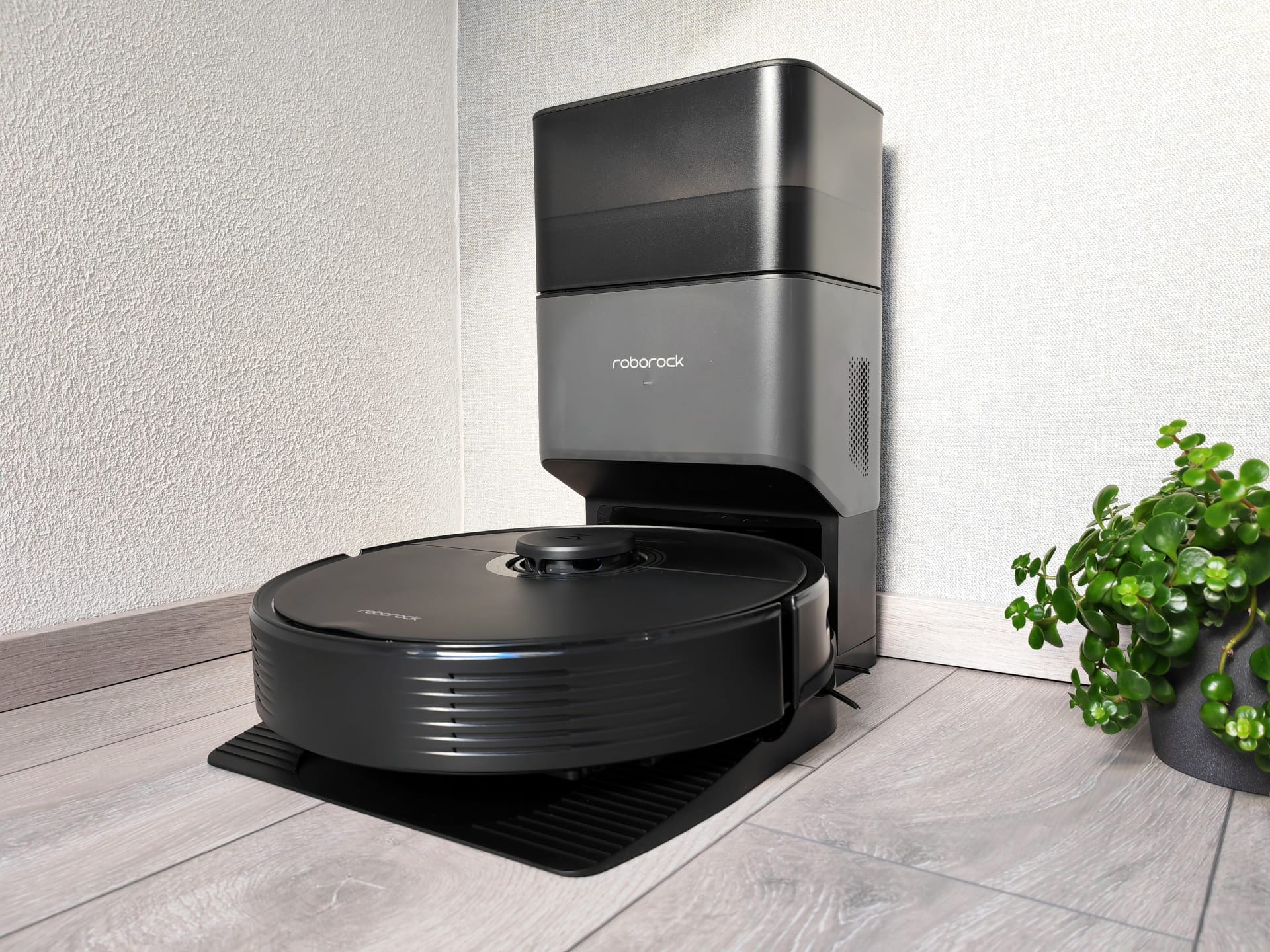
The (measured) dimensions of the dock are 43 cm in height, 43 cm in depth and a maximum of 30 cm in width, measured at the base plate. This makes the Roborock Q7 Max+ dock significantly more compact than those of some other robot vacuum competitors.
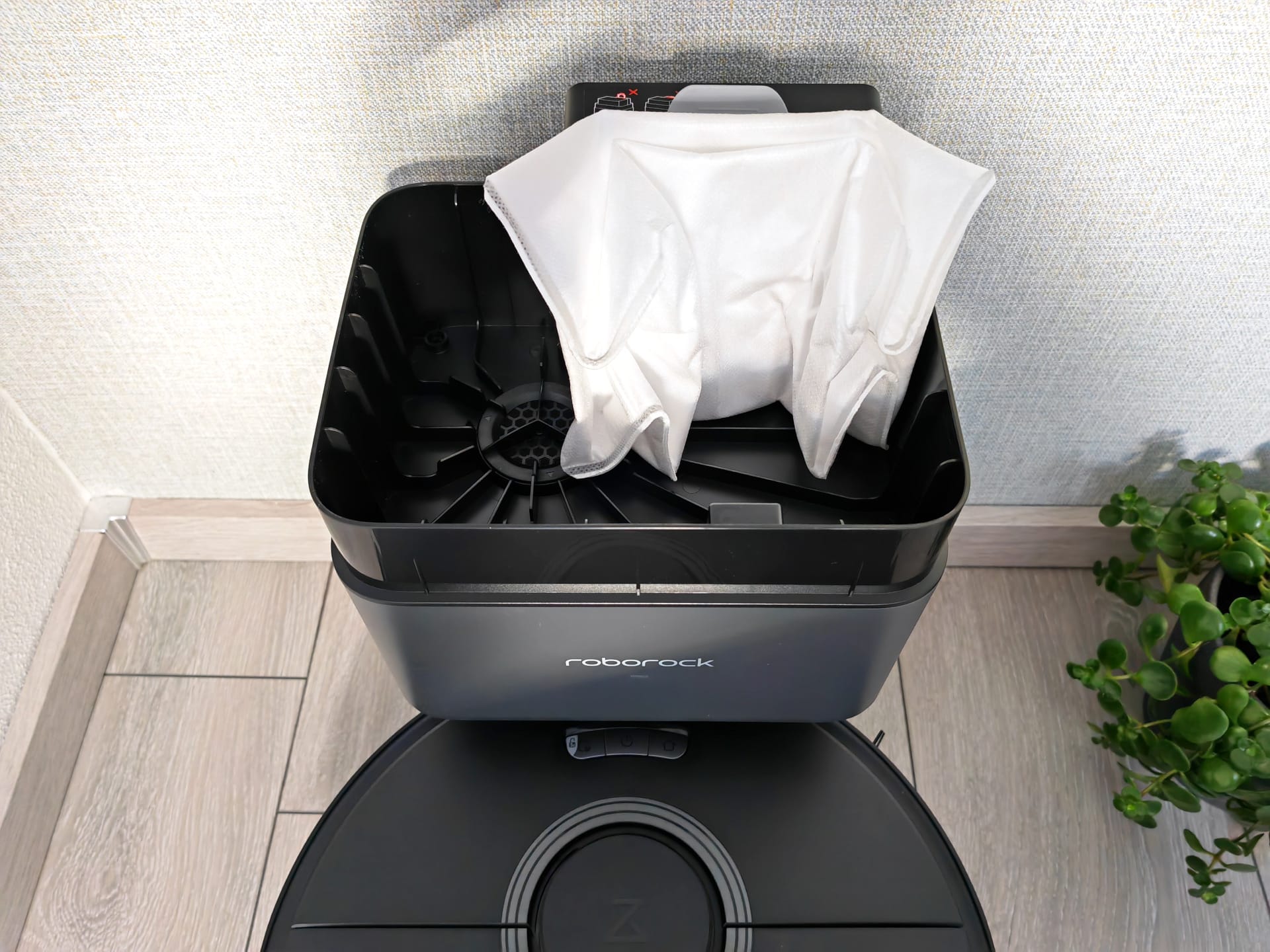
The design is discreetly simple, so the suction station fits almost any interior style. The construction is equally simple. Removing the top cover reveals the 2.5-litre dust bag. Depending on the level of soiling, such a dust bag lasts approximately one month. Replacements are available, among other places, on Amazon.
The power connection is on the side. The cable can be neatly tucked away into the cable management on the back.
Build quality
The Roborock Q7 Max+ robot vacuum boasts the familiar high Roborock build quality. Unfortunately, the suction dock cannot quite match the quality of the Roborock S7+ suction dock. Due to the merely placed cover, which does not close securely, the design seems somewhat poorly thought out.
Roborock Q7 Max+: Setup
The setup is simple, understandable and quick to carry out. Download the Roborock App from the respective app stores (Android / iOS), register with Roborock and then let the app search for a new Roborock device.
The Roborock Q7 Max+ was found without any problems in the test immediately after being switched on for the first time and was ready for operation in under a minute after entering the home Wi-Fi credentials. The only thing to note: 5 GHz networks are not supported.
Roborock Q7 Max+: App interface & features
The user interface of the Roborock app is one of the tidiest of its kind. The home screen provides us with important information about the cleaning area, the battery level and the cleaning duration of the last cleaning run. Via the centrally placed room map, we can track the position of the vacuum robot in real time and see which areas have already been covered during an ongoing cleaning process.
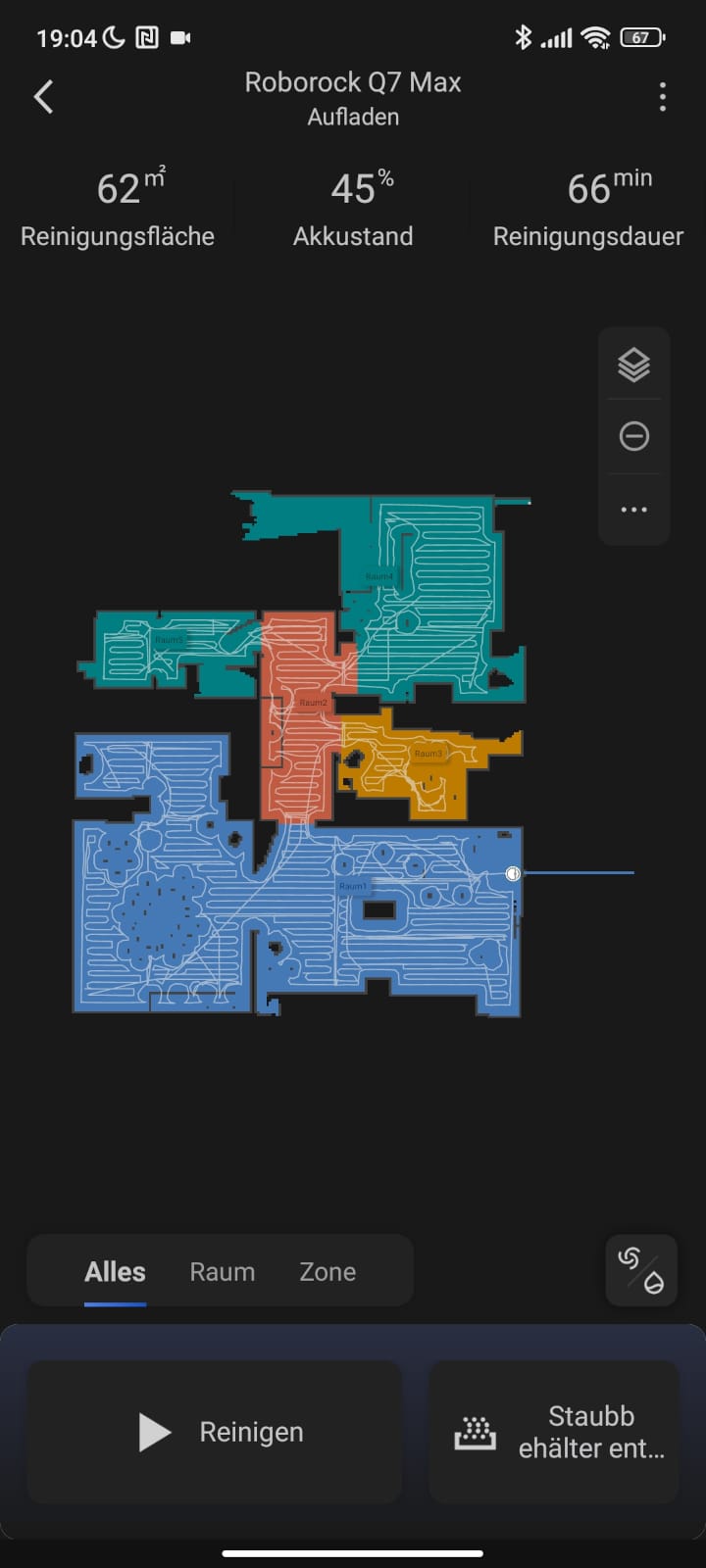
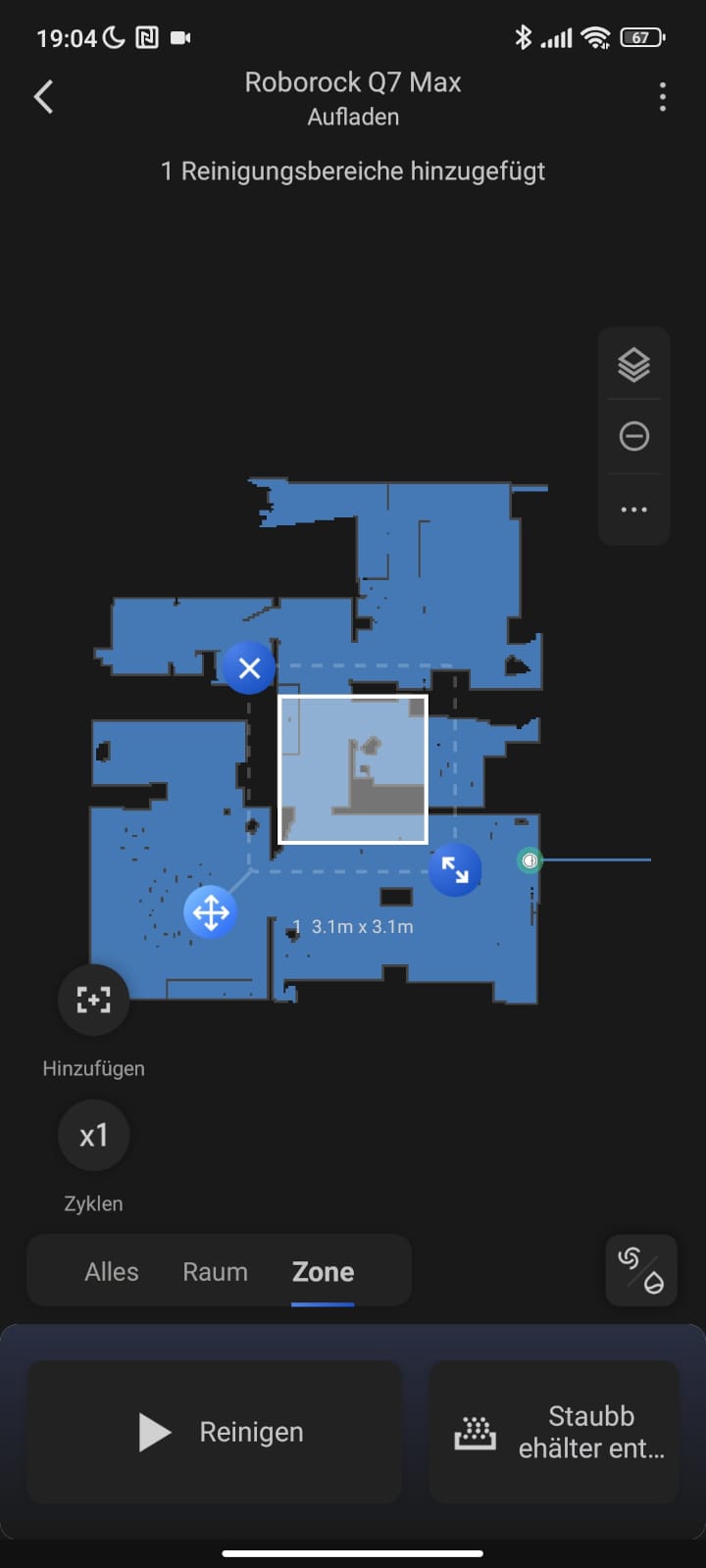
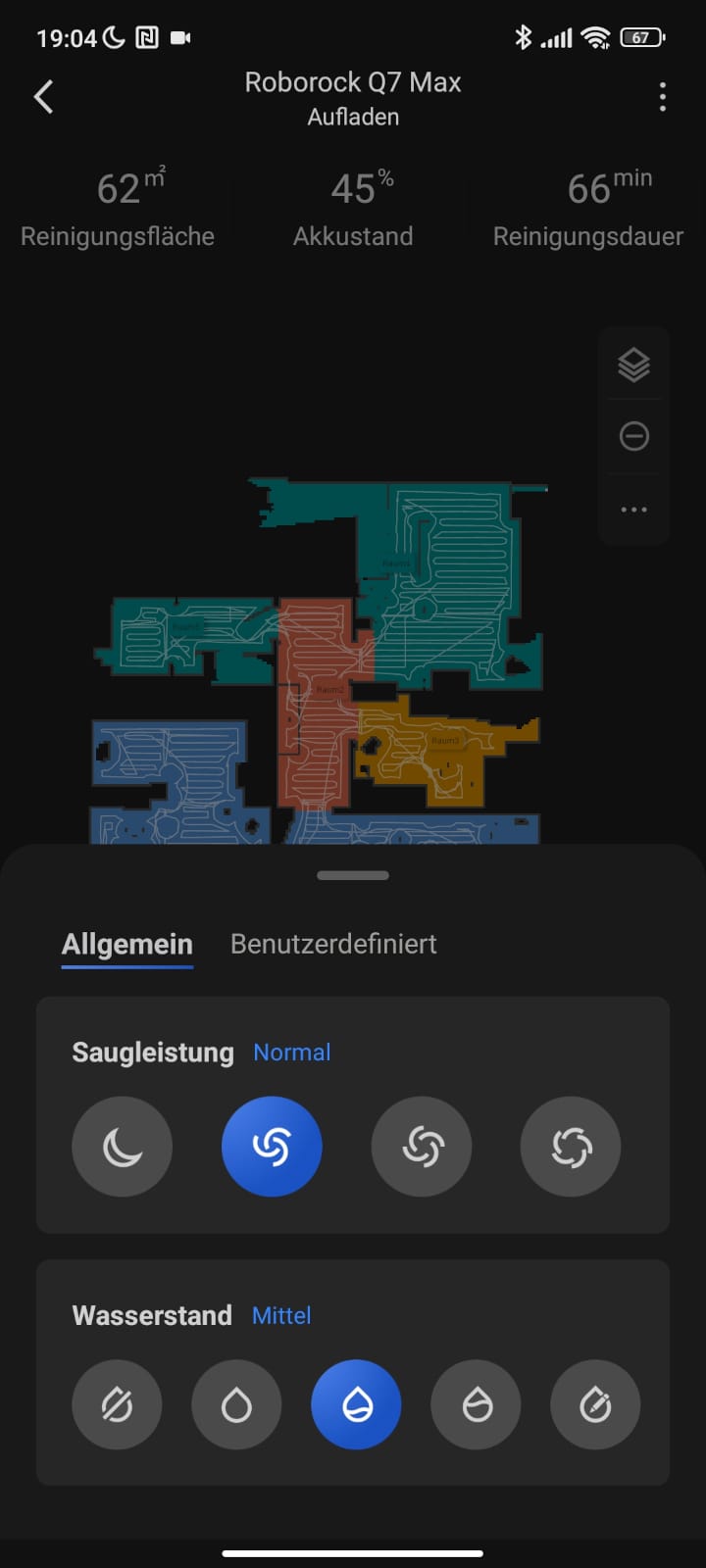
The room map is created after the first cleaning run and can then be edited in detail. Rooms can be separated, merged and renamed; there is the option to draw restricted zones, invisible walls and no-mop zones, and cleaning areas can be assigned. Those with more than one floor can create up to 4 maps of their living environment.
All key functions for the room map and suction behaviour are also accessible with a single click from the app's home screen. The suction power can be adjusted to the levels “Quiet”, “Normal”, “Turbo” and “Max” at the touch of a button and during the cleaning process. The same applies to the water flow onto the mop cloth, which can be completely switched off or adjusted across 4 levels.
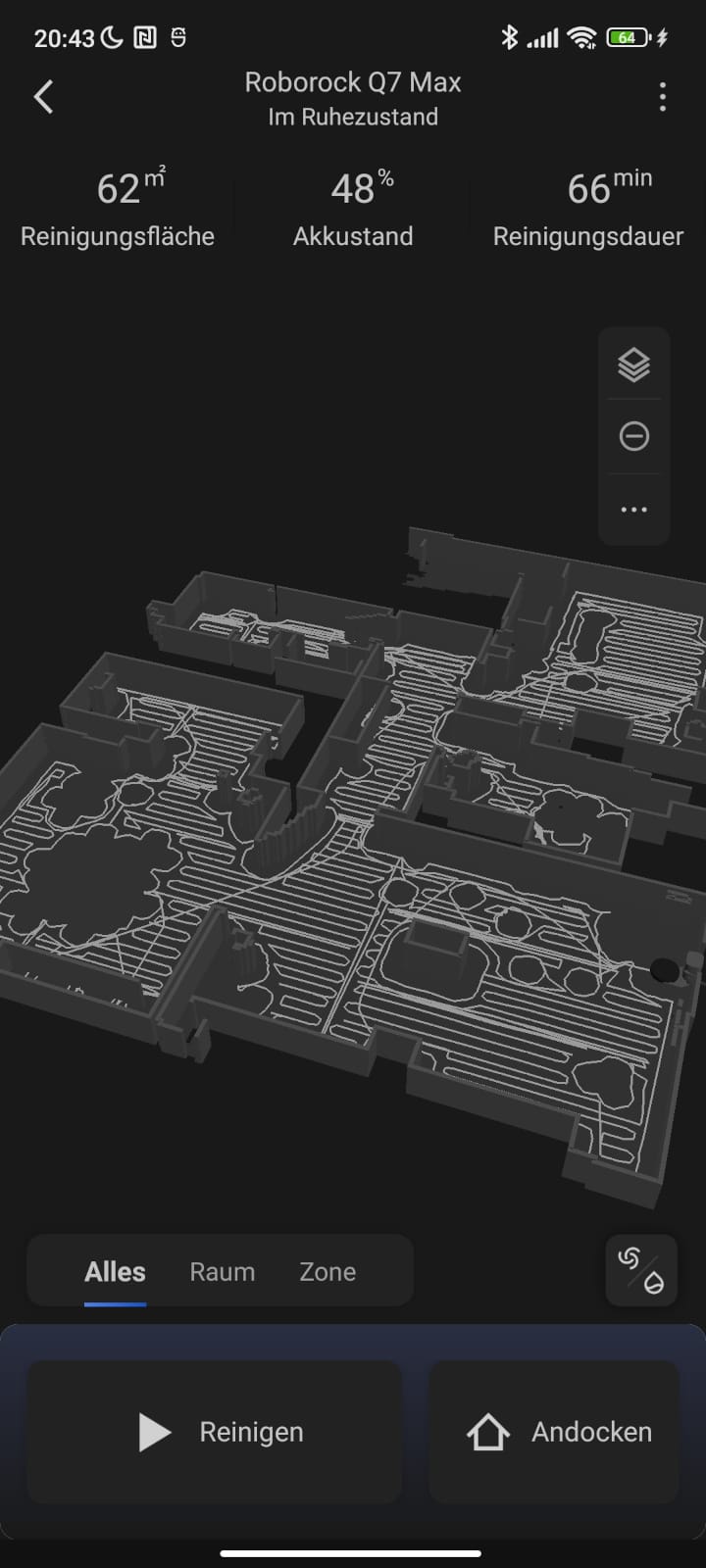
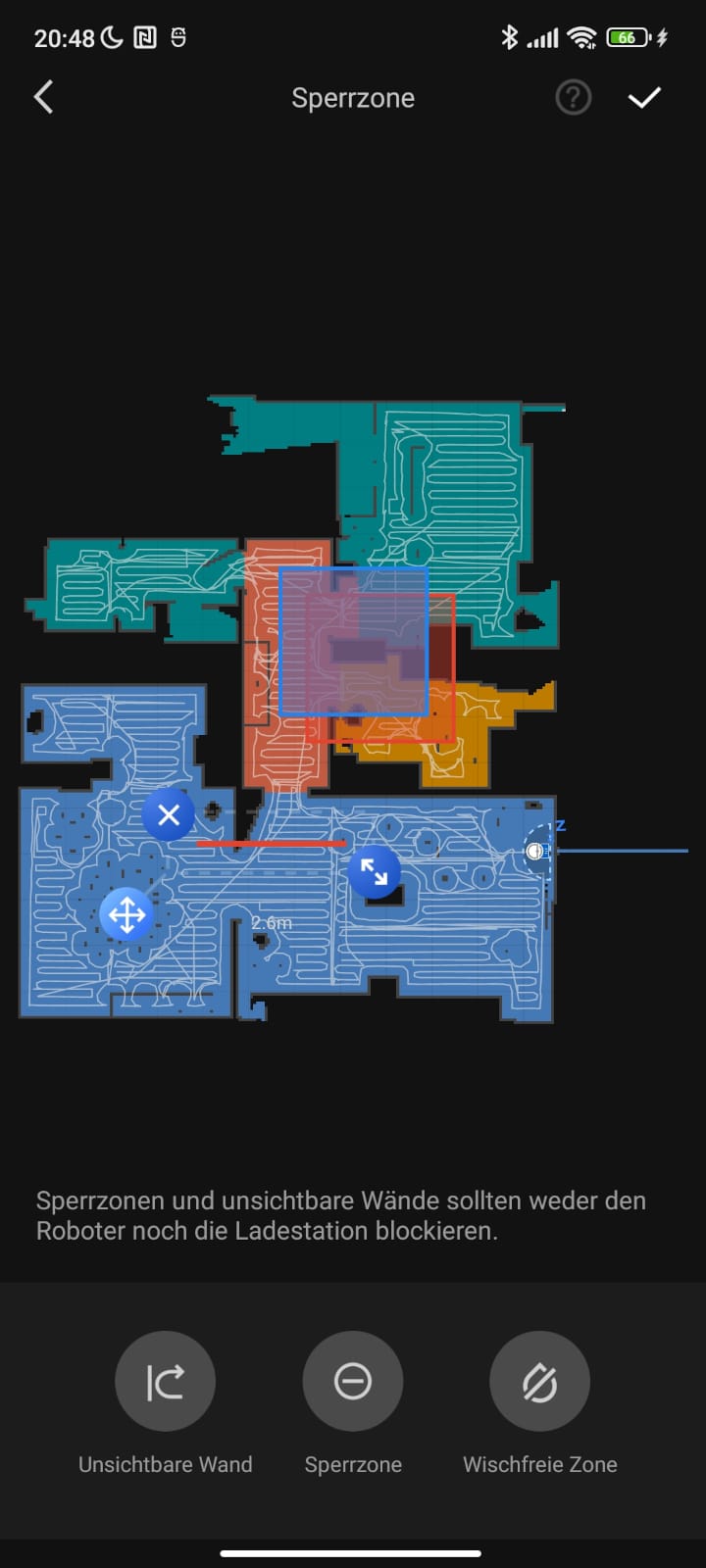
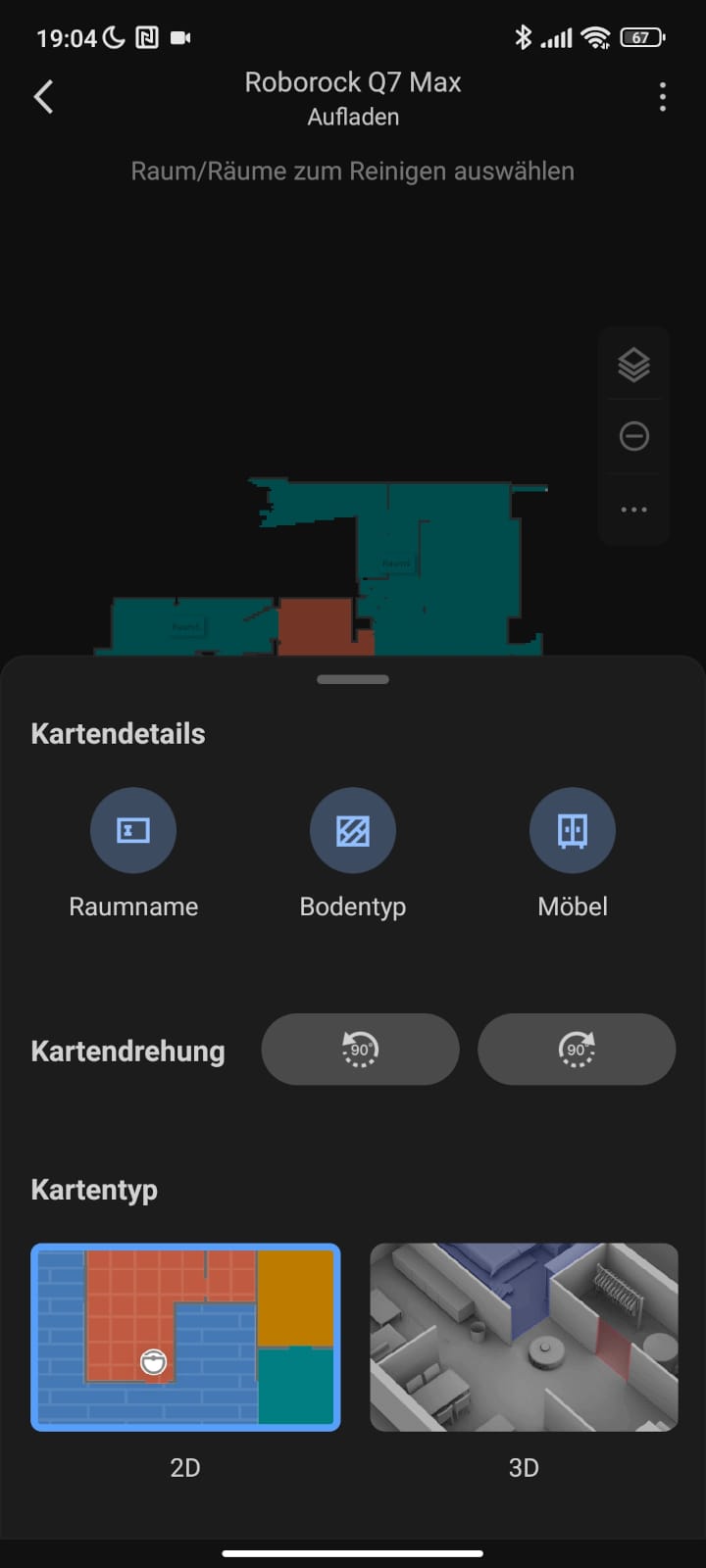
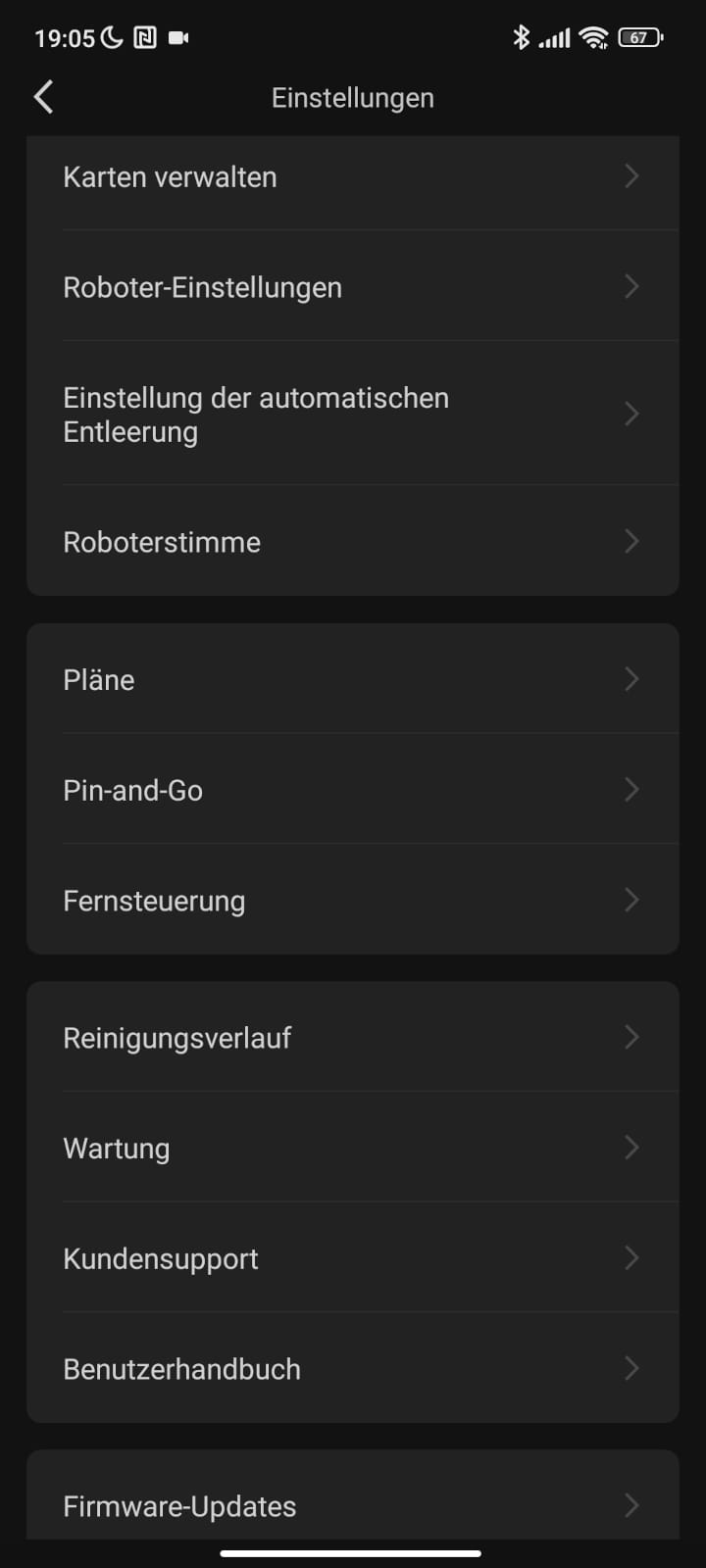
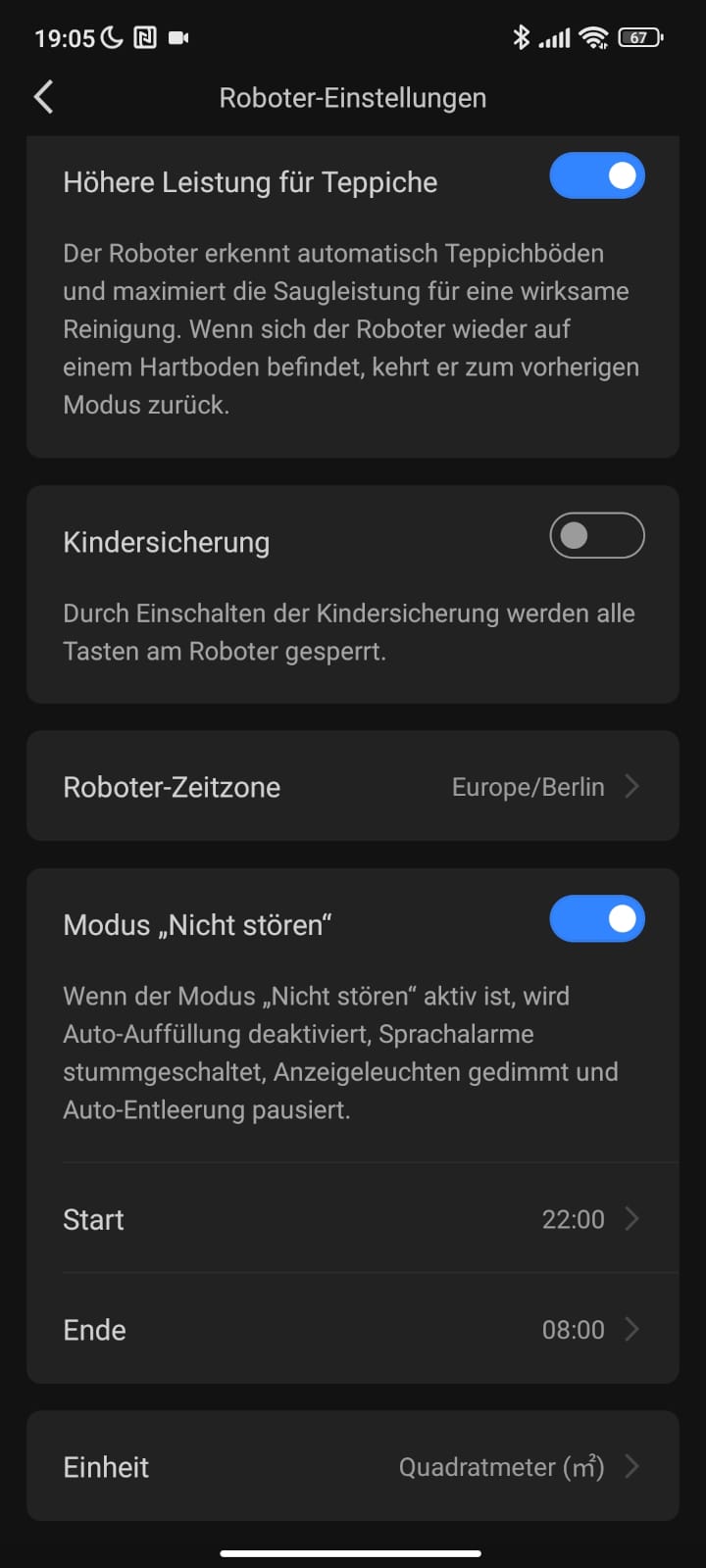
In the app's settings, we have access to, among other things, map management, can configure settings for the auto-empty station's emptying cycle and can programme timed cleaning schedules. Settings for performance boost on carpets, the child lock or the do-not-disturb mode can be found in the more specific robot settings.
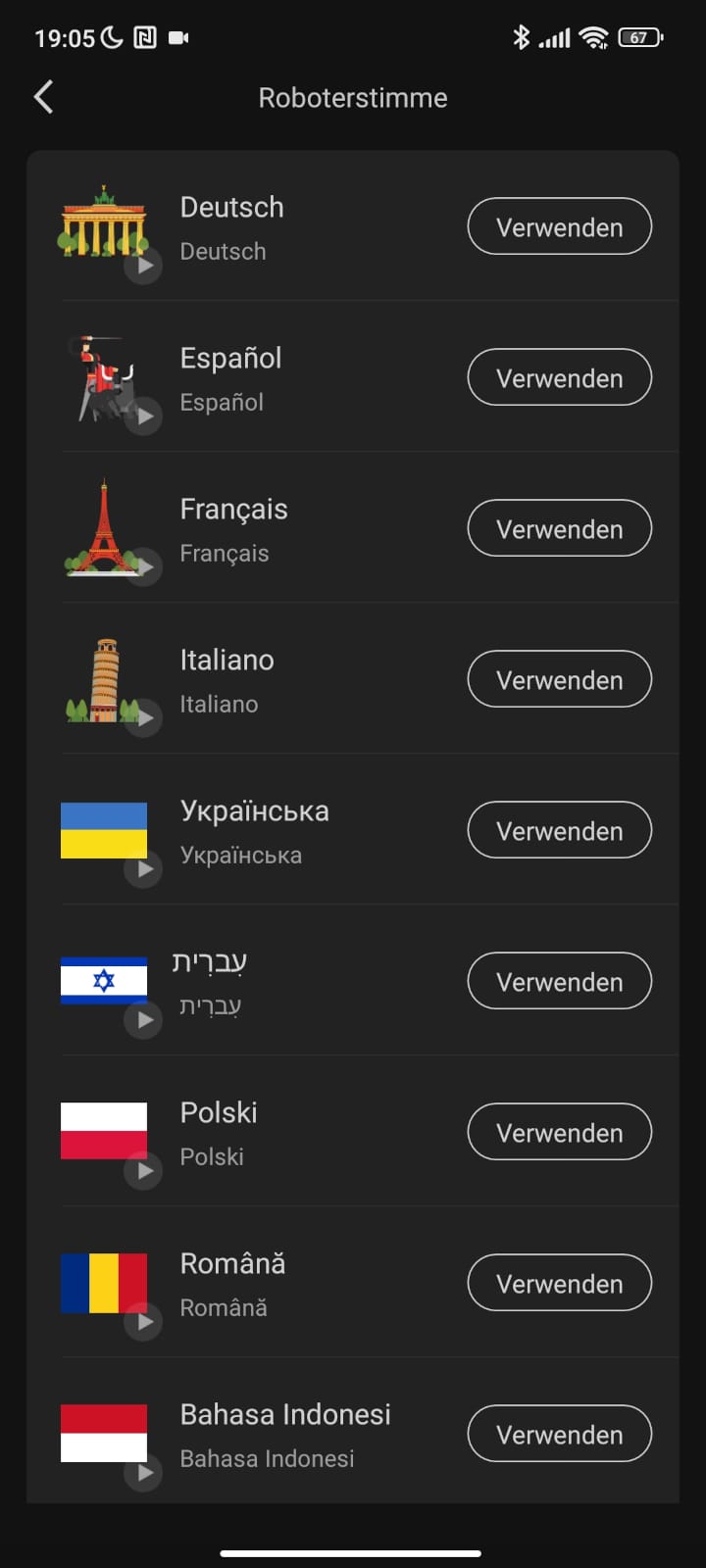
The various language packages that can be installed on the robotic vacuum are fun. Almost every common language has its own language package there. Unfortunately, the official installation of custom language packages is not supported. Control via a virtual directional pad or joystick is also advantageous. This allows you to manually control the robotic vacuum remotely in the room.
Integrating the Roborock Q7 Max+ into Google Home or Amazon Alexa is an additional option for controlling the vacuum robot via voice command. Apple users can create Siri shortcuts for voice control via the Roborock app.
Roborock Q7 Max+: Practical test
That’s enough about the app. Let’s see how the Roborock Q7 Max+ performs in practice.
Vacuuming
In terms of suction power, the Roborock Q7 Max+ surpasses several premium models from the S series. The datasheet specifies a maximum suction power of 4,200 Pascals (Pa). By comparison, the Roborock S5 Max achieves a maximum of 2,000 Pascals, and the Roborock S7 reaches 2,500 Pascals. Only the Roborock S7 MaxV exceeds this suction power with a substantial 5,100 Pascals.
However, higher suction power does not necessarily mean that the robot vacuum cleaner cleans better. In our suction test, we had the Roborock Q7 Max+ compete on various hard floors and carpets. On hard floors, the robot vacuum cleaner performs excellently. Typical household dirt, whether fine or coarse, is suctioned up in most cases on the first pass. The Roborock Q7 Max+ has nothing to hide from the Roborock S7 here.
Carpets are significantly more difficult for robot vacuums to clean. High-pile carpets, in particular, are a challenge to overcome. The maximum height must not exceed 2 centimetres, otherwise the Roborock Q7 Max+ cannot drive over the carpet edge. Fluff is picked up well on short-pile and high-pile carpets. For finer and deeper-set dirt, the Roborock Q7 Max+ requires several passes. The automatic carpet detection works reasonably well. However, it takes a while for the suction level to increase. Especially with small carpets, such as those often used in bathrooms, the robot vacuum is usually halfway across before the turbo kicks in.
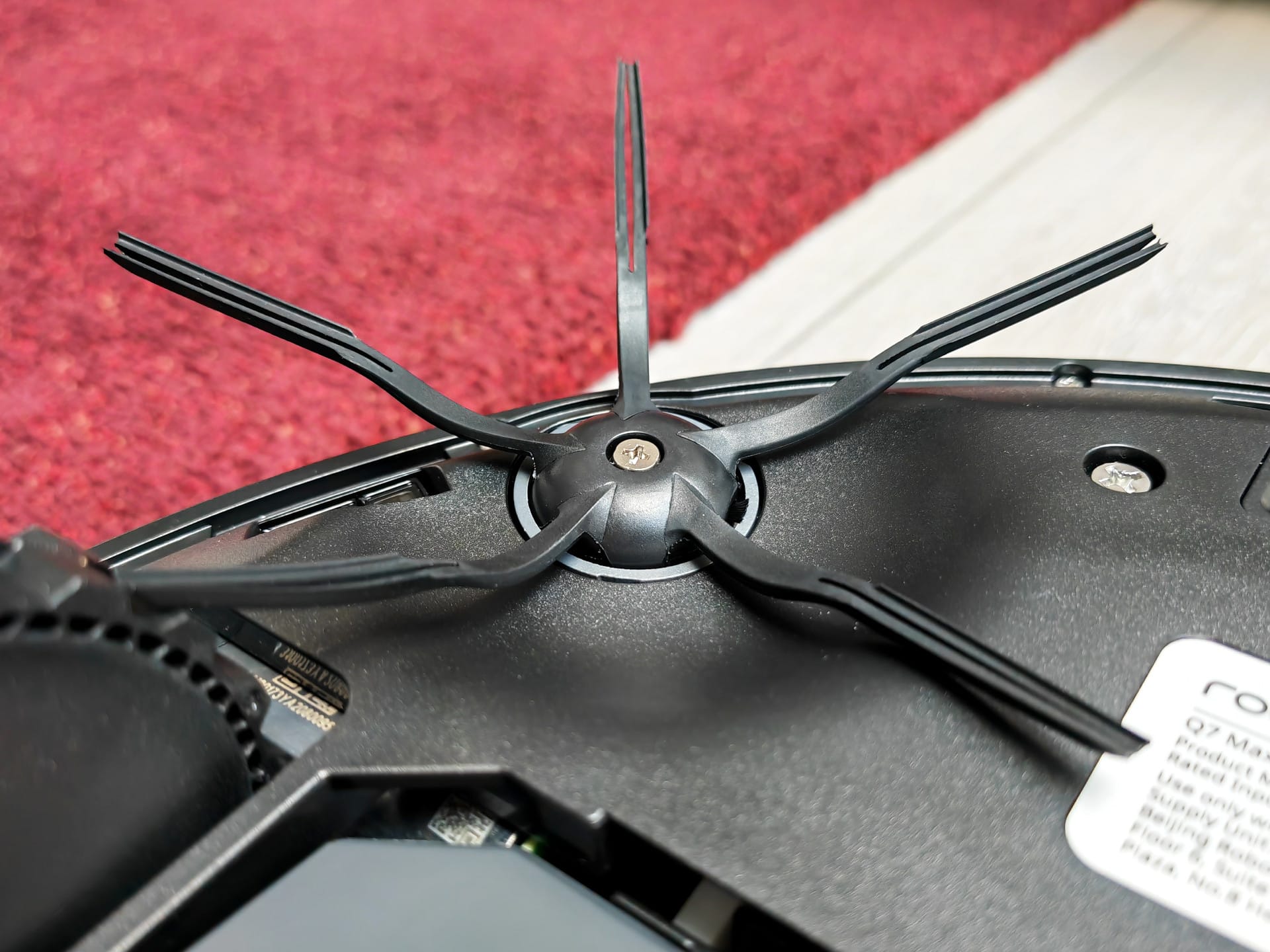
We were not so keen on the rubberised side brush. Unlike the main brush, hair wraps around it much faster, and the rubber arms tend to get stuck on carpets. Maintenance is also more difficult, as the side brush is screwed rather than clipped. However, on hard floors, the side brush does a good job of picking up dirt from corners.
Regarding volume, it ranges from pleasant (approx. 50 dB) to noticeably loud (approx. 70 dB) depending on the suction mode. However, the Roborock Q7 Max+ is not louder than other robot vacuum cleaners. The robot vacuum cleaner requires approximately 65 minutes to clean an area of 60 square metres.
Overall, the Roborock Q7 Max+ offers praiseworthy suction performance!
Swipe
The mopping function of the Roborock Q7 Max+ is a “nice-to-have” feature, but it cannot compete with the mopping performance of the current Roborock S7 series. The automatic lifting of the mop when vacuuming carpets and the sonic vibration technology (VibraRise) are missing here.
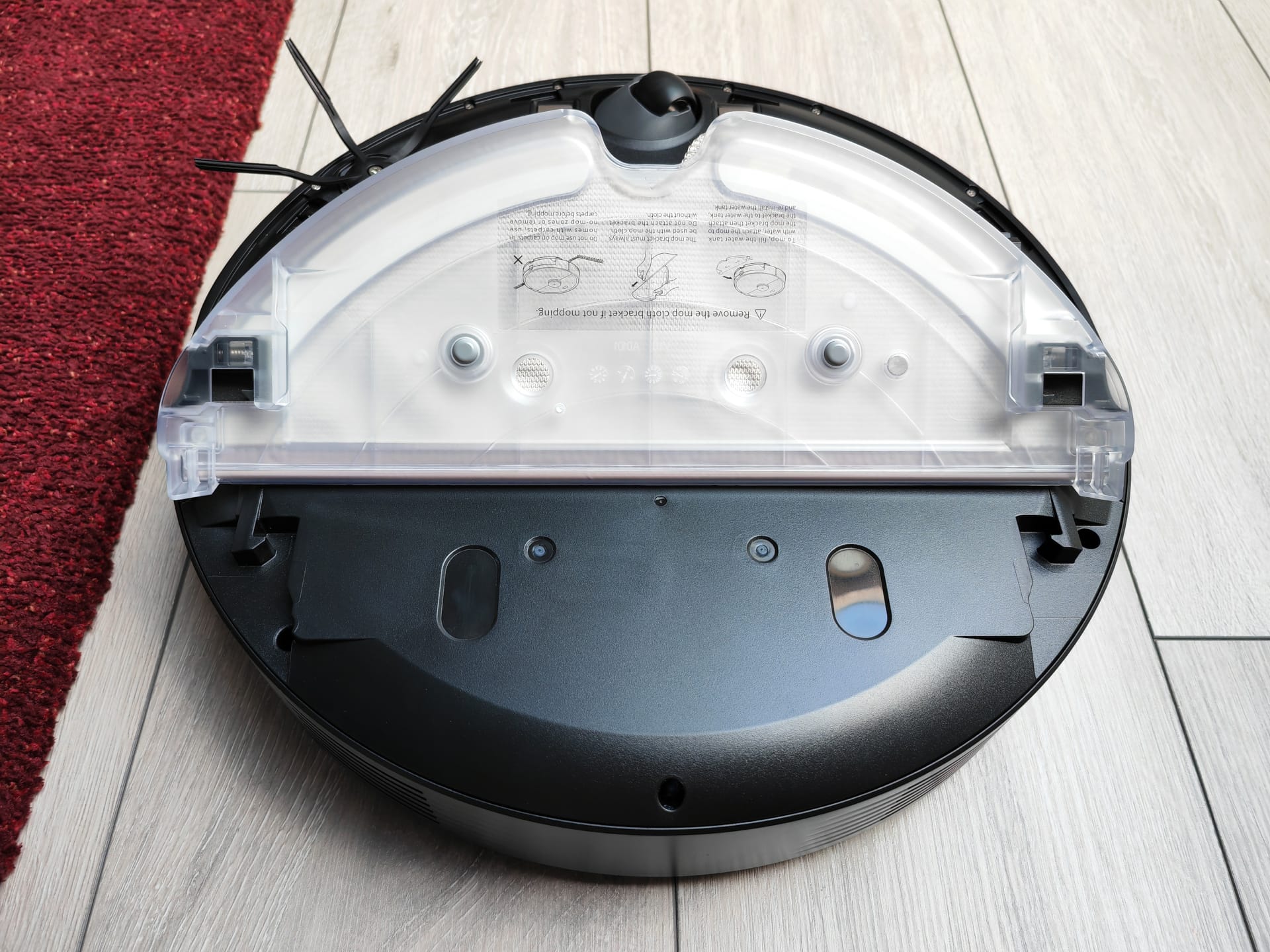
As mentioned earlier, the Roborock Q7 Max+ uses a combined tank, including a 350-millilitre water chamber. The mop attachment is attached to the rear of the robot vacuum and is equipped with a microfibre mop cloth that is automatically moistened via two small water outlets. The amount of water dispensed can be adjusted via the app. Two small springs on the mop attachment ensure a 300-gram pressure. The mop cloth is dragged behind across the entire diameter of the robot vacuum.
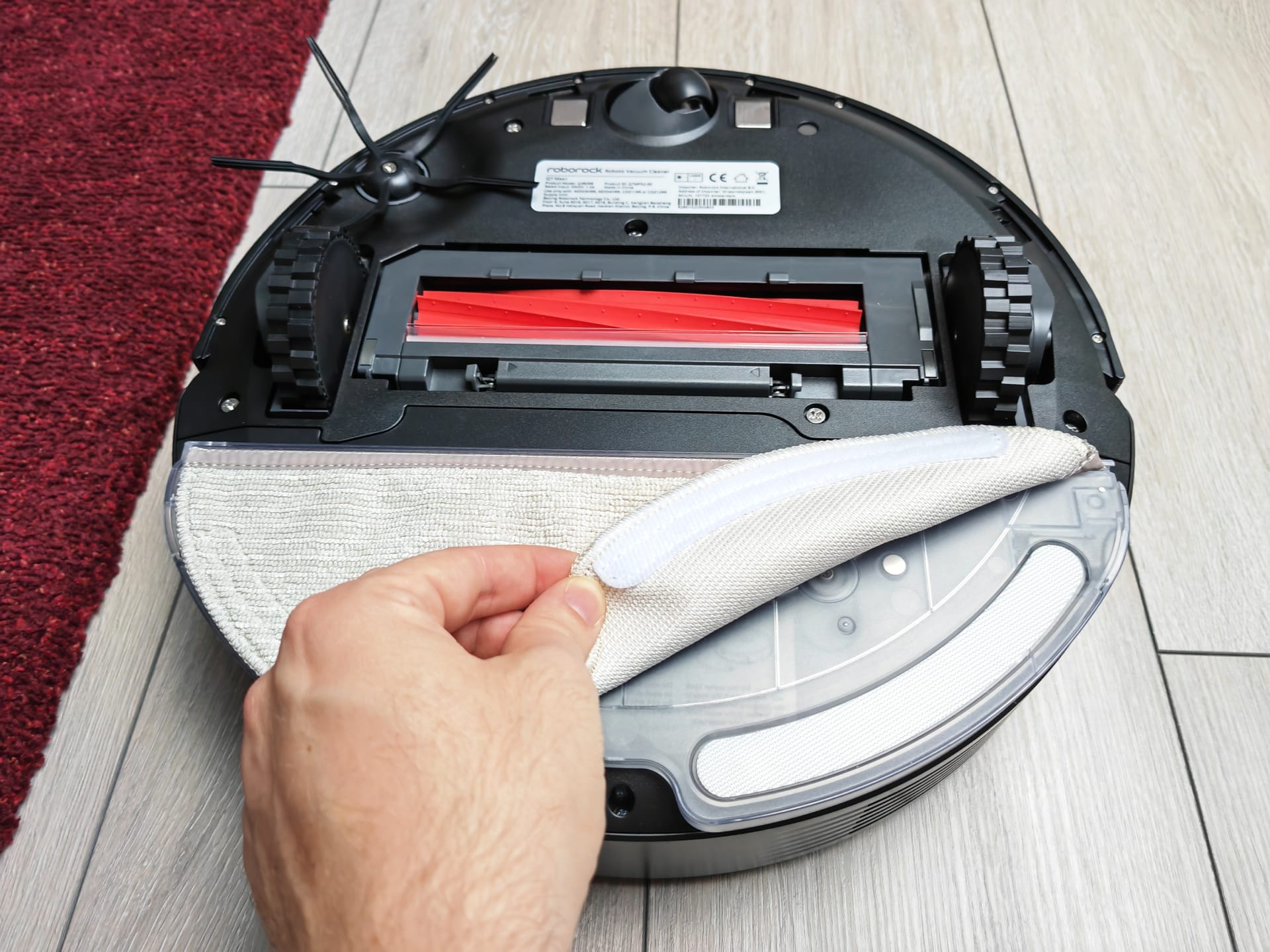
That’s the theory. In practice, the mopping performance is sufficient for a quick damp wipe. However, the Roborock Q7 Max+ does not replace manual mopping. Light dirt is picked up well, which is also visible on the cloth at the end. You can adjust how many times the robot vacuum passes over an area during a cleaning run. Unfortunately, the mopping performance is not sufficient to remove dried-on dirt or water stains, even with multiple passes. To prevent the mop plate from soaking the (wooden) floor and potentially softening it after mopping, you should remove it immediately. If you use the dust collection station, you do not need to worry about this. The station is designed so that the mop attachment does not touch the floor.
The mopping function of the Roborock Q7 Max+ is a “nice-to-have” but cannot compete with the more expensive models!
Navigation
For navigation, the Roborock Q7 Max+ uses various sensors. The most striking feature is the laser tower on the top, which detects obstacles from approximately 10 centimetres in size. The tower is supplemented by drop sensors on the sides and underside.
There is little to criticise about the navigation features of the Roborock Q7 Max+. The robot vacuum navigates through the room in a well-considered manner and reliably finds its way back to the station after cleaning.
It approaches obstacles and walls carefully. From time to time, the bumper is used, with which the vacuum robot gently touches the obstacle. One should monitor the first cleaning pass. Especially cables, clothing or toys should not be lying around in the way. The Roborock Q7 Max+ does not detect these. Larger obstacles such as table and chair legs, however, are cleanly circumvented.
Problems can also be caused by reflective surfaces or black carpets, which are currently not recognised as obstacles or which trigger the cliff sensors.
Sophisticated and precise navigation within the room. However, the Roborock Q7 Max+ does not detect cables, socks or other obstacles under 10 centimetres.
Emptying station
The operation of the docking station is largely self-explanatory. At the end of the cleaning process, the robot vacuum returns to the station and is emptied through its underside. The emptying process takes approximately 15 seconds. The volume is substantial and almost reaches the noise level of an industrial vacuum cleaner. However, it also applies here that the Roborock Q7 Max+ docking station is not unusually loud compared to other models.
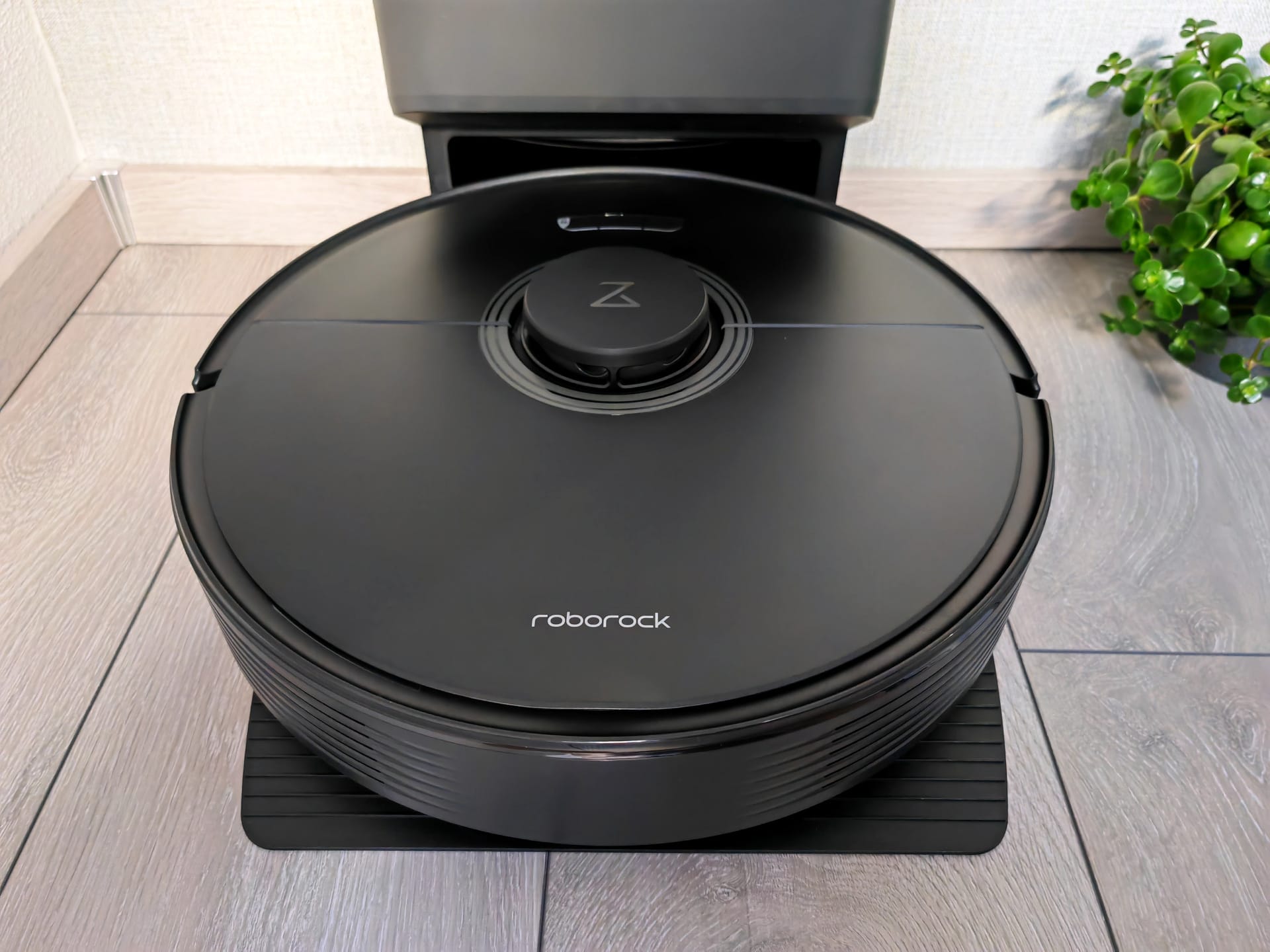
The extracted dirt eventually ends up in the 2.5-litre dust bag, which needs to be replaced roughly once a month with daily cleaning runs. This saves you the manual emptying of the dust chamber, from which allergy sufferers in particular benefit. However, the dust chamber is not completely clean after extraction. Dirt occasionally gets stuck on the filter inside the dust chamber. However, it is sufficient to rinse the chamber and filter under running water every few weeks. You can tell when it is time to replace the dust bag from the LED under the Roborock logo.
Battery
A permanently installed 5200 mAh Li-ion battery is responsible for powering the robot vacuum. According to Roborock, the Roborock Q7 Max+ is capable of cleaning up to 3 hours or 300 square meters of area continuously.
We were able to verify these values in practice to a large extent. After cleaning our 60 square metre area, which took the robot vacuum 65 minutes, there was still 78 percent of battery remaining. If the battery runs out during a cleaning cycle, the robot vacuum automatically returns to the charging dock, charges up and resumes from where it left off.
Our verdict
With the Roborock Q7 Max+, Roborock launches the beginning of its budget-conscious Q series. In the overall package with the docking station, the Q7 Max+ offers pretty much everything a vacuum robot should offer in 2022. High suction power, good navigation features and easy handling are essential strengths of the Roborock Q7 Max+.
The mopping function is somewhat disappointing, as the mop is simply dragged along. Top features such as automatic lifting of the mop on carpets or sonic vibration technology are so far only available on the more expensive S7 models.
One thing is clear though: the Roborock Q7 Max+ has the potential to become a bestseller among affordable robot vacuums with a docking station.
Price comparison
| Store | Price | Link |
|---|


Comments (8)
Hi Timo, first of all, thanks a lot for the detailed test. Maybe you can help me out, because I am looking for a vacuum robot with a self-emptying station and since I have only heard positive things about Roborock, I would like it to be one of that brand's models.
I am now unsure whether it should be an S7 or the Q7. I definitely want an auto-empty station included. The mopping function is less important to me, because my living room, which is the largest room in my 60 m² apartment, has carpeted floors. Is the Q7 sufficient or should I prefer the S7? LG 🙂
Hi Svenja, I'm glad you like my review. If we aren't dependent on the mopping function at all, the Q7 Max is completely sufficient.
Another consideration might be the docking station. For example, the S7's station can operate without a dust bag. The Q7's station cannot. The station is available separately and is compatible with the Q7.
Otherwise, you are very well served with the Q7 Max+. I hope I was able to help you a bit. 🙂
Hello Timo, you helped me a lot. 🙂 I have now ordered the Q7 Max with suction station and am really excited about it.
Can you also add cleaning fluid to the water tank? LG
Hi P, I would not recommend adding cleaning agents to the tank. The water is dispensed onto the cloth through tiny nozzles, and depending on the cleaning agent, they could become clogged.
There are special cleaning agents for vacuum and mop robots, but unfortunately I cannot tell you how good or bad they are.
Hello,
thanks for the review. Unfortunately, like all others, it leaves my question unanswered. It could be that my question is absurd, but the Q7 is my first serious robot vacuum and I am slowly testing my way through…
My question: what happens with the unused residual water in the combined container?
My robot drives to the station and wants to suck – wouldn't it then suck the residual water into the dust bag? And does that stay in there, if that is the case???
I would appreciate an answer.
And now we ignore the question and enjoy this nice review 😉
I've finally got it too… sorry 🙁
Hi Krissie,
Perhaps the review has already answered your question. 🙂 It is a combined container. The dust chamber and water tank are separated from each other. The water remains in the water tank during suction, and only the dust chamber is emptied into the dust bag. 🙂