Contents
Teclast M20
Design and display
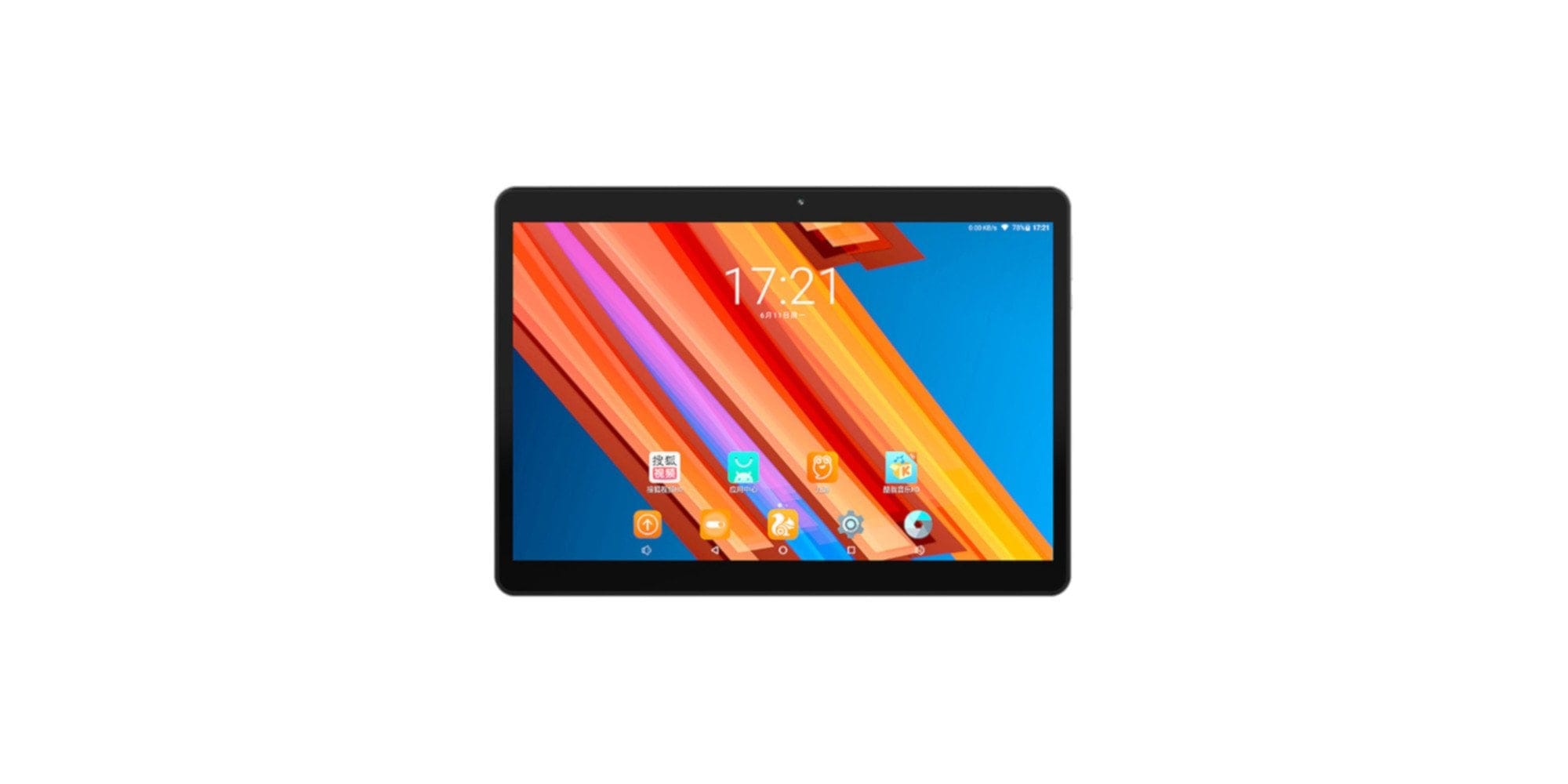
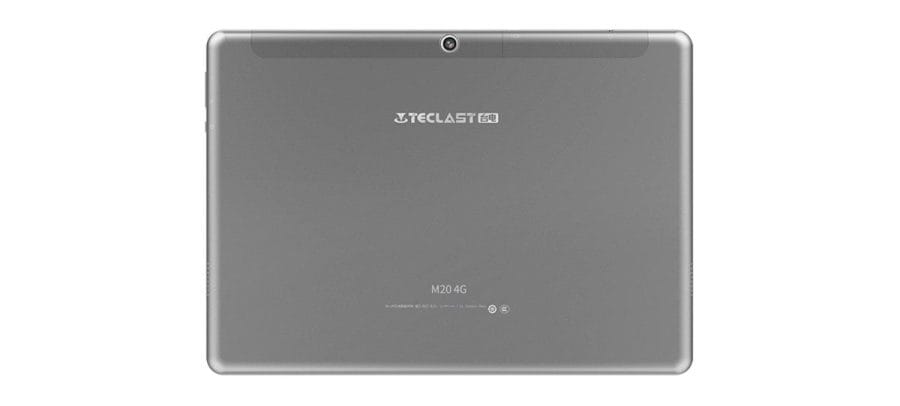
The Teclast M20 and the Chuwi Hi9 Air, which we recently tested, are very similar not only in terms of hardware but also in appearance. The M20 features a slim unibody design measuring 23.90 x 16.70 x 0.80 cm. A unibody design is characterised by the manufacturing of the casing from a single piece, in this case aluminium. The total weight of the tablet is 553g.
The rear main camera is surrounded by a narrow plastic cover, behind which the tablet's antennas run. Part of the cover is removable. Hidden behind it are the dual SIM slots and the microSD card slot. Other connection options include a Micro-USB port and a 3.5 mm jack audio output.
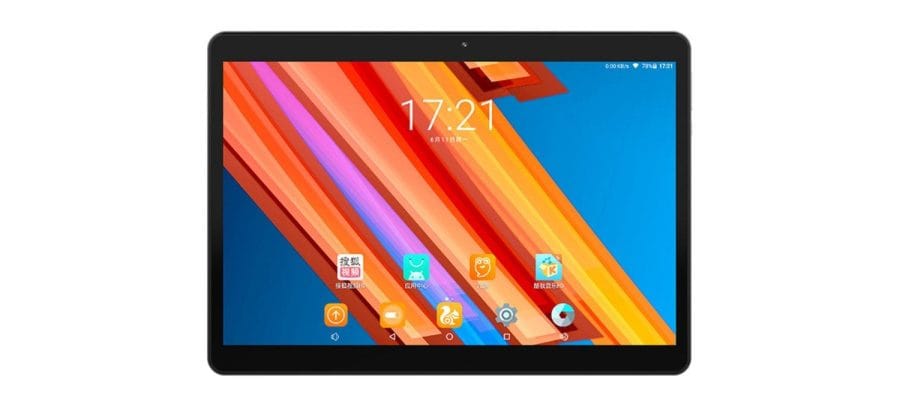
The display is of the IPS type and resolves at a diagonal of 10.1 inches with 2560 x 1600 pixels. The panel is manufactured by Sharp. Thanks to the "full lamination" manufacturing of the panel, the LCD, the touchscreen and the protective glass are not glued in multiple layers, but form a single unit. Advantages include an overall more compact panel with higher colour intensity and better light transmission. Multitouch is possible with up to 10 simultaneous inputs.
Processor and memory
The system-on-chip (SoC) is a MediaTek MTK6797, better known as the MediaTek Helio X20. Released in early 2016, the SoC was primarily designed for smartphones.
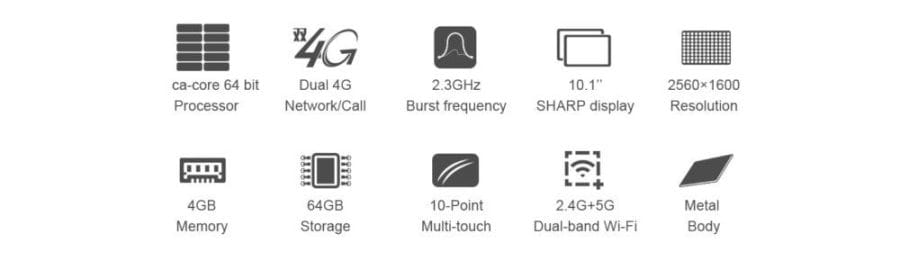
Key components of the system-on-chip include a CPU with 10 processor cores, which are further divided into 3 clusters, as well as an ARM Mali-T880 MP4 GPU. The CPU clusters consist of a high-performance cluster (2x Cortex A72 - 2.3 GHz), a performance cluster (4x Cortex A53 - 1.85 GHz) and a power-saving cluster (4x Cortex A53 - 1.4 GHz). The GPU clocks at up to 780 MHz. The memory configuration comprises 4GB DDR3L RAM and 64GB eMMC5.1 storage. A storage expansion via a MicroSD memory card is possible.
In our experience, the Helio X20 SoC should allow for largely smooth everyday operation. The SoC can also cope with one or two mobile games. However, it remains to be seen how well Teclast has tailored the Android system to the chip. The similarly equipped Chuwi Hi9 Air showed clear weaknesses in this area, which resulted in frequent stuttering and even total crashes in tests. A noteworthy difference between the Teclast M20 and the Chuwi Hi9 Air is the RAM type. Teclast uses slower DDR3L RAM, whereas Chuwi employs faster LPDDR4 RAM.
Connectivity, battery and misc
The tablet is dual-SIM compatible and supports 2G, 3G, and 4G mobile communications. However, the LTE bands 7 and 20 commonly used in Germany are not supported! Only LTE band 3 is present. Here is an overview of the frequencies and bands:
- GSM 850 / 900 / 1800 / 1900 MHz
- CDMA: CDMA800 BC0
- WCDMA: 2100 (B1) / 1900 (B2) / 850 (B5) / 900 (B8) MHz
- TD-SCDMA: B34 / B39
- LTE: 2100 (B1) / 1900 (B2) / 1800 (B3) / 850 (B5) / 900 (B8) / 2600 (B38) / 1900 (B39) / 2300 (B40) / 2500 (B41) MHz
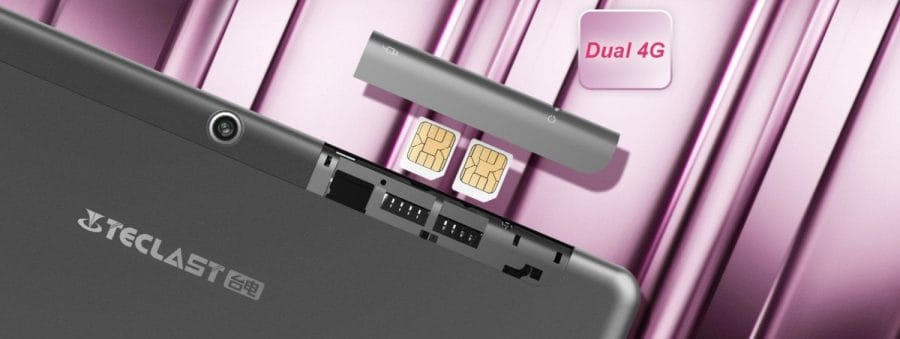
To connect to the home network, the Teclast M20 is equipped with a dual-band AC WiFi module. Bluetooth is available in version 4.2. It also features two cameras. A 5-megapixel main camera allows for the occasional snapshot, while the 2-megapixel front camera is suitable for video calls. There is a microphone. Accurate positioning is possible thanks to GPS. Teclast states the battery capacity as 6600 mAh. The battery life is between 6 and 8 hours, depending on usage.
First impressions
On the spec sheet, the Teclast M20 doesn't look quite as good as the competition from Chuwi. Although it offers a similar configuration from the display to the system-on-chip used, there are some minor weaknesses in the details. For example, Teclast does not use LPDDR4 RAM, but slower DDR3L RAM. There is a significant difference in the supported mobile frequencies. The Hi9 Air is better equipped for use in the local LTE network (LTE bands 3, 7, (8) and 20)!
Specifications
Processor and memory
- CPU
- MediaTek Helio X20 (MTK6797)
- GPU
- ARM Mali-T880
- RAM
- 4GB (DDR3L)
- Internal storage
- 64GB (eMMC5.1)
- Storage expansion
- Yes
Display
- Display type
- IPS (full lamination)
- Display size
- 10.1 inch
- Display resolution
- 2560 x 1600 pixels
- Multitouch
- 10 fingers
Cameras
- Main camera
- 5 megapixels
- Front camera
- 2 megapixels
Mains
- Dual SIM
- Yes
- SIM size
- Micro SIM
- GSM bands 2/3/5/8
- CDMA800 BC0
- WCDMA Band 1/2/5/8
- TD-SCDMA band 34/39
- LTE Band 1/2/3/5/8/38/39/40/41
Wireless
- Wi-Fi
- 802.11 a/b/g/n/ac
- Bluetooth
- 4.2
- GPS
- Yes
Sensors
- *Accelerometer
Battery
- Battery
- 6,600 mAh
- Connection
- MicroUSB
Other
- Operating system
- Android 8.0
- Size
- 23.90 x 16.70 x 0.80 cm
- Weight
- 553g
Comments