
Contents
Introduction: Xiaomi Mi A2 Lite
At the end of July, Xiaomi unveiled two Android One smartphones at once. The Mi A2 Lite is intended for sale outside China, although it is based on the Chinese Redmi 6 Pro. Instead of Xiaomi's MIUI user interface, users receive unmodified stock Android with a 2-year update guarantee. At the same time, the smartphone offers extended mobile network support, including local LTE bands 3, 7, 8 and 20.
Design, build quality, and included accessories
The smartphone is comparatively compact with dimensions of 149.33 x 71.68 x 8.75 mm. The weight, which weighs in at 178g, is all the more remarkable. The 5.84-inch display with a notch is striking for the device’s appearance. In the price range around 140€, it is the cheapest Xiaomi handheld to date with this design feature.
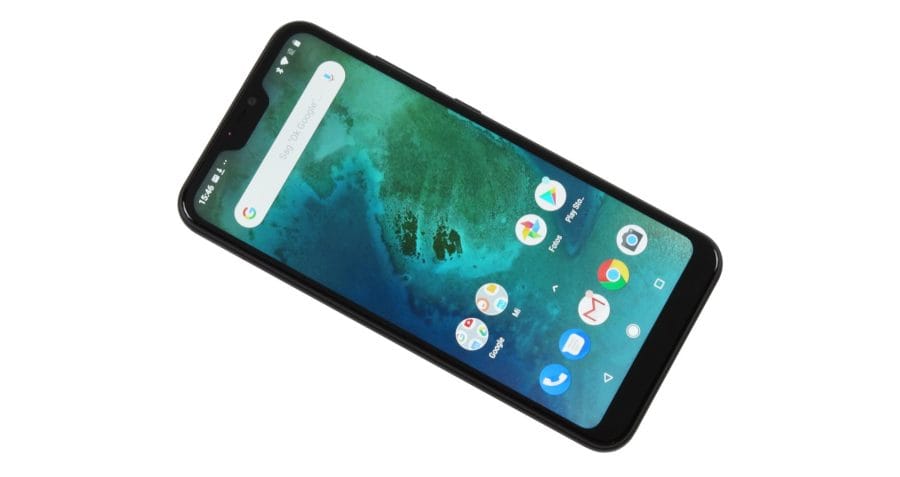
The smartphone is structured as follows:
The front is largely taken up by the 5.84-inch display. The somewhat wide display bezels are noticeable, measuring 3mm each on the left and right, and about 1cm at the bottom edge of the housing. The notch, on the other hand, is pleasantly narrow and includes a small receiver, a proximity sensor and the front camera in the centre.
Surprisingly, the notification LED is positioned to the left below the display by Xiaomi. Unfortunately, a conventional white LED was used again instead of an RGB LED.
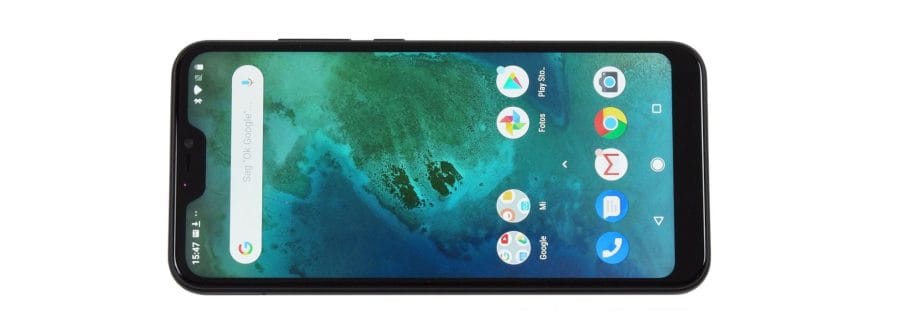
The chassis frame is made of plastic. It is slightly wider than the front and back and surrounds the smartphone noticeably. In addition to the typical control buttons, the top edge of the frame includes a 3.5 mm headphone jack and an infrared transmitter. The SIM slot is on the right side and can be fitted with 2 nano-SIM cards AND a microSD memory card. There are a total of 2 microphones. One is located next to the IR transmitter, and another is inside the bottom edge of the frame, next to the micro-USB port. Also next to the USB port, in classic fashion, is the mono loudspeaker.
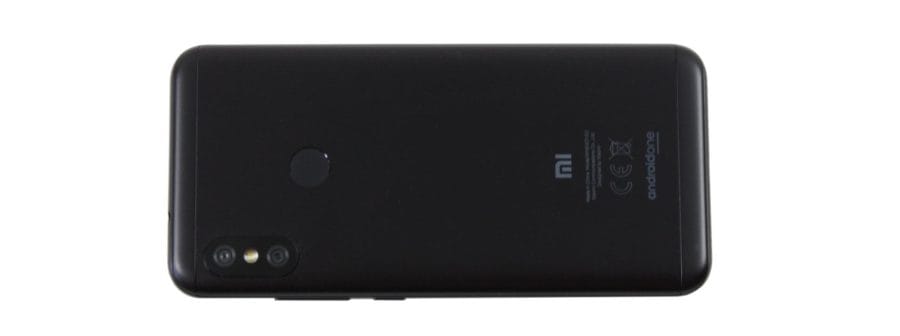
The rear housing consists of a central metal plate and antenna caps (plastic) attached to the top and bottom. The rear panel is slightly rounded towards the housing frame. Features of the rear include the vertically arranged main camera and a fingerprint scanner.
The build quality is beyond reproach. Despite the extensive use of plastic, the Mi A2 Lite feels substantial. With its narrow body design and high weight, the smartphone sits comfortably in the hand. The side buttons are easily accessible, offer good tactile feedback, and are firmly seated in the housing.
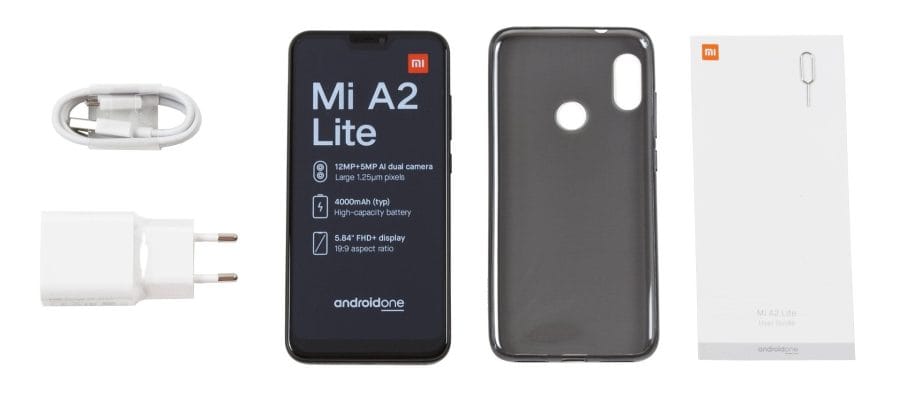
The delivery contents include, in addition to the smartphone, a charger with an EU plug (5V 2A), a Micro-USB cable, a flexible protective case, a SIM tool and an instruction manual. The handheld is available in blue, black and gold.
Display
Although the Xiaomi Mi A2 Lite is positioned in a low price segment, it features an excellent display. Characteristics of the IPS display include a 5.84 inch screen diagonal and a razor-sharp 2280 x 1080 pixel resolution (432 DPI). The aspect ratio is 19:9.
Display measurement
Measured with a colorimeter, the panel achieves a maximum luminance of 465 cd/m². The brightness deviation across the panel is below 25 cd/m² and is not visible. The measured black level is 0.48 cd/m², resulting in an rather average contrast ratio of 1:1088. The Delta E deviation from the sRGB colour space averages 4.4 and peaks at 7.6. The grey levels have a slight turquoise tint.

Display in everyday use
In everyday use, the display performs well. Colours are rendered particularly vividly without appearing unnatural. The viewing angle stability is good. Very shallow viewing angles only lead to a slight decrease in brightness. Colour shifts do not occur. The high display brightness of the IPS panel enables readability even in direct light, especially in sunlight.
Display settings and features
There are no extensive customization options for the display. The brightness can be adjusted manually or via an adaptive brightness mode. Additional display functions include a night mode, which filters the blue light component of the display manually or according to a schedule.
Touchscreen
The touchscreen works flawlessly. It recognises a maximum of 10 simultaneous inputs. The detection accuracy is high and occurs without delay. A coating on the tempered display glass ensures improved smoothness of touch.
Performance
Qualcomm Snapdragon 625
Built-in is a Qualcomm Snapdragon 625, which was already used in last year's Xiaomi Mi A1. The system-on-chip, which appeared in 2016, consists of, among other things, a CPU with 8 processor cores (8x Cortex-A53 – 2 GHz clock speed), and an Adreno 506 GPU.


The memory configuration consists, depending on the model, of 3GB or 4GB LPDDR3 RAM and 32GB or 64GB eMMC 5.1 storage. Storage expansion via a microSD card is possible.
Benchmark
With 78,307 points in the AnTuTu benchmark, the system-on-chip places itself in the lower mid-range segment. 3DMark results, which focus on the SoC's graphics performance, show a similar picture. Data storage achieves storage speeds of approximately 281 MB/s for reading and 212 MB/s for writing. RAM reaches a speed of around 5019 MB/s.


Performance in everyday use
Although the Xiaomi Mi A2 does not belong to the fastest mid-range smartphones due to the dated Snapdragon 625, the smartphone offers pleasant everyday performance. The Android 8.1 user interface works well with the SoC and enables smooth operation. Animations are displayed smoothly without stuttering or lagging effects. Apps start quickly, and multitasking is no problem up to a certain degree. Overall, Xiaomi presents a very well-optimised system.
Gaming
The currently popular PUBG Mobile was used to test gaming performance. On high graphics settings, the game is playable. Occasional frame drops cannot be ruled out but are rare. For guaranteed smooth gameplay, you should choose medium graphics settings. After a 30-minute gaming session, the temperature measured at the hottest point was just under 40 °C. Performance drops due to thermal throttling do not occur. Even in stress tests, performance remains constant without drops.
User interface
The Xiaomi Mi A2 Lite ships with stock Android 8.1. The identical Xiaomi Redmi 6 Pro, in turn, uses Xiaomi's user interface "MIUI", which will soon receive an update to Android 9 Pie with MIUI 10.


Nevertheless, users of the Mi A2 Lite, which is one of the few Google-certified "Android One" devices, receive a 2-year guarantee for system updates and a 3-year guarantee for security patches. An update to Android 9 is therefore also to be expected. The stock Android user interface comes without annoying bloatware. Only a few Xiaomi apps, such as the camera app, Mi Drop or the Mi Remote, are pre-installed as third-party apps. All other apps are from Google. Those who do not want them can conveniently uninstall the apps via the app manager.


The on-screen controls provide cause for criticism. As also criticised in the previously published test of the Xiaomi Mi A2, the alignment of the on-screen buttons cannot be customised. A disadvantage is that the layout is swapped compared to most Android smartphones. Unfortunately, there is also no full-screen mode that completely hides the buttons and scales the image accordingly.
Apart from the (subjective) point of criticism, the user interface is very clearly structured. The system is not artificially bloated. However, one has to do without many functions and settings options, such as those one might know from MIUI. Unexpected system crashes did not occur during the test phase. Friends of video on demand (e.g. Netflix) usually have to settle for SD. DRM, such as Widevine, is only supported at an insufficient security level (Widevine L3).
Camera
On the back is the dual main camera, consisting of a 12-megapixel Sony IMX486 main sensor with an f/2.2 aperture, as well as a 5-megapixel Samsung S5K5E8 secondary sensor. The main camera is supported by a single-LED flash. The front-facing selfie camera features a 5-megapixel OmniVision OV5675 image sensor with an f/2.0 aperture.
Main camera real-world test
Photo mode
The image quality of the dual main camera is generally convincing and matches the device's price bracket. Under good lighting conditions, the Mi A2 Lite captures vivid and detailed images. Sharpness distribution is even, although sharpness slightly decreases towards the distance. As expected, the dynamic range is limited, so colour distortions can occur in high-contrast scenes. With increasingly poor lighting conditions, images become noticeably blurry, colours fade and details are lost. Image noise is suppressed by software at the expense of image detail.









You can find all test shots at full resolution via this link
Zoom
The smartphone offers an 8x digital zoom. There is no optical zoom, as was previously featured on the Xiaomi Mi A1. Loss of detail occurs as early as 2x zoom and intensifies up to an (handheld) unusable 8x zoom.



HDR
The Auto-HDR mode is hit-or-miss. Frequently, the mode does not activate at all, despite high-contrast scenes. Sometimes it activates but offers barely visible differences compared to the SDR recording. Partially, HDR also kicks in when it is not needed. The result is recordings that look completely unrealistic.


Bokeh
The bokeh mode works reliably considering the price range. People are mostly extracted cleanly. However, complex objects are extracted less cleanly, meaning blur effect errors can occur here.


Video mode
Videos are recorded with the pre-installed Mi A2 Lite camera app at a maximum resolution of 1080p at 30 frames per second. Those who want to record in 4K should install an alternative camera app (e.g. Open Camera). The video recording quality via the Xiaomi camera app is disappointing. Recordings lack detail and are mostly blurry. Autofocus did not work during testing, meaning manual focusing was required. Recordings can be electronically stabilised (EIS). While EIS stabilises them, it shows a pulsating ghosting effect.
Video recording quality is significantly better with the Open Camera app. In addition to the benefit of 4K recording resolution, the autofocus works perfectly, and video recordings are much sharper and more detailed! The audio recording quality is clear and intelligible, despite the 96 kbps bitrate.
Front camera practical test
The recording quality of the front camera is only convincing under optimal lighting conditions. Even slight impairments to the illumination cause colours to visibly fade, details are lost and image noise becomes noticeable.


The software-based bokeh effect is well implemented, although it only works cleanly under really good lighting conditions. A palette of beauty filters is included and artificially enhances selfies. The front camera records videos at a maximum resolution of 1080p at 30 frames per second.
Connectivity
Telephony
The SIM slot of the Xiaomi Mi A2 Lite provides space for two nano-SIM cards and an additional MicroSD storage card. The following mobile network frequencies are supported.
- GSM: B2/B3/B5/B8
- WCDMA: B1/B2/B4/B5/B8
- LTE FDD: B1/B2/B3/B4/B5/B7/B8/B20
- LTE TDD: B38/B40
The LTE bands 3, 7, 8 and 20 common in Germany are supported. However, the smartphone is not designed for global mobile network use. The voice quality of the smartphone is clear and understandable in both directions. No reception problems occurred during testing. VoLTE is available and can be activated by entering *#*#86583#*#* within the dialling app. VoWiFi or Wi-Fi Calling is not supported.
Wi-Fi and Bluetooth
The smartphone supports dual-band WiFi with the 802.11 a/b/g/n protocols. Fast dual AC WiFi is not available. In Wi-Fi, the smartphone has a strong signal. The data throughput is average. The same applies to the Bluetooth 4.2 reception and transmission power.
GPS sensors
For positioning, the smartphone uses GPS, GLONASS and BeiDou. Galileo is excluded. Outdoors, a GPS fix is found within seconds. The positioning accuracy is between 3 and 4 meters, with an average of 17 connected satellites. It is also possible to establish a GPS fix indoors, although the signal strength is significantly weaker. Navigation is no problem for the smartphone. Positioning accuracy remains constant in both rural and urban areas. A compass for determining direction is included.


The further sensor suite includes a proximity sensor, an ambient light sensor, an accelerometer, a gyroscope and an infrared transmitter. With the infrared transmitter and the pre-installed Mi Remote app, various TV and household appliances can be controlled directly via the smartphone.
Fingerprint scanner
The fingerprint scanner on the back has a high recognition rate. The slow unlock time is worthy of criticism. The identical Redmi 6 Pro with MIUI unlocks the smartphone significantly faster!
Audio
Built in is a mono speaker, which reaches a high volume without sounding scratchy. As is often the case, the small speaker lacks bass, resulting in a rather linear-flat sound. Fans of the 3.5 mm jack socket will be pleased. It is present and provides interference-free sound.
Battery

The Mi A2 Lite's battery offers a capacity of 4000 mAh. A few calls, 30 minutes of navigation, WhatsApp and some web browsing only brought the battery to its knees after 2 1/2 days. Benchmark measurements showed a screen-on time of just under 11 hours at medium display brightness.


A complete charging cycle takes a good 160 minutes. Unfortunately, fast charging is not supported.
Our verdict
The Xiaomi Mi A2 Lite performs exceptionally well for an inexpensive mid-range smartphone. Particularly impressive are the very bright, high-resolution IPS display and the long-lasting battery life. Everyday performance is flawless, even though an older system-on-chip is installed.
The dual main camera delivers usable shots in good lighting conditions. However, recording quality noticeably reduces in poor lighting. In terms of connectivity, there is little cause for criticism. The smartphone has excellent reception for mobile data, Wi-Fi and Bluetooth. The dual SIM slot is advantageous, as it allows for memory expansion without giving up the dual-SIM function.
For just under €140, the Xiaomi Mi A2 Lite has a lot to offer and is a real hidden gem in its price class. Thanks to Android One, there is even a promise of updates for future system updates and security patches.
Specifications
Processor and memory
- CPU
- Qualcomm Snapdragon 625
- GPU
- Adreno 506
- RAM
- 3GB / 4GB (LPDDR3)
- Internal storage
- 32 GB / 64 GB (eMMC5.1)
- Storage expansion
- Yes
Display
- Display type
- IPS
- Display size
- 5.84 inches
- Display resolution
- 2280 x 1080 pixels
- Screen protector
- Unbekannt
- Multitouch
- 10 fingers
Cameras
- Main camera
- 12-megapixel Sony IMX486 + 5-megapixel Samsung S5K5E8
- Front camera
- 5-megapixel OmniVision OV5675
Mains
- Dual SIM
- Yes
- SIM size
- Nano SIM
Mobile network
- *GSM: B2/B3/B5/B8
- *WCDMA: B1/B2/B4/B5/B8
- *LTE FDD: B1/B2/B3/B4/B5/B7/B8/B20
- *LTE TDD: B38/B40
Wireless
- Wi-Fi
- 802.11 a/b/g/n
- Bluetooth
- 4.2
- GPS
- Yes
Sensors
- *Ambient light sensor
- *Accelerometer
- *Proximity sensor
- *E-compass
- *Gyroscope
- *Fingerprint sensor
- *IR transmitter
Battery
- Battery
- 4,000 mAh
Other
- Connection
- MicroUSB
- Operating system
- Android 8.1
- Size
- 149.33 x 71.68 x 8.75 mm
- Weight
- 178g

Comments (2)
Hello, I have been looking for a small smartphone for a long time because the new models are simply too big for me. I like the dimensions of this one. The Google Android aspect also sounds good, but I have not yet been able to find out what the advantages are, apart from this update guarantee. Do I not have that with other manufacturers as well?
The absence of unnecessary bloatware, which could potentially affect you with every update, is the decisive advantage.
I have the 4/64GB version and am thrilled. Brilliant price-performance ratio.