Contents
Xiaomi Mi WiFi Router 4
The Xiaomi Mi Router 4 is already the 11th WiFi router from Xiaomi. The product line primarily impresses with rich hardware and features at a low price. The most recently tested Xiaomi Mi Router 3G impressed with its diverse modification options. This router has found and continues to find great appreciation within the OpenWRT developer community. The Xiaomi Router 4 will most likely also be modifiable, as it is likewise based on a MediaTek MT7621A chipset supported by OpenWRT.
Design and connectivity
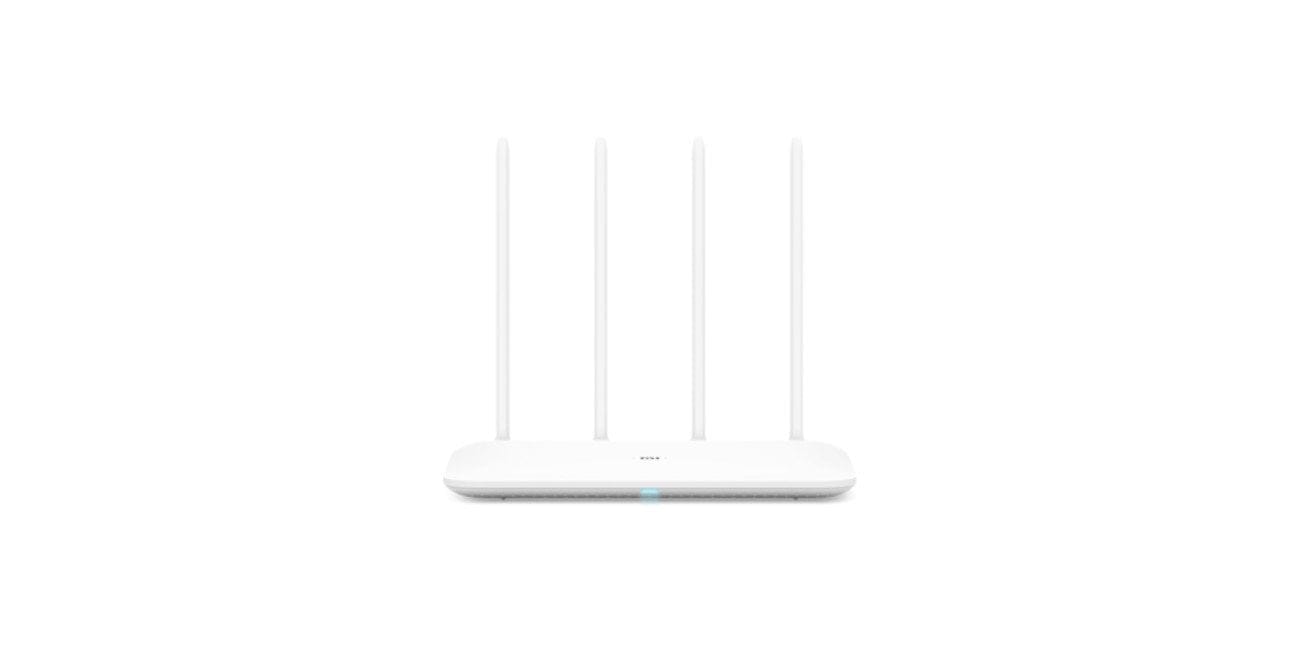
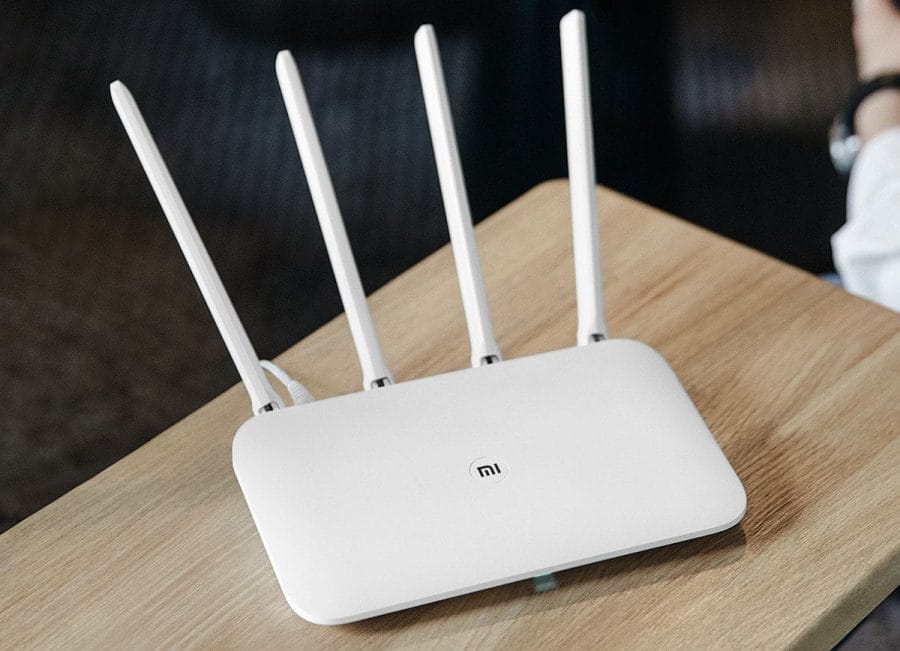
Compared with the previous model range, the Xiaomi Router 4 has undergone slight visual adjustments. The design of the simple white 200 × 134.86 × 178.98 mm router has become somewhat more rounded. The four movable omnidirectional antennas are still present. On the front of the housing is the status LED. The connection options on the back consist of one WAN and two LAN ports with Gigabit connectivity as well as a DC power input. Newly added is the "MiNet" button. The USB port, which would have allowed external data storage devices to be integrated into the network, has been omitted. Shame!

Hardware equipment
Like the Xiaomi Router 3G, the Router 4 is based on a MediaTek chipset. The MT7621A MIPS features two processor cores clocked at up to 880 MHz. The memory configuration consists of 128 MB SLC NAND flash and 128 MB DDR3-1200 RAM. This is also the most significant difference compared to the 3G model, which offers 256 MB DDR3-1200 with double the amount of RAM, which can certainly affect the router's performance.

WiFi and MiNet
The router supports the WiFi protocols IEEE 802.11a / b / g / n / ac and IEEE 802.3 / 3u / 3ab with the WPA-PSK / WPA2-PSK security protocol. The 4 omnidirectional antennas are used for both 2.4 GHz and 5 GHz connections. The transmission speed is a maximum of 300 Mbps on the 2.4 GHz network and 867 Mbps on the 5 GHz network.

The Xiaomi Router 4 introduced the so-called "MiNet". This is a special WiFi connection protocol that integrates the manufacturer's smart home devices into the network at the push of a button. According to Xiaomi, the router is supposed to be able to serve up to 128 simultaneously connected devices. The router's user interface is the so-called MiWiFi OS, which in turn is based on OpenWRT. The router can be controlled via web interface or app (Android and iOS). Plugins, such as an ad blocker or the option to create a guest network, are available.
First impression, price and availability
Strictly speaking, the Xiaomi Router 4 is just another filler between the Xiaomi Router 3 and Router 3G. The removal of the USB interface and the reduction in working memory in particular cast a shadow over the Router 4 (~€27) compared to the Router 3G (~€30). Whether the capabilities of "MiNet" make up for these points will have to be seen. At least in this region, "MiNet" will likely become just another unused feature that is mainly aimed at the Chinese user.
Specifications
Hardware
- CPU
- MediaTek MT7621A MIPS
- RAM
- 128 MB DDR3
- NAND
- 128MB Flash
Ports
- 1x Gigabit WAN
- 2x Gigabit LAN
- 1x Power
Network
- Protocols
- IEEE 802.11a/b/g/n/ac, IEEE 802.3/3u/3ab
- 2.4G channels
- 1, 2, 3, 4, 5, 6, 7, 8, 9, 10, 11, 12, 13
- 5G channels
- 36, 40, 44, 48, 52, 56, 60, 64, 149, 153, 157, 161, 165
- 2.4 GHz WiFi
- Up to 300Mbps
- 5G WiFi
- up to 867 Mbps
Other
- MiNet
- Yes
- OS
- Mod. OpenWRT
- Size
- 20.00 × 13.49 × 17.90 cm
- Weight
- 550g

Comments (1)
Hello, I don't quite understand this. There are three versions: 4, 4A, 4C. Where are the differences?